
Why The Black Racer Sliding Across Your Florida Lawn Is The Best Sign All Summer
Follow us on Google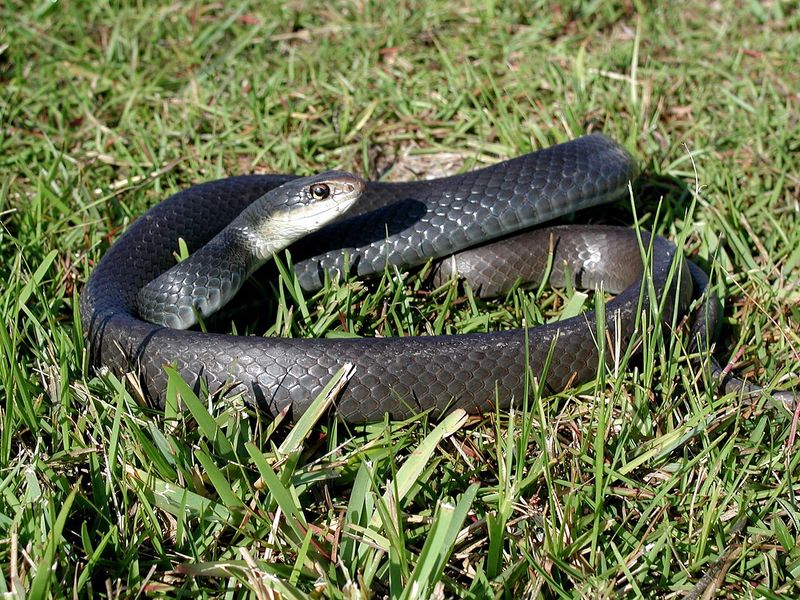
You step onto the back porch after breakfast, the air already thick and warm, and something long and dark cuts across the grass so fast you almost miss it.
That flash of movement can stop a Florida homeowner cold, heart rate up, coffee forgotten.
But before you back inside or reach for a shovel, it helps to know what you may actually be looking at and what it could be telling you about your yard.
A confirmed black racer is not a threat to chase off, and its appearance near your property may be a quiet clue that the landscape around you is offering something wildlife can use.
A Fast, Dark Snake May Be a Racer—but Confirm It Safely
Speed and color alone cannot tell you what kind of snake just crossed your yard.
Florida is home to roughly 50 native snake species, and several of them are dark or nearly black as adults.
Jumping to “racer” because something moved fast and looked black is the kind of assumption that can lead to a dangerous mistake, especially since some of Florida’s six venomous species can appear dark in certain lighting or life stages.
A confirmed adult North American racer in Florida has a distinct set of features.
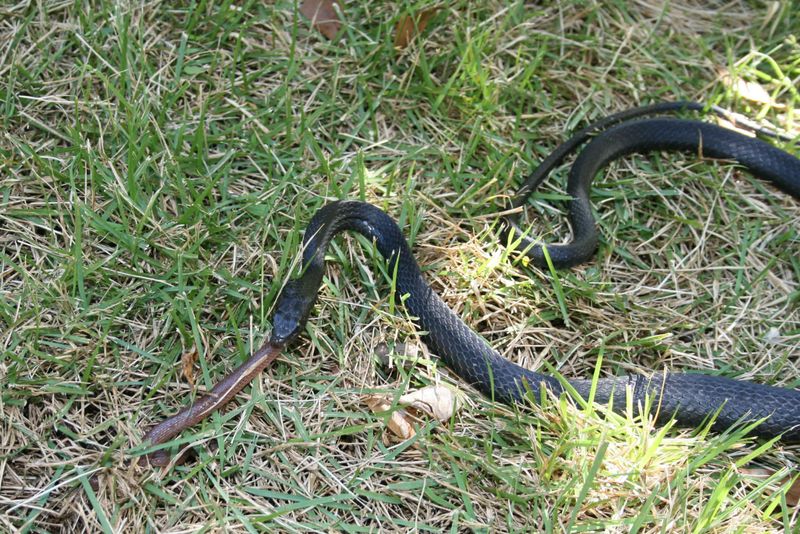
According to the Florida Museum of Natural History’s racer species account, adults are typically long and slender with smooth scales, often black or bluish-black overall, and they show a white or pale chin and throat that stands out clearly against the darker body.
Typical adult length runs from 20 to 56 inches, though the recorded maximum reaches 72 inches.
That is a substantial animal, and its slim build is one of the features that separates it from heavier-bodied species.
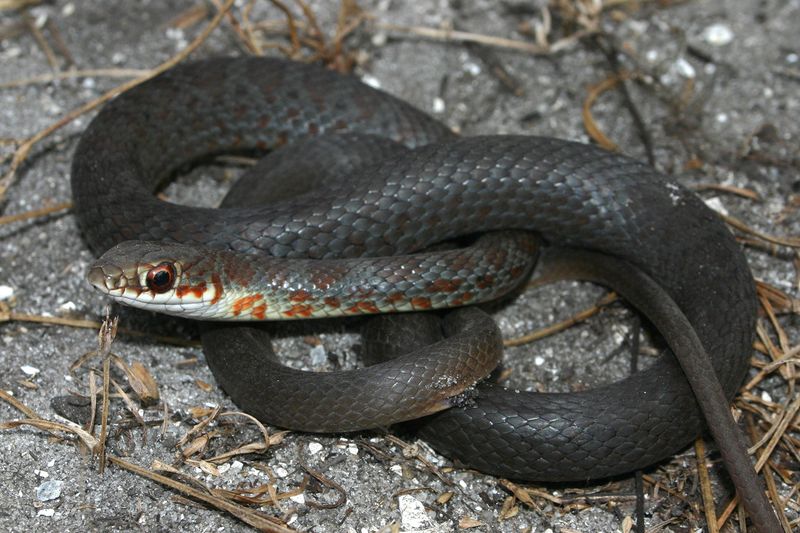
Juvenile racers look almost nothing like adults.
Young animals are gray with reddish-brown blotches that fade gradually as the snake matures, so a small, patterned snake near your garden bed may be a baby racer rather than a completely different species.
Florida also recognizes distinct racer forms by region, including the brown-chinned racer in parts of the Panhandle and the Everglades racer in South Florida and the Keys.
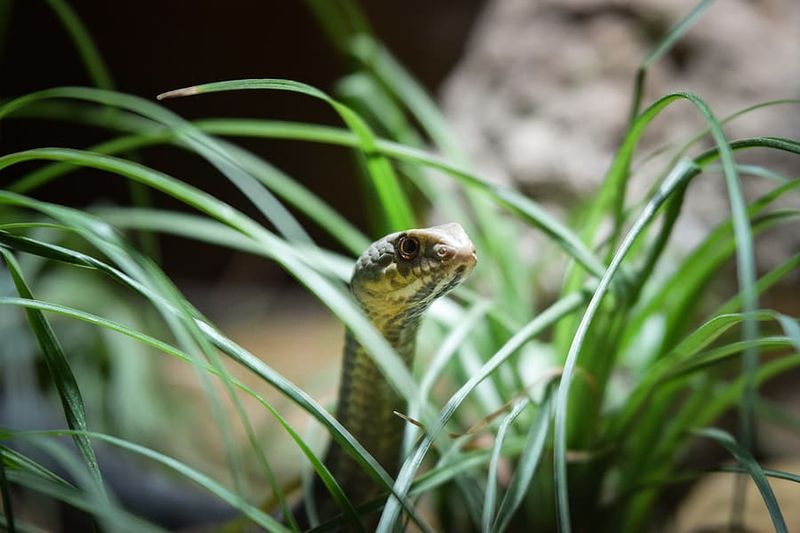
The dark lookalikes that cause the most confusion include black-phase cottonmouths, black ratsnakes, eastern indigo snakes, and eastern coachwhips.
UF/IFAS guidance on identifying commonly encountered Florida snakes recommends keeping your distance and using a reliable identification guide rather than moving in for a closer look.
If you genuinely cannot confirm the species from where you are standing, treat it as unidentified and contact a qualified wildlife professional.
The Florida Fish and Wildlife Conservation Commission offers resources to help residents find that kind of help.
What a Confirmed Racer Can Tell You
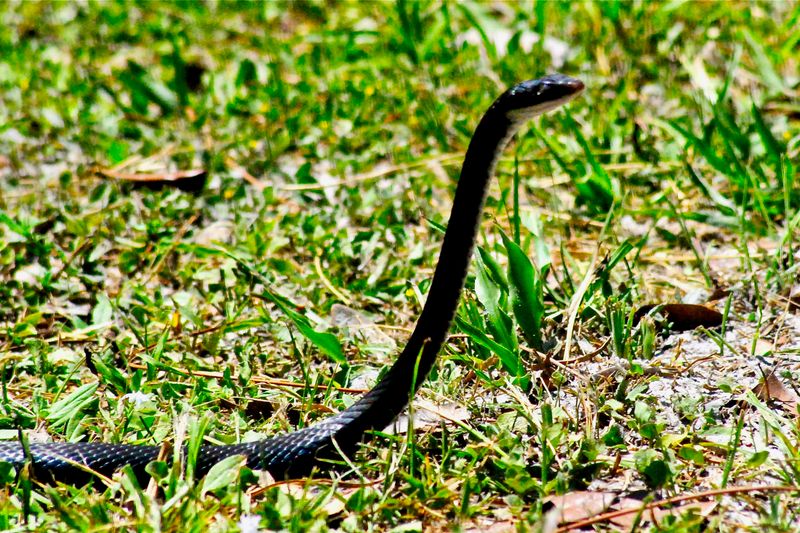
Once you have a confident identification, the animal’s presence starts to mean something.
Southern black racers are active daytime hunters, and they eat a broad, opportunistic range of prey.
UF/IFAS’s overview of black snakes in Florida lists frogs, lizards, insects, small snakes, birds, bird eggs, and rodents among their food sources.
That variety tells you the snake is not tracking one specific thing through your yard.
It is moving through a landscape that, somewhere nearby, offers options.
Here is where it gets interesting.
A racer crossing an open lawn may be using that sunny, warm turf as a travel corridor rather than a feeding ground.
The food and shelter it actually needs could be sitting in a shrub border on the far side of your yard, in a drainage swale along the property line, in a retention pond two lots over, or in a wooded edge behind the fence.
The lawn is the highway, not necessarily the destination.
Racers also occupy more than one position in the food web.
They consume prey, and they can be eaten in turn by hawks, owls, mammals, and larger snakes.
Seeing one does not mean the yard is producing a full, balanced ecosystem.
What it does suggest is that at least one resource, whether prey, warmth, open travel space, or access to cover nearby, exists somewhere in or around the property.
That is a genuinely useful piece of information, even if it is a limited one.
Do not expect a racer to clean up your yard.
UF/IFAS guidance on wildlife cover describes snakes as part of a broader food web, not as a pest-control service.
A racer may eat some rodents or insects, but it will not eliminate an infestation or replace thoughtful habitat and pest management.
Think of the sighting as one data point, not a report card.
One Snake Cannot Grade a Florida Yard
Florida wildlife authorities do not use a racer sighting as a formal measure of ecosystem health, and neither should you.
The Florida Museum’s species account describes the southern black racer as common across a wide range of habitats, urban, suburban, agricultural, wetland, and natural.
That range matters.
A snake adaptable enough to live in a parking-lot median or a roadside ditch is not a reliable signal that your specific lawn has achieved ecological balance.
UF/IFAS research on black snakes confirms that racers occupy highly altered suburban and urban landscapes regularly.
The presence of one does not prove the yard is pesticide-free, biodiverse, or thriving by any measurable standard.
The snake may be passing through on its way to somewhere richer, or it may have found one useful thing, a sunny patch of warm concrete, a frog near a garden hose drip, a gap in the fence that leads to better cover, while the rest of the property offers it very little.
Turfgrass is part of the picture worth understanding honestly.
UF/IFAS guidance on landscaping backyards for wildlife notes that turfgrass alone provides limited food and cover for most wildlife species.
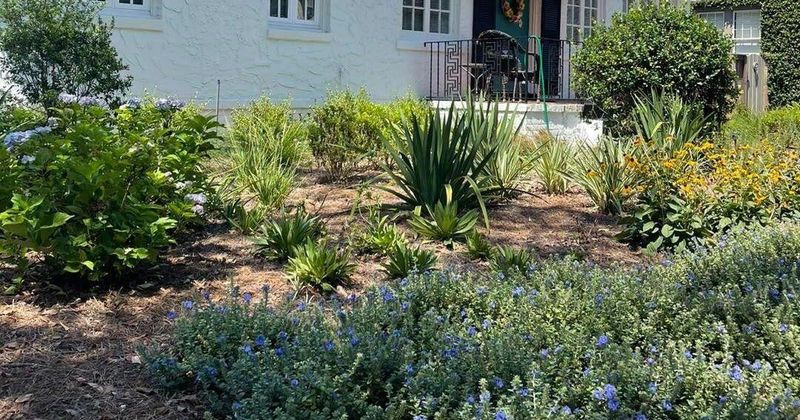
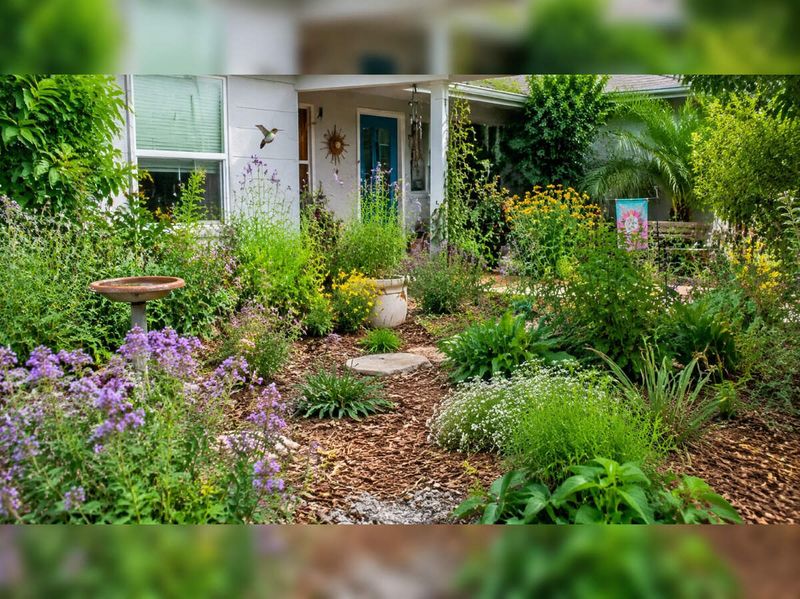
The landscape features that tend to support more wildlife are the ones surrounding the lawn: shrub borders, native groundcovers, trees with layered canopy, leaf litter zones, drainage areas, retention ponds, and less-mowed corners.
A racer may reflect the quality of that surrounding network more than the quality of the grass itself.
UF/IFAS community ecology guidance frames individual yards as pieces of a larger connected landscape, which is exactly the right way to read a racer sighting.
The snake crossed your lawn, but its world is bigger than your property line.
And UF/IFAS prevention guidance reinforces that habitat management works best when it accounts for the whole picture, not just what happens to be visible at one moment.
Assess the Yard by Several Habitat Features
One snake is a clue, not a conclusion.
If you want a clearer picture of what your yard is actually offering wildlife, look at several conditions together rather than reading too much into a single sighting.
UF/IFAS’s top ten tips for backyard wildlife habitat identifies food, water, cover, and space as the four basic elements an outdoor area needs to support wildlife consistently.
A yard that provides all four in some form is doing something genuinely useful for the landscape around it.
Food means more than a bird feeder.
Native plants that produce seeds, berries, nectar, and insects give wildlife a renewable supply tied to local conditions.
Water can be as simple as a shallow dish refreshed every day or two to prevent mosquito breeding, a rain garden that holds runoff briefly, or a pond edge that stays moist.
Cover includes shrubs, trees, brush, leaf litter, and dense plantings where animals can shelter, rest, and move without full exposure.
Space means the yard connects, even loosely, to other habitat nearby rather than sitting as an isolated patch surrounded by pavement.
UF/IFAS guidance on providing wildlife cover emphasizes that layered vegetation, meaning trees overhead, shrubs in the middle, and groundcovers below, supports a wider range of species than a single vegetation type alone.
Multiple layers give different animals the specific structure they need at different times of day and year.
Reduced pesticide use matters too, because broad-spectrum treatments can remove the insect base that feeds birds, frogs, lizards, and the snakes that eat them.
The practical move is to preserve useful habitat in parts of the property away from high-traffic areas, and to think of your yard as one piece of a connected community landscape rather than a self-contained unit.
Keep doorways, patios, and children’s play areas clear, but let the back corners, fence lines, and pond edges do ecological work.
Give the Snake a Clear Route Away

When a snake turns up near the back door, the patio, or anywhere children or pets are active, the first move is the same regardless of species: step back, keep everyone away from it, and give it a clear path to leave.
Most racers do exactly that on their own.
They are fast, alert, and strongly prefer to avoid contact with people.
A racer that has room to move will usually be gone in seconds.
The situation changes when the snake feels cornered, grabbed, pinned, or blocked.
A racer in that position may vibrate its tail in dry leaves, a sound that can startle anyone who hears it, and it may release musk or bite.
The bite is nonvenomous, but nonvenomous does not mean the animal is safe to handle.
Any bite from a wild animal carries risk, and intentionally provoking one creates a problem that did not need to exist.
UF/IFAS Gardening Solutions recommends leaving an outdoor snake alone once you have confirmed its identity.
If a confirmed nonvenomous snake has positioned itself somewhere that genuinely blocks a work area, and simply waiting is not practical, UF/IFAS prevention guidance describes gently spraying it with a garden hose from a safe distance, directing the water to encourage the snake toward cover rather than toward people, doors, or play spaces.
That is the extent of what is needed.
Do not use a shovel, your hands, a glue trap, or any improvised method.
For an unidentified snake, or one you suspect may be venomous, do not approach it at all.
Do not try to inspect its head shape, eye shape, or scale texture from close range.
Use the Florida Museum’s snake identification guide from a safe distance, and if you still cannot confirm the species, contact a licensed wildlife professional.
Florida Fish and Wildlife can point you toward qualified help in your area.
Reduce Encounters Without Removing Habitat
Making your living spaces safer for people and pets does not require stripping every natural feature from the yard.
The goal is to move potential conflict zones away from the places where people actually spend time, not to eliminate the habitat that makes the surrounding landscape worth living in.
A few targeted changes can reduce the chance of an unwanted encounter near the house without turning the yard into a wildlife desert.
Start with the areas closest to the building.
Keep grass shorter in zones where children play or where you need secure footing, roughly within 10 to 15 feet of play equipment, doors, and walkways.
Trim shrubs and low branches back from the foundation.
Store firewood on a rack at least 6 to 12 inches off the ground, away from the house, because ground-level wood piles are attractive shelter for both rodents and the snakes that follow them.
Keep brush piles, rock piles, and dense debris away from entry points, patios, and play areas.
UF/IFAS prevention guidance is clear that vegetation and brush provide useful wildlife habitat, so the recommendation is to relocate those features rather than eliminate them entirely.
Prey attractants matter as much as cover.
Store birdseed and pet food in containers with tight-fitting lids.
Clean up spilled seed promptly, secure garbage, pick up fallen fruit, and repair dripping hoses or irrigation heads.
Snakes often move through an area because prey is nearby, and reducing what draws rodents, frogs, and lizards close to the building can reduce snake activity in that same zone.
UF/IFAS guidance on managing conflicts with wildlife supports this approach as more effective than trying to deter snakes directly.
For a more defined barrier, extension guidance on reducing snake access describes fencing approximately 2 to 3 feet high, buried 6 inches into the ground, using one-quarter-inch hardware cloth or similar material.
Gates, drains, corners, and any other openings require careful sealing or the barrier loses most of its value.
Skip mothballs, sulfur, glue traps, and any product marketed as a snake repellent.
Florida Fish and Wildlife and university extension sources consistently find these methods ineffective, and mothballs in particular can expose people, pets, and wildlife to toxic chemicals while doing nothing useful outdoors.
Treat the Sighting as a Limited but Useful Clue
A confirmed black racer crossing your Florida lawn is worth a moment of genuine appreciation, but not an overreaction in either direction.
UF/IFAS research on black snakes supports the idea that a racer’s presence suggests the property or connected landscape offers at least one resource wildlife can use, whether that is prey, warmth, open travel space, or access to nearby cover.
That is a meaningful clue.
It is not a certification of ecological health, a seasonal milestone, or proof that the whole yard is balanced and thriving.
The most useful response is to look at the larger picture.
Use the sighting as a prompt to check whether the yard provides food, water, cover, and space in some combination, and whether those features are distributed in ways that serve both wildlife and the people using the property.
UF/IFAS backyard wildlife habitat guidance gives a practical framework for that kind of honest assessment.
Preserve habitat in the parts of the yard where it causes no conflict.
Keep high-use areas near doors, patios, and play spaces clear and tidy.
Reduce prey attractants close to the building.
And if a snake appears that you cannot identify with confidence, step back and contact a professional rather than trying to resolve it yourself.
The racer did not wander into your lawn by accident.
Something in or near your property caught its attention, and that is actually something to feel good about.
Managing your space thoughtfully means you can hold onto what drew it there while keeping the places where your family lives comfortable and safe.
A yard that makes room for a racer to pass through is doing something right, even if the full story is more complicated than any single summer sighting can tell.