
Why A Sudden Swarm Of Dragonflies Is The Best Sign Your Florida Yard Can Send
Follow us on Google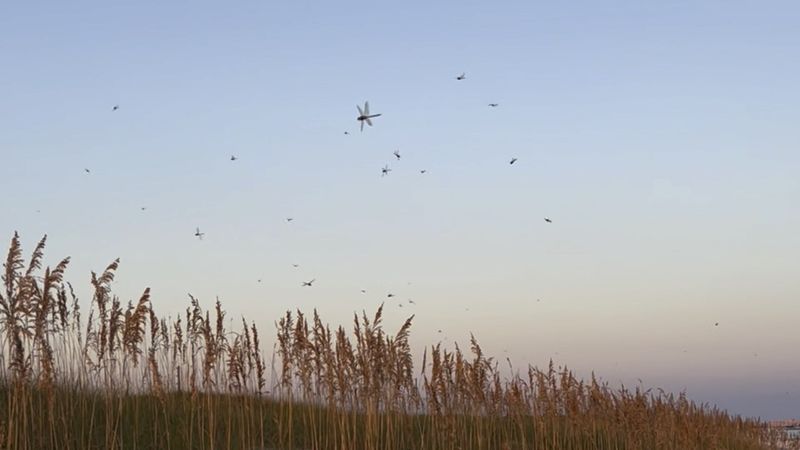
You step onto the patio after lunch and the air above the grass is suddenly alive, dozens or maybe hundreds of dragonflies cutting loops in every direction.
It’s a little startling, honestly, and your first instinct might be to wonder what’s wrong.
What it actually signals is more interesting than alarming, and understanding it can change the way you think about your yard and the insects sharing it with you.
A Swarm Offers A Clue, Not A Yard Report Card
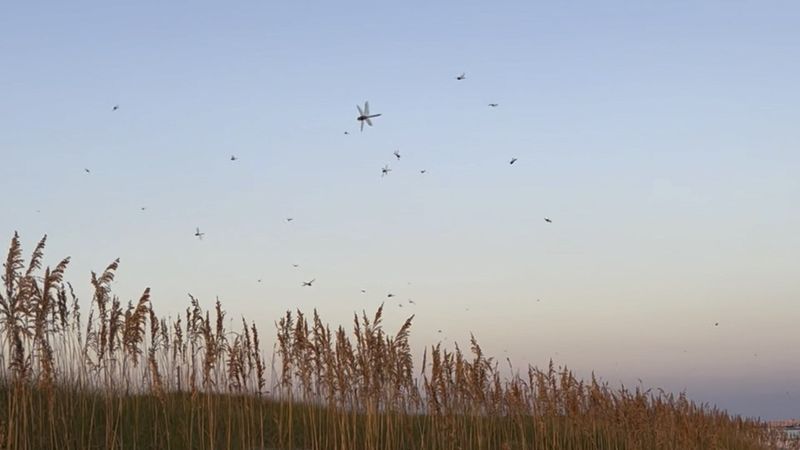
Seeing a hundred dragonflies wheel over your lawn feels like a grade on a test you didn’t know you were taking.
The honest answer, though, is that a swarm is an encouraging clue, not a full report card.
It may mean abundant flying prey is available somewhere in the surrounding landscape, or that your property sits along a foraging route or migration corridor.
What it cannot do, on its own, is confirm that your yard has excellent ecological conditions or that any nearby water is clean.
Dragonflies are predators from their first moments of life.
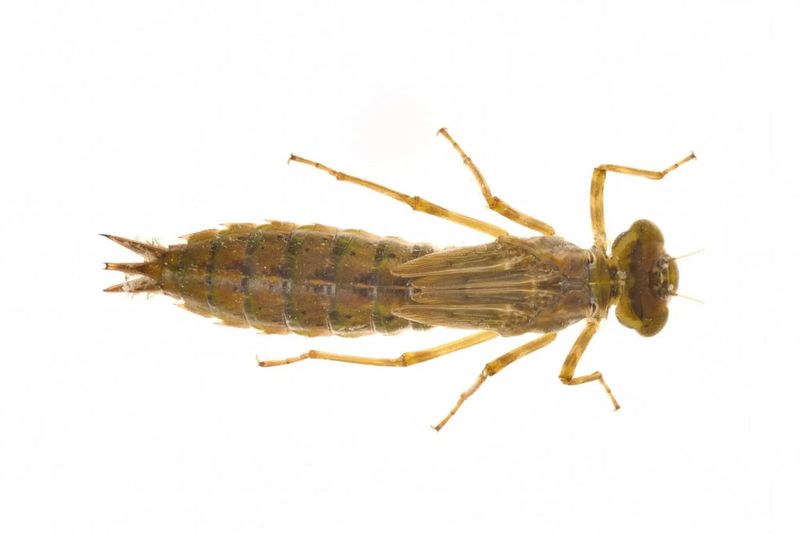
As aquatic nymphs, the National Park Service notes that they hunt aquatic insects, mosquito larvae, tadpoles, and occasionally small fish.
Once they take wing as adults, they shift to catching flying insects mid-air, including mosquitoes, gnats, and flies.
Both life stages are genuinely useful, but they operate in very different places.
Adult dragonflies can travel considerable distances from the water where they developed.
A swarm over your St. Augustine grass may reflect a pond three streets away, a drainage swale at the edge of the neighborhood, or a wetland you have never visited.
UF/IFAS Extension guidance on mosquitoes and their control reinforces that adult insect presence over a lawn does not establish what is happening in a specific water body nearby.
So take the swarm as a welcome sign of insect activity in your area, and keep reading before drawing bigger conclusions.
Weather And Migration Can Create A Sudden Show
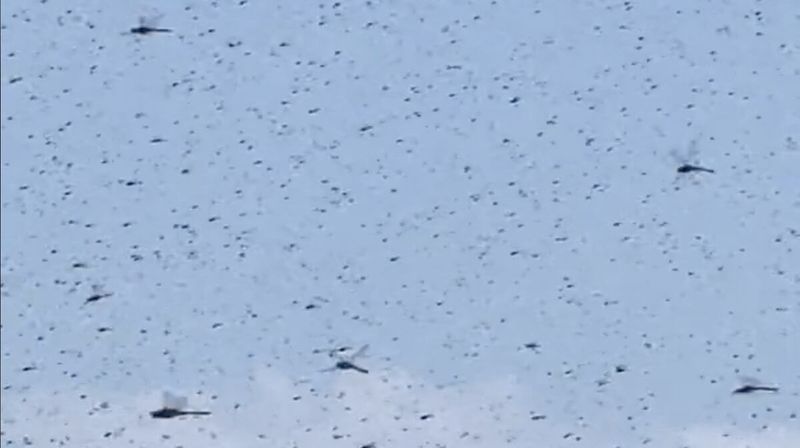
A Florida yard can fill with dragonflies without containing a single square foot of standing water.
The reason comes down to weather and landscape position more than anything happening on the property itself.
Research on eastern North American dragonfly movements found that major flights frequently followed cold fronts and occurred mainly from late July through mid-October.
Wind direction, coastlines, lakeshores, and nearby wetlands all shape where a flight becomes visible and how long it lingers.
A yard along the Atlantic Coast or the Gulf Coast sits right in the path of insects riding post-frontal northwest winds southward.
Even properties well inland can catch a feeding aggregation when a cold snap pushes insects into a lower layer of air and concentrates prey.
The common green darner, Anax junius, is the species most associated with dramatic fall migrations in the eastern United States.
Smithsonian researchers studying green darner migration documented that individuals can travel more than 1,500 miles over a season.
Not every Florida swarm belongs to that species, and many local aggregations involve resident species responding to prey rather than long-distance movement.
Near Crescent Beach on Florida’s Atlantic Coast, one documented event involved an estimated 200,000 dragonflies, a striking but exceptional example of what scale is possible, not a benchmark for a typical yard visit.
The practical takeaway is that the timing and weather conditions around a swarm tell you almost as much as the insects themselves.
Adult Dragonflies Do Not Prove The Water Is Clean
Here is where it gets genuinely tricky.
The most common claim about dragonflies and water quality is that seeing them means your pond or lake is healthy.
That claim applies much more accurately to larvae than to flying adults, and even for larvae it comes with real limits.
Dragonfly nymphs spend months or even years submerged.
Because they live in direct contact with sediment and water chemistry, USGS research has shown that dragonfly larvae are effective bioindicators of mercury exposure and certain aquatic habitat conditions.
The larval community, meaning which species are present and in what proportions, can give researchers a more direct picture of what is happening in a particular water body than a count of adults flying overhead.
The National Park Service describes nymphs as sensitive enough to environmental conditions that their presence and diversity help scientists assess aquatic ecosystems.
Adults, by contrast, can forage far from the water where they hatched.
A peer-reviewed study published in a water-quality journal found that adult dragonfly presence was not reliably associated with nearby water quality, while larval community data provided more direct information about the specific water body.
A separate analysis of odonate communities found that water chemistry alone did not fully explain dragonfly abundance or species patterns, suggesting that habitat structure and surrounding land use also matter.
Finding nymphs in your backyard pond is encouraging, but it does not independently prove that the pond or the yard is healthy.
The indicator value depends on which species are present, what the community looks like together, what variable you are assessing, and the specific water body.
Think of larvae as a more useful data point than adults, not as a complete answer.
A Prey Boom Can Power The Spectacle
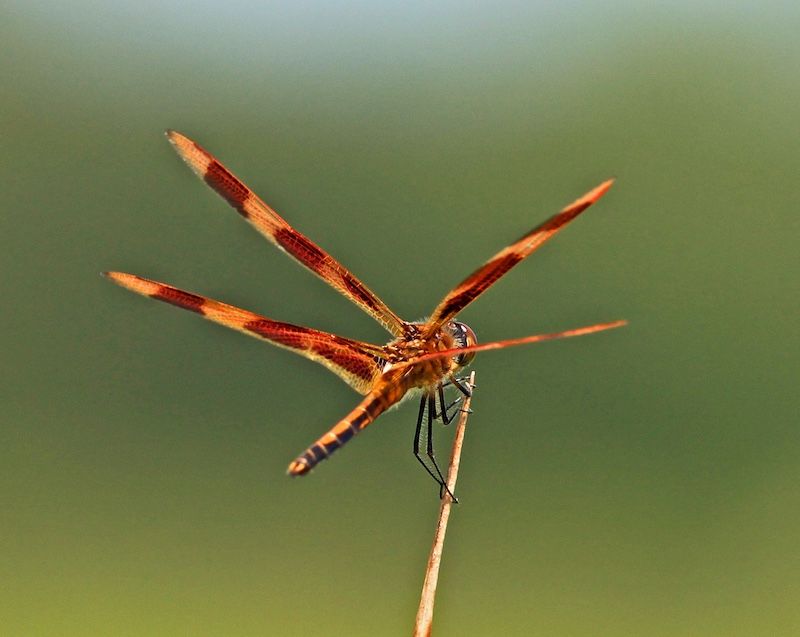
Sometimes a swarm has nothing to do with long-term habitat quality and everything to do with what showed up for dinner.
Adult dragonflies hunt mosquitoes, gnats, flies, and midges, and when any of those prey insects surge in number, predators follow fast.
Florida stormwater ponds are a useful example.
These ponds can support very large insect populations even when water quality is far from pristine.
UF/IFAS Extension research on freshwater midge emergences documents that midges can hatch from Florida stormwater ponds in tremendous numbers, sometimes covering patios, screens, and building walls in what looks like a dramatic pest event.
A related peer-reviewed study of odonate communities and water quality reinforces that a large insect emergence does not automatically signal excellent conditions in the water body below.
Midges do not bite and do not transmit disease, which matters before you decide how to respond.
UF/IFAS Extension guidance on mosquitoes is clear that correct identification should come before any treatment decision.
Many homeowners reach for a spray can when they see a cloud of small insects, not realizing the insects are harmless midges attracting beneficial predators.
Getting a closer look, or consulting your county extension office, takes about five minutes and can prevent a treatment that does more harm than good to the aquatic life nearby.
A prey boom is actually a reason to watch with curiosity rather than alarm.
The dragonflies will likely move on when the food does, and the event itself is a reminder of how connected your yard is to the larger insect community around it.
Observe Before You Reach For Spray

The single most useful thing you can do when a swarm appears is nothing, at least for the first few minutes.
Grab your phone, note the time and date, and take stock of what you are actually seeing before reaching for anything in the garage.
Record roughly how many insects are present, how high they are flying, and whether they concentrate over a specific spot, such as a lawn, a shrub border, a pond, a drainage swale, or a coastal edge.
Note the recent weather.
Research on eastern North American dragonfly swarms found that major flights frequently followed cold fronts, so a swarm appearing within 24 to 48 hours of a front passing through may represent a migration or weather-driven feeding event rather than local breeding activity.
That context changes what the observation means for your specific yard.
Mosquito concerns are reasonable, and dragonflies do contribute to natural predation of mosquitoes.
But UF/IFAS Extension is straightforward on this point: natural predators cannot consume every mosquito and should not be your only line of defense against mosquito-borne disease.
Use EPA-registered repellents, wear long sleeves during peak mosquito hours around dawn and dusk, keep window and door screens in good repair, and eliminate standing water in containers around the yard.
Dragonflies are one helpful layer, not a substitute for those steps.
Broad-spectrum insecticides sprayed during or after a swarm can kill the very insects you want to keep.
Identify first, then decide, and let the swarm run its course before concluding that any treatment is needed at all.
Protect Existing Water And Shoreline Habitat
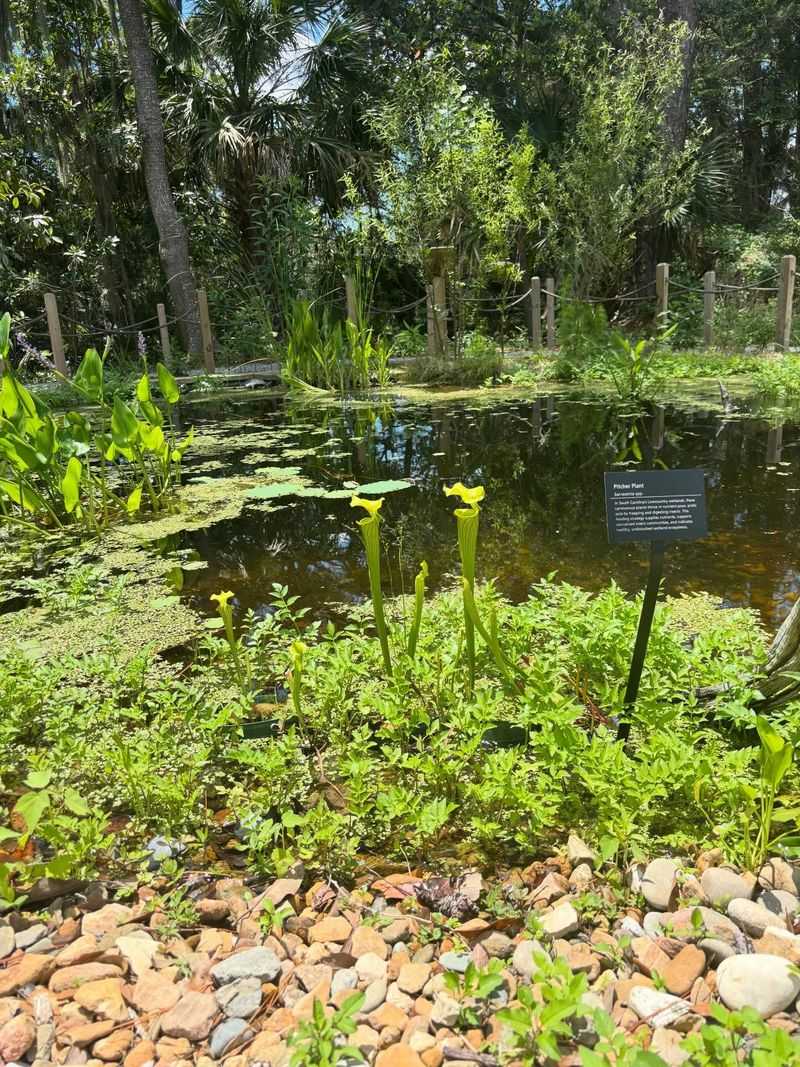
You do not need to build anything to support dragonflies.
Protecting what you already have often matters more.
If your property has a pond, a rain garden, a drainage swale, or even a stretch of native vegetation near a neighbor’s water, those features are already doing work.
Dragonflies need aquatic habitat for eggs and nymphs and nearby vegetation for perching, hunting, and shelter.
Peer-reviewed research linking riparian and in-channel habitat to dragonfly emergence confirms that both the water itself and the surrounding terrestrial area shape which species appear and how many.
Shoreline plants such as pickerelweed, native rushes, and muhly grass (Muhlenbergia capillaris) give adults places to perch and warm up in the morning sun, which is a genuinely important behavior for cold-blooded insects.
For readers who have or want a backyard pond, the Xerces Society’s backyard pond guidance offers a starting framework.
The Migratory Dragonfly Partnership’s pond construction guidelines suggest approximately 43 square feet as an estimated minimum viable pond area, while noting that smaller ponds may still attract some species.
Varied water depths help, along with submerged and emergent plants and some nearby upland vegetation.
A deepest zone of roughly 2.5 to 6.5 feet may be appropriate depending on pond size and local conditions, such as the intense summer heat across Central and South Florida that can stress shallow water.
Smaller ponds are worth having even if they fall short of these benchmarks.
A modest water feature with native plants is a better starting point than an empty lawn, and protecting existing water and vegetation almost always makes more sense than starting construction from scratch.
Manage Water And Mosquitoes Without Damaging Habitat
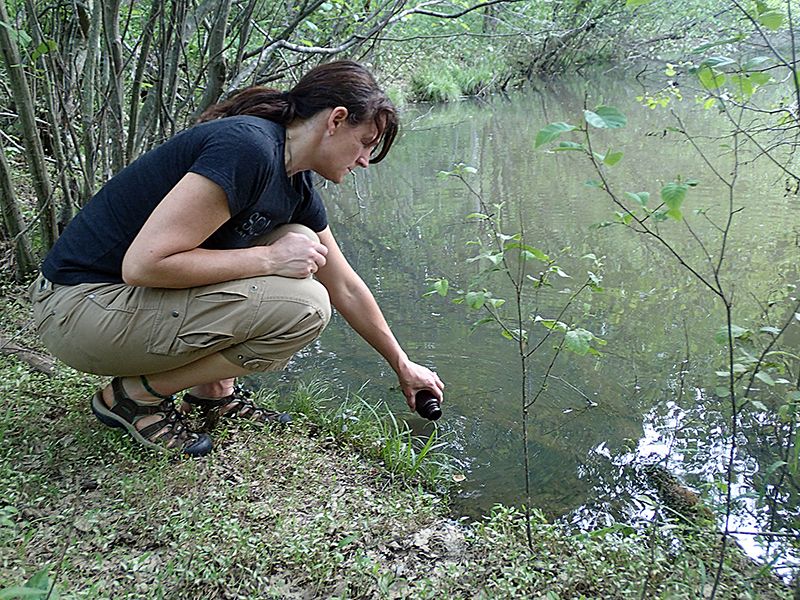
A well-meaning mosquito response can quietly undo the habitat a swarm just told you exists nearby.
The two goals, reducing mosquito breeding and supporting aquatic life, are compatible, but only if you are careful about which water you treat and how.
For any pond or water garden you want to keep, placement and runoff management matter from the start.
The Migratory Dragonfly Partnership’s pond guidelines recommend keeping overhanging trees to no more than one-third of the pond surface, allowing some woody vegetation on one side for afternoon shade and shelter while keeping the rest open.
Ponds should be sited away from heavy runoff when possible, because runoff from Florida lawns and driveways can carry fertilizer, oil, herbicides, and insecticides directly into the water.
For containers that do not need to hold water, the right answer is simply to empty them.
Buckets, saucers under pots, old tires, and neglected bromeliads can all produce mosquitoes without contributing any habitat value.
UF/IFAS Extension guidance on mosquito management and UF/IFAS water management guidance both emphasize source reduction as the first and most reliable step.
If retained water genuinely requires treatment, the EPA explains that Bti products target mosquito, blackfly, and fungus gnat larvae and are approved for certain residential water uses.
Labels differ by product and site, so read the label for your specific situation before applying anything.
EPA guidance on insecticides and aquatic life makes clear that broad-spectrum sprays can harm beneficial insects and reach water through drift or runoff, and EPA aquatic life benchmarks document how even low concentrations of some pesticides affect invertebrates.
UF/IFAS Florida-Friendly Landscaping guidelines recommend identifying the pest and using nonchemical methods first.
On the question of fish: UF/IFAS mosquito control guidance discusses eastern mosquitofish for suitable artificial ponds and ornamental systems, but releasing any fish into natural Florida waters is not appropriate.
Check local guidance before adding fish to any water feature, and remember that emptying unnecessary containers is almost always the simpler first step.
UF/IFAS water management resources can help you assess your specific situation.
Judge The Yard By Patterns, Not One Afternoon
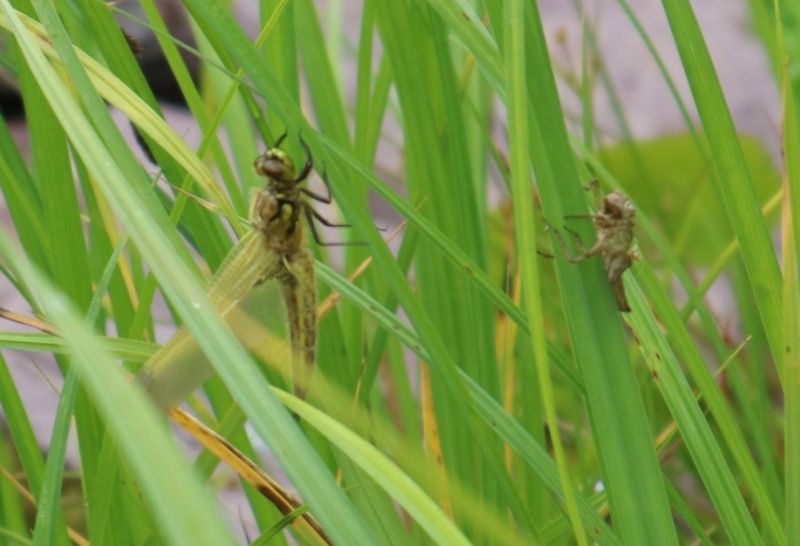
One swarm on one afternoon is a data point, not a verdict.
The more you watch over weeks and months, the more useful the picture becomes.
Pay attention to whether dragonflies return repeatedly rather than just once.
Notice how many different types you see, because research on odonate communities along urban gradients shows that species diversity, not just abundance, reflects habitat quality more reliably.
A yard that hosts five or six recognizable types over a season is telling a different story than one that briefly attracts a single species chasing a prey surge.
Studies linking riparian habitat to dragonfly emergence also point to shoreline vegetation as one of the stronger predictors of odonate activity, so the condition of plants around any nearby water matters alongside the water itself.
If you have access to a pond or water garden and can safely observe it, looking for aquatic nymphs adds a more direct layer of information.
USGS research on dragonfly larvae as bioindicators explains that larval community composition can provide more direct evidence about conditions in the specific water body where the nymphs live, including some habitat and mercury assessments.
That evidence is more grounded than adult counts, but it still is not a standalone score for overall yard health.
The study on adult versus larval water-quality associations is a useful reminder that no single observation settles an ecological question.
Repeated activity, multiple species, healthy vegetation, and the presence of nymphs in an identified water body are observations that can strengthen each other over time.
Research on dragonfly abundance along wetland buffers reinforces that landscape context shapes what you see as much as the yard itself does.
Treat a swarm with curiosity and habitat-friendly care, and let the pattern that builds over a full season be your real report card.