
More Owls Over Your Texas Home Means Fewer Rats Around The Barn
Follow us on Google
Step outside on a still Texas night and you might catch a pale shape banking low over the pasture, silent as a thrown sheet.
That’s a barn owl, and if you’ve heard they’ll clean out the rats around your barn, the truth is a little more interesting than the headline.
Barn owls are real, effective hunters of mice, voles, and similar small rodents in open farm country, but the story gets complicated when large household rats enter the picture.
Understanding what these birds actually do, and what they cannot do on their own, will help you make smarter choices for your property.
What Barn Owls Can—and Cannot—Tell You
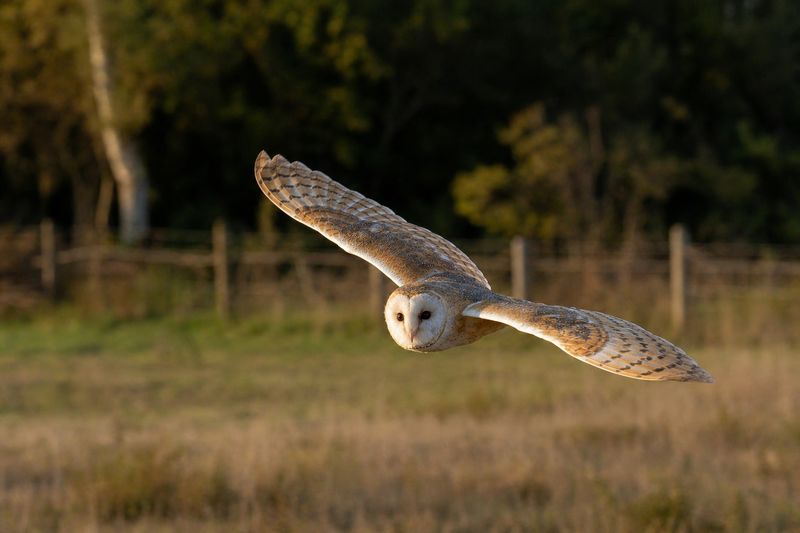
Spotting a barn owl gliding over your property on a warm Texas evening feels like something out of a nature documentary, and the instinct to think “good, the rats are finished” is completely understandable.
But that bird overhead is telling you something more specific, and more modest, than that.
Barn owls (Tyto alba) are nocturnal predators built for open country.
Cornell Lab’s All About Birds profile describes their preferred habitat as fields, pastures, grasslands, and structures like barns and silos that offer clear flight access and dark nesting cavities.
A dense suburban yard with mature trees and no nearby open hunting ground is genuinely a different world to them.
If you are seeing one regularly, it is a reasonable sign that your land offers something they need, open space, short grass or bare ground, and a food supply of small mammals moving around at night.
What they eat is worth understanding carefully.
Texas Parks and Wildlife notes that owl diets can include insects, reptiles, amphibians, fish, birds, and other small animals alongside the mice and voles most people picture.
Barn owls are not rat specialists.
They hunt what fits their hunting style, low, slow quartering flight over open ground, and their most common prey are the small mammals that live in that kind of habitat.
An owl passing over your barn is evidence of local habitat use.
Agricultural guidance from Utah State University’s Intermountain farmland research points out that barn owls can cover large territories in a single night, so the bird you see near your fence line may be hunting a quarter mile away most of the time.
That sighting is not proof of a rat infestation, and it is not a guarantee that the owl is patrolling directly over your feed room every night.
The Evidence Supports Help, Not a Rat Guarantee
Texas Parks and Wildlife genuinely does recognize owls as useful natural rodent control, and that recognition is not just folklore.
There is real research behind it, though the details matter a lot when you are deciding what to expect from the barn owl box you are thinking about building.
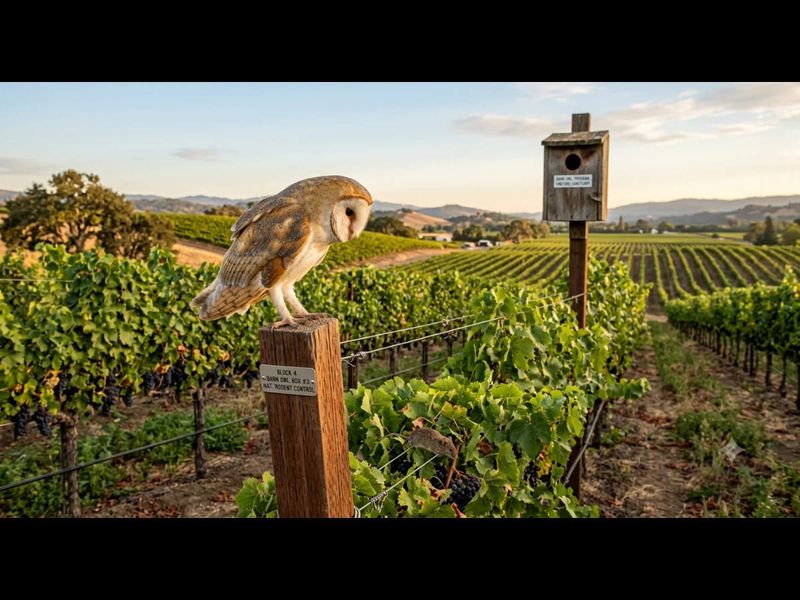
The most recent quantitative finding comes from a 2026 vineyard study in California’s Napa Valley.
That study found an association between stronger barn owl hunting pressure and a 38% to 52% reduction in relative rodent abundance, along with increased avoidance behavior in the remaining animals.
The primary prey in that study were deer mice, not Norway rats or roof rats.
And the setting was Napa Valley vineyards, not a Texas barn, not a Texas yard, not any Texas landscape at all.
Those details are not reasons to dismiss the finding.
They are reasons to apply it carefully.
A broader look at the science adds important nuance.
A systematic review published in Biological Control examined whether avian predators serve as effective biological control agents for rodent pests in agricultural systems.
The reviewers found generally positive effects but also concluded that many of the studies were short-term or lacked the statistical strength needed to demonstrate durable, long-term population suppression.
In plain language, owls probably help, but the science has not yet proven they keep rodent numbers down permanently.
The prey distinction is the most important thing to carry forward.
Barn owls are well matched to mice, voles, deer mice, gophers, and similarly sized small mammals that move through open ground.
Large commensal rats, the Norway rats and roof rats that set up shop inside walls, attics, and feed rooms, are a different animal in every sense.
They are heavier, more cautious, and more tied to human structures than the prey barn owls hunt most efficiently.
The available sources do not support a claim that owl presence reliably suppresses large household rat populations around a Texas home or barn.
Check the Habitat Before You Install a Box
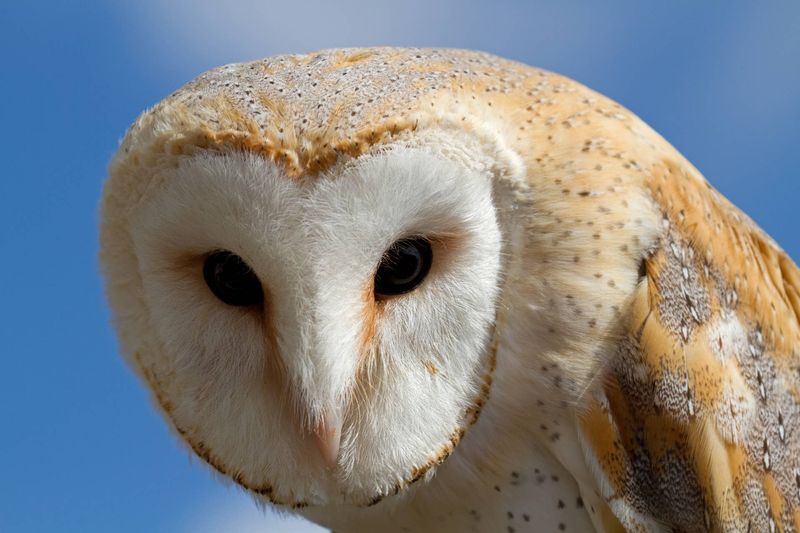
Before you pick up a single board, take an honest look at your land.
A nest box cannot create habitat where none exists, and putting one up in the wrong spot is mostly an exercise in building a very expensive squirrel house.
Barn owls want open nighttime hunting ground.
Think pasture, hayfields, native grassland, the margins of crop fields, or even a large mowed area around a working barn.
Cornell Lab’s barn owl profile is clear that these birds depend on that open flight corridor for their low, quartering hunting style.
A half-acre suburban lot surrounded by privacy fences and tall trees is unlikely to meet that need, no matter how well the box is built.
Prey availability matters just as much as open space.
Texas Parks and Wildlife recommends preserving old barns and sheds where it is safe to do so, and reducing unnecessary nighttime lighting around structures.
Both steps protect the conditions barn owls actually use.
Bright security lighting over open ground can suppress the small mammal activity that draws owls in the first place.
Not every Texas owl fits the barn owl profile, and that distinction matters when you are deciding what kind of box to build.
Screech-owls are the species more likely to show up in wooded edges, suburban backyards with mature trees, and park-like settings.
Texas Parks and Wildlife’s Eastern Screech-Owl page describes a bird that is comfortable in mixed woodland and suburban habitat, with a diet that includes large insects alongside small mammals.
A screech-owl box is smaller than a barn owl box and suits a completely different setting.
Matching the species to your actual land is the first practical step, and skipping it means the box may sit empty for years.
Build a Safe Texas Barn Owl Box
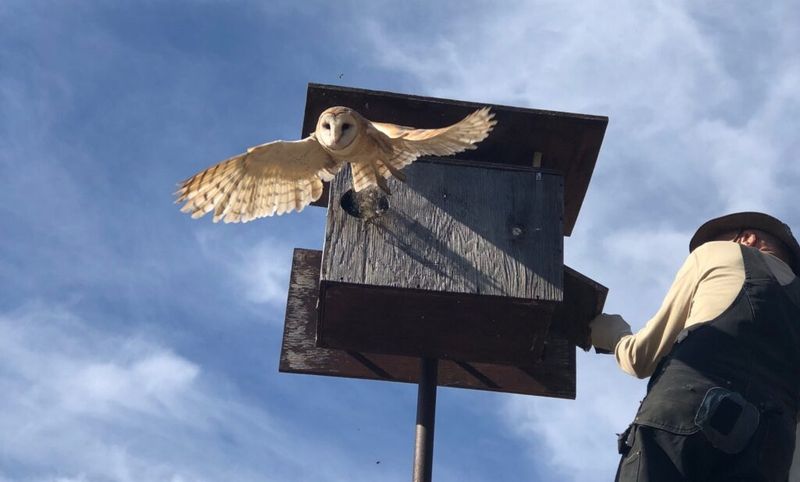
Getting the box dimensions right is not optional.
Barn owls are specific about the spaces they nest in, and a box that is too small, too shallow, or hung too low will not attract them regardless of how good the surrounding habitat looks.
Texas Parks and Wildlife’s nestbox guidance calls for a floor space of approximately 10 by 18 inches, a depth of 15 to 18 inches, and a 6-inch entrance hole.
The mounting height should be between 12 and 18 feet, high enough that the birds have a clear, unobstructed approach from the air.
These are the Texas-specific dimensions to build from, and they reflect what barn owls actually need rather than what a generic online plan might suggest.
The location of the pole or post matters as much as the box itself.
Agricultural guidance from Utah State University Extension’s farmland wildlife research recommends keeping boxes away from busy roads, where fledglings can be struck by vehicles as they leave the nest for the first time.
Avoid mounting near branches that give raccoons, snakes, or cats a climbing route to the entrance.
A smooth metal pole with a predator guard baffle is the safest mounting option for most Texas properties.
Orientation can help moderate heat inside the box.
Facing the entrance north or east limits direct afternoon sun exposure during the hottest months, which is a genuine concern on properties across Central Texas, South Texas, and the Hill Country where summer temperatures regularly exceed 100 degrees Fahrenheit.
Use exterior-grade lumber or plywood at least three-quarters of an inch thick, and drill several small drainage holes in the floor so rainwater does not pool inside.
Build the entrance with a small landing ledge just below the hole, and make the lid removable with a latch so you can clean the box each year without damaging the structure.
A well-built box, placed correctly, gives you the best realistic chance at occupancy.
It still does not guarantee it.
Give an Empty Box Time—and Protect an Occupied One
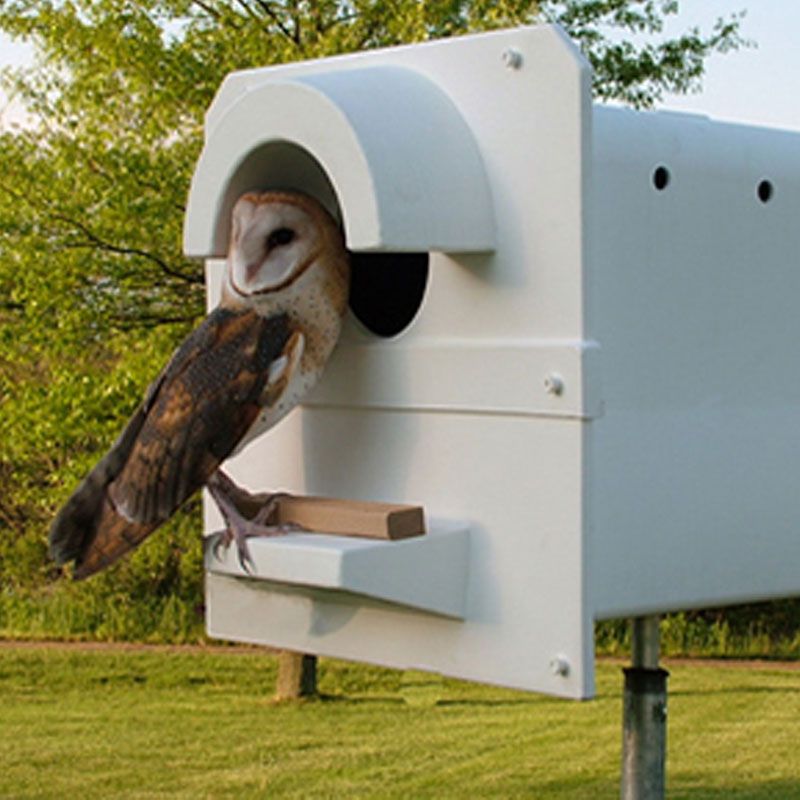
Putting up a box and checking it every weekend will not speed anything up.
Barn owls work on their own schedule, and that schedule is shaped by factors you do not fully control.
Territorial behavior, prey supply, competition from other cavity-nesting species, local predator pressure, box design, and the character of surrounding habitat all influence whether owls move in.
Utah State University Extension’s farmland wildlife research recommends installing more boxes than the number of occupied nests you hope to see, waiting several years before judging an unused box a failure, and relocating boxes that sit empty for multiple seasons.
That guidance was written for agricultural programs with many boxes across large acreage, not for a single backyard installation, so apply it as a patience principle rather than a guaranteed formula.
An empty box deserves annual attention.
Clean it out each fall after any nesting season has ended, repair cracked wood or loose hardware, and check the predator guard on the pole.
Leaving old nesting material inside can harbor parasites that discourage future occupants.
An occupied box is a different situation entirely.
Once barn owls are nesting, the box should not be opened or disturbed.
Disturbance during active nesting can cause adults to abandon eggs or chicks.
Intermountain farmland guidance reinforces that nest-season disturbance is one of the most common reasons nest box programs underperform.
Watch from a distance, keep dogs and foot traffic away from the base of the pole, and resist the urge to confirm what is happening inside.
Keep the area around the pole clear of barbed wire and exposed electrical lines.
Fledglings that leave the box before they fly well can land in unsafe spots, and a clean, open landing zone around the base of the pole gives young birds a better chance of surviving their first nights out.
Avoid Feeding, Baiting, and Rodent Poison
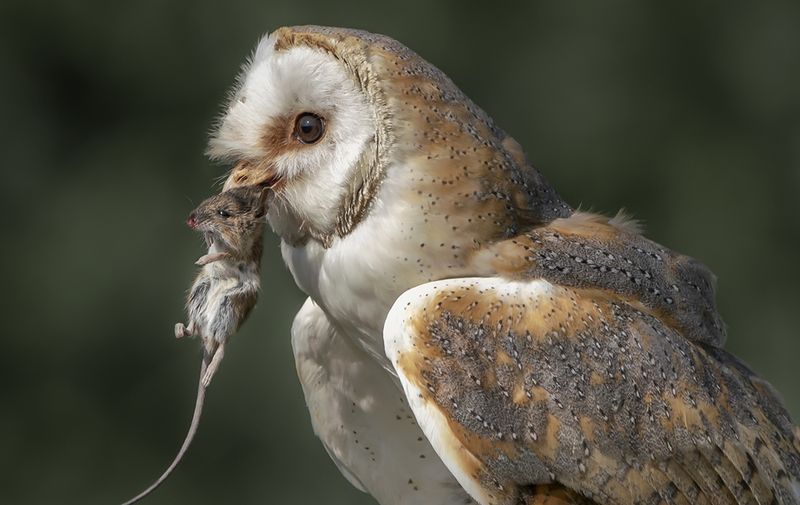
There are a few shortcuts that feel logical but can genuinely hurt the owls you are trying to attract.
Knowing what not to do is as useful as knowing what to build.
Do not place live mice, meat scraps, or any other food near the box to draw owls in.
Audubon’s guidance on feeding and baiting owls explains that this practice can alter the birds’ natural behavior, expose them to disease, attract rodents toward roads and other hazards, and create a dangerous dependence on human-provided food.
The right approach is to make the habitat attractive, not to manipulate individual birds with food rewards.
Rodent poison is a harder conversation, because it feels like the obvious solution when you have a serious rodent problem.
But Texas Parks and Wildlife specifically recommends traps rather than poisons when controlling rodents in areas where owls are present.
The reason is secondary exposure.
An owl that eats a rodent that has consumed anticoagulant rodenticide can accumulate a lethal or sublethal dose over time.
A Texas study screening rehabilitated and deceased owls found that 50.94% of tested birds showed exposure to at least one anticoagulant rodenticide, with lethal exposure detected in 13.21% of the screened sample.
That was a nonrandom sample of birds that came through rehabilitation or were found dead, so it does not represent the full Texas owl population, but the pattern is sobering.
Owls are protected under both state and federal law.
You may not legally harm, kill, or take them.
Texas Parks and Wildlife’s law enforcement FAQ explains that if owls enter an attic or create a conflict, the recommended path is preventive exclusion: close access points after the birds have left on their own, and use mesh or netting over vulnerable openings.
Do not handle birds, chicks, eggs, or active nests.
If a conflict is serious or an owl is injured, contact a licensed wildlife rehabilitator rather than attempting to manage it yourself.
Make the Barn Less Inviting to Rodents
Owls hunt what is available, but rodents settle where conditions invite them.
Changing those conditions is the most dependable thing you can do, and it works whether or not a barn owl ever moves into your box.
CDC guidance on sealing up against rodents recommends closing openings around doors, pipes, vents, eaves, and foundations.
Mice can squeeze through a gap about one-quarter inch wide, roughly the diameter of a pencil, so any crack you can slide a finger into is a door they can use.
Hardware cloth, steel wool packed into gaps before caulking, and metal flashing around door frames are all practical tools for a Texas barn.
Feed storage is where most Texas barn rodent problems start.
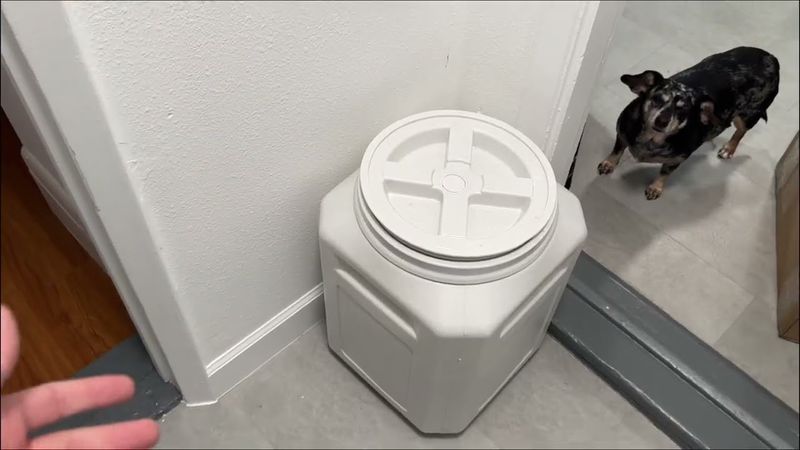
Store grain, pellets, and supplements in thick plastic, metal, or glass containers with tight-fitting lids.
Remove spilled feed the same day.
Keep pet food indoors overnight.
Secure garbage in cans with locking lids, because a single open bag left near the barn door is a standing invitation.
For the land around your buildings, CDC recommendations call for placing compost at least 100 feet from the house, moving woodpiles at least 100 feet away from structures and raising them at least 1 foot off the ground, and trimming brush and weeds within 100 feet of the home.
These steps remove the cover and harborage that rodents depend on between feeding runs.
They are rodent management recommendations, not owl-attraction requirements, and they deliver real results on their own.
When rodents are already inside walls, ceilings, or inaccessible crawl spaces, snap traps are the safest option near owl habitat.
CDC guidance on integrated pest management supports exclusion, sanitation, traps, and professional help when rodents occupy areas that cannot be reached by simpler methods.
A pest control professional is the right call when the problem is large, persistent, or involves Norway rats or roof rats inside a structure.
Treat Barn Owls as One Part of the Plan
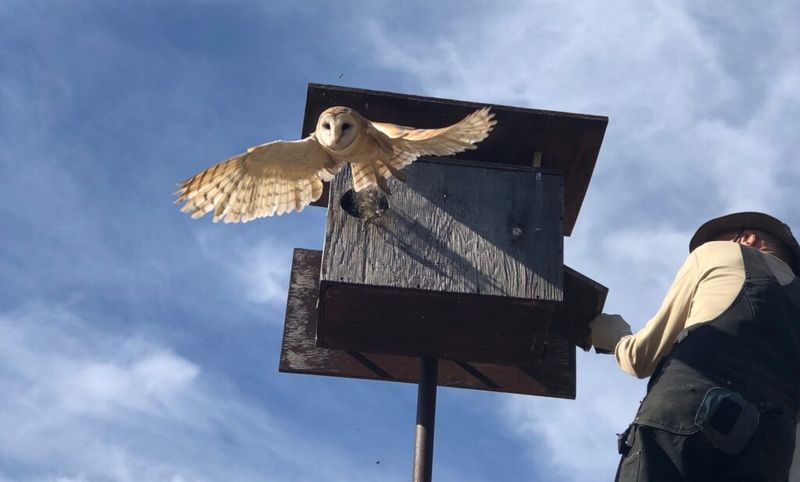
Pulling all of this together into a working plan starts with an honest property assessment.
Walk your land and ask whether you have open hunting habitat, short grass or bare ground where small mammals move at night, a structure or tall pole that could hold a correctly sized box, and low enough nighttime lighting to make the area usable.
If those conditions exist, a barn owl box is a reasonable and genuinely worthwhile addition.
If they do not, the box is unlikely to draw owls, and the rodent pressure you are dealing with needs other tools.
Utah State University Extension’s farmland wildlife guidance frames predator attraction as one layer of a broader management approach, not a standalone fix.
That framing fits Texas properties well.
Build the box to Texas Parks and Wildlife’s specifications, mount it at the right height with a predator guard, protect owls from poison hazards, and maintain feed storage, sanitation, and exclusion work alongside the box.
Texas Parks and Wildlife recognizes owls as a genuine part of natural rodent management, and that recognition is well earned for small agricultural rodents in suitable open habitat.
Keep expectations calibrated.
An owl may hunt across a wide territory and may never occupy your box.
Barn owl predation may reduce some small-rodent activity around your barn over time, but it cannot guarantee fewer large rats inside a Texas home, and the science does not claim otherwise.
Sealing entry points and removing food sources will always be the most dependable layer of your defense.
Welcoming a wild predator to your land is genuinely good for the land.
That quiet shape banking over the pasture at dusk is worth having around, even if the rats in the feed room still need a snap trap.