
What To Do With Your Florida Plumeria Now Before The Late-Summer Heat And Storms Peak
Follow us on Google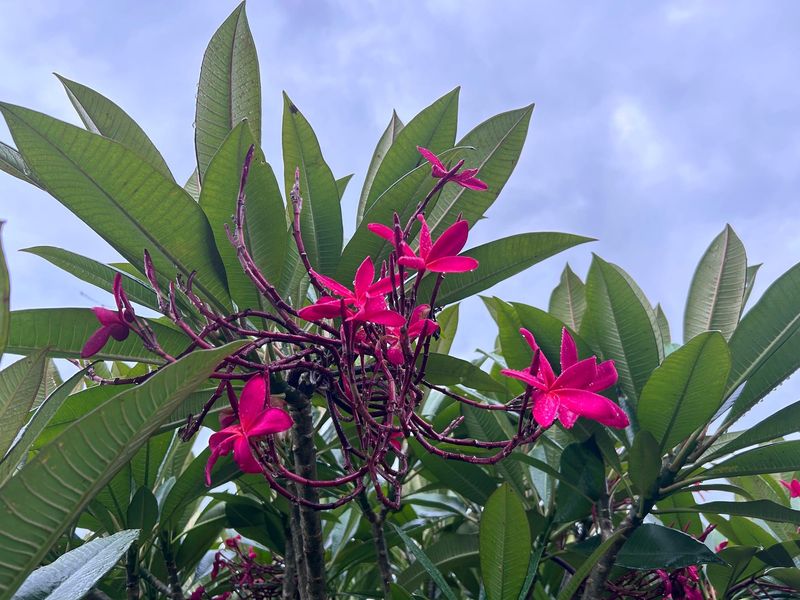
You step onto the patio after breakfast and the air already feels heavy, and your plumeria (Plumeria rubra) is loaded with clusters of blooms that could keep going well into November.
But the hottest, rainiest, stormiest stretch of the Florida year is right here, and a few wrong moves now can cost you those flowers before the season finishes.
The good news is that a steady, sensible routine can carry your plant through the heat and the rain and the wind threats without heroic effort.
This guide covers exactly what to do, region by region, before conditions get any more demanding.
Protect The Branch Tips That Carry Flowers
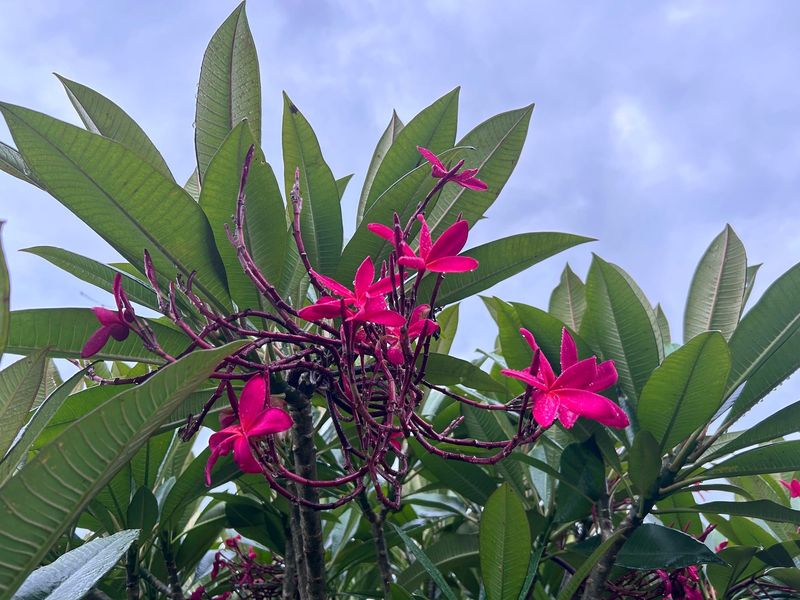
Plumeria is not a plant that hides its flowers deep inside the canopy.
UF/IFAS Extension notes that Florida plumeria commonly blooms from May or June through November, and every flower cluster forms at the end of a branch.
That single fact shapes everything about late-summer pruning decisions.
If you cut the tips now, you are not just trimming shape.
You may be removing the exact growth points that carry current blooms or would produce the next flush of flowers before the season closes.
The pruning caution here follows directly from where the plant flowers, not from a claim that every single cut shuts down the whole show.
The practical rule is straightforward.
Leave healthy branch tips alone through the flowering period.
If a branch is clearly broken, visibly diseased, or hanging in a way that creates a real hazard, remove it cleanly with a sharp, clean tool and wear gloves because plumeria sap can irritate skin and eyes.
Wash your hands afterward.
That kind of targeted removal is maintenance, not shaping.
Cosmetic work, meaning cuts made to improve the silhouette or reduce height while the plant is actively flowering, can wait.
A plumeria that looks a little rangy in August but keeps producing blooms is doing its job.
Published UF/IFAS species guidance supports waiting until the appropriate pruning window rather than cutting during peak flower production.
Many Central Florida gardeners make the mistake of tidying up in late summer and then wondering why the branch count drops into fall.
Protect those tips now, and the plant keeps working for you through the warmest months it has left.
Give Plumeria Sun And Fast Drainage
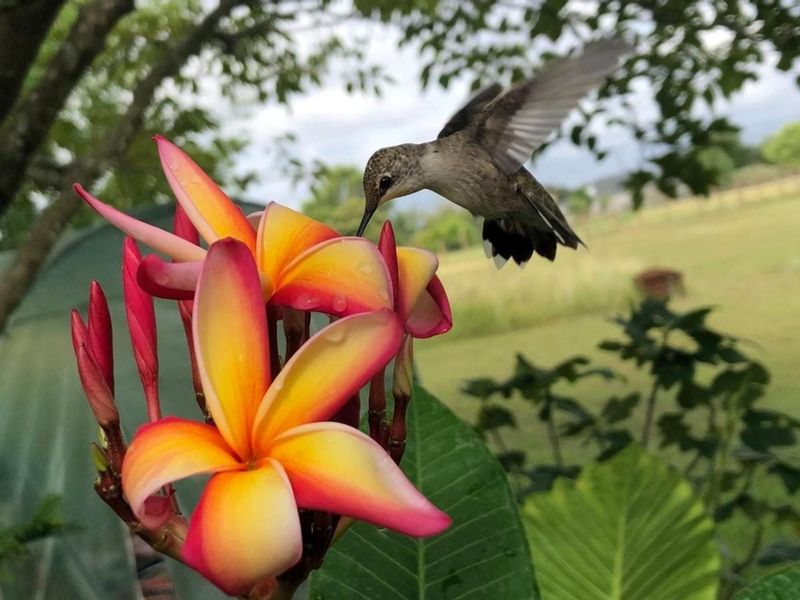
Full sun is non-negotiable for plumeria in Florida.
Six or more hours of direct light daily keeps the plant strong, but strong light cannot rescue a root zone that stays wet.
Drainage is the other half of the equation, and it matters just as much.
UF/IFAS Extension guidance on plumeria describes the plant as best suited to full sun and well-drained soil.
In Florida’s summer, sudden downpours can dump several inches of rain in under an hour.
A planting site that drains slowly, or a container without open drainage holes, can turn a normal rainstorm into a root problem.
Check your container before the next storm.
If the drainage holes are blocked by roots, compacted soil, or a saucer sitting underneath, clear them now.
Species fact sheet data points to poorly drained conditions as a contributor to root rot in plumeria.
A pot sitting in a saucer filled with stormwater is essentially a slow root-rot incubator.
For in-ground plants, walk the bed after a heavy rain.
If water is still pooling around the base 30 minutes later, the site drains too slowly for plumeria to thrive long-term.
Raised planting or a move to a container with proper drainage may be the honest fix.
Established plumeria can tolerate some drought and, according to UF/IFAS salt-tolerance references, handle moderate salt exposure.
But salt tolerance is relative.
A plant directly in the path of repeated coastal spray is still at risk of foliage injury, so a sheltered spot within a coastal yard is a better choice than the front-line fence if you have options.
Water When The Root Zone Is Drying
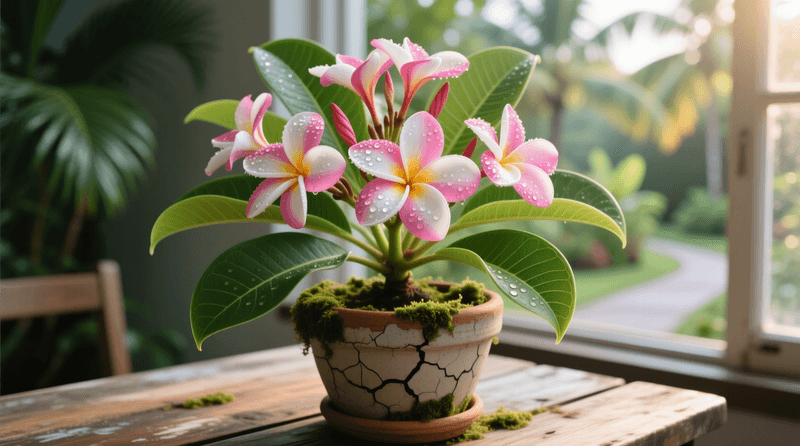
The biggest watering mistake Florida gardeners make with plumeria is treating it like a lawn.
A fixed daily schedule ignores everything that actually matters: recent rainfall, container size, soil type, drainage speed, and whether the plant is actually thirsty.
The better method is a finger check.
Push a finger or a wooden dowel about 2 inches into the root zone.
If the soil feels dry at that depth and the plant has not had meaningful rain in the past day or two, water slowly and directly at the root zone until water flows out the drainage holes or soaks in at least 6 to 8 inches deep.
Then stop and let the soil dry down before watering again.
UF/IFAS ornamental establishment guidance warns that overwatering is one of the leading causes of ornamental plant problems in Florida landscapes.
Constantly wet soil around plumeria roots is an invitation to rot, particularly in containers, low spots, or compacted beds.
Containers dry out faster than ground beds, especially small pots in direct sun.
A container plumeria may need water every 2 to 4 days during a dry stretch, but that interval can stretch to a week or more when afternoon storms are rolling through daily.
Let the root zone tell you, not the calendar.
For a plumeria installed within the past year, Extension guidance on ornamental plant care supports checking soil moisture every 2 to 4 days in North and Central Florida and roughly every 2 days in South Florida during establishment, with rainfall always taking priority over any schedule.
Once roots are settled and the plant is clearly growing, back off and let the soil guide you.
Rain does not automatically cancel the need to check.
A brief afternoon shower may wet only the top inch of soil while the root zone stays dry.
Conversely, a week of daily downpours means you almost certainly do not need to add more water.
Plumeria species data supports preventing prolonged wetness as a core care principle.
Feed Carefully Instead Of Chasing Blooms
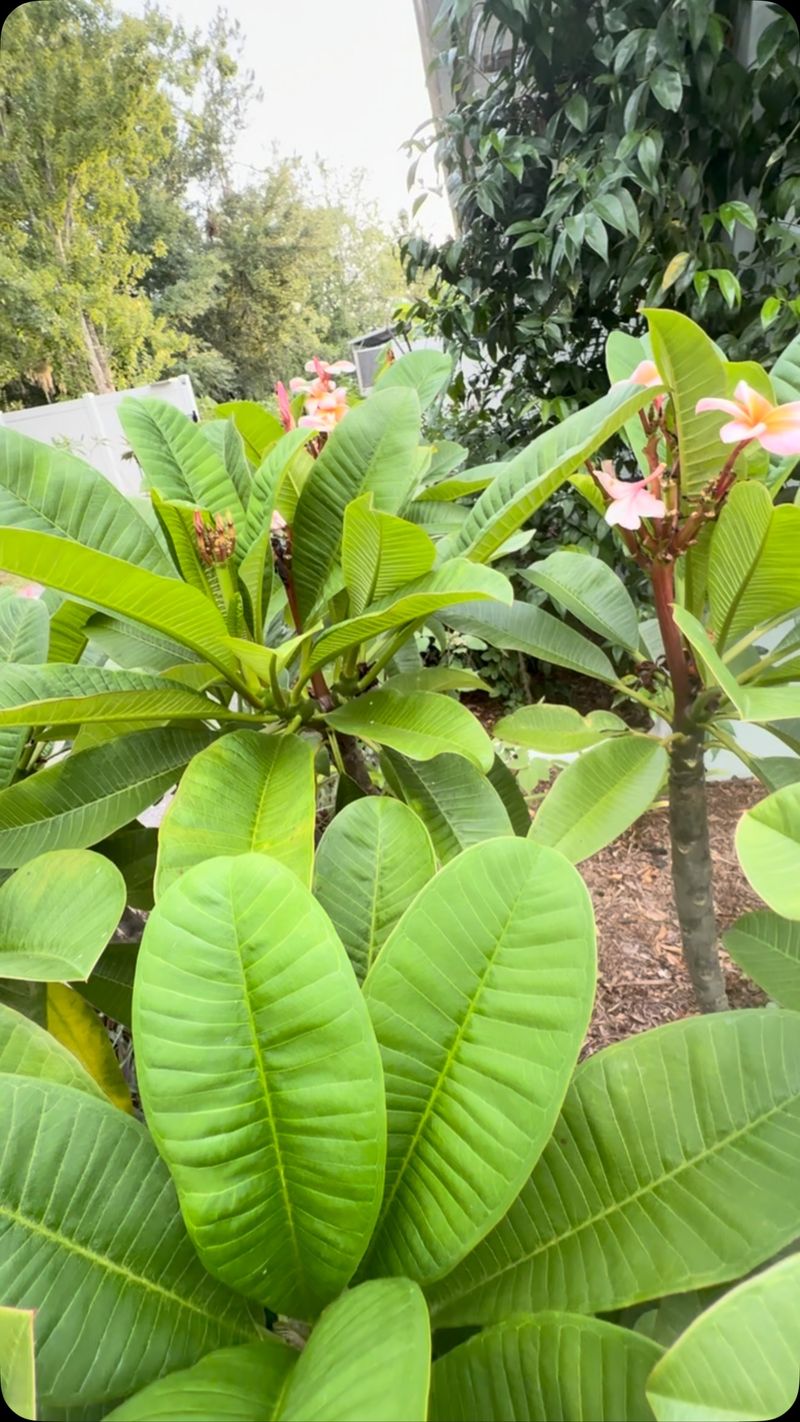
Late summer is when some gardeners reach for a bloom booster and apply a heavy dose, hoping to push one more round of flowers before the season winds down.
That impulse is understandable, but the result is often the opposite of what you want.
Excess fertilizer on plumeria in Florida’s sandy soil can drive a flush of soft, leafy growth instead of flowers, increase salt stress at the root zone, and accelerate nutrient loss through the ground before the plant can use what you applied.
Extension guidance on ornamental plant nutrition consistently points toward soil testing, appropriate product selection, and following label directions rather than applying a universal high-phosphorus or high-potassium formula.
If you have not had your soil tested recently, your local UF/IFAS Extension office can walk you through the process.
A soil test tells you what is actually missing, so you are not guessing.
If the plant is actively growing and blooming in well-drained soil with good sun, a light application of a balanced slow-release fertilizer applied according to the label is a reasonable choice.
UF/IFAS ornamental guidance supports slow-release products for Florida landscapes because they reduce the risk of salt buildup and nutrient runoff in sandy conditions.
Restrained nutrition supports the plant, but it cannot substitute for full sun, healthy roots, good drainage, or favorable weather.
A well-fed plumeria in a shady, waterlogged spot will still struggle.
Get the basics right first, then fertilize modestly to maintain what is already working.
Inspect Regularly Before Choosing A Treatment
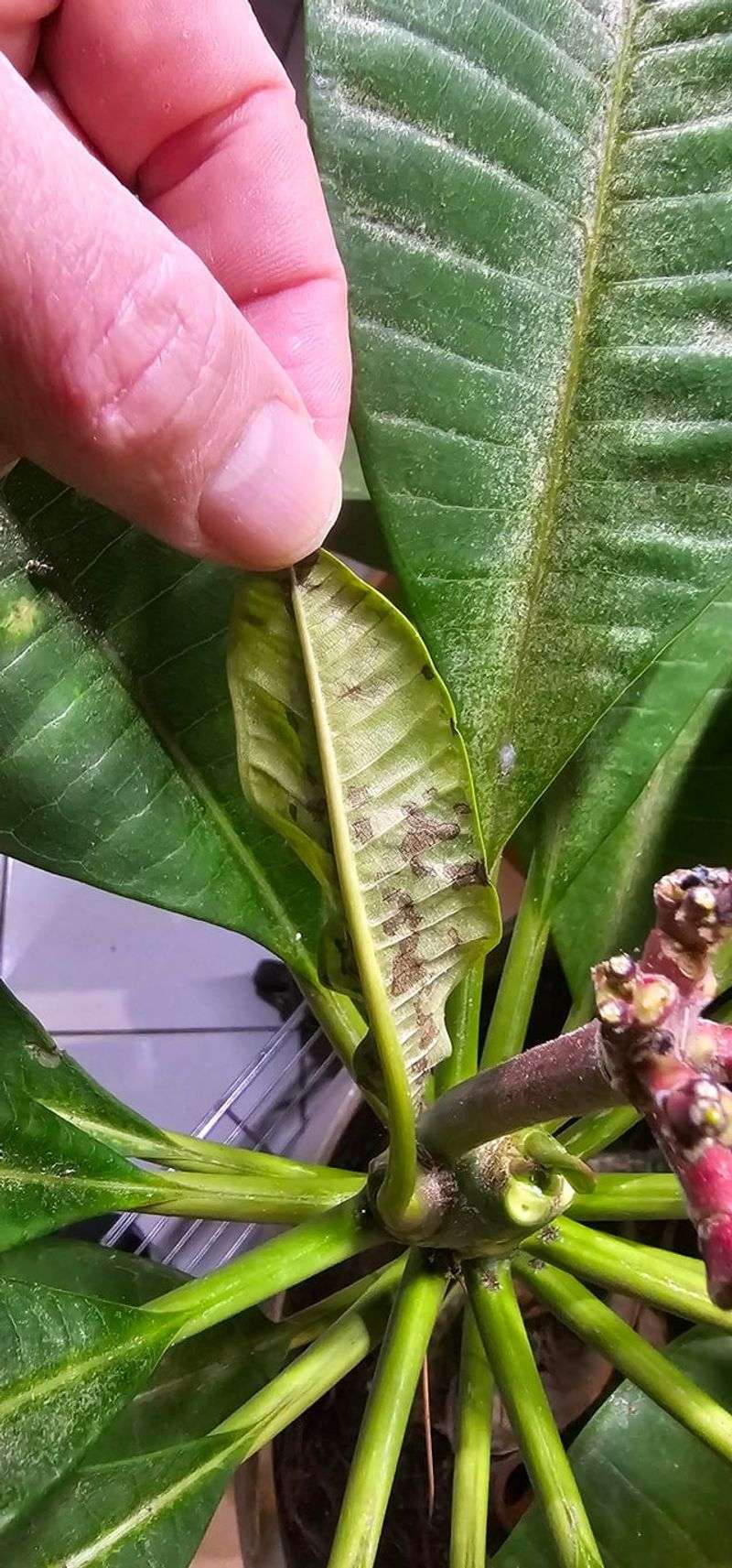
Something is eating your plumeria, or the leaves are turning yellow and dropping, and the instinct is to grab whatever spray is under the sink and apply it immediately.
That approach can cause more damage than the original problem.
Regular inspection is the first and most important step.
Flip leaves over and look at the undersides.
UF/IFAS Extension identifies frangipani rust as a fungal disease capable of causing serious defoliation in Florida plumeria, especially in Plumeria rubra.
The signs are yellow-orange powdery pustules on the leaf undersides and yellow or brown spotting on the upper surfaces.
If you see those symptoms, collect and dispose of fallen infected leaves to reduce the amount of fungal material available for reinfection.
Fungicides can help in some situations, but product choice, application timing, and repeat treatments all matter.
Identify the problem first, then look up the appropriate product and follow the label.
Scale insects appear as small, flat, waxy bumps on stems and leaves.
They feed quietly and are easy to miss until the plant starts looking stressed.
UF/IFAS species documentation lists scales among common plumeria pests in Florida.
Caterpillars are harder to miss.
The tetrio sphinx caterpillar is a large, striking pest that feeds heavily on plumeria foliage.
A UF/IFAS Pinellas County Extension report describes these caterpillars as active on plumeria roughly from July through September in parts of Florida, though that timing is not uniform across the state.
Hand removal is a reasonable first response when numbers are manageable.
Before applying any product, including neem oil or anything labeled as insecticidal soap, read the label completely.
UF/IFAS Extension specifically distinguishes labeled insecticidal soap products from household dish detergent, which can burn foliage.
When in doubt, contact your local Extension office before treating.
And whenever you prune during inspection, wear gloves and wash your hands afterward because UF/IFAS notes that plumeria sap can irritate skin and mucous membranes.
Prepare Containers And Young Plants Before Winds Arrive
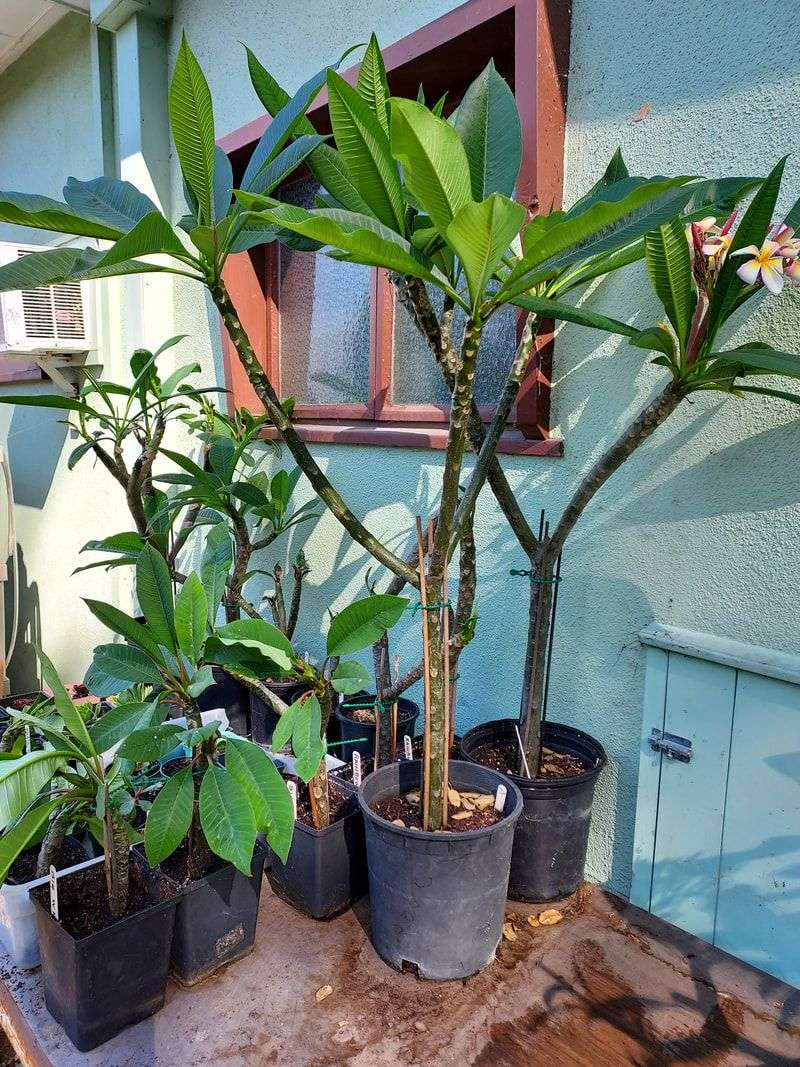
The time to move a potted plumeria is before a storm watch is posted, not during one.
Once winds pick up, a large container becomes a projectile and moving it safely becomes difficult or impossible.
Make a habit of checking the forecast during the active part of hurricane season.
National Hurricane Center climatological data shows that Atlantic hurricane-season activity usually concentrates between mid-August and mid-October, with a climatological peak around September 10.
That is a reason to build a preparation routine now, not a prediction that a storm is heading your way.
Move potted plumeria to a sheltered location, such as a garage, a covered porch, or a spot against a protected interior wall, well before strong winds arrive.
Bring in or secure any loose pots, furniture, tools, and yard objects nearby.
An unsecured pot in 60-mile-per-hour gusts can shatter a window.
For a plumeria installed within the past year, or for a larger young specimen that still moves when you push it, staking provides temporary support.
UF/IFAS Okaloosa County Extension guidance supports using three or four stakes driven about 18 to 24 inches into the soil, angled roughly 45 degrees away from the plant, connected to the trunk with soft, loose ties that allow the plant to move slightly in the wind.
Movement is not a problem.
Movement actually helps young trunks develop strength.
Do not leave stakes and ties in place indefinitely.
UF/IFAS guidance on proper staking makes clear that tight or permanent staking can weaken a trunk and cause injury over time.
Check ties every few weeks and remove the whole system once the plant stands firmly on its own, usually within a few months of planting.
UF/IFAS Northwest District Extension reinforces that storm preparation for landscape plants is most effective when done before a storm threat develops, not after.
Remove Hazards Without Hurricane Pruning
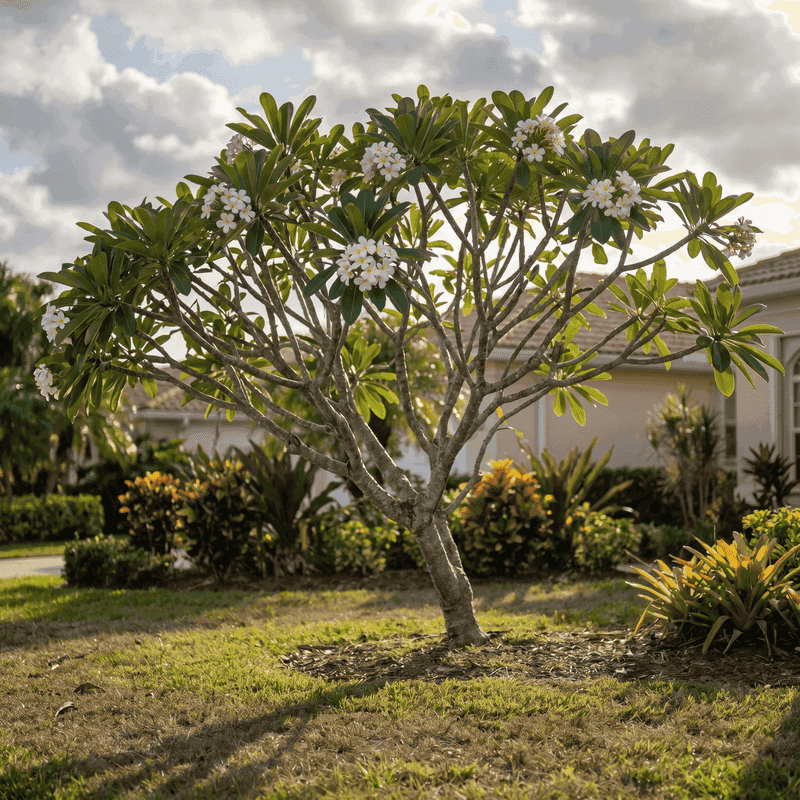
Here is where a lot of well-meaning advice goes sideways.
Someone reads that trees should be pruned before hurricane season and goes after their plumeria with loppers, cutting back branches to reduce wind resistance.
That is not what the guidance actually says, and for plumeria it can cost you the rest of the season’s flowers.
UF/IFAS Extension guidance on preparing trees for hurricanes states plainly that there is no such thing as hurricane pruning.
Topping a plant or indiscriminately thinning the canopy to let wind pass through does not make a plant storm-proof.
It creates large fresh wounds, removes the branch tips that carry plumeria’s flowers, and can actually make the plant structurally weaker by stimulating fast, poorly attached regrowth.
The right approach is selective.
Walk around the plant and look for branches that are already dead, clearly broken, visibly diseased, or attached so weakly that a moderate wind gust would snap them anyway.
Remove those, cleanly and carefully, with sharp tools.
That kind of targeted work reduces genuine hazard without sacrificing healthy flowering growth.
UF/IFAS Lake County Extension and UF/IFAS Polk County Extension both support correcting specific structural defects rather than broad canopy reduction as the sound pre-storm approach for landscape plants.
One firm boundary: if your plumeria has grown large and is positioned near a roof, a walkway, a fence, or a power line, do not try to manage it yourself based on general guidance.
UF/IFAS recommends consulting a qualified professional for specimens that pose a genuine safety risk to structures or people.
That call is worth making before a storm season, not after one.
Adjust The Routine To Your Florida Region
Florida is not one climate, and plumeria care is not one-size-fits-all across 500 miles of peninsula.
Where you garden changes what the late-summer routine actually looks like in practice.
UF/IFAS Extension places plumeria’s best landscape performance mainly in USDA Zones 10B and 11, which covers most of South Florida and the Keys.
If you are in those zones, late summer is full-on growing season, and your main concerns are drainage, storm preparation, and keeping an eye out for rust and caterpillars.
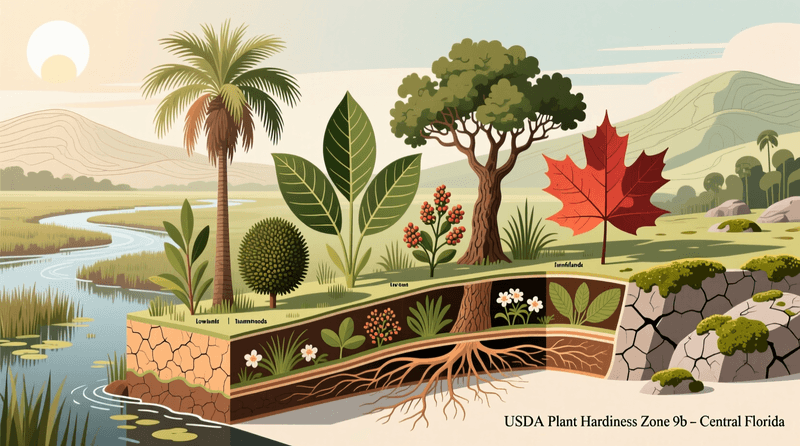
Central Florida sits mostly in Zone 9B, where frost is a real and recurring threat every winter.
Gardeners in Orlando, Tampa, and surrounding areas are wise to grow plumeria in containers that can be moved indoors or into a garage when cold snaps arrive.
Do not assume that Central Florida’s winters are mild enough to leave a plumeria in the ground unprotected every year.
UF/IFAS frangipani resources support container growing as a practical strategy for frost-prone areas of the state.
North Florida and the Panhandle face greater freeze risk still, with some areas reaching Zone 8B.
An in-ground plumeria in Pensacola or Tallahassee is a gamble most winters.
A container that moves to a protected space from November through March is a much safer investment.
South Florida and the Keys are generally warmer and more stable, but variable weather still happens.
UF/IFAS Miami-Dade landscape references note that year-round growth or partial evergreen behavior applies to some species and cultivars, particularly Plumeria obtusa and Plumeria pudica, not to all plumeria types.
Many Plumeria rubra varieties still drop leaves during the cooler months even in South Florida.
Along both coasts, salt exposure adds another layer of concern.
UF/IFAS lists frangipani among salt-tolerant plants for South Florida, but that tolerance is relative.
Rinsing salt deposits off foliage with fresh water after a heavy onshore wind event is cautious maintenance worth doing, as long as you do it in the morning so leaves dry before nightfall.
Wherever you garden in Florida, the core routine stays the same: protect healthy branch tips, check moisture before watering, inspect the plant regularly, and get storm preparations done before conditions develop.
The rest is adjustment for your zip code, and the honest truth is that extreme weather remains outside any gardener’s control no matter how well the routine is executed.