
The Familiar Pennsylvania Vine You Should Cut Out Now Before It Weakens Your Trees
Follow us on Google
Walk around a Pennsylvania yard on a cool October morning and you might spot it right away, a glossy green vine climbing your oak or maple like it owns the place.
That vine is English ivy, and many homeowners have let it grow for years because it looks tidy and stays green all winter.
The trouble is that dense, unchecked ivy can quietly weaken your trees, shade out branches, and add risky weight to the canopy before you ever notice a problem.
Fall is a practical time to cut it back, and this guide will show you exactly how.
Identify English Ivy Before You Act
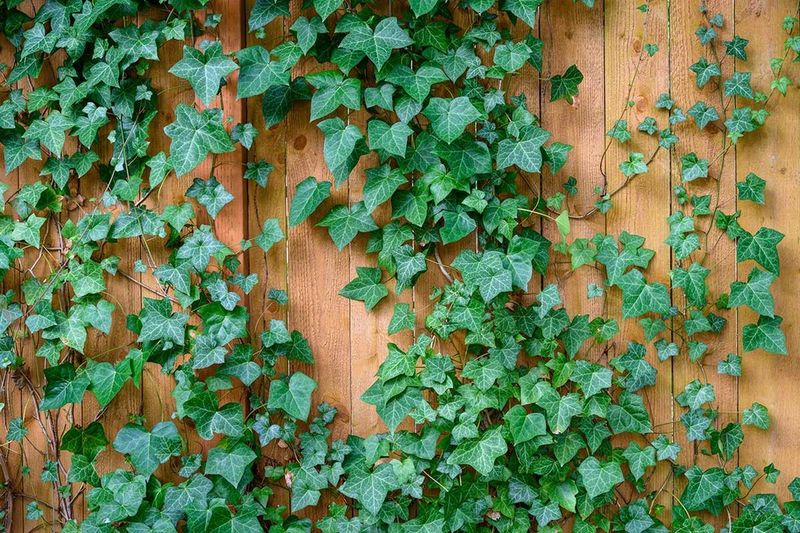
The vine climbing your backyard oak might be English ivy, Hedera helix, and knowing that for certain before you grab pruners matters more than most people realize.
Pennsylvania DCNR’s invasive plant fact sheets identify English ivy among the non-native plants capable of smothering native vegetation on state lands, which tells you something about how aggressively it spreads once it gets going.
Look for waxy, dark green leaves that stay on the plant all winter.
Juvenile growth, the kind you will see climbing a trunk or spreading across the ground, typically produces leaves with three to five pointed lobes, a little like a small maple leaf with a glossy finish.
Older growth near the top of a tree or on a long-established stem can shift to rounder, unlobed leaves, and a truly mature plant may develop small greenish-white flowers and dark berries in fall.
The plant climbs using tiny root-like structures called aerial holdfasts, not twining tendrils.
Run your hand along the stem and you will feel how firmly those holdfasts grip the bark.
University of Maryland Extension’s English ivy profile describes this attachment method clearly, and it explains why pulling a climbing vine straight off a trunk is a bad idea.
Before you touch any vine, make sure it is not poison ivy, Toxicodendron radicans.
Poison ivy generally has three leaflets per stem, not the single lobed leaf of English ivy, and older poison ivy stems can look fuzzy or rope-like.
National Park Service guidance on poison ivy notes that urushiol, the oil that causes poison ivy’s notorious rash, is present in live and dead material alike.
English ivy can irritate skin and is toxic if eaten, but it does not carry urushiol.
Wear gloves either way and identify the plant carefully before you start.
Understand the Real Tree Risk
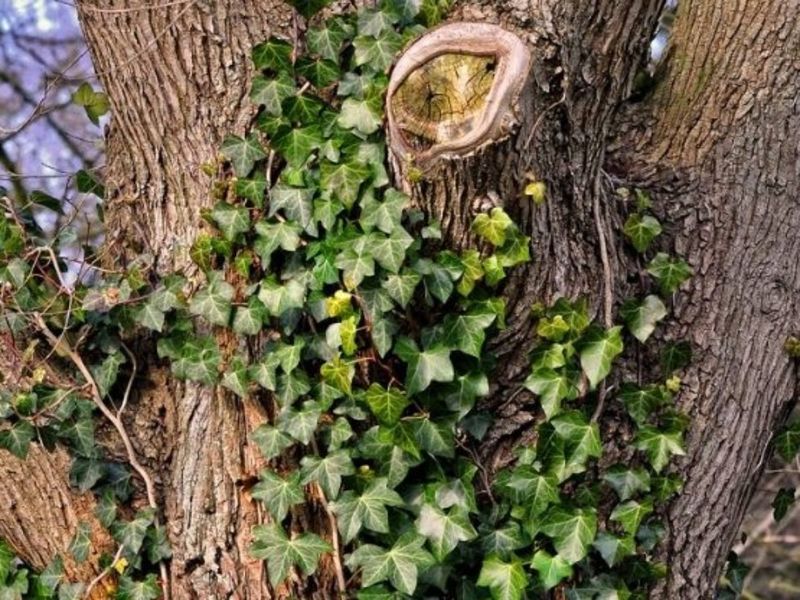
English ivy does not strangle a tree the way a boa constrictor would, and getting that picture right helps you make smarter decisions about removal.
University of Arkansas Extension’s English ivy overview is direct on this point: the vine is not parasitic, does not feed on a tree’s sap, and does not normally constrict a trunk the way a twining vine can.
The real risk is more like a slow accumulation of disadvantages.
Dense ivy foliage in the canopy shades lower branches, and branches that cannot photosynthesize eventually die.
Thick mats of ivy climbing high add real weight, which becomes a serious problem when a Pennsylvania winter piles on ice or wet snow.
The vine’s aerial holdfasts also press moisture against bark and make it harder to spot decay, cracks, or pest damage during a routine inspection.
The U.S.
Forest Service’s species review of Hedera helix notes that ivy-associated tree failure is especially a concern where trees are already weak or where several ivy stems cover the trunk.
That same review acknowledges that impacts may be less severe in parts of the northeastern United States than in some other regions, so the threat is real but conditional, not a death sentence for every healthy tree with a few vines at its base.
A young, vigorous red oak with a handful of low ivy stems is in a very different situation from an aging silver maple covered trunk to canopy in a thick green coat.
Penn State Extension’s weed management guidance notes that unchecked English ivy can kill tree branches, which is a precise and defensible way to describe what dense canopy growth actually does over time.
Inspect the Tree and Choose a Safe Window
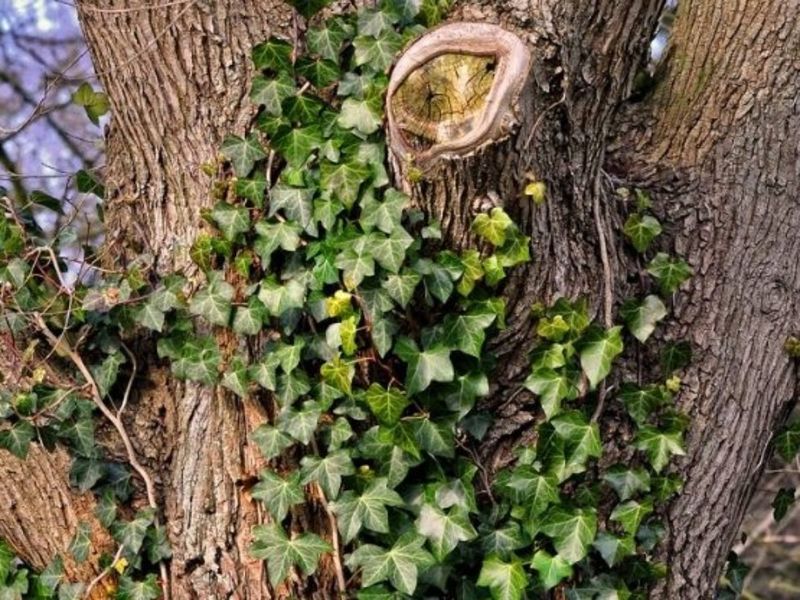
Before any cutting starts, spend five minutes walking around the base of the tree.
Look at the trunk from the root flare up to about 8 feet, check for deep cracks in the bark, leaning limbs, or spots where the wood looks discolored or soft.
Scan the ground around the root flare for any exposed roots that could be damaged if you dig.
Then look up and honestly assess how high the ivy has climbed and whether any large dead branches are hanging above the area where you would be working.
Penn State Extension’s guidance on when to call an arborist is clear: if branches are dead or hazardous, bark is deeply cracked, the tree leans, or you cannot reach the work safely from the ground, call a qualified arborist before you pick up a tool.
Ground-level cutting with hand pruners, loppers, or a hand saw is reasonable for most homeowners.
Climbing the tree, using a chainsaw overhead, or working directly below a large dead branch is not.
Fall is a genuinely practical window for this work in Pennsylvania.
Penn State Extension’s Forest Snapshot recommends cutting woody invasive vines during the non-growing season, when the plant is not actively pushing new growth.
That said, fall is not one fixed date across the state.
A yard in the Poconos or the northern tier may see hard frost weeks before the Delaware Valley does, and a site at higher elevation in the Laurel Highlands can experience early ice and freeze-thaw cycles that make footing unstable.
Work when ivy growth has slowed, temperatures are comfortable, the ground is firm, and no storm is expected.
Your local conditions are the real calendar, not a statewide rule.
Cut the Vines Instead of Pulling Them
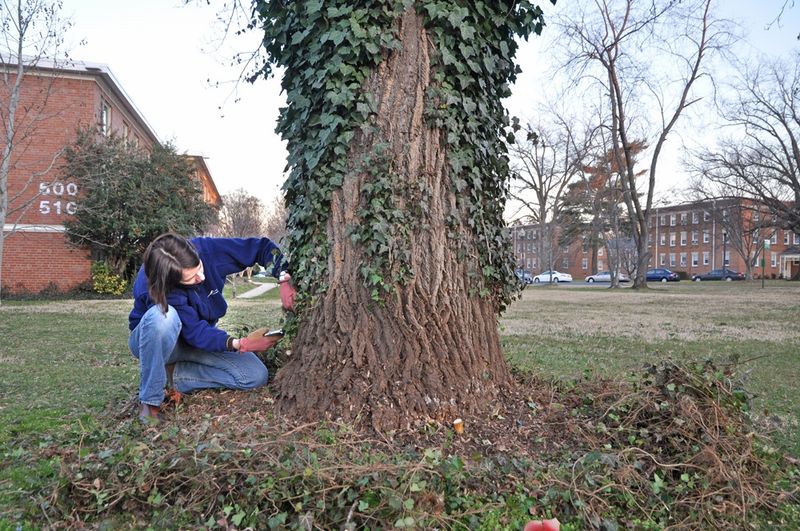
Here is where a lot of well-meaning homeowners make a costly mistake.
They grab a thick ivy stem and yank, tearing bark from the trunk and sometimes pulling loose a dead branch from above.
The correct move is to cut, not pull, and the sequence matters.
Work your way around the base of the tree and cut every ivy stem as close to the ground as you can reach, using hand pruners for stems thinner than about three-quarters of an inch and loppers or a hand saw for anything thicker.
Then make a second cut several inches to about 1 foot above the first.
That gap, sometimes called a window cut, gives you a clear visual confirmation that the vine has been severed and creates a section you can remove from the soil without disturbing the upper growth.
University of Maryland Extension’s woodland ivy guide recommends creating an ivy-free band roughly 3 to 4 feet above the ground where practical, which gives the bark a chance to dry and makes future inspections much easier.
Once the stems are cut, remove the lower rooted sections and pull them gently from the soil only when they come away without gouging the trunk, root flare, or surface roots.
If a root is tangled around a surface root or pressed against the bark, cut it free rather than wrestling it out.
Ask Extension’s English ivy on trees answer is explicit: do not yank vines from bark, and do not pull large dead growth down from the canopy.
Leave every vine above your cut in place.
The upper growth will die once it loses its connection to the soil, and it will eventually fall on its own.
Pulling dead vines downward risks tearing bark, dislodging compromised branches, and putting you directly beneath falling material.
Patience here is the safer and smarter choice.
Dig Out Ground Mats and Expect Regrowth
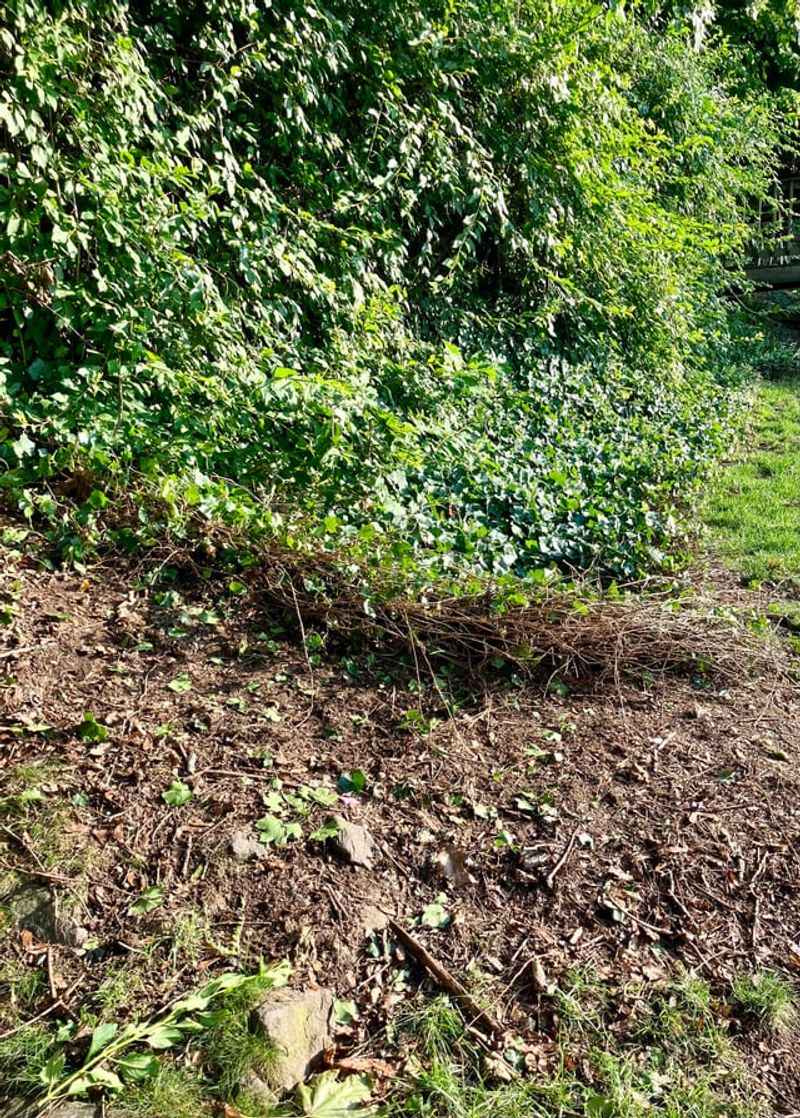
Cutting the vines at the tree base solves the immediate canopy connection, but the ground mat is a separate problem with its own rules.
Many Pennsylvania yards have English ivy spreading across 20, 30, or even 50 square feet of a shrub bed or woodland edge, and that mat will not disappear just because you cut the climbing stems.
For smaller patches, hand-pulling and digging are genuinely effective, especially after a rain when the soil is moist and roots release more easily.
The key is to remove rooted sections rather than simply snipping the leaves or runners at the surface.
Penn State Extension’s English ivy in the landscape guide notes that cut stems can root and resprout, which means a quick trim creates the illusion of progress without actually reducing the patch.
Work in sections about 3 feet wide so you can see what you have cleared.
Pull runners carefully away from the base of any desirable shrubs, a spicebush or mountain laurel, for example, where ivy runners love to hide under low branches.
Lift rooted nodes completely rather than snapping the stem and leaving the root behind.
Plan to come back.
One removal pass rarely ends an established English ivy patch.
University of Maryland Extension’s invasive woodland ivy resource and related guidance both make clear that follow-up checks and repeat removal sessions are a normal part of managing this plant, not a sign that you did the first pass wrong.
Mark the area and revisit it in 4 to 6 weeks, then again in early spring when new growth is easiest to spot and pull.
Dispose of Ivy Without Spreading It
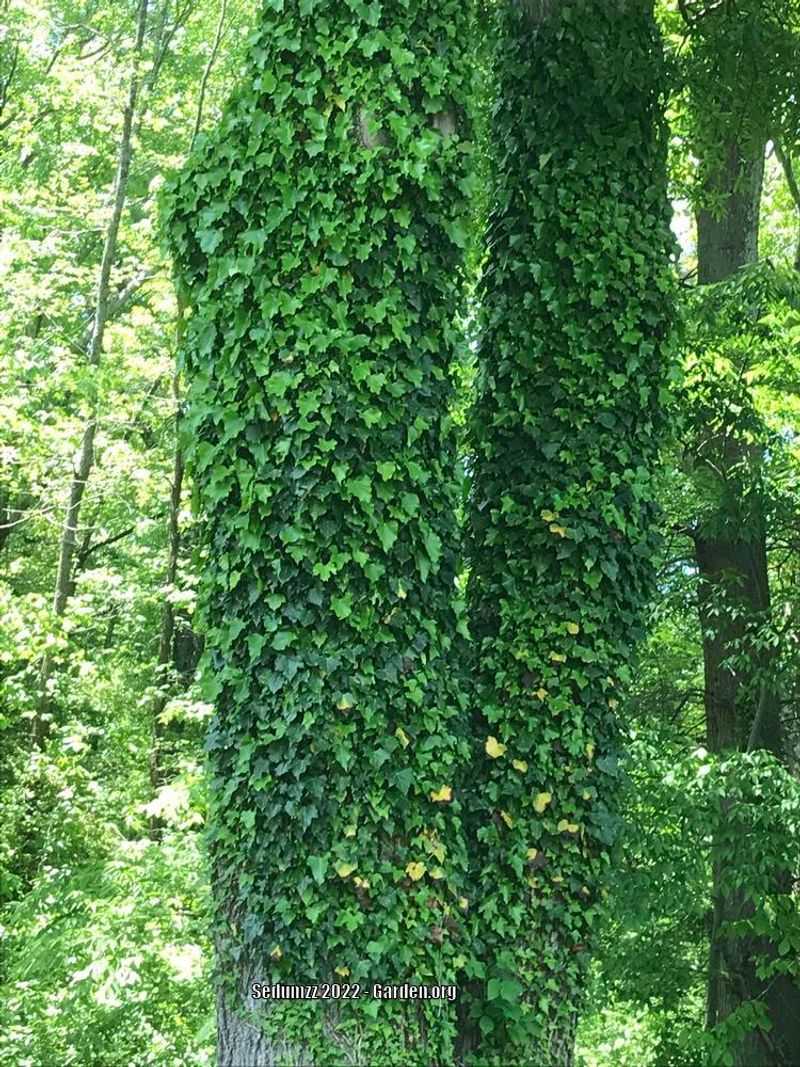
Removed ivy has a frustrating habit of starting a new patch wherever you drop it.
A stem with a node can root in a pile of mulch, along a drainage edge, or in the leaf litter at the back of a shrub bed, and within one growing season you have a new problem 10 feet from where you started.
Penn State Extension’s invasive plant disposal guide is straightforward: bag viable stems, rooted pieces, and any fruit in sealed plastic bags, then use a designated invasive-plant disposal site when one is available in your area.
Do not place material with viable stems, roots, or berries in ordinary compost.
Home compost piles rarely reach the sustained temperatures needed to kill viable plant fragments, and the risk of spreading a new patch through finished compost is real.
Mature English ivy plants can flower and produce dark berries that birds carry to new locations.
National Park Service ecological threat guidance documents this dispersal pattern as one of the reasons ivy spreads so effectively into natural areas near residential yards.
If your ivy has berries, bag those separately and seal the bag before moving it.
Burning removed ivy is not a universal solution.
Local ordinances in many Pennsylvania municipalities restrict open burning, and smoke from mixed plant material can carry its own hazards.
Bagging and sealing, or using a designated disposal route, is the safer general approach for most homeowners across the state.
Use Herbicide Only for Persistent Regrowth
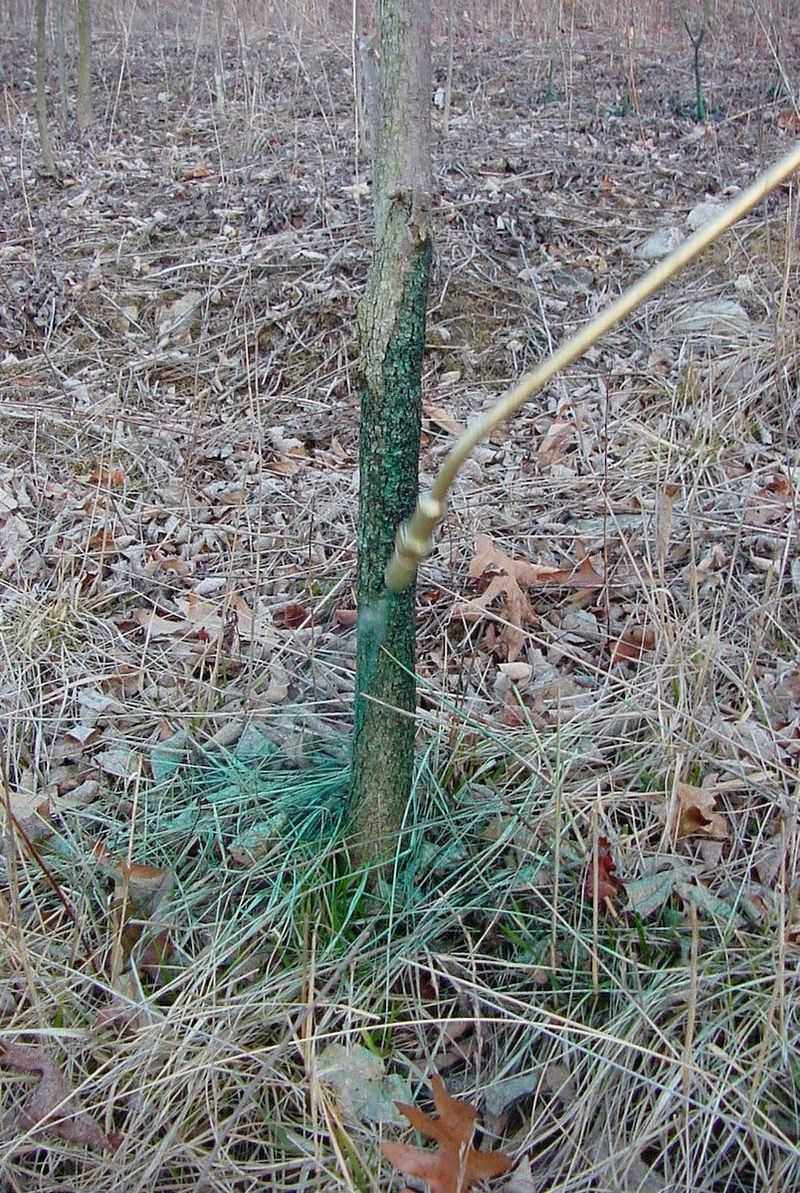
Herbicide is not the first tool to reach for, and for many Pennsylvania homeowners doing a fall removal, it will not be necessary at all.
Mechanical cutting and digging, done carefully and followed up consistently, can manage English ivy without any chemical involvement.
But if a patch keeps resprouting after two or three removal passes, a targeted herbicide application may help.
Penn State Extension lists glyphosate and triclopyr as possible options for treating young English ivy regrowth or for direct cut-stem application, where you paint or apply the product directly to a freshly cut stem surface.
Young, actively growing ivy is more susceptible than the older, waxy foliage on an established mat.
Neither product is a guaranteed fix, and neither should be used without reading the label first.
The product label is the legal document that controls where, how, and at what rate a pesticide can be used.
EPA’s pesticide label guidance explains what that label must contain and why following it is required by law, not optional.
Confirm that English ivy or woody vines are listed on the product label before you open the container.
The EPA’s pesticide labels resource can help you locate and read a label before purchase.
Keep any application targeted and away from the bark, exposed roots, desirable shrubs, garden plants, streams, and ponds.
Spraying ivy foliage through a canopy is not safe around a tree you want to keep.
Do not improvise mixtures or exceed label rates.
Penn State Extension’s poison ivy safety guide warns explicitly that mixing bleach with vinegar can release chlorine gas, and household detergents are not plant-safe herbicides.
That warning applies equally to English ivy removal.
Stick to labeled products, apply them precisely, and treat herbicide as one layer of a broader removal plan, not a standalone solution.
Monitor the Site and Call for Help When Needed
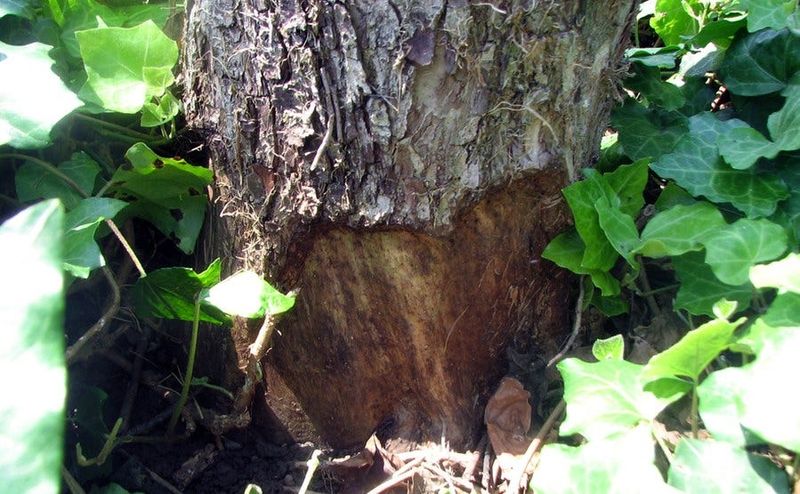
Cutting and digging in fall gets you most of the way there, but the work is not finished when you seal the last bag.
English ivy is persistent, and a well-established patch has rooted sections spread across more soil than a single removal session can fully reach.
Mark the tree on a simple calendar and plan to inspect it again in 4 to 6 weeks, then once more when growth resumes in spring.
New runners are easiest to remove when they are young and shallow-rooted, usually in early spring before they have had a chance to anchor deeply.
Check the base of the tree, the edges of any shrub beds nearby, and any fence lines or woodland borders where removed material may have been dropped or dragged.
Penn State Extension notes that even ivy kept strictly as low groundcover can eventually send runners up a nearby fence or trunk, so containment without active monitoring is not a long-term strategy.
As the seasons pass, look up.
High dead vines that were left in place after cutting will eventually fall, but some may hang in the canopy for a year or more.
University of Maryland Extension and Pennsylvania DCNR both flag the ongoing management commitment that comes with established English ivy, and that includes watching for dead branch hazards as the upper vines dry out.
English ivy can also serve as a reservoir host for bacterial leaf scorch, a disease that affects oaks, maples, and elms.
Removing ivy from your yard may reduce one potential reservoir, but it does not guarantee the disease will not reach your trees from other sources, so treat that as a secondary benefit rather than a promise.
One careful cut breaks the vine’s grip on your tree, repeated monitoring keeps it from coming back, and that combination is genuinely within reach for most Pennsylvania homeowners this fall.