
The Early Signs Of Spotted Lanternfly North Carolina Gardeners Spot On Plants Before The Bug Itself
Follow us on Google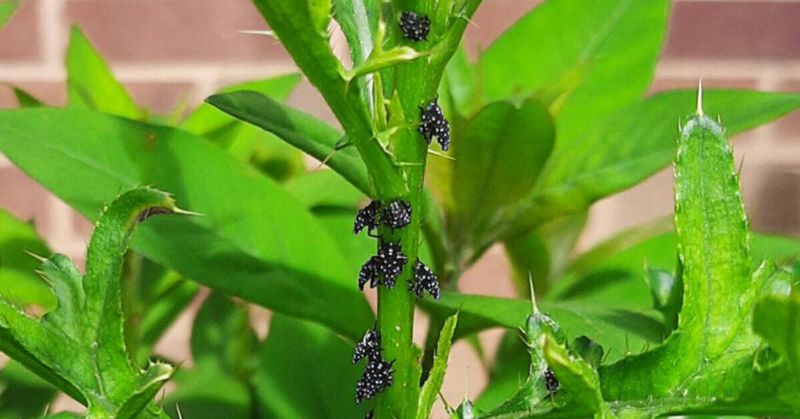
You drag your patio chair into the shade on a June evening and notice the seat is weirdly sticky. The leaves above look shiny, a dark film is creeping across the bark, and something smells faintly like old vinegar.
That combination of clues may be showing up in your yard before you ever lay eyes on a spotted lanternfly adult, and catching it early can make a real difference for your trees and garden.
The First Clue Usually Falls Below the Tree
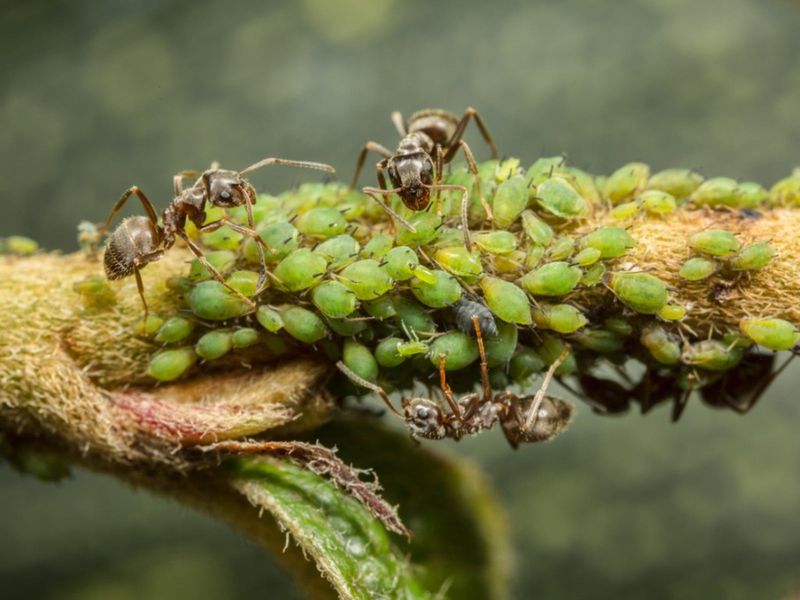
Pull a patio chair out from under your maple or willow on a warm Piedmont afternoon and you may find the seat tacky without any obvious reason. That sticky film is honeydew, a sugary liquid that sap-feeding insects excrete as they drain fluid from plant tissue.
When spotted lanternfly nymphs or adults are feeding in numbers above you, honeydew can rain down and coat leaves, trunks, cars, decks, furniture, and even the groundcover plants growing in the shade below.
According to USDA APHIS spotted lanternfly guidance, this sticky buildup is one of the most homeowner-visible early clues, appearing on surfaces well before many people notice the insect itself. The residue can also carry a faint fermented or vinegar-like odor when it begins to break down, which is another signal worth tracking.
Once honeydew accumulates, a black fungus called sooty mold moves in. As NC State Extension explains in its sooty molds guide, the fungus grows on the sugary residue rather than feeding directly on the plant.
A light coating is mostly a cosmetic nuisance, but heavy growth can cover leaves entirely, cut off sunlight, stain hard surfaces, and harm understory plants that depend on filtered light reaching them.
None of this is a diagnosis. Aphids, scales, whiteflies, and other sap-feeders also produce honeydew, and any of them can trigger the same black mold.
What the sticky film and dark coating actually do is tell you to look closer, not reach for a spray bottle. NC State’s nursery IPM guidance consistently frames honeydew and mold as reasons to inspect, not reasons to conclude.
Small Nymphs Explain the Missing Adult
Here is where the headline needs a small correction, because it matters for how you scout. Feeding damage cannot appear before the insect begins feeding, so if your tree is dripping honeydew, lanternflies are already on it.
The reason you may not have spotted them yet is that the early nymphs are genuinely easy to miss.
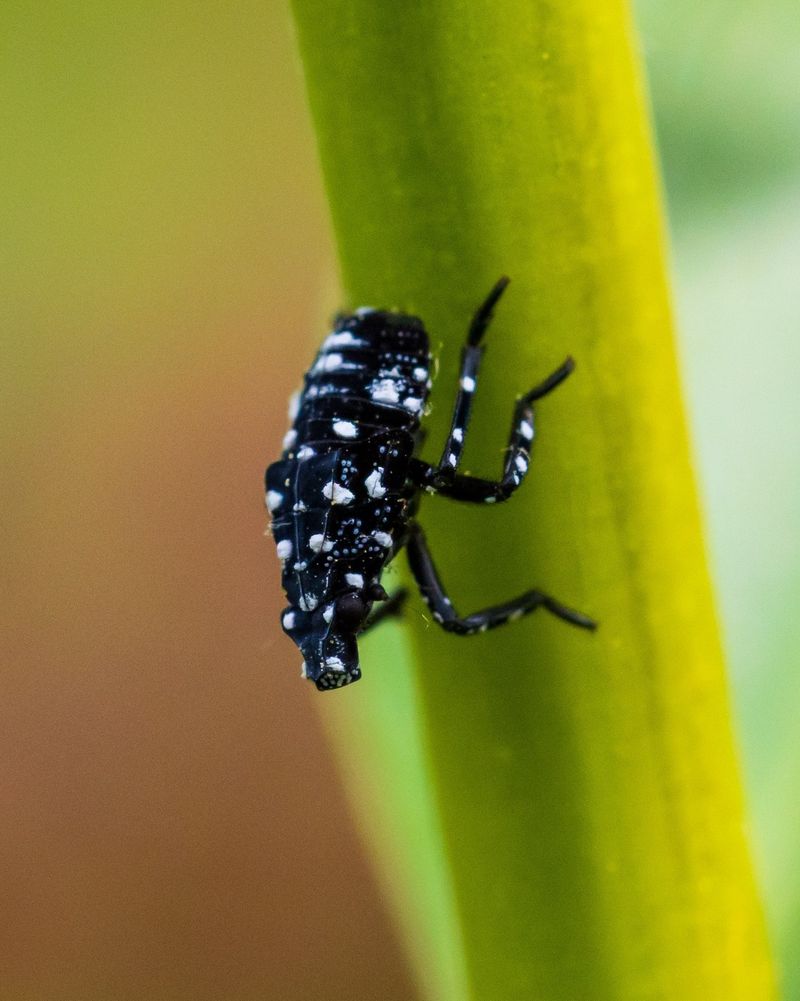
According to NC State Extension’s integrated pest management guide for nurseries, early nymphs in North Carolina can hatch as early as late March or early April. At that stage they are only about 1/8 to 1/4 inch long, black with white spots, and they move fast.
They tend to feed in clusters on herbaceous plants and small woody stems before migrating upward into tree canopies as they grow, which puts them out of easy eye level for most of the spring.
Later nymphs reach about 1/2 inch and shift to a striking red, black, and white pattern that is easier to see once you know what you are looking for. Adults, which appear later in the season and run roughly 1 inch long, are the ones most people recognize from news photos: gray-brown spotted forewings, and when the wings open, a flash of bright red underneath.
Those adults are conspicuous. The nymphs that preceded them by weeks were not.
So the practical takeaway is this: you may notice sticky residue or plant stress before you notice an adult lanternfly, but feeding has already begun and small nymphs are likely already present. USDA APHIS notes that the insects can congregate on trunks and upper stems in ways that are easy to overlook until populations grow.
Your job is to look before the adults become impossible to miss.
Plant Stress Tells You to Look Closer
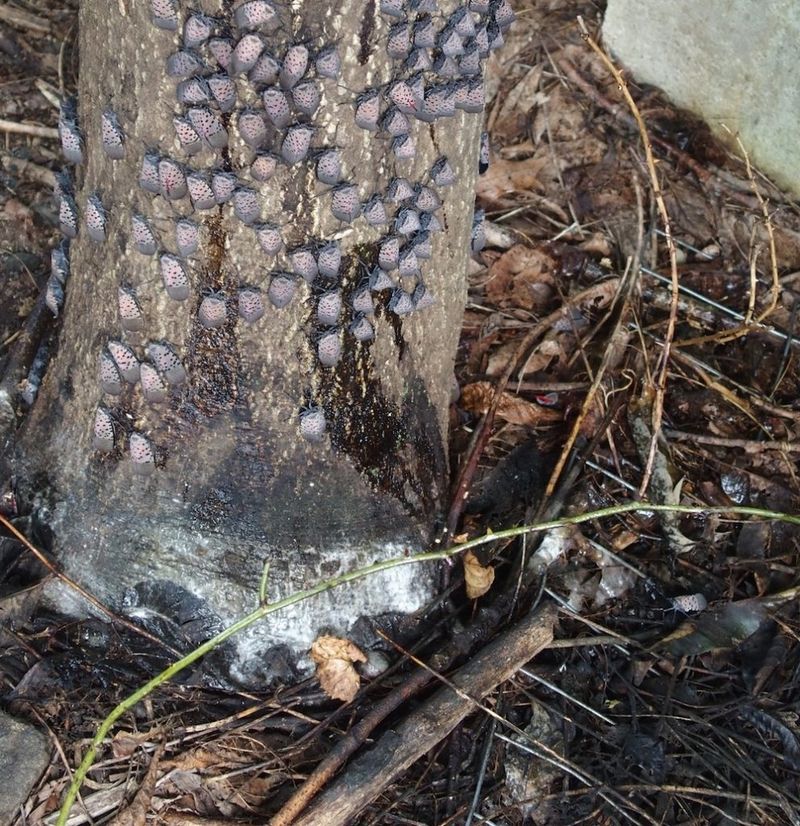
Beyond the sticky mess, spotted lanternfly feeding can push plants into visible distress. Wilting at the branch tips, oozing or weeping sap on the trunk, reduced new growth, and localized sections of dieback are all possible effects when populations are heavy enough to drain significant plant fluid.
NC State Extension’s spotted lanternfly page notes that in rare cases young or not-yet-established plants have died under heavy feeding pressure, while broader damage tends to show up as stress and reduced vigor rather than sudden collapse.
The sooty mold that follows honeydew adds another layer of indirect harm. Dense mold coverage blocks sunlight from reaching leaf surfaces, which slows photosynthesis and can weaken understory plants growing beneath a heavily infested tree.
That harm is real, but it is worth separating from the direct feeding damage, because the two call for different responses.
Here is the honest complication: drought, poor planting conditions, disease, storm damage, and a long list of other pests can produce the same wilting, sap ooze, and dieback you might attribute to lanternfly. The Piedmont’s summer heat and stretches without rain put trees under stress every year without any insect involvement.
NC State’s nursery IPM guidance and Penn State’s management guide both emphasize that host species, insect density, plant age, and existing stressors all shape how much damage actually occurs.
A few lanternflies on a healthy, established maple, dogwood, or azalea are unlikely to kill it. The plants most at risk are grapevines, young saplings, and trees-of-heaven under heavy infestation.
Plant stress signals are a reason to inspect more carefully, not a reason to assume the worst before you have confirmed the insect.
Where to Scout First
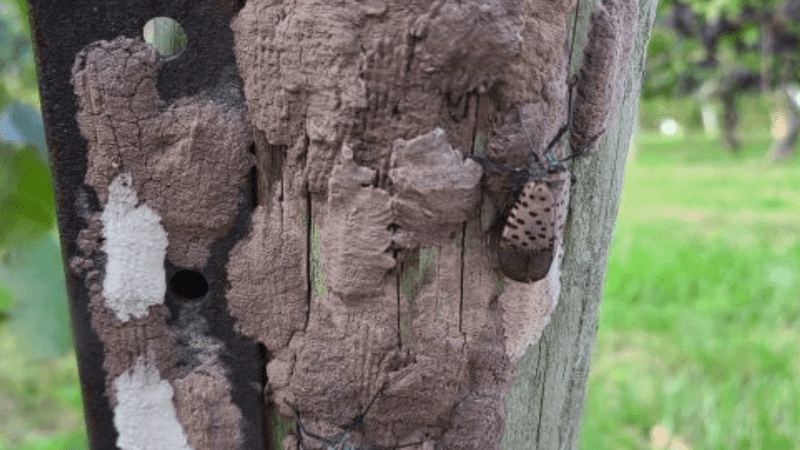
Knowing that something is wrong is one thing; knowing where to look is what turns a hunch into actual information. Start with the trunks and upper stems of trees in the area where you noticed the sticky residue or mold.
Spotted lanternfly nymphs and adults tend to congregate on trunks, particularly in the evening when they move down from the canopy to feed at lower levels.
USDA APHIS identifies tree-of-heaven (Ailanthus altissima) as a favored host and a productive place to start a search, but the insect feeds on a wide range of plants including grapes, stone fruits, apples, maples, walnuts, willows, and many woody ornamentals common in North Carolina yards. Do not limit your search to one species.
After the trunks and new growth, check the groundcover and any plants growing directly beneath the trees you are investigating. Honeydew falls, so a sticky understory plant can point you toward activity in the canopy above it.
Then look outward to smooth nearby surfaces: bricks, stones, fences, the grill cover, lawn furniture, vehicles parked in the driveway, and any equipment stored near the trees. NC State’s nursery IPM guidance notes that egg masses can be deposited on almost any hard surface, not just tree bark, which means a fence rail or trailer hitch can harbor them just as easily as a walnut trunk.
A sticky area beneath a tree is a useful starting point, not a verdict. Work outward from the drip zone, check both sides of leaves and stems at multiple heights, and resist the urge to treat every surface you find until you have actually confirmed what is causing the problem.
Scouting takes twenty minutes. Undoing a rushed pesticide application on a blooming plant takes much longer.
Identification Turns Suspicion into Evidence
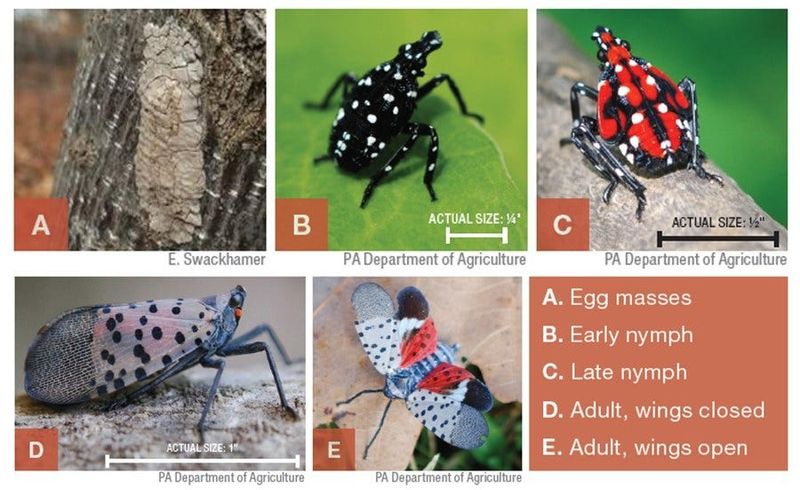
Sticky leaves and black mold give you a reason to look. What you actually find during that inspection is what turns a suspicion into something you can act on or report.
Spotted lanternfly has a distinctive appearance at every life stage, and matching what you see to a description is the step that separates a confirmed sighting from a false alarm.
Early nymphs run roughly 1/8 to 1/4 inch long, black with small white spots, and they are genuinely easy to confuse with other tiny insects if you only glance. Later nymphs reach about 1/2 inch and show a bold red, black, and white pattern that is harder to mistake.
Adults are close to 1 inch long, with gray-brown forewings covered in black spots. When an adult opens its wings, the red hindwings with black spots and a white band become visible.
USDA APHIS and NC State Extension’s nursery IPM guide both describe these stages consistently.
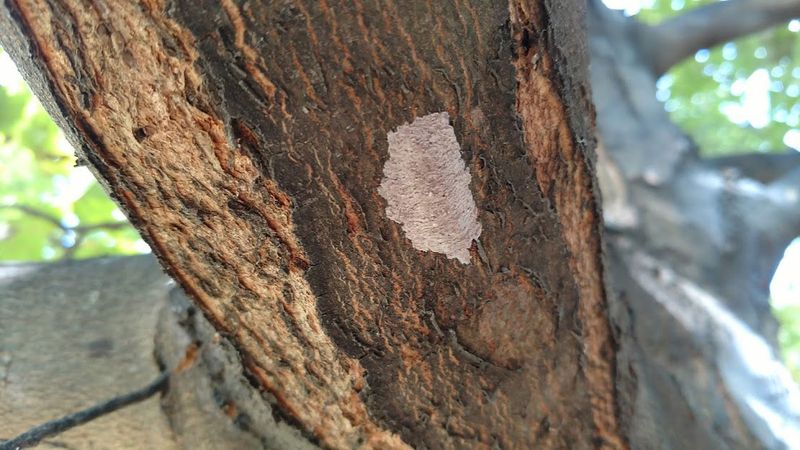
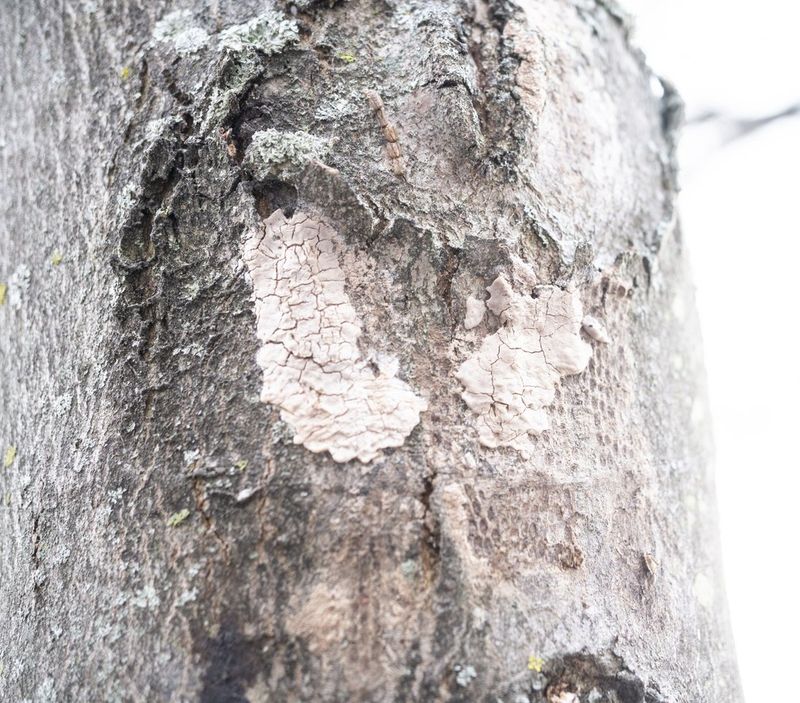
Egg masses are another confirming sign. A fresh mass looks like a smear of gray putty, roughly 1 inch long, sometimes with a cracked or waxy surface.
An older mass dries to look more like brown mud. Each mass holds approximately 30 to 50 eggs arranged in rows beneath a coating.
They can appear on bark, bricks, stones, fences, or outdoor furniture.
The USDA APHIS spotted lanternfly lookalike guide is worth bookmarking, because several native moths and planthoppers can fool a quick look. Black mold alone cannot identify this pest, and neither can sticky residue.
If you find something that matches the description and you are outside a known established area in North Carolina, photograph it with a coin or ruler in the frame for scale before you remove or disturb anything. Record the date and your exact location.
That photograph is what makes your report useful to the people tracking the spread.
North Carolina Timing Changes the Next Move
Knowing what the insect looks like matters less if you are searching in the wrong season for the wrong stage. North Carolina’s warm springs and long humid summers create a fairly predictable window for each life stage, though weather and local conditions can shift things by a few weeks in either direction.
Based on NC State Extension’s nursery IPM calendar, a practical scouting framework runs like this: egg masses are present from roughly September through March, so winter is a productive time to check trunks and hard surfaces even when the yard looks quiet. Early nymphs can hatch as early as late March or early April and feed through June.
Later nymph stages and movement into tree canopies happen from June through July. Adults are active from June through November, with August and September being peak adult monitoring months.
Egg laying begins again in October and continues through November.
The timing matters because egg-mass removal in winter and early spring targets the pest before it hatches, while summer scouting focuses on nymphs and adults on trunks and in the canopy. Matching your search to the right stage saves time and helps you find what is actually there.
On February 10, 2026, NCDA&CS confirmed established populations in Davidson, Rowan, and Caswell counties, bringing the state total to seven counties including Forsyth, Guilford, Rockingham, and Caldwell. If you live in or near those counties, your scouting is especially timely.
If you live elsewhere in the state and find something that looks like a match, NCDA&CS reporting guidance and your county Cooperative Extension office are the right contacts. Reports from outside established areas are exactly how agencies track where the pest is moving next.
Confirm First, Then Choose the Lightest Response
Finding a sticky tree or a patch of black mold does not mean your yard needs a pesticide application. The first response is always confirmation, and the second is a scouting count that tells you how heavy the pressure actually is before you decide anything else.
If you find an egg mass, USDA APHIS guidance says to scrape and smash it into a sealable plastic bag containing hand sanitizer or rubbing alcohol, close the bag, and put it in the trash. Before you scrape, photograph it with a coin or ruler in the frame, especially if you are outside a known established county.
That image is your record for reporting and helps extension staff verify the find.
For living insects, Penn State Extension’s management guide makes clear that not every tree needs treatment. Healthy, established landscape trees may tolerate moderate feeding without lasting harm, and treatment decisions should weigh both the size of the population and the vulnerability of the plant.
Young vines, grapevines, and newly planted trees deserve more concern than a mature shade tree with a few insects on it.
Tree-of-heaven is a useful scouting landmark because spotted lanternfly is strongly attracted to it, but removing one tree is not a reliable control strategy. Penn State’s management guide supplement notes that host removal has not been fully evaluated as an area-wide control method.
NC State Extension’s tree-of-heaven guidance warns that cutting the tree without treating the stump or root system causes vigorous resprouting, and that the tree is sometimes confused with native sumac or black walnut, so confirm what you have before you cut anything.
When treatment is genuinely warranted, use only a product registered for your specific plant and site. NC State’s nursery IPM guidance lists products by setting, and those settings do not automatically translate from a commercial nursery to a backyard edible garden.
Follow the label exactly. EPA pollinator protection guidance identifies bloom-time restrictions, application timing, and drift reduction as key label protections; do not spray blooming plants unless the label specifically permits it with pollinator-protective directions.
For large trees, systemic treatments, or a heavy infestation, a licensed pest management professional is the safer call. The goal is a measured response that protects your plants without turning a manageable problem into a bigger one for the bees working your garden.