
Kill This Beautiful Spotted Bug On Sight Because It Feeds On 70 Plants And Ruins Your Grapes
Follow us on Google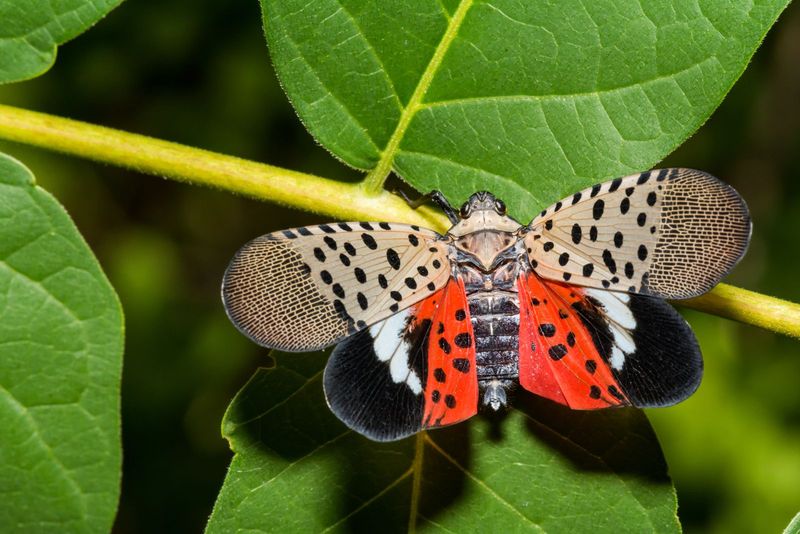
A striking insect with jewel-like wings has been spreading across the eastern United States, and many homeowners who spot it have no idea what they are looking at.
The spotted lanternfly, Lycorma delicatula, is an invasive planthopper recorded feeding on more than 70 plant species, and grapevines rank among its most seriously affected hosts under heavy infestation.
Knowing how to identify it correctly, and what to actually do next, matters a lot more than a simple stomp-on-sight rule.
Identify the Spotted Lanternfly Before You Act
A lot of red-and-black insects pass through a backyard in a single summer, and not all of them deserve the same response.
Before you crush anything, take three seconds to look closely, because the spotted lanternfly has a specific combination of features that no common native insect quite matches.
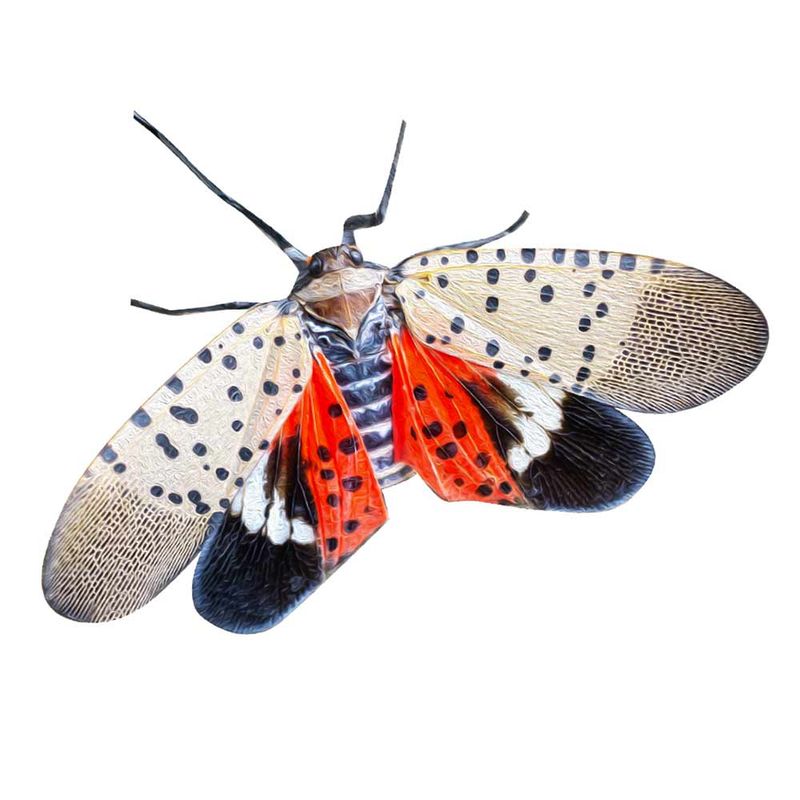
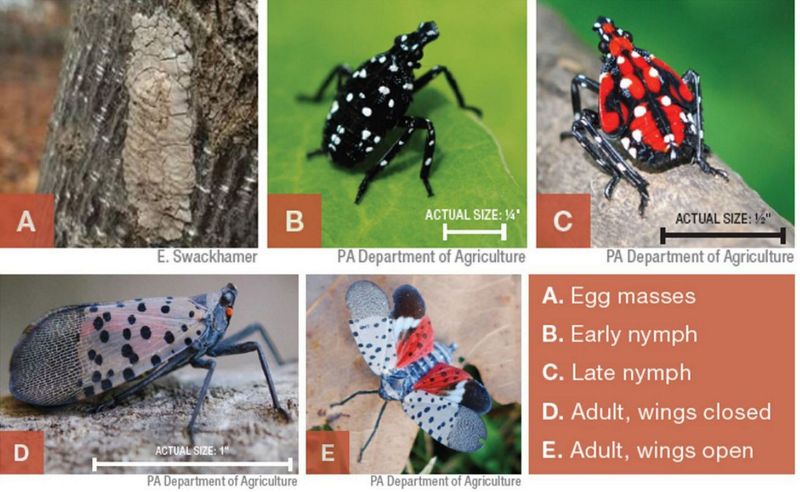
Adult spotted lanternflies are roughly one inch long.
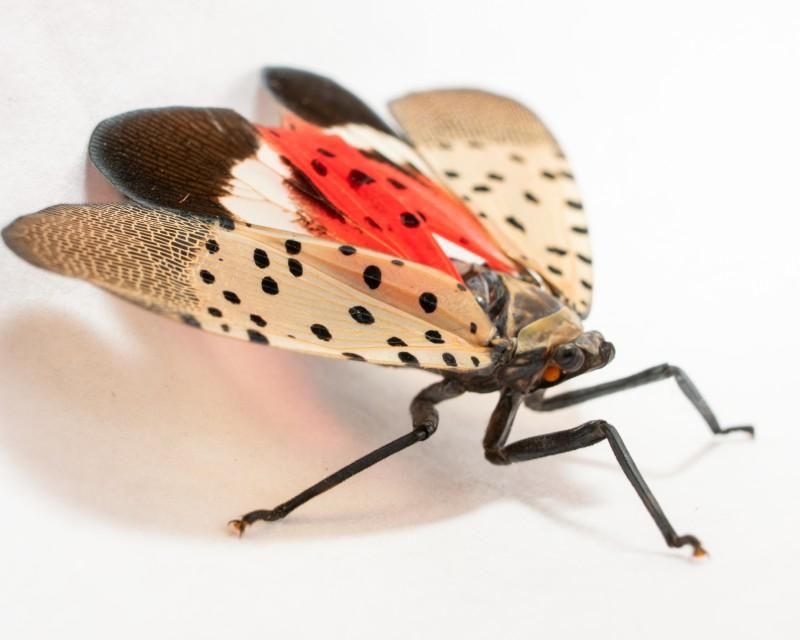
At rest, you see gray forewings covered in bold black spots, which makes the insect look almost like a painted tile.
When the bug is startled or takes flight, it flashes red, black, and white hindwings that are genuinely hard to forget.
According to Penn State Extension’s identification guide, that hidden red wing panel is one of the most reliable field marks for adults.
The younger stages look completely different.
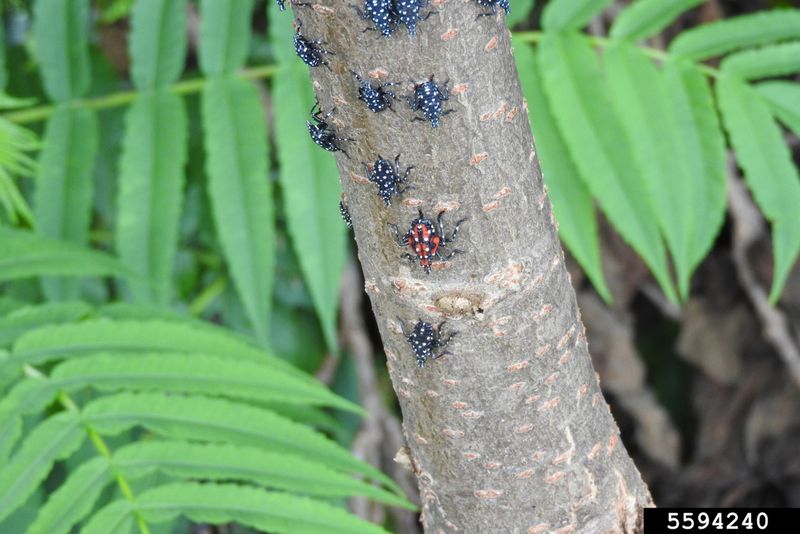
Early nymphs are black with crisp white spots and are roughly the size of a pencil eraser.
Late nymphs, which appear before the final adult molt, are red with black-and-white markings and grow to about half an inch long.
Both stages are distinctive, but they do not look like adults at all.
Native lookalikes exist, particularly among nymphs, so Penn State’s nymph lookalike resource is worth bookmarking before the season starts.
Killing a native beneficial insect by mistake does real harm to your garden’s pest-control network.
Once you have a confirmed spotted lanternfly, stomping it is a safe, low-toxicity action that removes one invasive insect from your yard.
That is genuinely useful, but one stomp cannot protect an entire orchard or stop a regional population.
Think of it as the first move in a longer game, not the whole strategy.
More Than Seventy Hosts Do Not Face Equal Risk
Hearing that an insect feeds on more than 70 plant species sounds alarming, like every shrub and flower in your yard is equally threatened.
The reality is more specific, and understanding the difference can keep you from panicking over a bug on your petunias while missing a real problem on your grapevine.
Spotted lanternfly has been recorded on a wide range of hosts including maples, walnuts, birches, willows, hops, stone fruits, and ornamentals.
But as Penn State’s landscape management guidance explains, host preference and actual damage vary sharply depending on the insect’s life stage, the season, the health of nearby plants, and how large the local population has grown.
Young nymphs feed on many tender plants.
Adults tend to concentrate on certain woody trees and mature vines, especially as summer turns to fall.
Tree-of-heaven, Ailanthus altissima, sits at the top of the preference list.
If you have one growing near your property line, spotted lanternflies will find it.
But tree-of-heaven is not required for the insect to survive and reproduce, so removing it is not a guaranteed fix for a vine or ornamental nearby.
Removing tree-of-heaven also requires care.
Cutting or injuring the tree incorrectly can stimulate aggressive root suckering, which means you may end up with more stems than you started with.
Penn State’s tree-of-heaven control resource recommends consulting your local cooperative extension office or a qualified professional before making removal decisions.
A plan that accounts for suckering and timing will do more good than a chainsaw on a Saturday morning.
Heavy Feeding Can Harm Grapevines Without Ruining Every Harvest
Grapevines are where spotted lanternfly earns its worst reputation, and that reputation is not exaggerated when infestations are heavy.
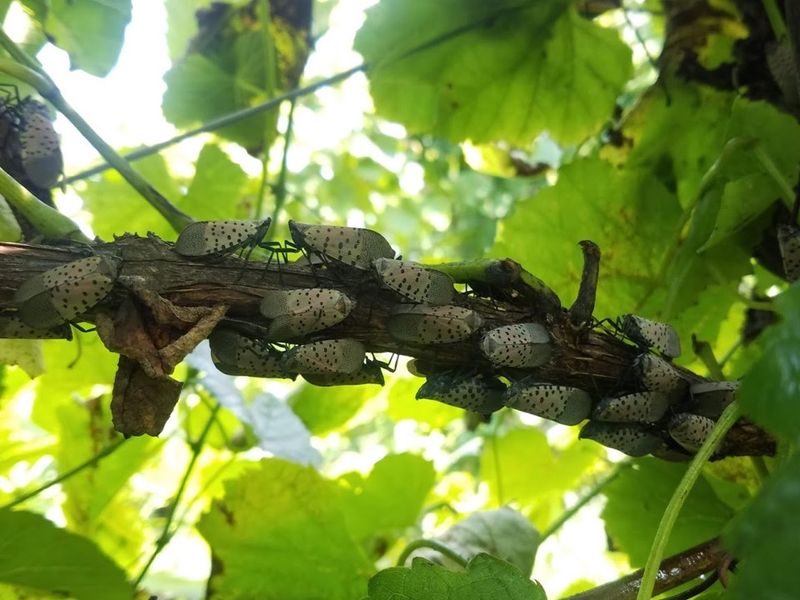
But a single adult on a cane on a Tuesday afternoon is a different situation from a colony of hundreds feeding through August and September.
The insect feeds by piercing plant tissue and drawing out sap.
It does not eat the grapes directly.
What it leaves behind, though, creates its own problem.
As the insects feed, they excrete a sticky, sugary waste fluid called honeydew, which coats leaves, vine trunks, decks, patio furniture, and any plant growing beneath a feeding site.
Honeydew then supports sooty mold, a dark fungal growth that can block sunlight from reaching leaves and reduce the vine’s ability to photosynthesize.
The USDA APHIS spotted lanternfly page describes honeydew and sooty mold as significant nuisance and plant-health factors associated with heavy feeding.
Research published and indexed through PMC on spotted lanternfly grapevine damage exposed vines to densities ranging from 0 to 15 insects per shoot.
At high densities, root starch reserves fell sharply and fruit soluble solids, a measure tied to sugar concentration, declined in Riesling grapes.
Additional work available through PubMed on lanternfly vine stress and the Journal of Integrated Pest Management’s lanternfly vineyard review supports concerns about reduced winter hardiness and, in severe cases, vine survival.
Effects varied between grape varieties and between years in those studies, so the evidence supports a clear heavy-infestation warning without claiming that any single sighting will destroy a harvest.
A few insects feeding briefly may cause little visible harm.
The risk scales with density and duration, which is exactly why monitoring matters.
Check the Insect and Your Local Quarantine
Spotted lanternfly was first detected in the United States in Berks County, Pennsylvania, in 2014.
Since then it has moved steadily outward, and the list of affected states has grown faster than most homeowners expected.
As of the USDA APHIS spotted lanternfly resource page, established populations have been confirmed in 19 states and the District of Columbia, including Connecticut, Delaware, Georgia, Illinois, Indiana, Kentucky, Maryland, Massachusetts, Michigan, New Jersey, New York, North Carolina, Ohio, Pennsylvania, Rhode Island, South Carolina, Tennessee, Virginia, and West Virginia.
That list is time-sensitive.
Quarantine boundaries and confirmed-population maps are updated as new detections are verified, so check current USDA and state guidance rather than relying on any article, including this one, for the latest boundaries.
Before you act on a sighting, confirm what you are seeing.
Go back to the life-stage descriptions: black-with-white-spots for early nymphs, red-with-black-and-white markings for late nymphs, gray spotted forewings and hidden red hindwings for adults.
The Penn State have-you-seen-a-spotted-lanternfly guide walks through each stage with photos.
Native insects and other egg masses can look similar enough to fool a quick glance.
Quarantine rules in many states require residents to inspect and clear vehicles, trailers, firewood, outdoor furniture, and other objects before moving them out of a quarantine zone.
A single egg mass hidden on a camping chair or a log rack can establish a new population miles away.
Reporting a confirmed sighting to your state department of agriculture or through the USDA reporting tool helps track the spread and supports faster local response.
Remove a Confirmed Adult Without Spraying the Yard
You have looked carefully, matched the markings, and you are certain it is a spotted lanternfly on your porch railing.
The good news is that your immediate options are simple, free, and safe for the rest of your garden.
Crush it with your shoe, smash it with a fly swatter, or scoop it into a container of soapy water or rubbing alcohol.
A handheld vacuum works well on clusters resting on a hard surface.
According to University of Maryland Extension’s home garden guidance, these physical removal methods are the appropriate first response for individual insects in a residential setting.
They remove the insect without introducing any chemical into your yard, and they carry no risk to pollinators, birds, or pets.
These methods do have real limits.
Spotted lanternflies can occupy tree canopies 30 or 40 feet up, arrive continuously from neighboring properties, and scatter the moment a shadow passes over them.
Random individual kills are useful, but they are not a substitute for a broader management plan.
Do not spray the yard, the garden bed, or a tree simply because you spotted a suspicious insect.
USDA APHIS guidance and Penn State’s management guide both make clear that broad insecticide applications based on suspicion alone can harm beneficial insects, miss mobile adults entirely, and create risks for pollinators and non-target wildlife.
Positive identification comes first, then a proportionate response.
After you remove a confirmed insect, report the sighting to your state department of agriculture so local tracking records stay current.
Reachable Egg Masses Can Reduce Next Year’s Hatch
An adult spotted lanternfly is easy to see and satisfying to stomp.
An egg mass sitting quietly on your deck railing or the side of your grill can hatch 30 to 50 new insects in spring without anyone noticing it first.
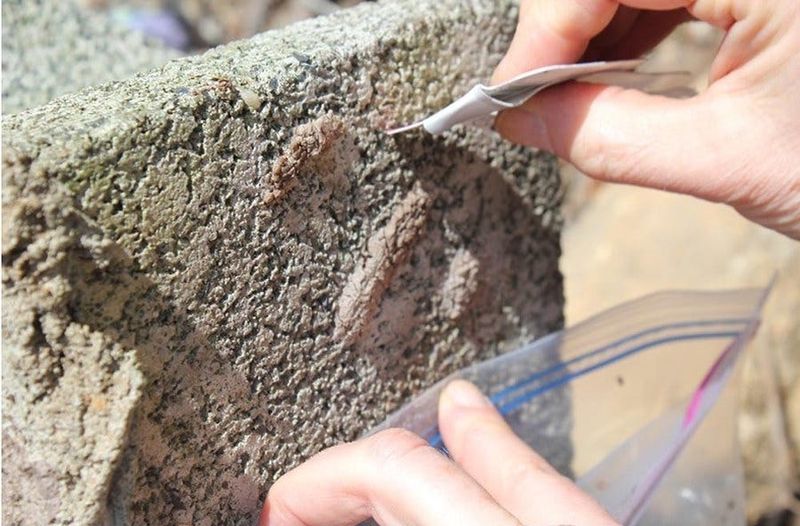
Egg masses are generally 1 to 1.5 inches long and covered with a gray or brown coating that looks a bit like dried mud or old putty.
Older masses lose that coating and show rows of seed-like eggs underneath.
They can appear on tree bark, grapevine trunks, decks, rocks, vehicles, outdoor furniture, firewood, toys, and other hard surfaces.
Spotted lanternflies typically lay eggs from September through December, and those eggs hatch from late April through June.
From September through May, you can scrape reachable masses from hard surfaces using a plastic card or putty knife.
Penn State’s egg-mass guidance and their step-by-step egg removal instructions are consistent: collect the scraped material in a bag or container filled with rubbing alcohol or hand sanitizer, and leave it submerged.
Eggs dropped on the ground can still hatch, so do not just scrape and walk away.
If you prefer to smash rather than scrape, the entire mass must be crushed forcefully to destroy the eggs.
Do not climb a ladder or go up into a tree to reach egg masses.
Penn State research found that less than 2 percent of egg masses on trees were laid at reachable heights of about 10 feet or less.
Removing what you can reach genuinely helps reduce next year’s local hatch, but it will not eliminate a neighborhood population when most eggs are high in tree canopies, hidden on rough bark, or sitting on property you cannot access.
Protect Grapevines With Layered, Wildlife-Safe Management
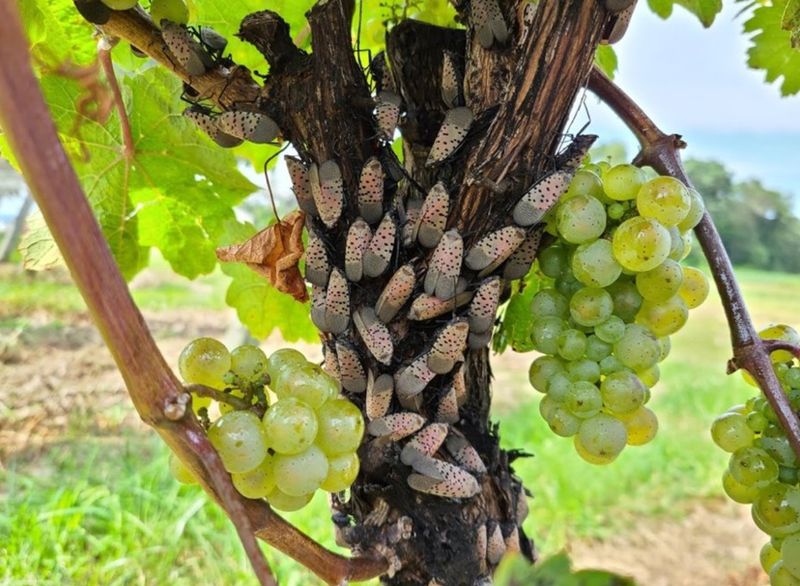
A backyard grapevine or small planting deserves a plan that goes beyond the occasional stomp.
Pulling several tools together, and knowing when each one applies, is what actually keeps a vine productive through a spotted lanternfly season.
Start with weekly inspections while adults are present.
In Pennsylvania, vineyard researchers use August through November as the core monitoring window, though timing shifts with regional temperatures, so treat that range as a useful benchmark rather than a nationwide calendar.
Walk the vine trunks, cordons, and nearby likely feeding sites including any tree-of-heaven, wild grape, black walnut, maple, or willow growing close by.
Commercial vineyards in Pennsylvania use a threshold of roughly 10 to 20 spotted lanternflies per vine as a point at which growers may consider insecticide treatment or exclusion netting, according to Penn State’s vineyard management guidance.
That is commercial guidance designed for professional operations, not a rule that automatically applies to a backyard planting.
A homeowner seeing one or two insects on a single vine is in a very different situation from a grower watching hundreds per plant.
If you consider exclusion netting, it can physically block adults from reaching vines and avoids chemical exposure entirely.
If you consider sticky bands on trunks, know that uncovered adhesive traps can kill birds, squirrels, bats, butterflies, bees, and predatory insects.
Any band must have a wildlife barrier or screen cover, and University of Maryland Extension notes that bands are not a stand-alone control tactic.
Any pesticide applied to grapevines must carry a label that specifically lists grapes as an approved crop.
Penn State’s pesticide safety guidance is clear that the label controls the legal crop, application rate, timing, protective equipment, and preharvest interval.
Do not use homemade sprays or household chemicals, which can burn foliage, harm aquatic life, and kill beneficial insects.
For tree-of-heaven growing nearby, consult Penn State’s tree-of-heaven control resource or your local extension office before cutting.
Before moving your car, gear, or furniture out of a quarantine area, inspect everything carefully.
A stomp matters most when it is one piece of a plan that also includes monitoring, egg destruction, reporting, and the simple habit of checking what you carry.