
Hummingbirds Stop Visiting Feeders For Reasons Most Backyards Never Notice
Follow us on Google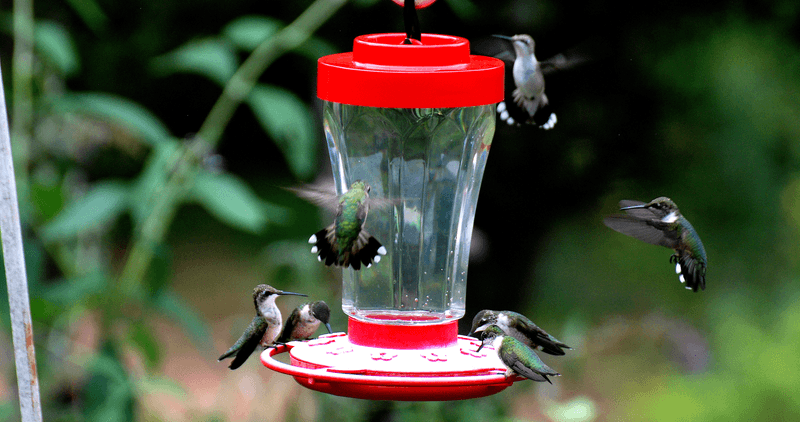
You fill the feeder, hang it in the same spot, and wait.
Then one morning the visits slow down or stop almost entirely, and you start wondering what went wrong.
The feeder looks fine, the nectar is fresh, and yet the little birds that were buzzing around last week seem to have vanished.
Before you assume something is broken, there are several perfectly natural explanations worth checking, and most of them have nothing to do with the feeder itself.
A Quiet Feeder Does Not Prove It Failed
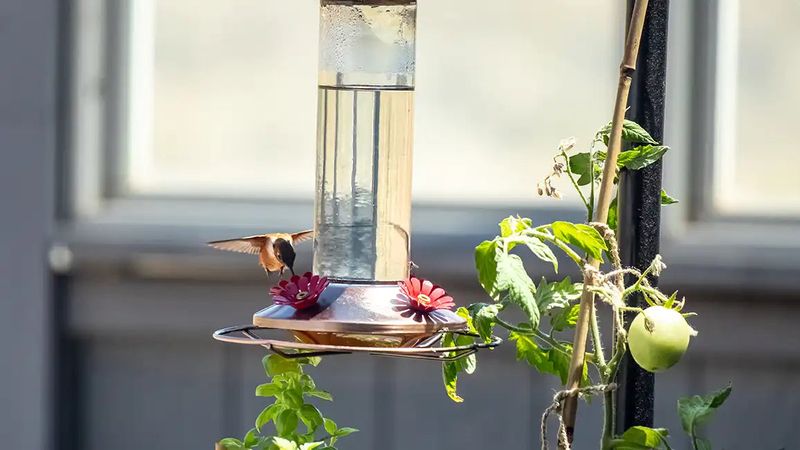
Watching a full feeder go untouched for a few days can feel like a small failure, but fewer visits at one feeder rarely tell the whole story.
Hummingbirds move through a neighborhood the way people move through a grocery store, choosing whatever is most convenient at that moment.
A quiet feeder is a local snapshot, not a report card on the whole yard or the local bird population.
Cornell Lab of Ornithology guidance on feeder visits makes this point clearly: a decline at one feeder does not necessarily reflect what is happening in the wider neighborhood.
Birds may have shifted to flowers two houses over, a neighbor’s feeder, a patch of blooming salvias down the street, or a yard that simply offers better shelter.
The feeder in your yard is one data point, not the full picture.
Rather than changing everything at once, a troubleshooting approach works better.
Start by asking a few layered questions: Is the timing seasonal?
Are there natural blooms nearby competing for the birds’ attention?
Could one aggressive bird be blocking others?
Is the nectar fresh and the feeder clean?
Is the location creating a heat, wind, or safety problem?
Working through those questions one at a time gives you real information to act on.
Cornell’s hummingbird feeding guide recommends checking feeder condition, placement, and natural food availability before assuming the setup has failed.
Some declines call for a small adjustment.
Others reflect seasonal rhythms that require no intervention at all.
Knowing which situation you are in saves time and keeps you from fixing something that was never broken.
Migration And Nesting Can Create A Natural Lull
Picture a busy April morning when hummingbirds are darting to the feeder every few minutes.
Then June arrives, and the visits slow to a trickle.
The nectar has not changed, but the birds’ priorities have, and that shift is completely normal.
Migration and nesting are the two biggest natural drivers of feeder activity.
In the eastern United States, Ruby-throated Hummingbirds often show up in large numbers during spring migration as they move north.
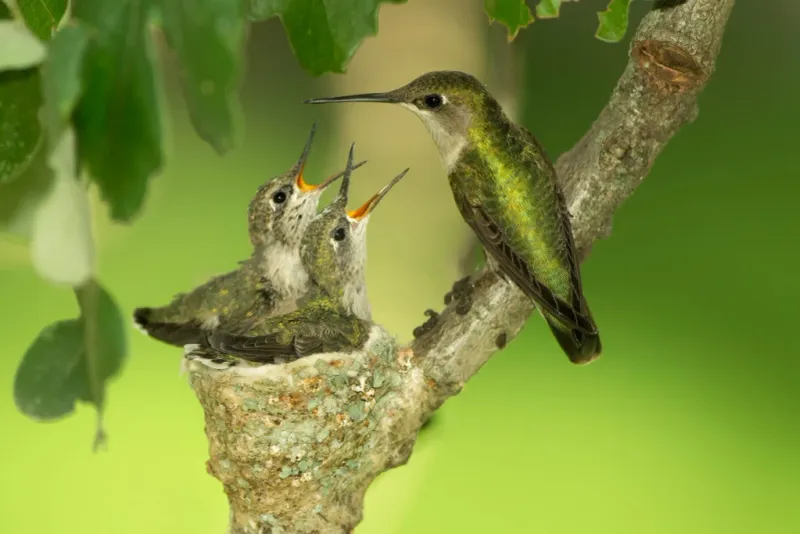
Once nesting begins, females spend long stretches incubating eggs and raising young, and they collect insects and spiders to feed their chicks rather than making constant feeder runs.
Cornell Lab’s explanation of midsummer feeder slowdowns confirms that this midseason dip is a predictable part of the breeding cycle, not a sign that something has gone wrong.
Timing varies significantly by species and region.
Ruby-throated patterns in the Southeast look different from what western homeowners see with Anna’s, Costa’s, or Rufous Hummingbirds.
Checking local bird records or eBird reports for your area gives a more accurate picture of when activity typically rises and falls than any single nationwide calendar can provide.
One concern that comes up often is whether leaving a feeder up will prevent migration.
Audubon’s answer from ornithologist Kenn Kaufman is reassuring: migration is driven by day length and other internal cues, not by feeder availability.
Keeping the feeder stocked after your last expected visitor is actually a kindness to late migrants passing through.
Cornell reinforces this, recommending that feeders stay up for a stretch beyond the typical departure window.
And Audubon’s spring timing guidance shows just how much arrival dates differ across the country, which is a good reminder that seasonal patience often works better than an immediate fix.
Natural Flowers Can Change Feeder Counts
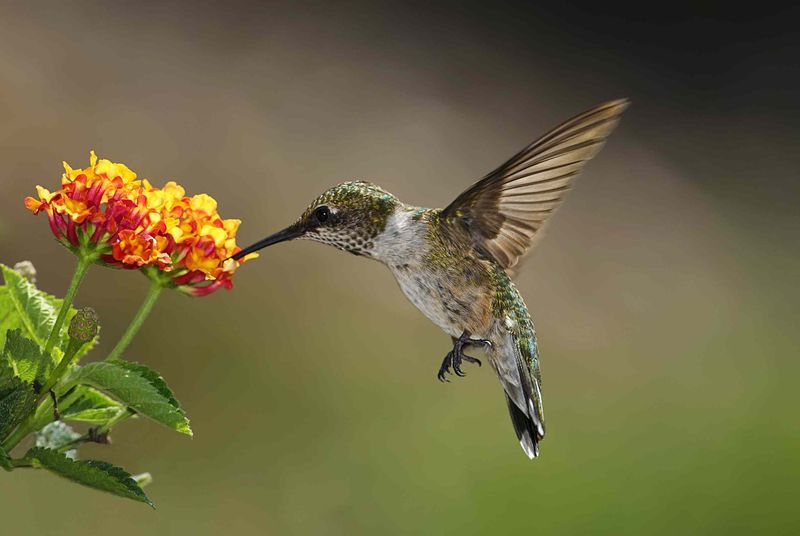
Backyard feeders compete with something hummingbirds have relied on for thousands of years: real flowers.
When a neighborhood or nearby field hits a strong bloom, hummingbirds often spend more time at the natural source and less time at the feeder.
That is not a problem, it is the birds making a reasonable choice.
Research conducted on Broad-tailed Hummingbirds at a Colorado field site found that feeder visits dropped when natural floral resources were more abundant.
That Rocky Mountain Biological Laboratory study is worth understanding carefully: it applies to a specific species at a specific elevation in a specific habitat.
It does not prove that every backyard with flowers will see fewer hummingbird visits.
Species, local weather, migration timing, and the mix of plants around your yard all shape what happens at your feeder.
The takeaway is that natural food affects feeder counts, not that planting flowers will always push birds away.
Beyond nectar, hummingbirds depend on animal protein.
Forest Service identifies nectar, insects, spiders, and occasionally tree sap as core food sources.
A yard that sprays broad insecticides around flowering plants may offer less of what hummingbirds need for a complete diet, even when the feeder is full.
Reducing pesticide use near flowers and feeder areas is a supportive step, though it is not a guaranteed explanation for every decline you observe.
Audubon’s habitat guidance frames flowers and insects together as the foundation of a genuinely useful yard.
Planting regionally appropriate flowers that bloom in sequence across the season may increase the chances of visits, while also supporting the insects that hummingbirds need.
Think of flowers not as a replacement for the feeder but as a partner that makes the whole yard more worth visiting.
Territorial Birds Can Hide Other Visitors
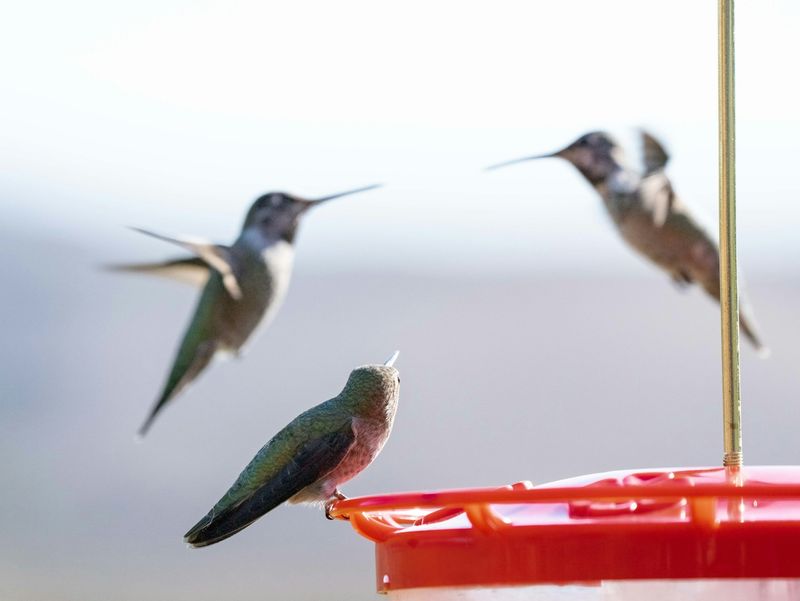
One hummingbird at a feeder can actually mean fewer hummingbirds overall.
Male hummingbirds are remarkably aggressive about defending food sources, and a single dominant bird can make a busy feeder look almost deserted by chasing away every competitor before they get a sip.
Cornell Lab’s explanation of hummingbird territorial behavior describes how males will perch in a nearby tree or shrub and launch repeated dive-bomb chases to keep other birds away.
If you notice one bird returning again and again to a high perch near the feeder, or if you see birds approaching only after another bird leaves, territorial exclusion is a likely explanation.
The feeder may be attracting several hummingbirds that you simply never get to see together.
The practical response is to spread the competition out.
Cornell recommends placing several small one-port feeders around the yard, ideally out of sight of one another, so no single bird can patrol all of them at once.
A dominant male can defend one feeder or one sightline, but defending three or four spread across different parts of the yard becomes much harder.
This arrangement may reduce territorial exclusion and give other hummingbirds a chance to feed.
Keep realistic expectations about this approach.
Spreading feeders is a useful test, not a guarantee of more birds.
If migration timing, regional abundance, nearby habitat, or weather limits the number of hummingbirds in your area, additional feeders will not change that.
Watch for a few days after repositioning and let the birds tell you whether the adjustment helped.
Sometimes a quiet feeder simply reflects a quiet season, and patience is the most honest response available.
Nectar And Pests Offer Concrete Clues
Hold the feeder up to the light.
Cloudy nectar, a slightly sour smell, or a dark film inside the ports are signs the nectar has turned, and hummingbirds are sensitive enough to avoid a feeder that smells fermented or contaminated.
Heat speeds that process dramatically, sometimes reducing safe nectar life to a single day in midsummer.
The safe nectar recipe is plain white table sugar mixed with four parts water to one part sugar.
Boil the water first if you prefer, let it cool, then fill the feeder.
Pennsylvania State University Extension recommends replacing nectar every three to five days under normal conditions, while Cornell advises every two to three days and daily inspection in hot weather.
Inspect the nectar each day, discard it if it looks cloudy or smells off, and always clean the feeder before adding a fresh batch.
Honey can support harmful fungal growth, artificial sweeteners provide no nutrition, and red food dye is unnecessary because Audubon confirms that red feeder parts are enough to help birds locate the feeder without adding anything to the liquid itself.
Pests are a separate but related problem.
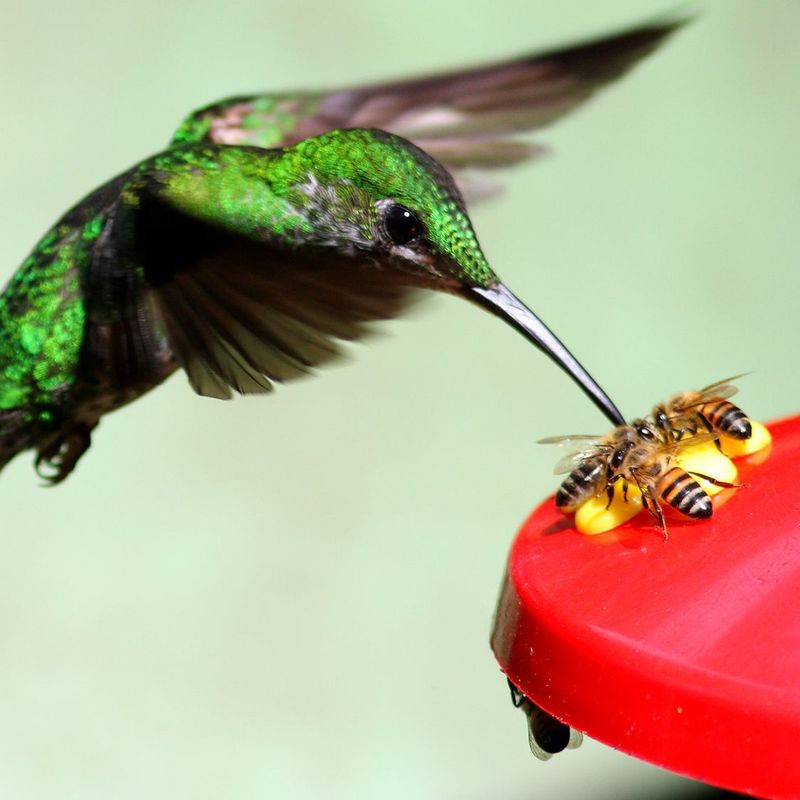
Ants, bees, and wasps around feeder ports can discourage hummingbirds from landing, and spilled nectar on the outside of a feeder draws insects faster than almost anything else.
Audubon’s pest guidance recommends drip-resistant saucer-style feeders and keeping the outside clean and dry.
Cornell’s ant guide suggests a water-filled ant moat mounted above the feeder or a separate ant guard between the hook and the hanger.
If bees or wasps persist, try moving the feeder several feet to a new location, or take it down for one or two days and rehang it slightly differently.
One approach to avoid completely: Cornell specifically warns against petroleum jelly, oil, grease, or any sticky substance near the feeder.
These can mat hummingbird feathers and compromise the bird’s ability to fly and regulate body temperature.
Shade or partial shade for the feeder helps slow spoilage and reduces the heat that draws stinging insects in the first place.
A feeder that stays clean, cool, and dry outside is one that hummingbirds are more likely to return to.
Placement Can Make Feeding Riskier
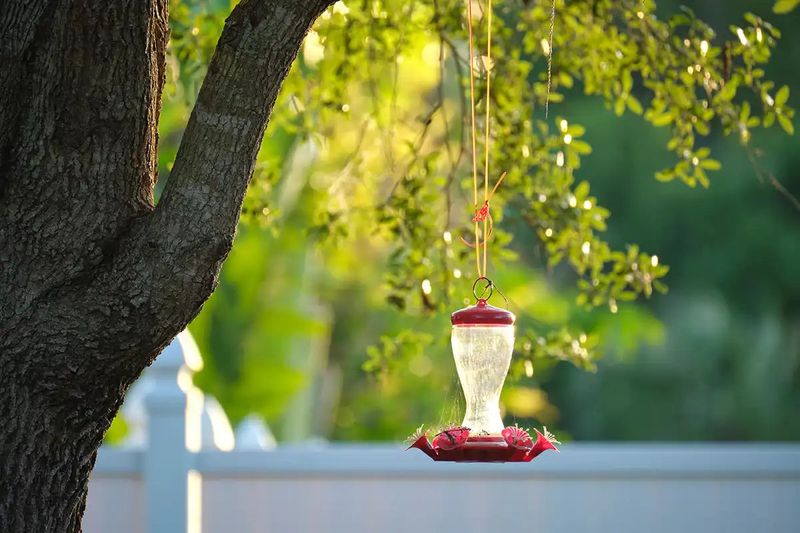
A feeder in the wrong spot can be more hazard than help.
Full afternoon sun heats nectar quickly, speeds fermentation, and can make a feeder too hot to approach comfortably.
Strong wind causes drips that pool below the ports, creating sticky puddles that invite ants and bees and can discourage hummingbirds from hovering long enough to feed.
Shade or partial shade is the practical fix for heat.
A spot that gets morning light and afternoon shade works well in most parts of the country.
Wind protection matters too, either from a fence, a wall, or a dense shrub nearby, as long as the approach path stays clear and the feeder is visible from multiple directions.
Cornell’s feeding guide recommends easy-to-clean feeders placed where spills can be wiped up and where birds have a clear, unobstructed route in and out.
Windows are a specific concern that many people do not connect to feeder placement.
Glass that reflects sky or vegetation can look like open air to a bird moving at speed.
Cornell’s DIY collision deterrents guide and their glass-kills live event resource both support placing feeders either within about 3 feet of a window or more than 30 feet away.
At intermediate distances, birds build enough speed to strike glass hard.
Window tape, decals, or exterior screens reduce the risk where strikes have already occurred.
Cats deserve a mention here too.
Audubon recommends keeping cats indoors, and Cornell notes that a predictable feeder location can create a predictable hunting opportunity for an outdoor cat.
Check beneath the feeder for dense shrubs or low cover that could serve as an ambush point.
Penn State Extension echoes this, noting that yard safety is part of a complete feeder setup, not an afterthought.
Build A Yard That Supports More Than Nectar
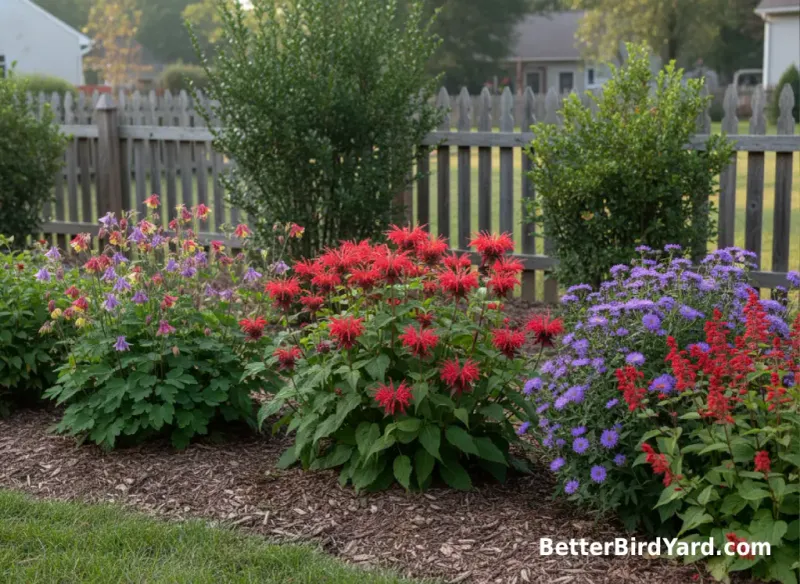
A feeder is an invitation, but the yard around it determines whether hummingbirds stay long enough to matter.
Think of the feeder as one room in a house: useful on its own, but far more functional when the rest of the structure supports it.
The U.S.
Forest Service identifies flowers, insects, spiders, cover, and perches as the core elements of useful hummingbird habitat.
Flowers that bloom in sequence from early spring through fall give birds a reason to return across the season.
Locally native plants are a good starting point because they tend to attract the native insects that hummingbirds also eat, though what counts as native changes by state and region, so check local extension resources or native plant societies for your area rather than relying on a nationwide plant list.
Audubon’s yard habitat guide recommends pairing flowering plants with shrubs and small trees that offer perching spots and quick escape routes.
Hummingbirds need to feel safe enough to hover, and a yard with dense cover nearby but open airspace near the feeder tends to work better than one that is either completely open or heavily overgrown.
Avoid broad insecticide use around flowering plants and feeder areas, since these birds rely on small insects and spiders for protein, and a yard scrubbed of insect life is a less complete food source regardless of how full the feeder is.
Moving water or a fine mist sprayer can add another layer of appeal.
Audubon’s spring timing guidance notes that hummingbirds are attracted to the sound and movement of water, and wet areas can support more insects.
A dripper or mister is an optional feature that may increase the chances of visits, but it works alongside flowers, prey habitat, shelter, and clean nectar, not instead of them.
Audubon also cautions that water sources placed too close to a feeder can complicate pest management, so a few feet of separation between the mister and the feeding port makes practical sense.
Troubleshoot The Change Without Chasing A Guarantee
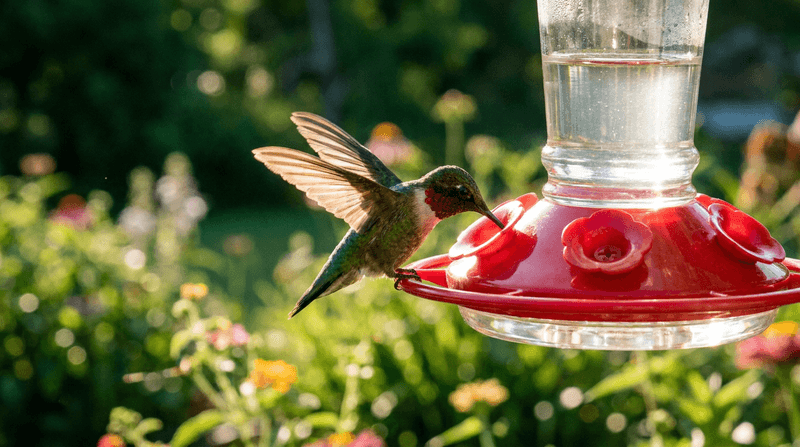
Working through a feeder decline is more useful than reacting to it.
Start with the calendar.
Check whether the timing lines up with spring migration, the nesting period, a late-summer lull, or fall departure for your region.
Cornell’s feeder-worry guide is a good first reference for putting local observations in seasonal context.
Next, look at the yard around the feeder.
Are nearby flowers blooming right now?
Could natural nectar be drawing birds away from the feeder temporarily?
Then inspect the feeder itself: check the nectar color and smell, look for mold or residue inside the ports, and check the outside for drips or sticky buildup that might attract ants or bees.
Move to placement: is the feeder in full afternoon sun, exposed to strong wind, or positioned at an intermediate distance from a window?
Any of those conditions can reduce visits without the nectar being the problem.
After the physical checks, watch for behavior.
Spend ten minutes near the feeder at different times of day and look for a bird perching nearby and chasing others off.
If territorial exclusion seems likely, try moving one feeder out of sight of the other or adding a second small one-port feeder in a sheltered corner.
Audubon’s habitat guide and Cornell’s feeding guide both frame these as practical measures that may improve conditions, not promises of an immediate return.
Change one thing at a time and give it a few days before adjusting something else.
A quiet feeder may simply mean the birds are using flowers, insects, a neighbor’s setup, or a different seasonal route through the neighborhood.
A yard that offers clean nectar, natural food, shelter, and safe access is doing its job well, even on the days when no one seems to be watching.