
Before You Squish That Caterpillar, It Might Be The Monarch Your Garden Actually Needs
Follow us on Google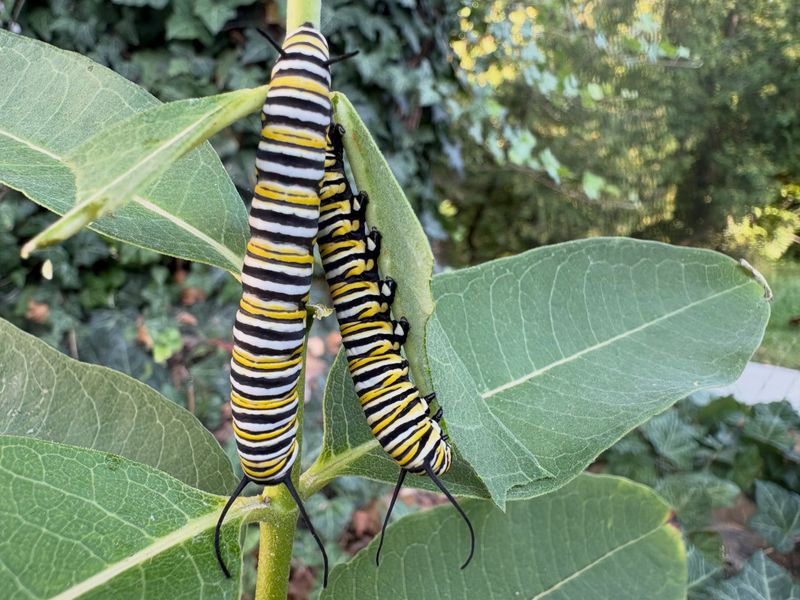
You’re pulling weeds near the milkweed when you spot it: a fat, striped caterpillar chewing a leaf down to the stem.
Your first instinct might be to flick it off or reach for the spray bottle.
Hold on, because that caterpillar is probably one of the most important insects your yard will see all season.
Monarch butterflies are struggling across the country, and your garden might be exactly the nursery they need.
That Striped Caterpillar Is Probably a Monarch
Stop before you reach for anything.
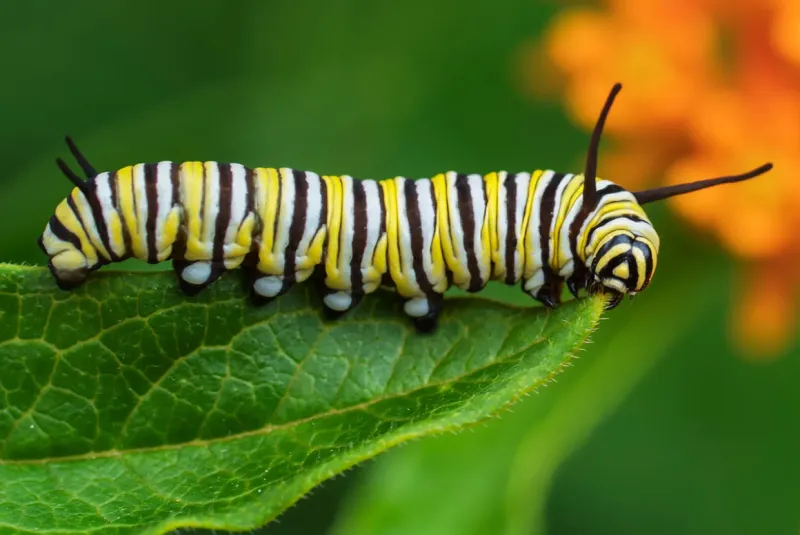
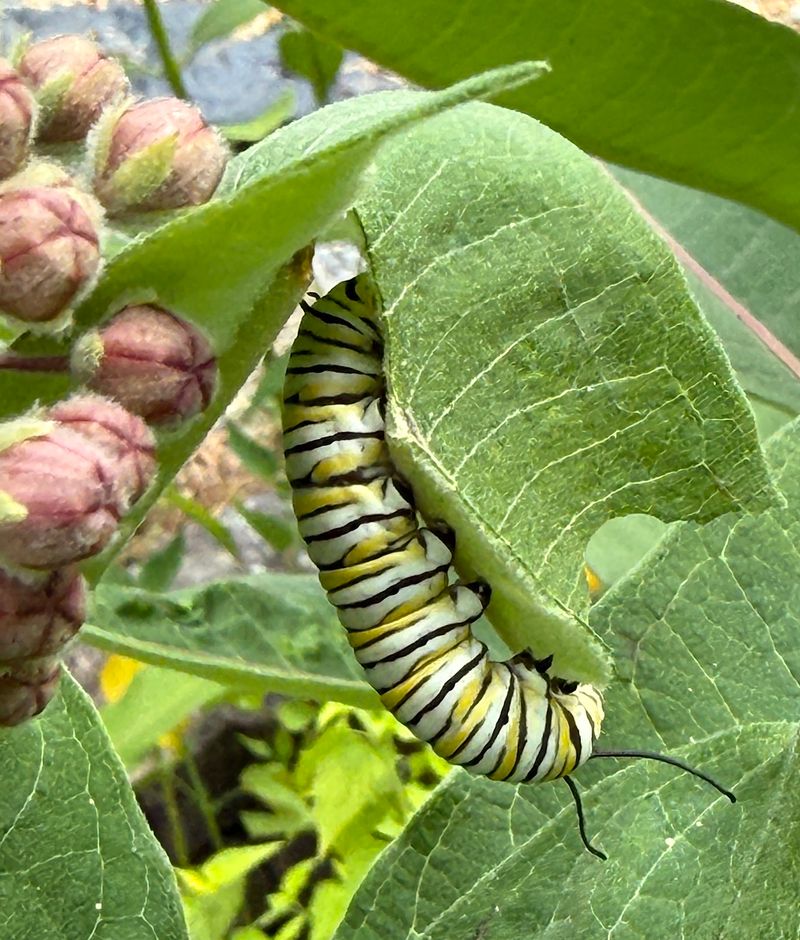
A caterpillar with alternating black, white, and yellow bands sitting on a milkweed plant is very likely a monarch, Danaus plexippus, and it belongs exactly where you found it.
The combination of host plant and body markings is the strongest quick check you have, and right now it is pointing toward one of North America’s most recognized pollinators.
Look for two pairs of black, tentacle-like filaments, one pair near the head and one near the tail.
Those thin, whip-like threads are one of the clearest signals that separates a monarch larva from most other caterpillars you will encounter on milkweed.
USDA Agricultural Research Service documentation on monarch larvae confirms that these markings appear consistently across all five instars, though young caterpillars can be smaller than a pencil eraser and harder to read at a glance.
Size matters here.
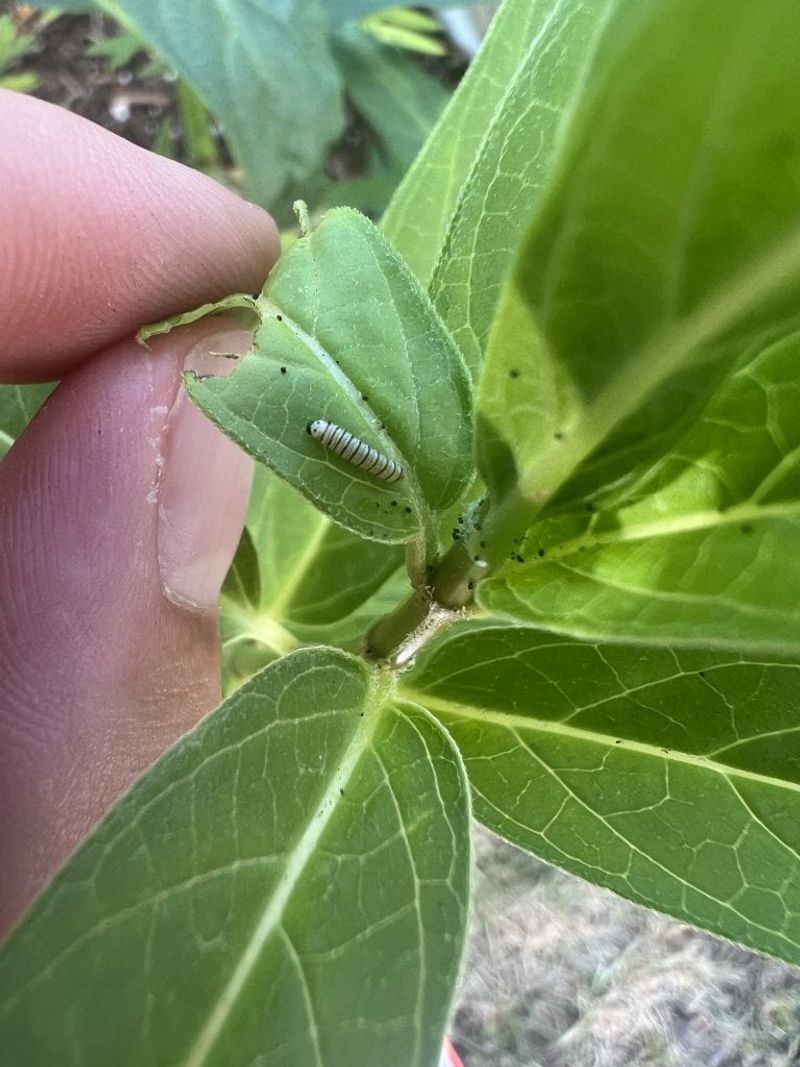
A newly hatched monarch larva is tiny, pale, and easy to overlook or misread.
Give it the benefit of the doubt if you find a small, faintly striped caterpillar on confirmed milkweed, because it may simply be in an early stage.
The plant is the first clue, the bands are the second, and the filaments are the third.
Do not squish it, spray it, or pick it up to examine it more closely than you need to.
Observe from a few inches away, confirm the plant beneath it, and let it keep eating.
That is the full action required at this moment, and it is the right one.
Milkweed Turns a Leaf-Eater Into a Nursery Resident
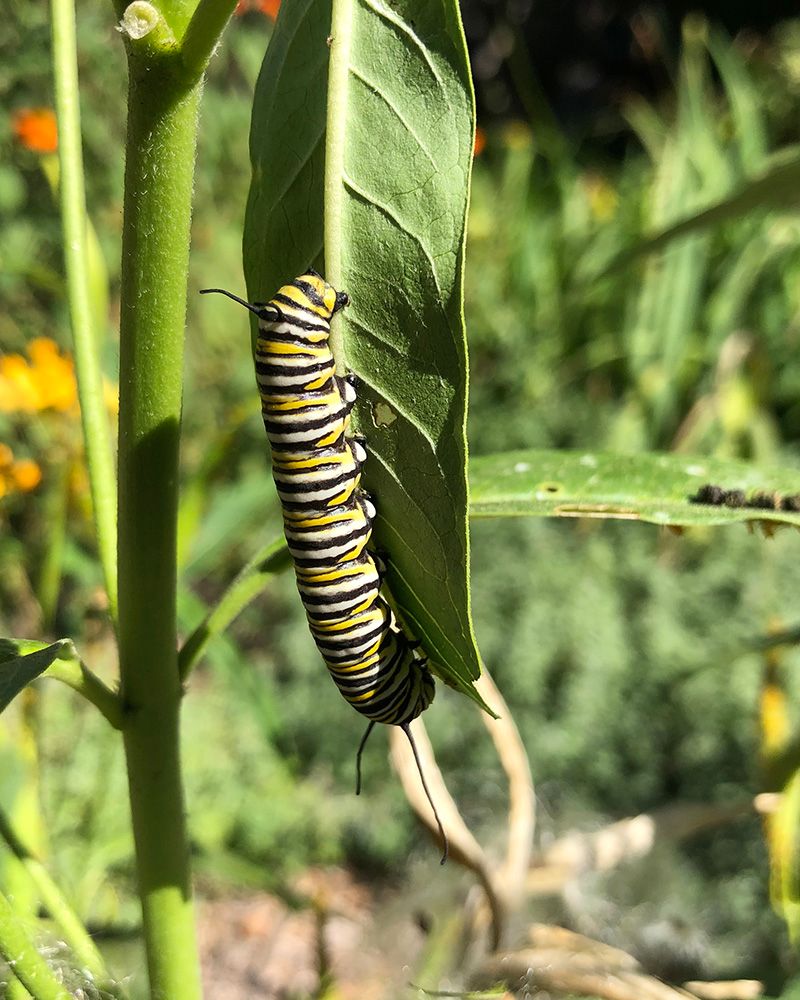
Monarch females do not lay eggs on random plants.
They search specifically for milkweed, plants in the genus Asclepias, because their caterpillars cannot complete development without it.
USDA Forest Service milkweed guidance explains that monarch larvae require milkweed not just for food but for the plant’s natural chemicals, called cardenolides or cardiac glycosides, which accumulate in the caterpillar’s body and can make it distasteful or even toxic to many vertebrate predators like birds.
The plant is doing double duty: feeding the larva and arming it.
When you see holes chewed along the leaf edges of your milkweed, that is not a sign of a sick plant.
That is a sign the plant is functioning exactly as it evolved to function.
USDA research on monarch caterpillar feeding notes that larvae feed on leaves, stems, and flowers of milkweed plants, working their way through available foliage as they grow through their instars.
Ragged leaves mean a caterpillar is growing.
Adult monarchs are different.
Once they emerge from the chrysalis, they switch entirely to nectar from flowering plants for energy.
The milkweed’s job at that point is already done.
Think of your milkweed patch less like an ornamental bed and more like a maternity ward: a little wear and tear is part of the work it is there to do.
University of Minnesota Extension milkweed diagnostics remind gardeners that feeding damage on milkweed is a normal, expected outcome of planting it as a host species.
A chewed leaf is not a problem to solve, it is evidence that something important is happening.
Stripes Alone Cannot Settle the Case
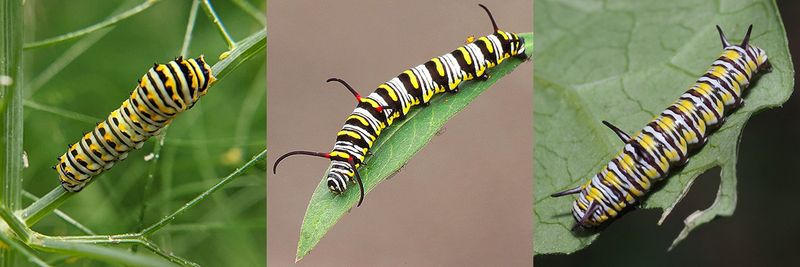
Plenty of caterpillars are striped.
The plant beneath them is what narrows the field fast.
Find a caterpillar with bold yellow, black, and white markings on dill, parsley, fennel, celery, or related herbs, and you are almost certainly looking at a black swallowtail, not a monarch.
Black swallowtails are valuable native butterflies in much of the United States, but their larvae eat garden herbs, not milkweed.
Monarch Joint Venture’s guide to monarch mimics walks through these distinctions clearly and is worth bookmarking for the season.
On milkweed itself, the trickiest lookalike is the queen butterfly caterpillar.
Queens are close relatives of monarchs, and their larvae can look nearly identical at a glance.
The key difference is the filament count.
A monarch caterpillar has two pairs of black filaments, one near the front and one near the rear.
A queen caterpillar has three pairs, adding a middle set.
Lean in, count carefully, and you have your answer most of the time.
A third milkweed resident worth knowing is the milkweed tussock moth caterpillar.
It feeds on milkweed in groups and looks nothing like a monarch once it develops its signature tufts of black, white, and orange hair.
Extension guidance on bugs eating milkweed notes that tussock moth caterpillars are native members of the ecosystem and can coexist with monarchs on the same plants.
If you need to move them, wear gloves, because those hairs can cause a skin rash on contact.
The simple rule: identify the plant first, then count the filaments, then look at the body.
In that order, you will get the right answer most of the time without needing a field guide.
The Safest Move Keeps the Caterpillar Outside
The moment you spot a suspected monarch, the best action is also the easiest one: do nothing that harms it.
Put down the spray bottle.
Skip the herbicide on that weedy patch next to the milkweed.
Xerces Society’s milkweed FAQ is direct on this point: insecticides and herbicides applied on or near milkweed can kill caterpillars outright, remove the host plant entirely, or harm adult pollinators visiting the flowers.
Even products labeled organic or natural affect insects, because that is what they are designed to do.
A monarch caterpillar will eventually leave the milkweed plant to find a place to form its chrysalis, often on a fence post, a garden stake, or a nearby shrub.
If you check the plant one morning and the caterpillar is gone, do not assume something went wrong.
University of Maryland Extension guidance on helping monarchs notes that caterpillars commonly wander several feet or more before pupating, so searching only among the leaves will miss them.
Bringing a wild caterpillar indoors to raise it might feel like helping, but it often is not.
Monarch Joint Venture’s guidance on captive rearing explains that crowded indoor conditions can spread Ophryocystis elektroscirrha, known as OE, and other pathogens between caterpillars.
Conservation organizations generally favor leaving wild caterpillars outdoors, where they have space, airflow, and natural cues.
The practical takeaway is this: withhold treatment, watch from a distance, and let the cycle run.
Xerces Society’s western monarch guidance frames habitat protection, not intervention, as the most reliable household contribution.
Your milkweed is already doing the work.
Let it.
A Chewed Milkweed Plant Is Usually Doing Its Job
A milkweed patch that looks like it lost a fight is not a garden emergency.
Established milkweed, especially common milkweed, Asclepias syriaca, can handle substantial leaf loss and keep growing.
The plant’s role as a host species means being eaten is part of its job description, not a sign that something is wrong with your soil or your care routine.
Where things can get tight is in a small planting.
If you have two or three milkweed plants and four or five caterpillars arrive at the same time, the math gets difficult fast.
Monarch Joint Venture’s milkweed FAQ suggests that the better response to this situation is planting more host plants rather than trying to protect one plant from every caterpillar that finds it.
More milkweed means more capacity, and that serves everyone.
Before you add plants or worry about the damage, check the undersides of the upper leaves.
Monarch eggs are tiny, pale, and ribbed, about the size of a pinhead, and females tend to place them toward the top of the plant where new growth is most tender.
USDA research on monarch feeding sites confirms that egg placement and early larval feeding tend to concentrate near the upper portions of the plant.
You can inspect gently without disturbing anything.
Turn a leaf over slowly, look for the tiny ridged egg or a very small pale caterpillar, and then set the leaf back.
Illinois Extension’s pesticide review newsletter notes that unnecessary handling of caterpillars or their host plants can cause stress and dislodgement.
Look, confirm, and step back.
The Right Milkweed Depends on Your Garden
Milkweed is not one plant.
Choosing the right species for your yard depends on where you live, what your soil does, and how much sun your beds get.
Planting the wrong milkweed in the wrong conditions wastes your money and does not serve the monarchs you are trying to help.
For gardeners across much of the eastern and central United States, common milkweed, Asclepias syriaca, is often the practical starting point.
USDA Forest Service milkweed planting guidance notes that it thrives in sunny, well-drained locations and is native to that broad region.
Swamp milkweed, Asclepias incarnata, fits moist soils and rain garden edges.
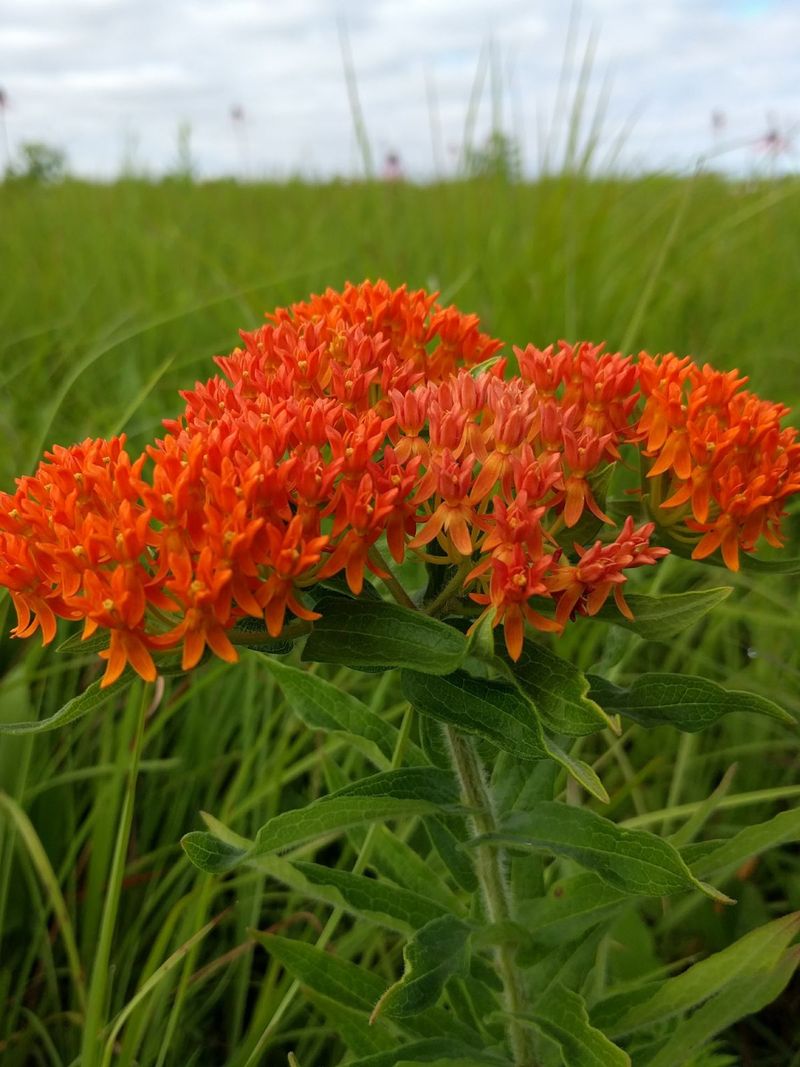
Butterfly weed, Asclepias tuberosa, wants full sun and well-drained, even dry soil, and it stays more compact than common milkweed.
University of Minnesota Extension’s common milkweed profile adds that A. syriaca spreads by both rhizomes and windborne seed, so place it where some lateral expansion is acceptable, or choose a clumping species for tighter beds.
Western gardeners should look for species native to their specific region, since milkweed preferences and availability shift considerably across the country.
A nursery that specializes in native plants for your state is the most reliable source for that guidance.
Growing from seed takes patience but works well.
Most native milkweeds benefit from cold, moist stratification before planting, meaning you mix the seeds with slightly damp material, refrigerate them for about 4 to 6 weeks, then sow them after your local last frost date.
Monarch Joint Venture’s seed-starting guidance recommends placing seeds about 1/4 to 1/2 inch apart and covering them with roughly 1/4 inch of soil, kept frequently moist until seedlings establish.
USDA Forest Service research on propagating native milkweeds notes that stratification needs vary by species, so follow the supplier’s instructions when they differ from the general approach.
Illinois Extension’s milkweed planting guide suggests eventually spacing established plants about 2 feet apart, though final spacing depends on species and mature size.
Three Garden Traps Can Undo Good Intentions
Good intentions can backfire in three specific ways, and knowing them ahead of time saves you the frustration of doing everything right and still losing caterpillars.
The first trap is retail milkweed treated with systemic insecticides.
A plant can look perfectly healthy at the nursery while carrying pesticide residues that are not visible on the leaves.
A 2022 study published in Biological Conservation detected 61 different pesticides across 235 milkweed leaf samples collected from retail sources in 15 states.
Not every detected chemical had a known effect on monarchs, but the range was wide enough that asking before you buy is the only reliable safeguard.
A “pollinator-friendly” label does not guarantee pesticide-free production.
Ask the nursery directly whether the plants were treated with any systemic products, and choose growers who can answer that question clearly.
The second trap is tropical milkweed, Asclepias curassavica.
It is sold widely, it blooms heavily, and monarchs will use it.
But it is not native to the United States, and Xerces Society’s milkweed FAQ explains that in warm regions where it stays leafy through winter, it can encourage monarchs to breed outside the normal migration window and allow the OE parasite to build up on the foliage over time.
In southern areas where it is already established, cutting it back in early fall reduces the risk, but locally native species are the better long-term choice.
The third trap is a plant that is not milkweed at all.
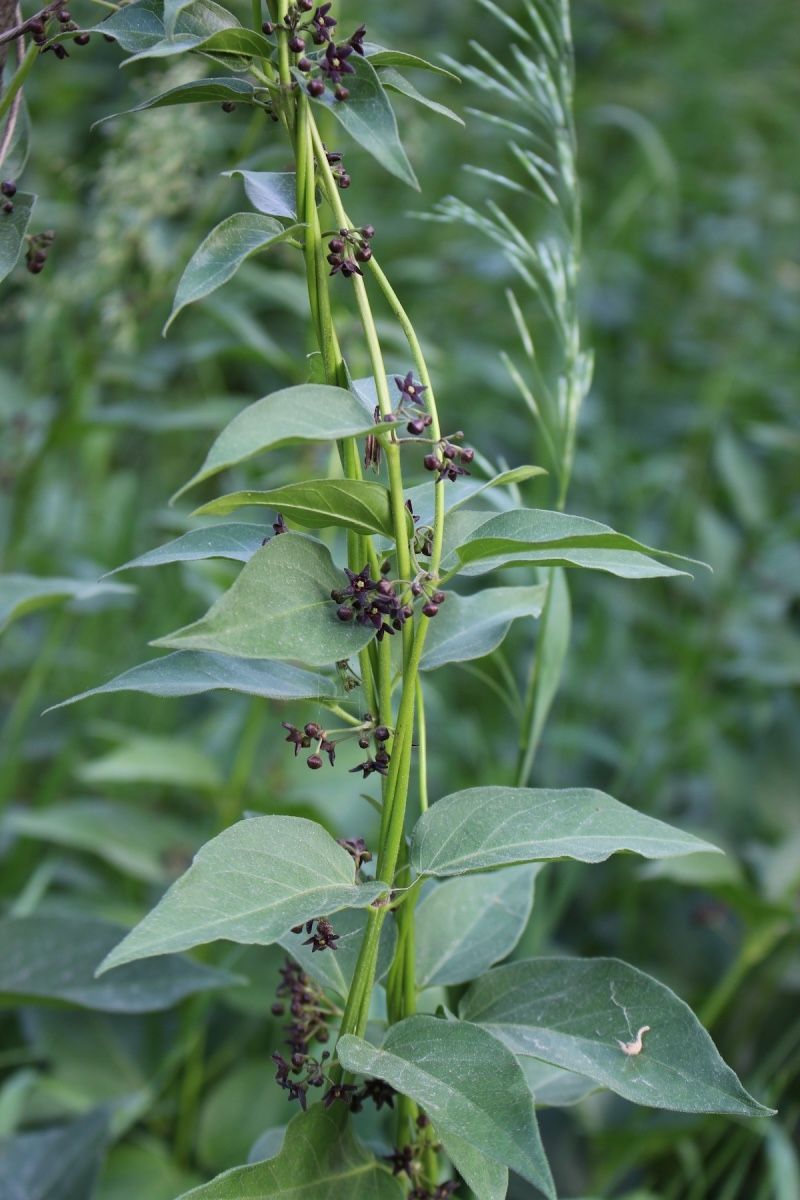
Black swallow-wort, Cynanchum louiseae, is an invasive vine whose leaves can be fatal to monarch caterpillars that mistake it for a host plant.
University of Minnesota Extension’s black swallow-wort profile describes it as a serious invasive threat in parts of the Northeast and Great Lakes region.
Do not remove a plant simply because it has opposite leaves or milky sap, confirm the identity first, then follow local invasive-plant guidance for control.
One more proportionate note on milkweed safety: its cardenolides can be harmful if eaten in large amounts by people, pets, or livestock.
Fish and Wildlife Service guidance on milkweed myths keeps this in perspective, noting that ordinary contact is not automatically dangerous.
Keep children and animals from chewing the plant, avoid eating it yourself, and wash your hands after handling broken stems or leaves.
That is the full household precaution.
One Caterpillar Helps, but Habitat Does More
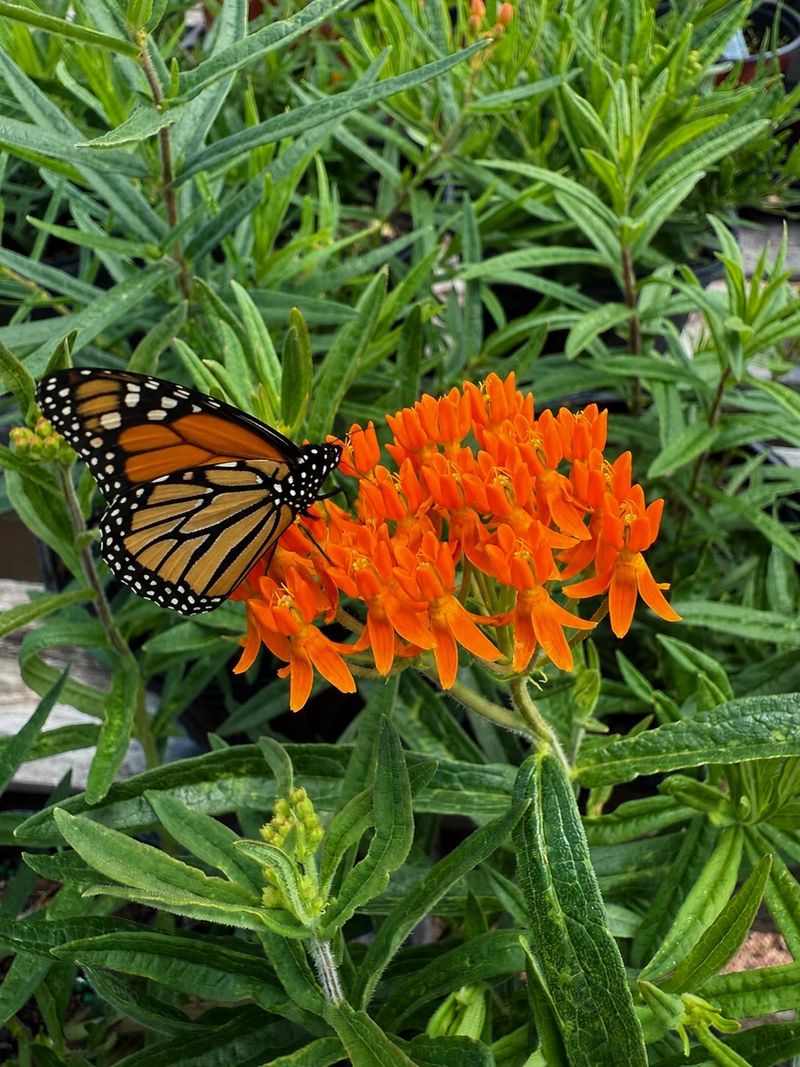
Leaving one caterpillar alive matters.
So does protecting the milkweed it feeds on, avoiding pesticides near flowering plants, and adding more host plants when you can.
These are real contributions, and they are worth making.
But they sit inside a much larger problem.
Fish and Wildlife Service’s monarch species status assessment identifies habitat loss and degradation, pesticide exposure, and climate-related pressures as the primary drivers behind monarch population declines.
USGS research on pesticides and grassland management documents how insecticide and herbicide use across agricultural landscapes affects monarchs at a scale that no single yard can offset on its own.
Your garden is one useful patch in a much larger mosaic of habitat that monarchs need across their entire migratory range.
On the question of legal protection: U.S.
Fish and Wildlife Service’s current monarch conservation page is the authoritative source for the butterfly’s current status under the Endangered Species Act.
Verify that page before publication for any claim about federal listing, because the regulatory picture can change, and reporting an outdated status does real harm to reader trust.
As of this writing, do not call the monarch federally endangered or state that harming one caterpillar is a federal crime without confirming the current rule.
University of Maryland Extension’s monarch help guidance frames the household role clearly: protect the milkweed, skip the pesticides on flowering plants, and add suitable host plants where your yard allows.
Those actions make your yard a safer place for monarchs to pass through, and that is exactly enough.
The next time you spot a striped caterpillar on milkweed, identify it first, let the plant be eaten, and know that your yard is doing something quietly important.