
Before You Squash That Daddy Longlegs, It Is Not A Spider And It Is Eating Your Aphids
Follow us on Google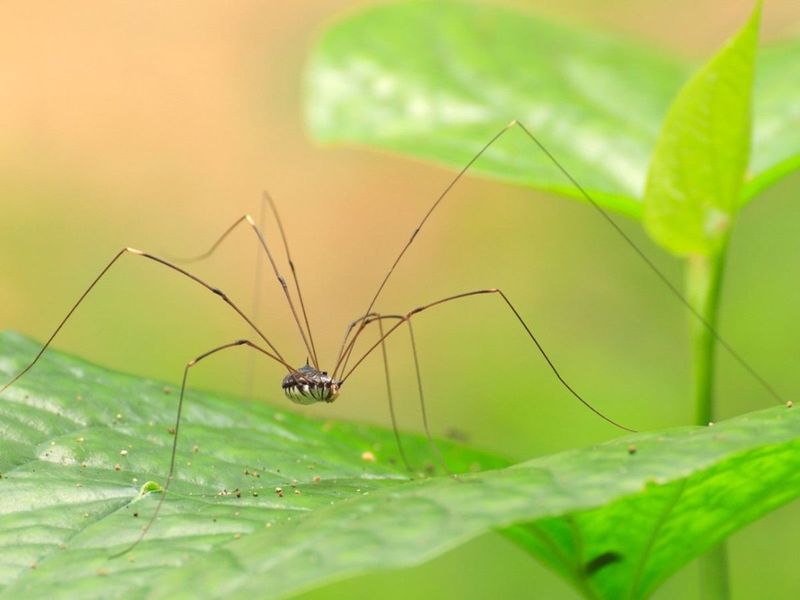
That long-legged creature on your porch railing is not what most people think it is, and squashing it may cost your garden more than you realize.
The animal most Americans call a daddy longlegs is likely a harvestman, an arachnid that belongs to a completely different group from spiders and has been quietly patrolling yards and garden beds for an extraordinarily long time.
Harvestmen do eat aphids, among many other things, though one visiting your rose bush is not a guaranteed aphid-control service.
Getting a closer look before you reach for the spray can is worth the ten seconds it takes.
First Identify the Harvestman
Before anything else, check what you are actually looking at.
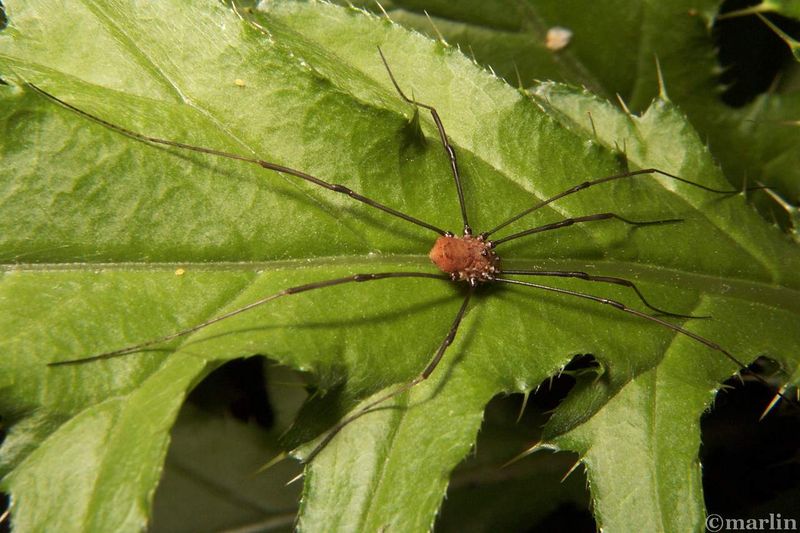
The animal most Americans call a daddy longlegs is almost certainly a harvestman, a member of the order Opiliones, and it is not a spider, even though both are arachnids with eight legs.
Getting that identification right is the first practical step before you decide whether to spray, squash, or simply walk away.
The visual check is quick.
A harvestman has one compact, oval body section, while a spider has two distinct parts joined at a narrow waist.
Look at the eyes next: the Burke Museum at the University of Washington explains that harvestmen usually carry just two eyes, perched on a small central bump, whereas most spiders have eight.
The legs on a harvestman are famously long relative to the body, sometimes several times the body length, and the whole animal typically measures somewhere between 1/16 and 1/2 inch across the body.
Two other features seal the ID.
Harvestmen do not spin webs, full stop, because they have no silk glands.
They also lack the fang-and-venom apparatus that spiders use to subdue prey.
If the creature on your garden wall left no web and looks like a tiny pill on stilts, you are almost certainly looking at a harvestman.
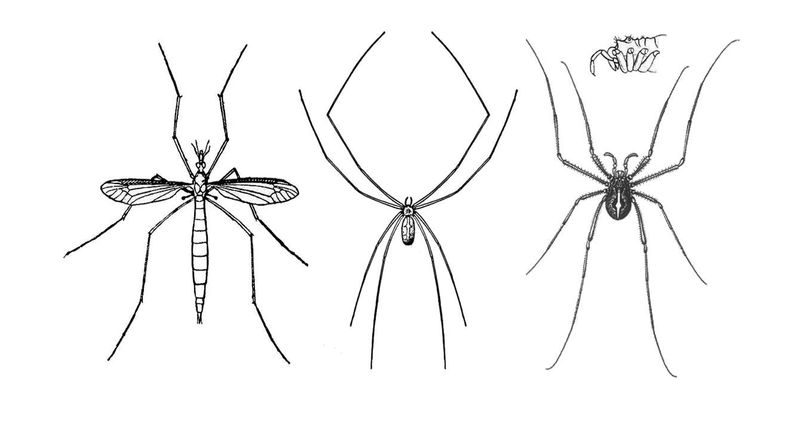
The name daddy longlegs creates real confusion because it also gets attached to cellar spiders and, in some parts of the country, to crane flies.
Those are entirely different animals, so the name alone tells you very little.
University of Minnesota Extension describes harvestmen as harmless to people and notes their role as predators and scavengers in garden settings.
Confirm the one-part body and the absent web before you do anything else, because the right identification changes every decision that follows.
The Venomous Spider Myth Depends on the Name
Most people have heard the story: daddy longlegs are the most venomous spiders in the world, but their fangs are too short to bite you.
It is a satisfying piece of backyard trivia, and it is wrong in almost every direction you push it.
The story collapses the moment you sort out which animal is being discussed.
When the daddy longlegs in question is a harvestman, the whole premise fails immediately.
The Burke Museum addresses this myth directly, pointing out that harvestmen have no venom glands at all.
There is no venom to measure, no danger to rank, and no fang structure designed for injecting anything.
The myth simply does not apply to harvestmen.
Cellar spiders, the long-legged spiders in the genus Pholcus that build loose, messy webs in corners and basements, also carry the daddy longlegs name in some households and regions.
Cellar spiders are true spiders and do possess venom, which is how they catch prey.
But University of California Riverside entomologists note that there is no scientific evidence supporting the claim that cellar spiders are the world’s most venomous spiders or that their venom poses unusual danger to people.
The American Arachnological Society echoes that position, finding no credible basis for treating cellar spider venom as medically extraordinary.
Crane flies, the gangly flying insects sometimes called daddy longlegs in parts of the South and Midwest, do not even have venom as a category worth discussing.
The myth survives because the name travels across three completely different animals.
Pin down which animal you have, and the story falls apart on its own.
A Generalist Diet Can Make Them Potentially Useful
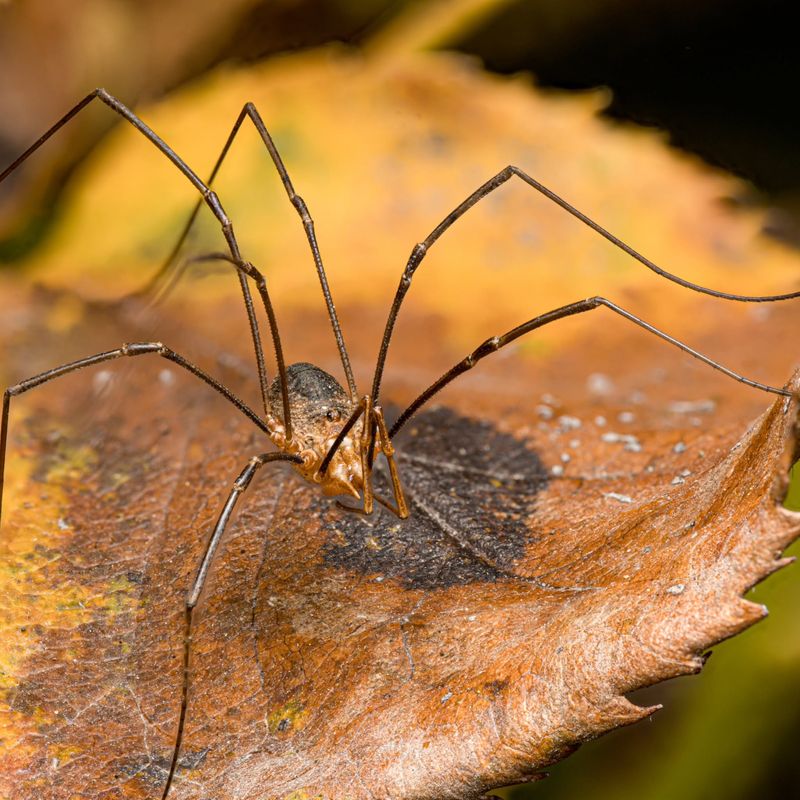
Calling a harvestman a cleanup crew is a colorful shorthand, not a strict ecological job title.
These animals eat a wide range of things, and their diet is one reason they can be quietly useful in a garden without ever being a single-purpose pest controller.
University of Minnesota Extension identifies harvestmen as generalist predators and scavengers that consume dead arthropods and plant juices in addition to live prey.
Published research extends that list further: aphids, mites, springtails, flies, leafhoppers, insect eggs, earthworms, millipedes, and other small arthropods have all been documented as harvestman food.
They will also work through decaying organic material and fungi when live prey is scarce.
That variety is the point.
A harvestman moving across your tomato plant may be hunting aphids, or it may be picking off a spider mite, eating a dead beetle, or sampling plant material.
There is no way to know from across the yard, and the harvestman is not particularly loyal to any one food source.
Think of it less like a specialist exterminator and more like a generalist forager that happens to find your garden a productive place to work.
A study on harvestman diet and development confirmed aphids among the documented prey items but also showed that harvestmen do not thrive on aphids alone.
The cleanup-crew description fits best when you picture an animal eating a little of everything, keeping the garden floor and plant surfaces a bit tidier without specializing in any single pest.
That mixed feeding is what makes harvestmen potentially useful neighbors rather than reliable hired hands.
Aphids Are Possible Prey, Not a Guaranteed Solution
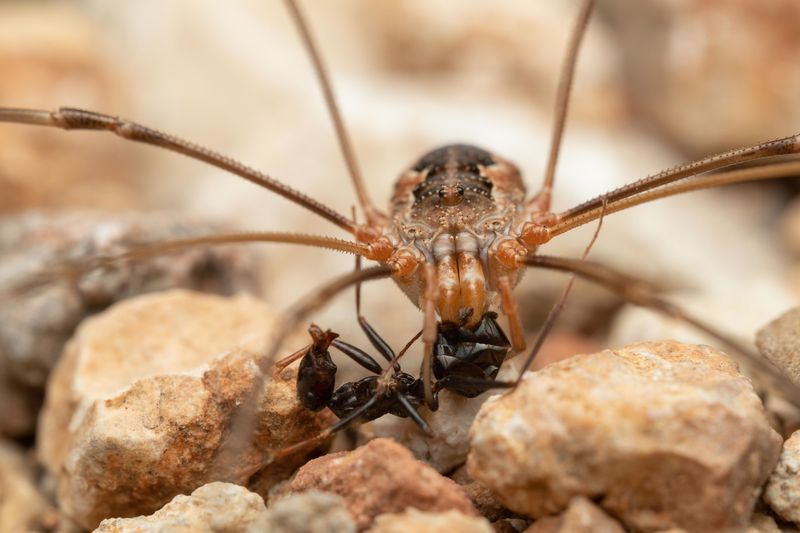
The headline’s claim that a harvestman is eating your aphids is possible, and there is real research behind it.
But possible is doing a lot of work in that sentence, and the full picture from the lab and the field is more complicated than the headline suggests.
One of the clearer pieces of evidence comes from a study of Phalangium opilio, a common North American harvestman species, and soybean aphids.
That Environmental Entomology research confirmed that harvestmen consumed soybean aphids in laboratory colonies, which is meaningful.
The same study found that an aphid-only diet produced poor development and reproduction in the harvestmen, which tells you something useful: aphids are food, but they are not great food on their own.
A harvestman eating only aphids would not do well, so it is eating other things too, which limits how much aphid pressure any individual harvestman removes.
Field research adds another layer of nuance.
A study of harvestman populations in Maine lowbush blueberry fields found harvestmen abundant in the crop and documented broad predation and scavenging across many prey types.
The researchers noted that opinions on harvestmen as biological-control agents are mixed, partly because harvestmen eat both pest species and beneficial organisms like predatory mites and parasitoid insects.
Measuring their net effect on a pest population is genuinely difficult under field conditions.
Some research has found harvestmen acting as meaningful predators in specific crops and habitats, while other studies found their pest-control contribution uncertain or minor.
The honest summary is that a harvestman near your aphid-covered rose may be reducing the colony, or it may be eating something else entirely nearby.
It is one possible layer of natural control, not a replacement for monitoring the plant and deciding whether any intervention is actually needed.
Their Fossil Record Reaches Roughly 400 Million Years
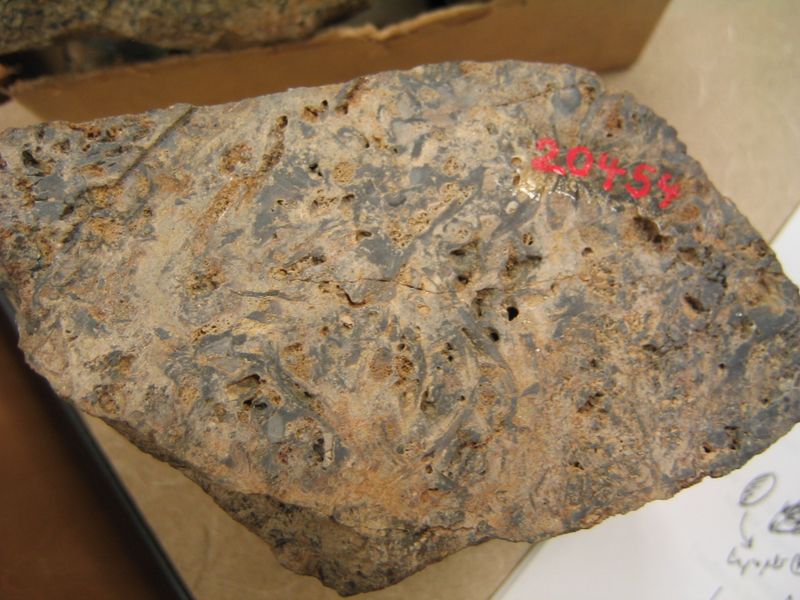
Long before there were gardens to patrol or aphids to eat, harvestmen were already walking the earth.
Their fossil record is one of the more surprising facts about an animal most people dismiss without a second glance.
The oldest known harvestman fossils come from the Rhynie cherts in Scotland, a remarkable deposit of Devonian-age rock that preserved extraordinary detail about early land life.
Research published in Nature on preserved organs of Devonian harvestmen places these fossils at roughly 400 million years old.
That date applies to fossil harvestmen from that specific deposit, not to any modern species or to the individual animal on your porch wall.
Modern harvestmen have changed over geological time, as all living groups do.
Phylogenetic analysis suggests the origin of Opiliones may extend even further back than the oldest physical fossils, but that kind of estimate comes from statistical modeling of evolutionary rates rather than from a directly observed specimen.
Treat it as a working hypothesis, not a confirmed fossil date.
What the 400-million-year figure does tell you is that harvestmen predate dinosaurs, predate flowering plants, and predate the rise of most modern insect groups.
They survived mass extinctions and continental drift.
The creature on your garden fence is part of a lineage that has been navigating a changing planet for an almost incomprehensible stretch of time, adapting its generalist diet and small body plan through conditions that wiped out far more specialized animals.
That context does not change how you manage aphids, but it is a reasonable argument for pausing before you squash one.
Check Whether the Aphids Actually Need Treatment
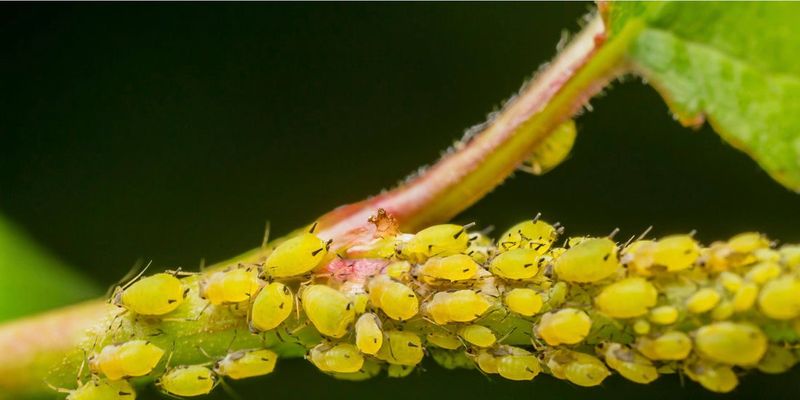
Spotting aphids on a plant is not a reason to spray.
Many gardeners reach for a product before the plant has shown any real sign of trouble, and that reflex can wipe out the harvestmen, parasitic wasps, and lady beetles that were already working on the problem.
University of Minnesota Extension notes that aphids are common in yards and gardens and often cause little or no plant damage.
A small colony on a healthy plant frequently resolves on its own as natural enemies move in or as conditions shift.
The right first move is to look at the plant itself, not just the insects on it.
Signs that suggest closer attention is warranted include leaves that are curling or twisting inward, foliage that is yellowing without another obvious cause, shoots that are stunted or failing to elongate normally, dead shoot tips, and overall poor growth that does not match the rest of the plant.
One or two distorted leaves on a vigorous shrub is a different situation from a tomato seedling whose newest growth is puckered and sticky with honeydew.
The approach that holds up best across different plants and pest levels follows integrated pest management principles.
USDA guidance on integrated pest management recommends identifying the pest accurately, monitoring the level of damage, deciding whether that damage actually justifies treatment, and then choosing the least disruptive effective option.
That sequence protects the harvestmen and other beneficial arthropods that are already present while keeping genuine pest problems from getting out of hand.
USDA Natural Resources Conservation Service pest management guidance reinforces that framework for home garden and landscape settings.
Monitor first, act when the plant tells you it needs help.
Leave the Harvestman and Choose Targeted Controls
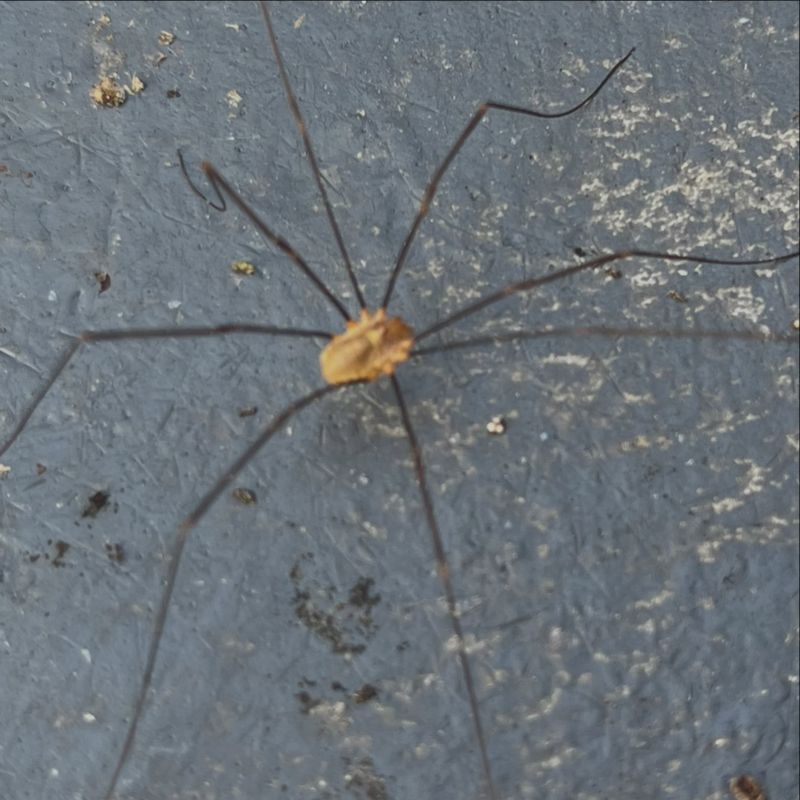
Finding a harvestman on your garden bed or porch wall calls for one action: leave it alone.
Outdoors, a harvestman that is not causing any plant damage is doing you no harm and may be doing some quiet good.
Avoid spraying it directly, and think carefully before applying a broad-spectrum insecticide anywhere nearby, because those products do not distinguish between aphids and the arthropods eating them.
Penn State Extension guidance on conserving natural enemies supports habitat protection and reduced pesticide disruption as the most reliable way to keep beneficial arthropods working in your garden.
There is no proven recipe for attracting harvestmen to a specific aphid colony, no particular mulch depth or moisture level that reliably draws them in.
The practical move is to avoid disrupting the ones already there.
When aphid damage on a plant is genuine and the symptoms described in the previous section are present, start with the least disruptive option.
A strong stream of water from a garden hose knocks aphids off foliage effectively and does not leave residue that harms other arthropods.
On woody plants or shrubs, pruning out heavily infested shoot tips removes a concentrated aphid source before the colony spreads.
Both steps are worth trying before reaching for any product.
If monitoring shows that physical removal is not keeping up with the damage, University of Minnesota Extension supports choosing a low-risk labeled product applied only where damage justifies it.
Always follow the current product label and check with your local cooperative extension office for guidance specific to your plant and region.
Harvestmen are one possible layer in a garden that manages pests through many overlapping hands, and a yard that makes room for them tends to need fewer interventions over time.