
American Beautyberry: The North Carolina Fence-Line Native With a Real but Limited Insect-Repellent Research Connection
Follow us on Google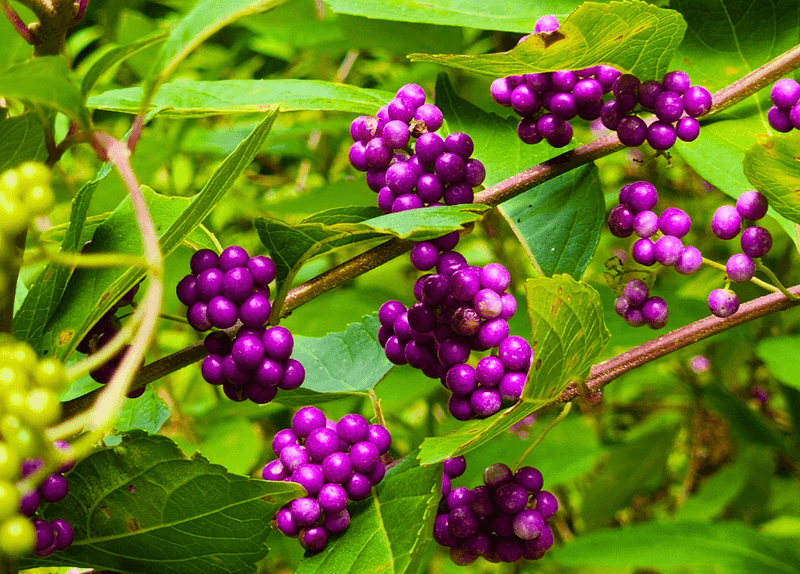
Something grows along the back fence in certain North Carolina yards, and it stops people mid-step every August when those clusters of purple berries appear. The plant is American beautyberry, and it carries a genuine scientific story about mosquito and tick repellency that has been circulating since USDA researchers started publishing on it in the early 2000s.
That story is real, but it is narrower than the headlines suggest, and knowing the difference could save you from skipping the yard work that actually keeps biting insects away from your porch.
The Likely Fence-Line Plant Is American Beautyberry
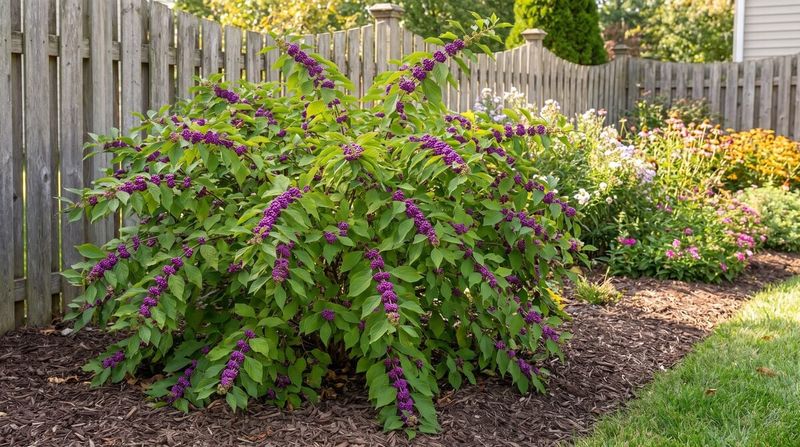
Pull back the curtain on the plant behind the corrected premise, and you find a native shrub that has been quietly growing along woodland edges, pond margins, roadsides, and fence rows across North Carolina since long before anyone called it a garden plant. American beautyberry, Callicarpa americana, is the species most likely behind the viral fence-line claim.
It grows in the mountains, through the Piedmont, and all the way to the Coastal Plain, which means it is genuinely at home whether your soil is red Piedmont clay or sandy eastern loam.
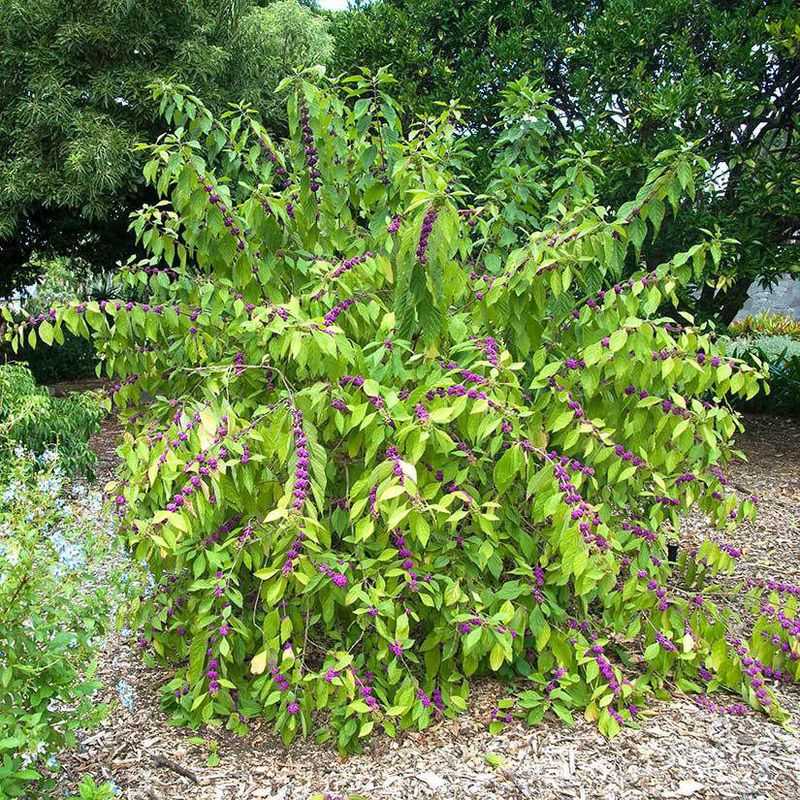
Mature plants typically reach 3 to 8 feet tall and spread 3 to 6 feet wide, so a fence-line planting fills in nicely without immediately swallowing a neighbor’s view. NC State Extension’s plant database lists it as suitable across hardiness zones 6a through 10b, covering essentially every North Carolina address.
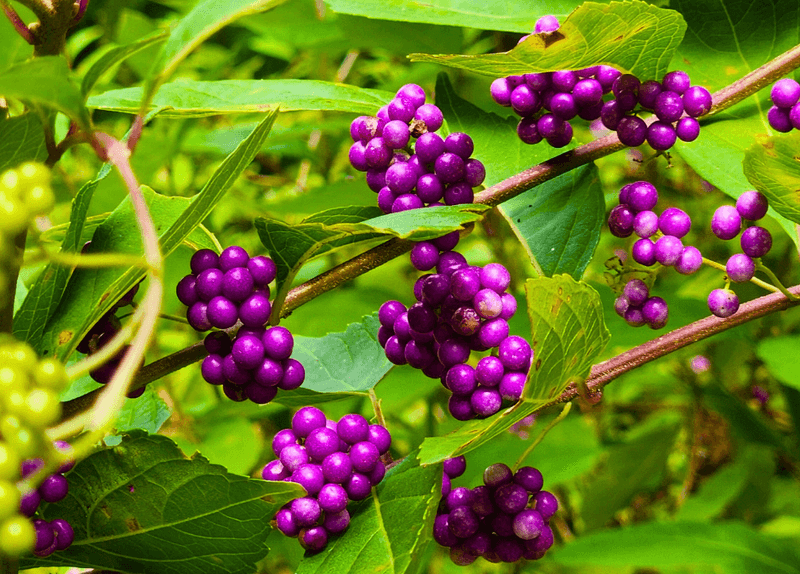
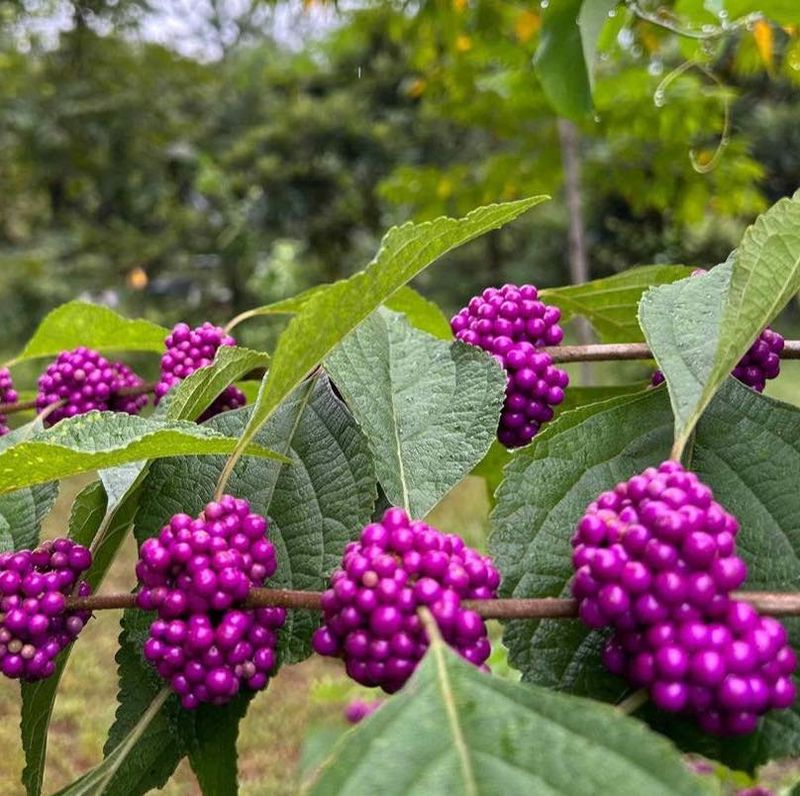
The showstopper feature is the berry clusters, tight bands of purple, blue, pink, or white fruit that ring every stem in late summer and persist well into fall.
Beautyberry does have a genuine connection to insect-repellent research, and that is the honest reason it keeps showing up in yard-and-garden headlines. But the research involves crushed leaves and isolated compounds tested under controlled laboratory conditions, not an untouched shrub standing guard along a fence.
The original claim that yards with fewer bugs almost always have beautyberry growing along the fence is too strong, and the evidence does not back it up. Think of this plant as an attractive, wildlife-friendly native with an interesting scientific backstory, not a proven bug-control barrier.
Researchers Tested Beautyberry Leaves and Compounds
The scientific story starts with folk knowledge. Rural communities across the South had long claimed that rubbing crushed beautyberry leaves on skin or tucking them under a hat brim kept mosquitoes and flies away.
USDA Agricultural Research Service scientists took that tradition seriously and went looking for the chemistry behind it. What they found were two terpenoid compounds, callicarpenal and intermedeol, concentrated in beautyberry leaves and carrying measurable repellent activity in the lab.
USDA ARS reporting on the research confirmed that the leaf compounds showed repellency against mosquitoes in controlled tests. A separate tick study, published in peer-reviewed form and summarized in a 2007 PubMed-indexed study, found that callicarpenal repelled 98 percent of blacklegged tick nymphs on treated cloth at a specific test concentration.
That number sounds striking, and it is, but the same compound tested against lone star tick nymphs performed far more modestly, reaching only about 20 percent repellency at a higher dose in that experiment.
Here is where it gets tricky. Every one of those tests used crushed leaves, purified compounds at measured concentrations, or cloth treated with extracted material.
None of the tests placed a living shrub in a yard and measured whether the surrounding space had fewer biting insects as a result. The compounds have real laboratory activity, which explains why the reputation spread, but laboratory repellency at a controlled dose is a different thing from a growing plant quietly protecting a patio.
North Carolina homeowners encounter both blacklegged ticks and lone star ticks, and the two species responded very differently in the study, so even the tick result should not be read as a blanket promise.
A Living Shrub Does Not Create a Bug-Free Perimeter
Many Piedmont gardeners have planted fragrant herbs or aromatic shrubs near a porch and waited for mosquito relief that never quite arrived. There is a plain reason for that disappointment.
Penn State Extension’s guidance on pollinator-friendly mosquito control makes the point directly: living aromatic plants generally do not repel mosquitoes effectively because the oils in their leaves are not concentrated enough to disperse into the air at levels that matter to a biting insect. The plant has to be crushed, distilled, or processed before the chemistry does meaningful work.
That same principle applies to beautyberry. The NC State plant profile for American beautyberry emphasizes its ornamental beauty and its value as wildlife food, not its pest-suppression ability, and that framing is accurate.
No supplied research shows that planting beautyberry lowers the total number of mosquitoes, ticks, Japanese beetles, stink bugs, or any other pest species around a home. The shrub is genuinely useful, but it is useful in a different way than the headline suggests.
Actually, beautyberry is wildlife-friendly in ways that welcome insects rather than repelling them across the board. The flowers bloom in late spring and early summer and may support pollinators.
The berries attract birds and small mammals, which is a real and worthwhile outcome for a living yard. None of that means the plant suppresses the insect population around your patio chair.
Treat beautyberry as one attractive layer of a landscape, not a force field, and you will enjoy it honestly and avoid skipping the water-management and personal-protection steps that genuinely reduce biting-insect exposure.
Give Beautyberry the Conditions It Needs
Most fence lines in North Carolina can support beautyberry without much fuss, but a few conditions make the difference between a shrub that thrives and one that sulks. Full sun to partial shade is the target, with at least 2 to 6 hours of direct sun per day.
More sun generally means a fuller plant and a better berry display come August. Soil flexibility is one of beautyberry’s genuine selling points: the NC State Extension plant database confirms it tolerates clay, loam, and sand, which means Piedmont red clay and sandy Coastal Plain sites both work as long as drainage is reasonable.
Standing water after a heavy summer storm is the condition to avoid.
Plan for the mature width before you dig. The NC State plant toolbox entry lists a spread of 3 to 6 feet, so allow roughly 4 to 6 feet of space per shrub along the fence.
Adjust that spacing closer if you want a denser, more informal hedge effect, or farther apart if you prefer individual specimens with visible stems. Keep branches clear of gates, walkways, play areas, and air-conditioning equipment because the arching growth habit will eventually push into open space.
Mountain locations in zones 6a and 6b may need a sheltered spot away from harsh northwest winds, but the species handles most North Carolina winters without drama.
Pruning is where many gardeners hesitate, and they should not. The NC State Extension Gardener Handbook identifies beautyberry as a shrub that can be cut back severely, sometimes nearly to the ground, in late winter before spring growth begins.
That severity is not a punishment; it is the correct technique. Beautyberry flowers and fruits on new growth produced each season, so a hard late-winter cut resets the plant and sets up the next berry display.
Leave the pruning until February or early March, after the worst cold snaps have passed.
Keep the Fence Line Useful and Inspectable
Where you plant beautyberry along the fence matters as much as whether you plant it. Put it along the stretch of fence that borders woods, a naturalized area, or a neighbor’s overgrown lot, not directly beside patio furniture, a children’s swing set, or the gate the family uses every evening.
Arching branches need a few feet of clearance to do their thing without grabbing a shoulder or snagging a dog leash. The high-use zones of your yard, the spots where kids play, where adults sit after dinner, where the grill lives, should stay open, sunny, and easy to walk through and inspect.
That placement principle connects directly to tick management. A dense, damp border filled with tall grass and leaf litter is exactly the microhabitat where ticks wait for a host, and a beautyberry planting that becomes unkempt can add to that problem rather than solve it.
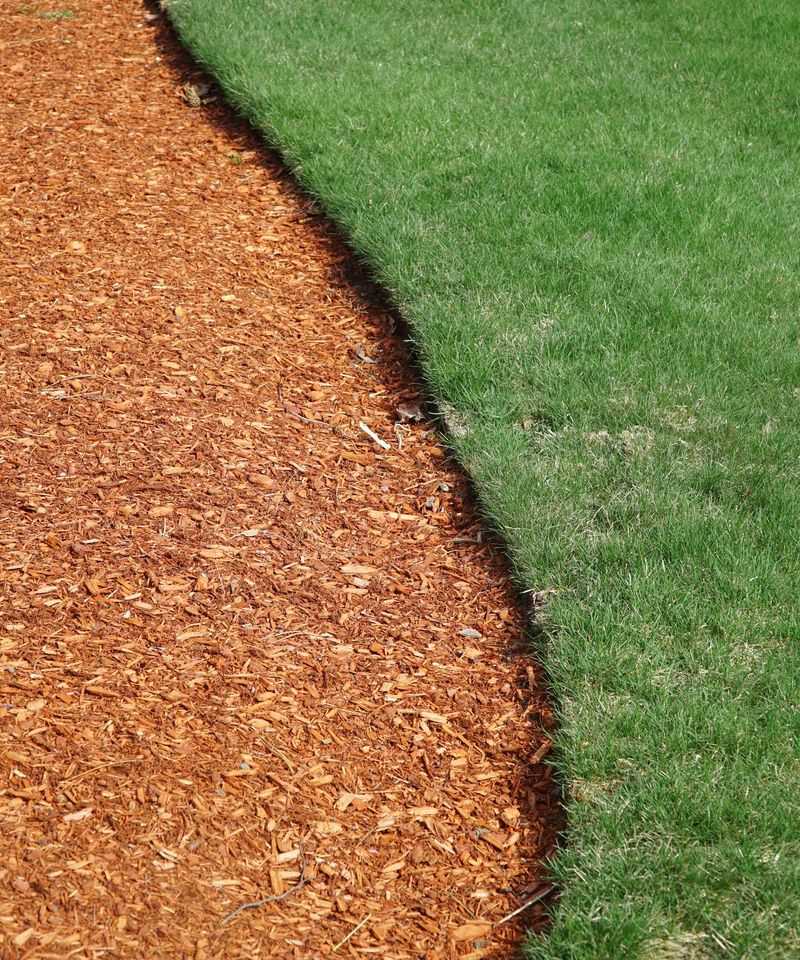
CDC guidance on preventing tick bites recommends clearing tall grass and brush, removing leaf litter regularly, and mowing the lawn on a consistent schedule. The same guidance describes a 3-foot-wide wood-chip or gravel barrier placed between the maintained lawn and any wooded or naturalized border as a useful way to reduce tick movement into frequently used yard areas.
Beautyberry’s arching, open form actually helps here if you manage the ground beneath it. Rake out accumulated leaf litter in fall and early spring, keep the grass mowed to the edge of the planting, and maintain that gravel or wood-chip strip if ticks are a real concern on your property.
The shrub itself does not control ticks, but a well-maintained fence line with beautyberry can look intentional, support wildlife, and still be a space you can actually walk along and check after an evening outside.
Expect Seasonal Color, Fruit, and Bare Branches
Beautyberry earns its keep for about half the year in ways that are genuinely visible from the patio. Small pink to lavender flowers open along the stems in late spring and early summer, modest in size but reliably produced.
By August, those flowers have given way to the berry clusters that stop people in their tracks, tight rings of purple, blue, pink, or white fruit wrapped around every stem at the leaf nodes. The berries typically hold from August through October and may persist into early winter, especially in a mild Coastal Plain fall.
Those berries do real ecological work. NC State Extension notes that more than 40 bird species may use the fruit, and the USDA NRCS plant fact sheet confirms the shrub’s value to songbirds and small mammals.
That wildlife benefit is worth celebrating on its own terms. Birds eating beautyberry fruit are doing exactly that, eating fruit, not patrolling your yard for mosquitoes, so keep the two ideas separate.
After the berries drop or the birds claim them, beautyberry goes dormant and drops its leaves. It is a deciduous shrub, which means no year-round leafy screen and no year-round plant-based repellency, even the theoretical kind.
The bare stems stand through winter, and then late February arrives, which is the moment to pick up the pruners and cut the plant back hard. That cut is what drives the flush of new growth that produces the next season’s flowers and berries.
Cut it, and next August the purple clusters come back even thicker.
Use Proven Controls Alongside the Plant
Beautyberry earns a spot along the fence. It does not earn a spot on the list of things that actually reduce how many mosquitoes find you on a Tuesday evening in July.
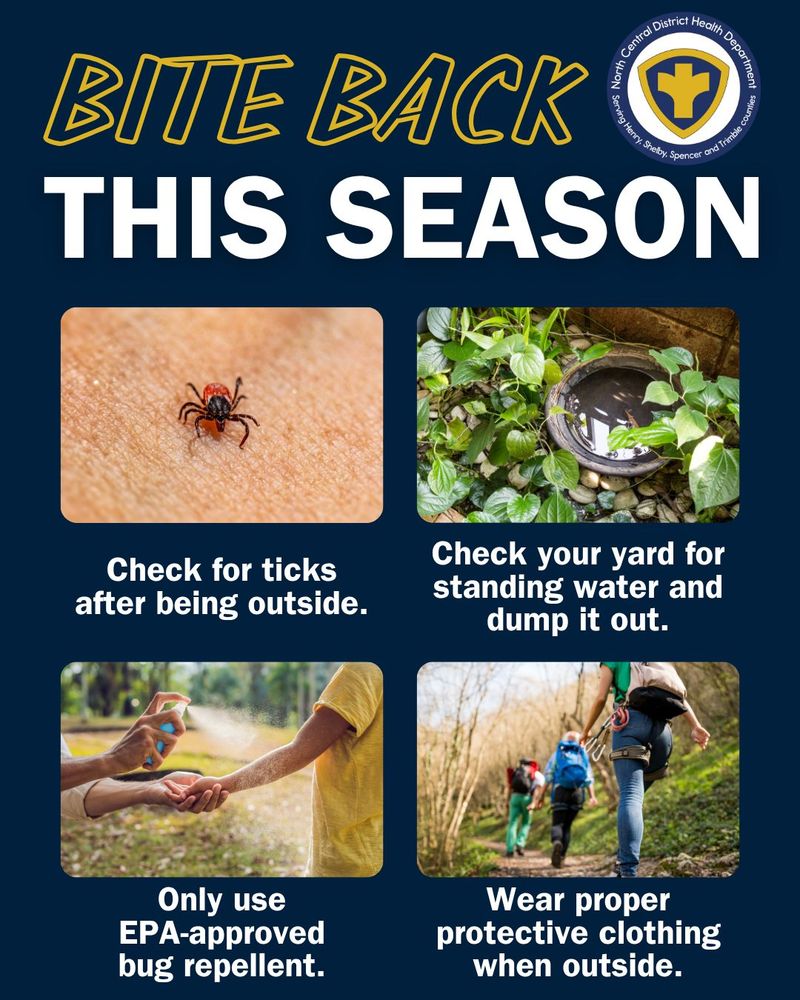
For that, the work starts with water. CDC guidance on mosquito control at home is straightforward: empty, scrub, cover, or turn over anything that holds water at least once a week.
That means flowerpot saucers, toys left in the yard, buckets, clogged gutters, tarps, rain barrels without tight screens, unused wading pools, and birdbaths.
North Carolina DHHS guidance adds that birdbath and pet-bowl water should be changed at least twice a week, and leaky outdoor faucets should be repaired promptly. A single clogged gutter over a Piedmont porch can produce hundreds of mosquitoes.
That is the antagonist worth focusing on, not the shrub along the back fence.
For personal protection when you are actually outside, use an EPA-registered skin repellent applied according to the label. Ingredients recognized by the CDC and EPA include DEET, picaridin, IR3535, oil of lemon eucalyptus, PMD, and 2-undecanone.
Do not substitute crushed beautyberry leaves or any homemade beautyberry preparation for a registered product. The leaf compounds have not been evaluated for safety and effectiveness as a topical application the way registered repellents have, and you would have no validated concentration, reapplication interval, or guidance for children.
For ticks, reinforce what you are already doing along the fence line: managed edges, short grass, leaf-litter removal, and a gravel or wood-chip barrier. Check yourself, your kids, and your pets after time in the yard, especially after August evenings near any wooded border.
CDC tick prevention guidance also covers appropriate pet protection products and when professional yard treatment may be worth considering. Beautyberry is a genuinely good plant for a North Carolina fence line, it just works best as one layer of a yard you have already made harder for biting insects to use.