
One Good Shade Tree Changes Your Yard More Than You Think
Follow us on Google
Step outside on a July afternoon and the patio feels like a skillet.
A single well-placed shade tree will not drop the air temperature by 20 degrees or slash your electric bill in half, but it can make the spot where you actually spend time feel noticeably cooler and more welcoming.
That difference comes down to blocking direct sun and cutting radiant heat off hot surfaces, and it depends entirely on choosing the right tree, putting it in the right place, and keeping it healthy through the early years.
Get those three things right, and one tree can quietly change how you use your yard.
Why One Canopy Can Feel Like Refuge
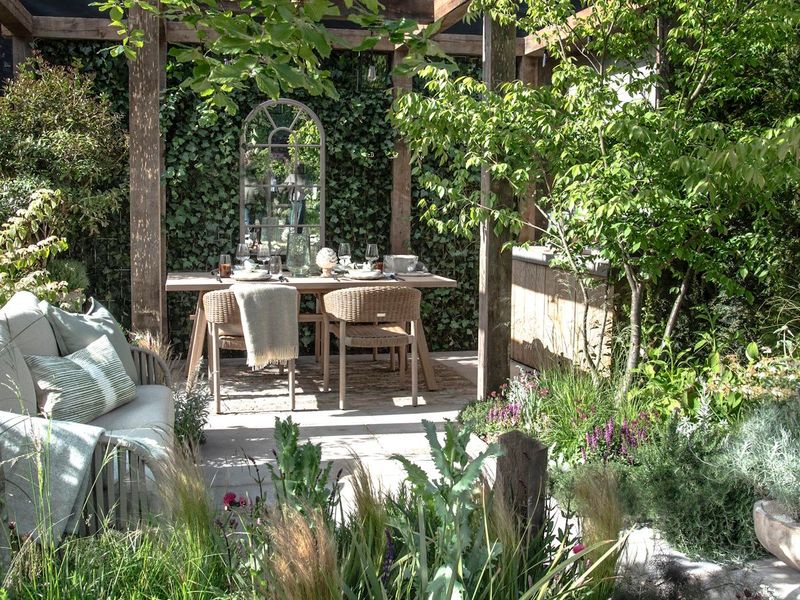
Stand on a sun-baked patio in August and you feel two kinds of heat at once.
The sun hammers down from above, and the concrete or pavers beneath your feet radiate heat back up at you.
A tree canopy addresses both, and that is why shade can feel so much more powerful than a simple air-temperature reading suggests.
Field research in residential parks in Phoenix found that dense tree canopies provided meaningful relief from heat and sunlight, with a 2018 Phoenix park study showing that solar radiation is a central driver of how hot people actually feel outdoors.
The air temperature in the shade and the sun might differ only a few degrees, yet the felt difference can be far greater because the canopy is blocking direct radiation and reducing heat bouncing off surrounding surfaces.
The EPA’s overview of tree and vegetation benefits explains that trees cool through both shade and evapotranspiration, the process by which leaves release water vapor.
Together, those two mechanisms can reduce surface temperatures and improve comfort in the space directly beneath and around the canopy.
None of that is automatic or universal.
The relief you get from one backyard tree depends on how large and dense the mature canopy becomes, how much paving or dark surface surrounds the area, local wind patterns, and whether the canopy actually reaches the place where you sit.
A small ornamental tree over an unused corner of lawn will do far less work than a large-canopied tree positioned to shade a patio at 3 p.m. on a hot afternoon.
The decisions that follow, where to put it, what species to choose, and how to establish it, are what determine whether the promise holds.
Put the Shade Where It Solves a Problem
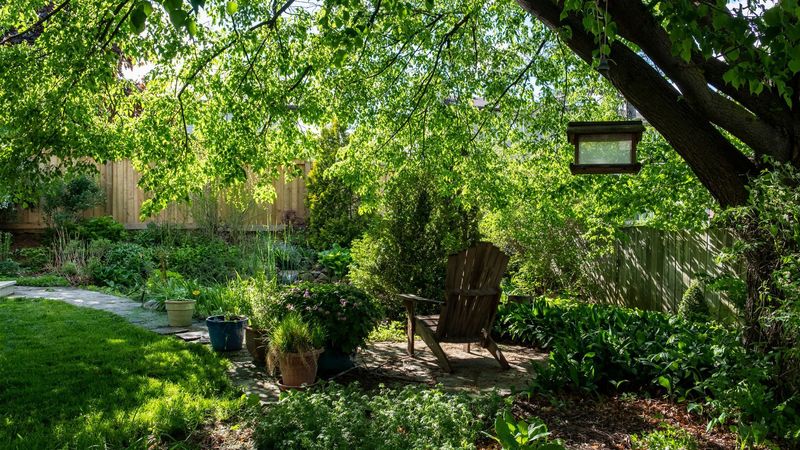
Before you pick a tree, spend time in your yard during its worst hour.
For most backyards, that is somewhere between 2 p.m. and 5 p.m. in midsummer, when the sun is still high but angled enough to pour directly onto a west-facing wall or deck.
Notice which surface makes you want to go back inside.
That is where the tree needs to work.
A tree earns its keep by shading the space people actually use, not the empty lawn nobody sits on.
Research on outdoor thermal comfort consistently points to solar radiation as the dominant factor in how hot a person feels outside.
Placing a tree so its mature canopy falls over a patio, play area, or outdoor dining spot at peak heat hours will deliver more practical benefit than a tree positioned for symmetry or curb appeal.
House-shading decisions require more care.
The angle of the sun, your home’s orientation, the size and placement of windows, your local climate, and winter heating needs all interact in ways that vary by region and household.
The US Department of Energy’s home cooling guidance notes that trees on the west and east sides of a house can block low-angle morning and afternoon sun, while a deciduous tree on the south side may shade summer sun while allowing winter light through bare branches.
But those principles are starting points, not rules that apply equally in Tucson, Minneapolis, and coastal Georgia.
The practical standard is to map your site before you commit to a location.
Watch where the sun lands during the hottest period of the day, identify the surface or spot that causes the most discomfort, and plan the planting location so the mature canopy, not the nursery-sized tree you bring home, covers that exact area.
Choose for the Canopy You Will Live With
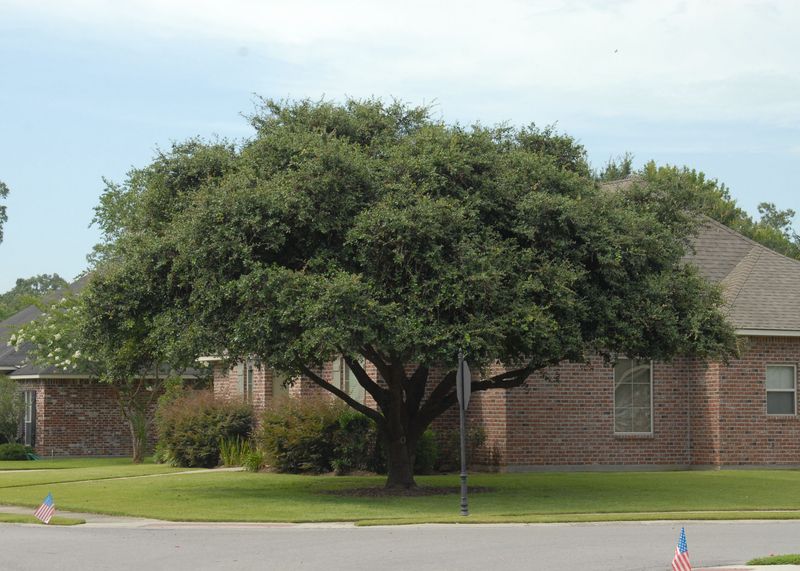
The tree you carry home in a 15-gallon pot might be 8 feet tall today.
That same species could top 50 feet and spread 40 feet wide within two or three decades.
Buying for the nursery size and ignoring the mature canopy is one of the most common and costly mistakes a homeowner can make.
ISA guidance on choosing the right tree lists mature height and spread, soil drainage, sun exposure, wind, disease susceptibility, proximity to sidewalks and driveways, and overhead and underground utilities as factors that should all be checked before a species is chosen.
USDA hardiness zones tell you whether a tree can survive winter cold in your area, but they say nothing about summer heat, rainfall, soil drainage, salt exposure, or wind, so zone numbers work best alongside regional extension advice and an honest look at your specific site.
Planting directly beside a house is not a universal shade strategy.
The right distance depends on the tree’s mature crown and root spread, the foundation type, nearby utility lines, and which part of the house you are trying to shade.
Roots do not automatically threaten every foundation or pipe, but a species with a wide, shallow root system planted in a narrow strip between a driveway and a wall can create real conflicts over time, as Penn State Extension’s guidance on construction-damaged soils makes clear.
Overhead utilities deserve a specific check.
ISA’s utility conflict guidance recommends tall trees be planted at least 50 feet from distribution lines, with shorter species used beneath or near lines.
Local utility rules are sometimes stricter, so call before you dig and confirm what your provider requires.
A tree that grows into a power line will eventually be pruned in ways that compromise its structure and its shade.
Give the Root Flare Room to Breathe
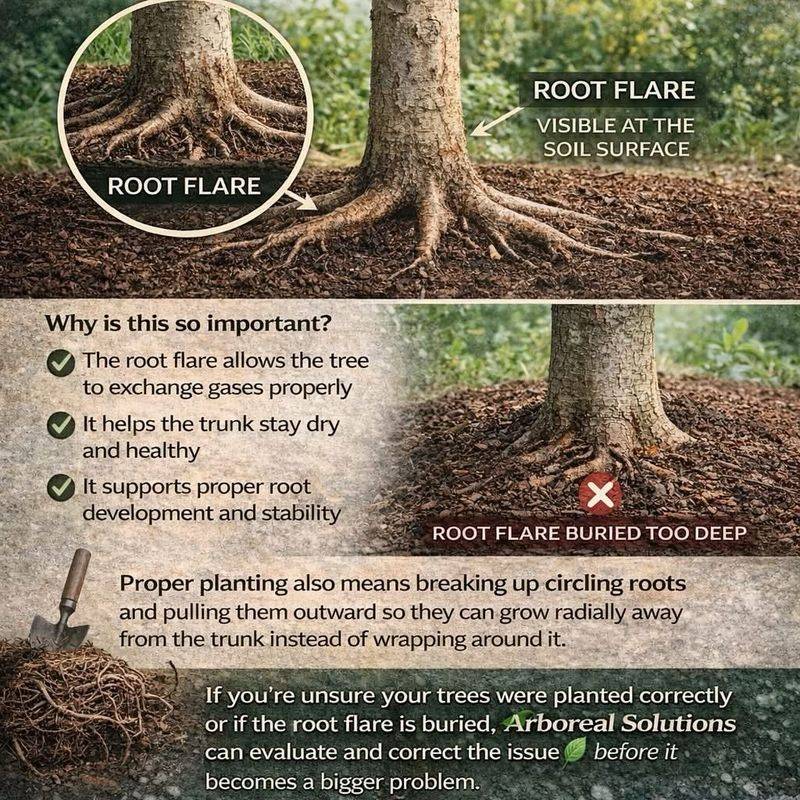
At the base of every tree, the trunk widens and flares outward before it transitions into the major roots.
That flare is supposed to sit above the soil line, visible and exposed to air.
Bury it, and you set the tree up for a slow decline that may not show for years.
University of Minnesota Extension’s planting guidance is direct on this point: the planting hole should be about twice the width of the root ball but no deeper than the root ball itself.
Digging deeper and then backfilling does not help, because loose backfill settles and the root flare ends up buried anyway.
The goal is to set the root ball on firm, undisturbed soil so the flare stays right at or just above grade.
When the root flare is buried, the tissue at the base of the trunk stays too wet, oxygen cannot reach the roots effectively, and conditions favor decay and girdling roots, roots that circle back and eventually choke the trunk.
Penn State Extension’s tree myths resource also corrects the idea that deep planting produces deeper, stronger roots.
Many roots naturally occupy the top 12 to 18 inches of soil, where oxygen is most available.
Planting deeper does not change that, it just stresses the tree.
Staking is a related decision that homeowners often get wrong in the other direction.
Penn State Extension’s garden myths guidance notes that a stable tree with a firm root ball may not need staking at all.
Unnecessary staking can restrict the natural trunk movement that builds taper and strength.
Temporary staking makes sense on exposed, windy, or sloped sites, for bare-root trees, or when the root ball is genuinely unstable, but it should come down within one growing season once the tree can stand on its own.
Support the Tree Through Establishment
Planting day is not the finish line.
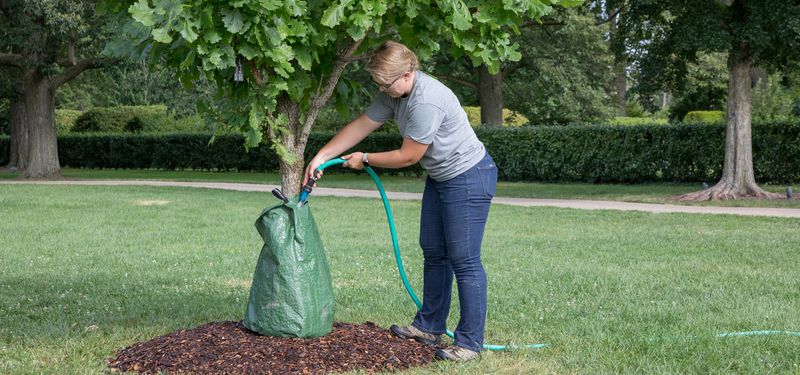
A newly planted tree has a fraction of its original root system in contact with surrounding soil, and until those roots spread outward and anchor into new ground, the tree is relying almost entirely on you for water.
That early period is when most trees fail, and most of them fail from too little water, not too much neglect later on.
University of Minnesota Extension’s watering guidance for newly planted trees offers a schedule worth using as a starting framework: water daily during the first one to two weeks, shift to every two to three days from weeks three through twelve, then move to weekly watering until the tree is established.
A practical volume is 1 to 1.5 gallons of water per inch of trunk diameter at each watering.
A 2-inch-caliper tree, for example, needs roughly 2 to 3 gallons per session.
Establishment timelines are planning estimates, not guarantees.
The same Minnesota guidance describes roughly 1.5 years for a 1-inch-caliper tree, about 3 years for a 2-inch tree, and around 4.5 years for a 3-inch tree.
Larger specimens, compacted soils, hot and dry climates, and sites with poor drainage can push those timelines well beyond three years.
Adjust everything, the schedule, the volume, the frequency, based on your rainfall, soil texture, heat, and wind.
Mulch is the other half of establishment care.
A 3-inch layer of organic mulch spread over the root zone conserves moisture, buffers soil temperature, and suppresses weeds.
Keep it pulled back from the trunk and root flare so those surfaces stay dry and exposed to air.
Piling mulch up against the bark, the classic volcano shape, holds moisture against the trunk and encourages the same decay and girdling root problems that come from planting too deep.
More mulch is not better.
Three inches, flat, with a clear gap around the base, is the right approach.
Build Wildlife Value in Layers
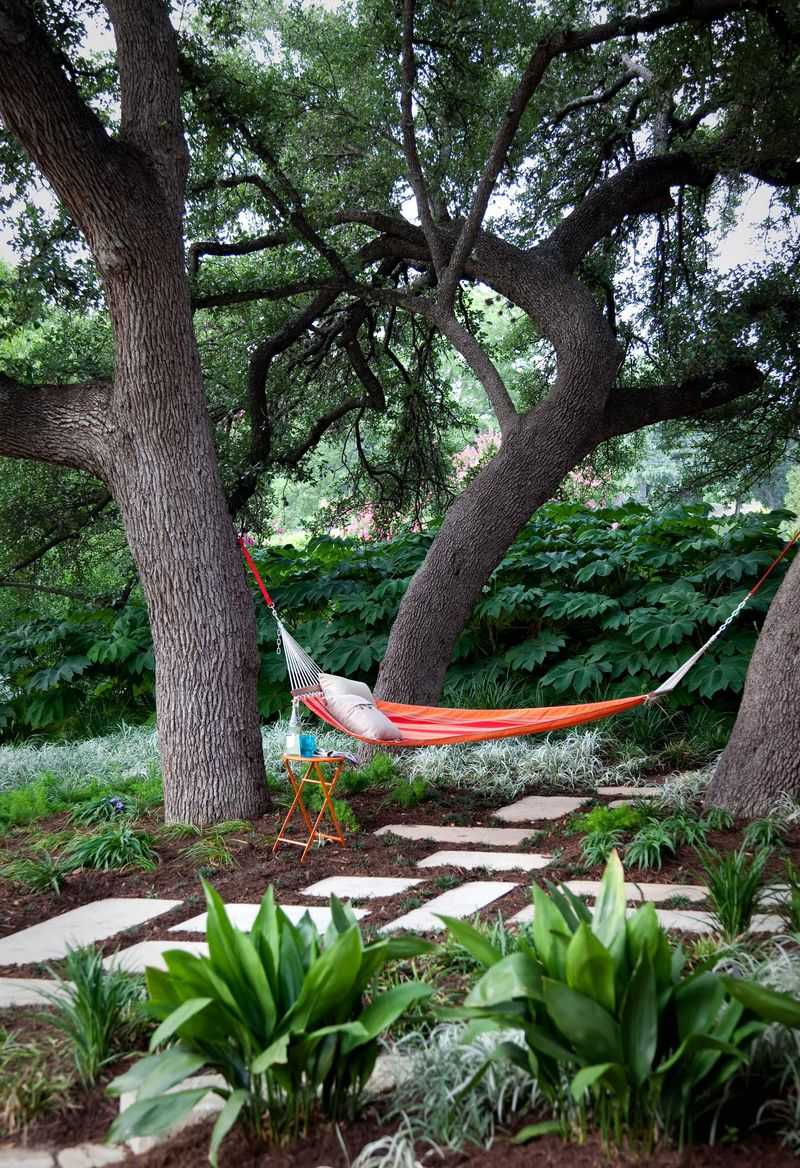
A single tree can offer a lot to the animals that share your neighborhood.
Branches become perches and nesting platforms.
Bark crevices shelter insects.
Fruit and seeds feed birds and small mammals.
Caterpillars feeding on leaves become the protein source that most songbirds rely on to raise their young.
But whether any of that actually happens in your yard depends on more than just planting a tree.
The USDA Forest Service’s urban and community forestry program recognizes that locally appropriate tree species often support a wider range of native insects and wildlife than ornamental species bred for appearance.
The connection between native insects and native plants developed over long periods, so a tree that is native to your specific region tends to host more insect life than one imported from a different part of the country.
Native status is always regional.
A river birch (Betula nigra) native to the Southeast and Midwest is not native to the Pacific Northwest or the Southwest high desert.
One tree is only one layer of habitat.
The USDA Natural Resources Conservation Service’s Backyard Conservation guide recommends combining trees with shrubs, flowering plants, leaf litter, nesting cover, and a clean water source to provide food, shelter, and nesting opportunities across multiple habitat layers.
Adding those elements around your shade tree can strengthen its wildlife value, though the outcome still depends on your region, local predator pressure, pesticide use, and what habitat exists in the surrounding landscape.
Wildlife response is also tied to regional native plant guidance and tree maturity.
A young tree offers less than a mature one, and a yard with diverse plantings and a water source will generally support more species than an isolated tree surrounded by mowed turf.
The tree is a starting point, not a complete answer.
Keep the Promise—and the Risks—in View
Shade from a well-placed tree can make a hot backyard spot feel genuinely more comfortable, but that is a different thing from a dramatic drop in measured air temperature.
The relief comes from blocking direct sun and reducing radiant heat from surrounding surfaces, and it varies by canopy size, density, surrounding paving, and how well the placement matches the problem.
Anyone who promises a specific degree drop for every yard is overstating what the research supports.
Energy savings follow the same logic.
A US Forest Service analysis of urban and community trees estimated meaningful energy benefits at scale, but those figures describe modeled effects across many trees and locations, not a fixed bill reduction from one new backyard tree.
Whether a single tree reduces your cooling costs depends on your home’s orientation, window placement, climate, insulation, and how well the mature canopy shades the walls and glass that matter most.
EPA guidance on tree benefits frames the potential accurately: placement and species matter, and savings are possible, not guaranteed.
Trees also create real conflicts when the species and planting space are poorly matched.
Penn State Extension’s guidance on construction-damaged soils notes that compacted soil limits rooting and can shorten tree life, while a large-rooted species in a narrow strip between pavement and a structure is a predictable future problem.
Always check for buried utilities before digging, and call 811 to have lines marked.
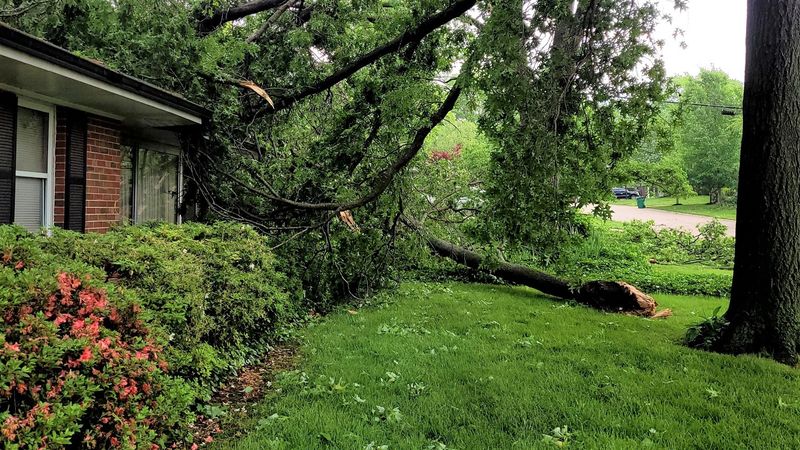
As the tree matures, dead branches, weak branch unions, cavities, and storm damage all become legitimate concerns.
ISA’s hazard and risk guidance recommends contacting a qualified arborist for serious storm damage, large hazardous limbs, or any work near power lines.
The best standard for the whole process is simple: choose a healthy tree that fits the site, put it where people and habitat can actually benefit, and tend it carefully through establishment.
That is a realistic promise, and it is one a single good tree can keep.