
Why An Eastern Indigo Snake Crossing Your Florida Lawn Is Genuinely Good News
Follow us on Google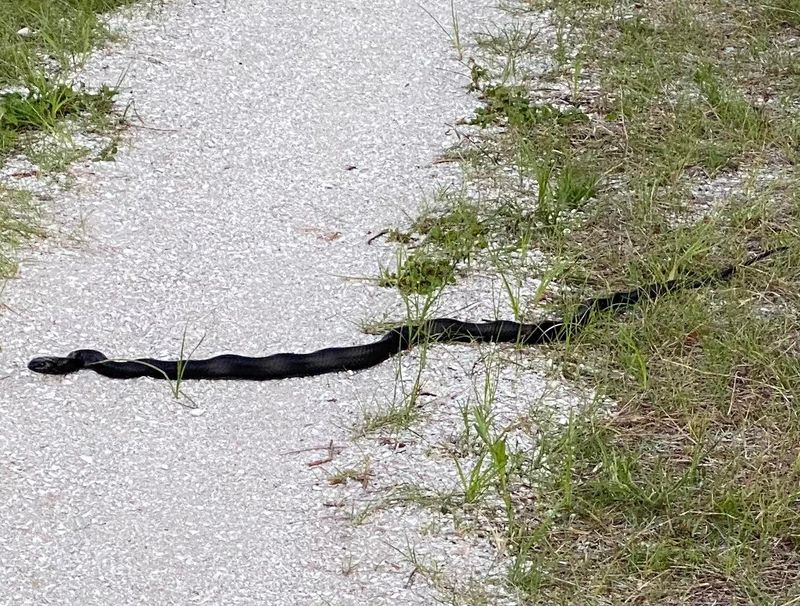
You’re watering the azaleas one humid Florida morning when something long, black, and shiny slides across the grass. Your first thought might be a shovel, but hold on.
If it’s an eastern indigo, you just saw a protected native snake that eats other snakes, including rattlesnakes. Here’s what that sighting does and does not mean, and what to do while it passes.
The Glossy Black Snake May Be an Indigo
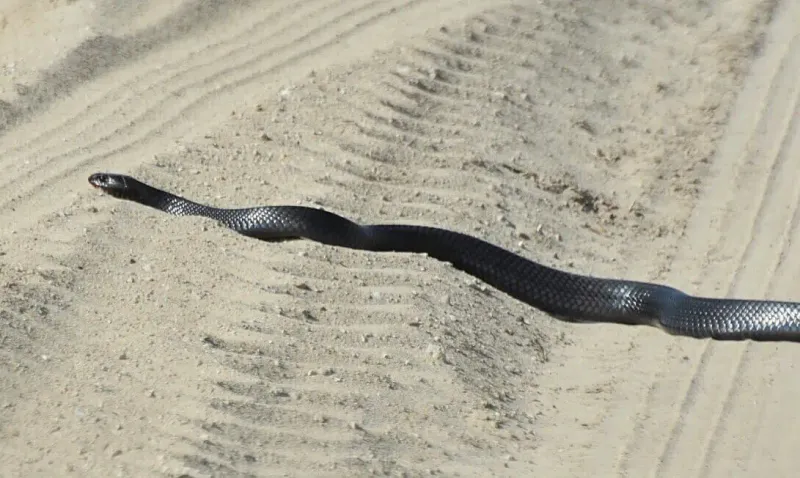
Picture a snake so shiny it looks polished. The eastern indigo is glossy black or bluish-black, often with blue or purple highlights in the sun.
Its chin and throat are often reddish, orange, cream, white, or dark.
Size is part of the wow factor. The Florida Museum of Natural History says adults commonly measure about 60 to 82 inches, with a recorded maximum of 8.6 feet.
That is a lot of snake crossing a lawn.
Here is the catch. Color and size alone cannot confirm what you are looking at, because Florida has other dark snakes, including racers and coachwhips.
Plenty of big black snakes are not indigos, and nobody should assume otherwise.
The good news is simple. The eastern indigo is nonvenomous and is not considered dangerous to people or pets.
That is a fact about this one species, not a promise about every snake in your yard.
So how do you check? You do not.
UF/IFAS Gardening Solutions advises leaving snakes alone, and that includes never walking up for a closer look or picking one up to identify it. Watch from a distance, enjoy the show, and let it go on its way.
Rattlesnakes Are Prey, But Not the Whole Menu
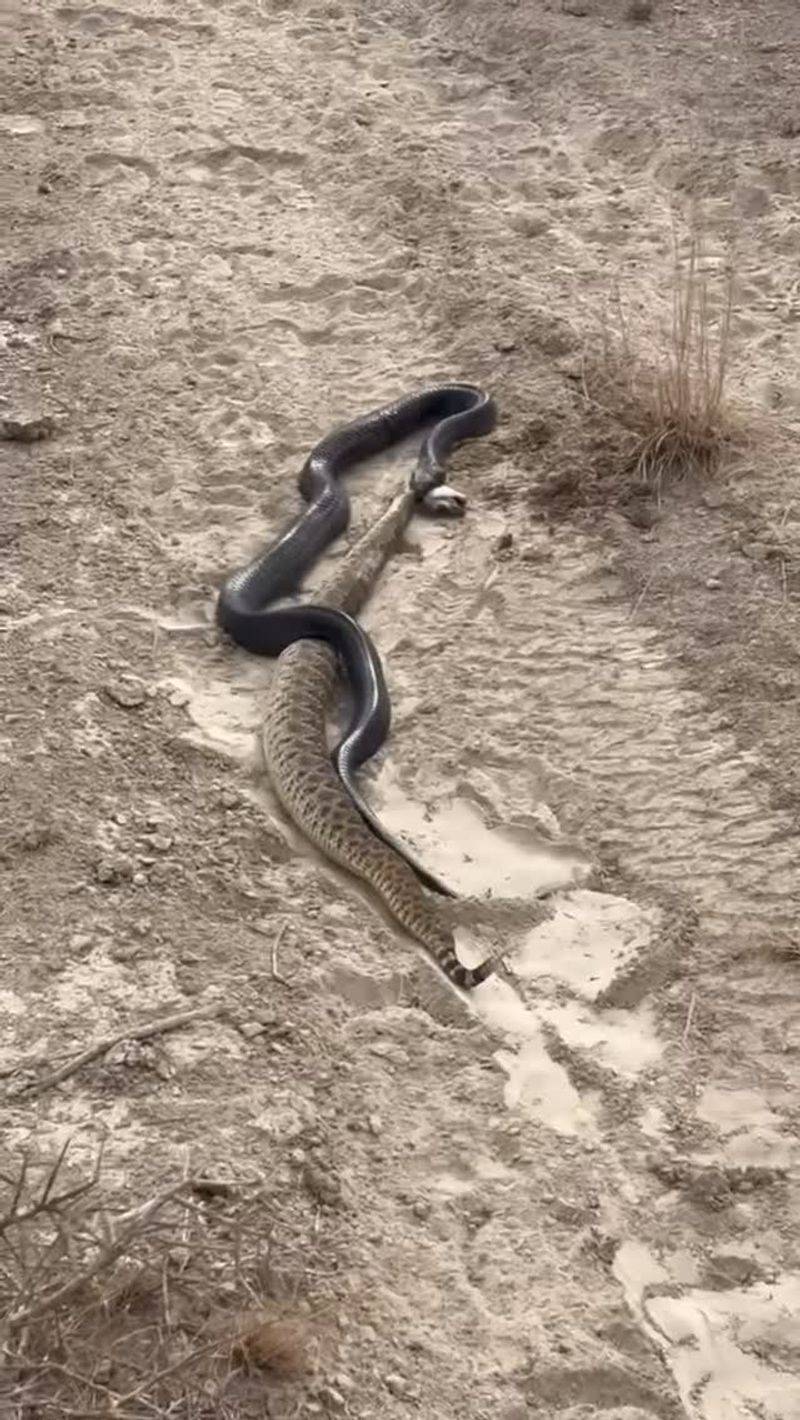
Here is the headline fact that makes people cheer. Eastern indigos eat other snakes, and a compiled set of prey records includes eastern diamondback rattlesnakes.
So the rattlesnake-eater reputation is genuinely earned.
Now the fine print. Rattlesnakes are one documented item on a long menu, not the main course.
Florida Fish and Wildlife Conservation Commission (FWC) lists small mammals, birds, frogs, toads, turtles and their eggs, lizards, and even small alligators.
The Florida Museum says the snake appears to prefer reptiles, including venomous snakes, but it also eats mammals, amphibians, and birds. A hungry indigo is an opportunist, not a rattlesnake specialist.
That is why one sighting should not be read as a pest-control service. An indigo passing through does not mean it will clear your yard of rattlesnakes, and it does not mean rattlesnakes are nearby.
Think of it like a hawk overhead. You can admire what it does without expecting it to patrol your garden on your schedule.
Its place in the food web is the real story.
One Crossing Does Not Map Its Home
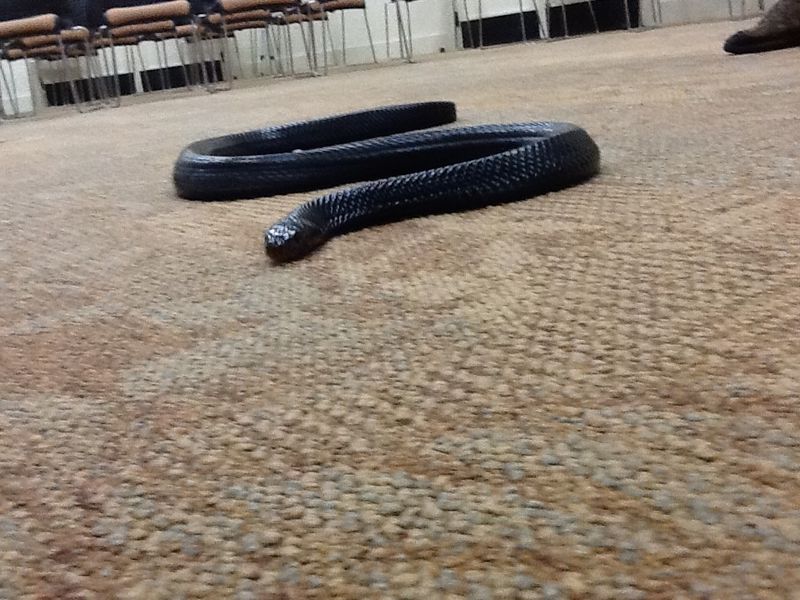
A snake on your lawn feels personal, like it picked your yard. Usually it is just passing through.
Eastern indigos use varied habitats, move with the seasons, and can have large home ranges.
In plain terms, that means the lawn could be a small piece of a much bigger travel route. A U.S.
Fish and Wildlife Service biological opinion describes this kind of habitat use and movement.
So a crossing does not prove the snake lives on your property. It also does not tell you what other snakes are nearby, or that your yard has especially healthy habitat.
Those are tempting stories, but one sighting cannot back them up.
Where could it be? FWC says eastern indigos occur in peninsular Florida and southeastern Georgia.
The Florida Museum reports sightings throughout Florida, but says sightings in the Keys are extremely rare.
That means a big black snake in the Panhandle or the Keys deserves extra caution before anyone says indigo. Still, a real sighting is meaningful.
You witnessed a rare animal on the move, and that is worth a moment of wonder.
Protected Status Makes the Sighting Matter

Many people assume a snake this big must be everywhere. It is not.
The eastern indigo is federally threatened, which is why calling it a protected native is accurate. Endangered is not its current federal listing category.
The U.S. Fish and Wildlife Service Florida office keeps a list of threatened and endangered species in the state, and this snake appears on it.
This article does not set any legal rules beyond that, so check official sources for specifics.
FWC names habitat destruction, fragmentation, and degradation among the pressures it faces. Roads add danger through vehicle strikes, and some snakes are captured or intentionally killed.
That last one is where your reaction matters. A homeowner who sees a huge dark snake and grabs a shovel could end the life of one of Florida’s rarest native predators.
One yard sighting does not prove the species is thriving. It is a glimpse, not a report card.
Still, leaving the snake undisturbed is the simplest thing anyone can do to help it.
What Should You Do While It Passes?
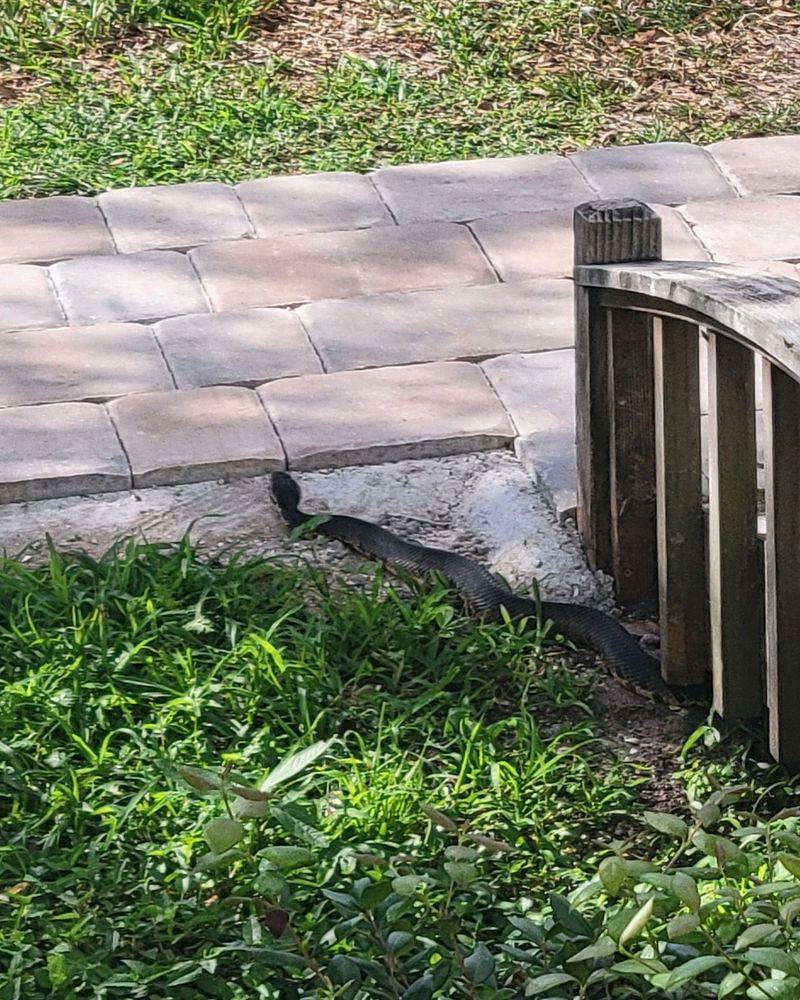
The best plan is a boring one. Stay back, keep children and pets well away, and let the snake leave on its own.
Most of the time it will be gone in a minute or two.
Do not touch it, catch it, corner it, or kill it. Cornered animals of any kind may defend themselves, and an escape route is the kindest and safest gift you can give.
Just as important, do not walk closer to figure out what it is. If you cannot identify the snake, treat it as unknown and keep your distance.
A glossy black coat is not a safe test.
FWC’s general guidance is to watch snakes from a distance and leave them alone. That advice fits every snake in Florida, not just indigos.
What if you think the snake may be venomous? UF/IFAS recommends leaving it alone and contacting a professional.
Do not try to intervene.
Venom resistance in an indigo is no reason to step in on its behalf, either. It does not make the snake invulnerable.
Let it travel, then go back to your watering.
A Good Sighting Is Not Yard Control
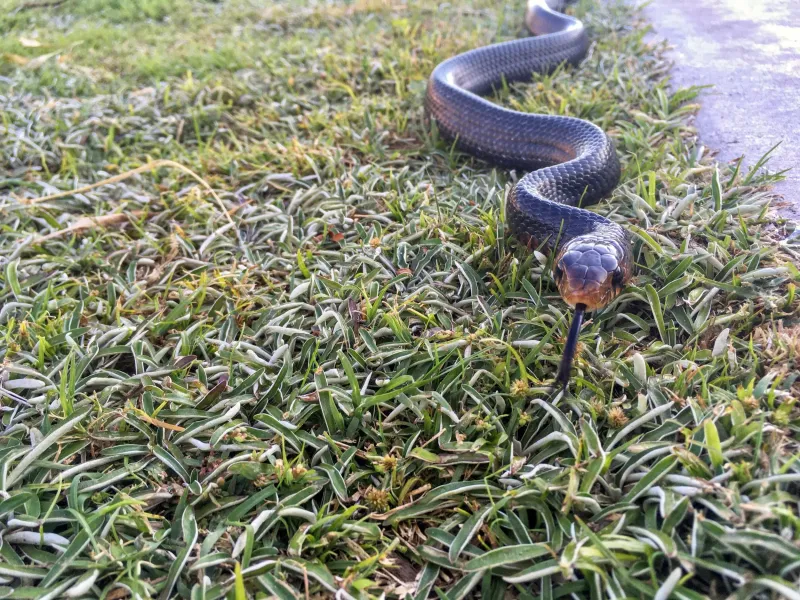
Once the snake has moved on, you can still do something useful. FWC asks the public to report suspected eastern indigo sightings through its Rare Snake Registry.
Your report helps scientists track a species that is hard to find.
A photo can help confirm identification, but only if you can take it safely from a distance. Never follow or approach the snake for a better shot.
No picture is worth chasing, and an unclear photo is still better than a close call.
Here is how to think about what you saw. The encounter is good news because a protected native predator passed through, as described on the FWC species profile.
It is not a guarantee of fewer rattlesnakes, and it does not prove the indigo lives on your property.
That is plenty to appreciate. The snake you nearly feared is part of the wild Florida that surrounds your lawn.
