
Texas Lantana Is The Fence-Line Plant Behind The Mosquito Claim, And Here Is What The Research Actually Says
Follow us on Google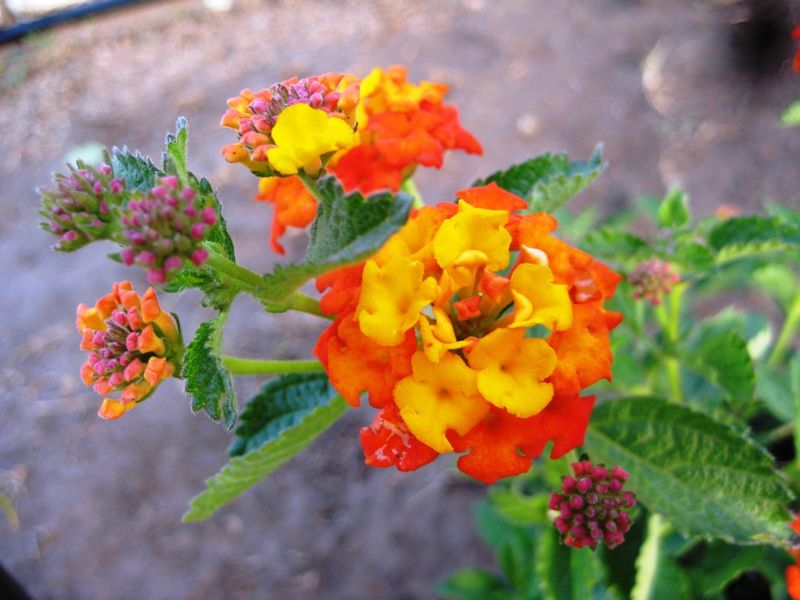
You step outside on a July morning in Central Texas and the air is already thick, the patio furniture warm to the touch, and the mosquitoes are waiting.
Someone told you that yards with a certain plant along the fence tend to have fewer of them, and now you want to know if that is actually true.
The plant people are talking about is Texas lantana, and it genuinely is one of the toughest, most beautiful fence-line shrubs you can grow in this state.
But the mosquito story is more complicated than the headline makes it sound, and you deserve the straight version.
The Likely Plant Is Texas Lantana
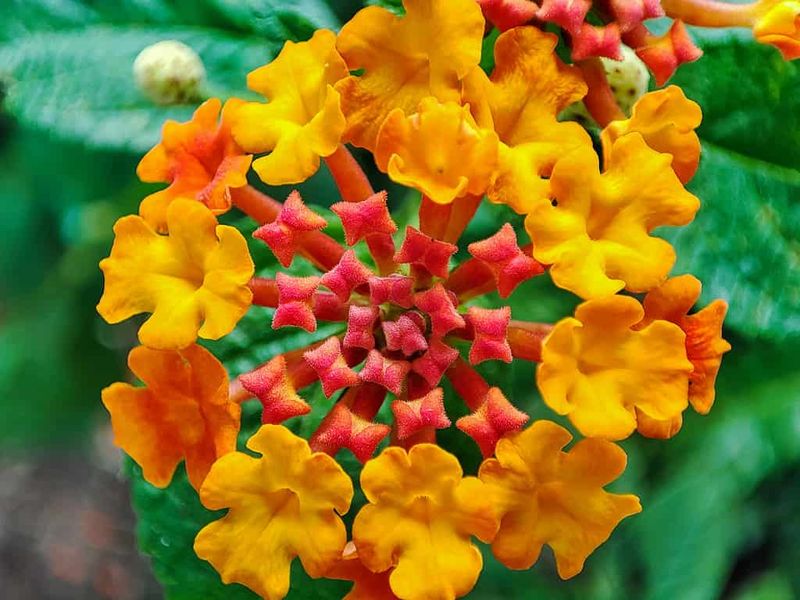
Walk through any well-established Central Texas neighborhood in June and you will spot it: a sprawling, sun-loving shrub covered in tight clusters of orange and yellow flowers, growing right along the fence line without a drip system in sight.
That plant is almost certainly Texas lantana, known botanically as Lantana urticoides, featured in Texas A&M AgriLife Extension guidance as a heat-tough, drought-tolerant landscape plant.
You may also see it listed under the older name Lantana horrida, which is simply a naming variant for the same species.
Texas A&M describes mature plants reaching roughly 4 to 6 feet in height and spread, which makes them a natural fit for screening a fence line without constant attention.
They bloom from approximately April through October, tolerate full sun, and pull through long dry stretches once they are established.
Those are genuinely impressive credentials for a Texas summer.
Here is the part that needs saying right up front: those landscape strengths do not prove that Texas lantana controls mosquitoes.
The headline connecting this plant to fewer mosquitoes in Texas yards is not backed by a statewide survey or a controlled Texas landscape study.
Plant it because it performs beautifully in the right spot, not because it promises to keep the bugs away.
One more thing before you head to the nursery.
The word lantana covers a lot of ground.
Common lantana, Lantana camara, is a separate species with different characteristics, and many nursery tags simply say lantana without specifying whether the plant is Lantana urticoides, Lantana camara, a hybrid, or a cultivar.
Check the botanical name before you apply any species-specific advice, including the planting and pruning guidance in this article.
The Mosquito Research Does Not Prove A Texas Hedge Works
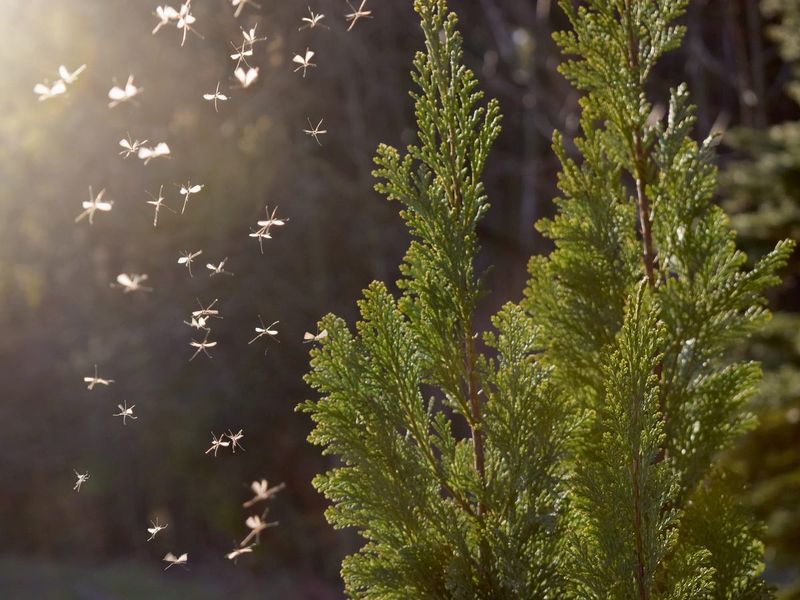
The research on lantana and mosquitoes is real, and it is interesting.
But it does not say what the headline implies, and pulling it apart is worth your time before you spend a summer counting on a shrub to do a job it has not been tested for.
Start with the oldest and most-cited study.
A 1996 study reported 94.5 percent protection from mosquito bites when lantana flower extract was mixed into coconut oil and applied to skin, with protection lasting roughly 1.9 hours on average.
That is a topical skin application test, not a yard-wide effect.
The extract was processed, concentrated, and rubbed directly on a person.
A flowering shrub growing 6 feet away from your lawn chair is a completely different situation.
A more recent finding comes from laboratory work.
The concentrations used were precise experimental doses, not the natural scent drifting off an intact plant on a breezy Texas afternoon.
Laboratory results like this point toward possibilities, not proven backyard outcomes.
The field study that comes closest to a real-world test happened in Tanzania.
That Tanzanian field study reported roughly 50 percent fewer indoor mosquitoes in homes surrounded by dense living lantana, with reductions in two malaria-vector species.
But the setting was tropical, the goal was reducing mosquitoes entering homes through screened points, and the study did not measure outdoor patio mosquito counts or test anything resembling a Texas fence border.
Iowa State Extension puts it plainly.
Iowa State guidance confirms that planting mosquito-repellent plants near a home has not been shown to work reliably as a mosquito-control method.
No cited study establishes that intact Texas lantana planted along a fence reduces the mosquito population in a residential Texas yard.
The plant has real research behind it, just not the research the headline is selling.
Plant It For The Landscape Benefits
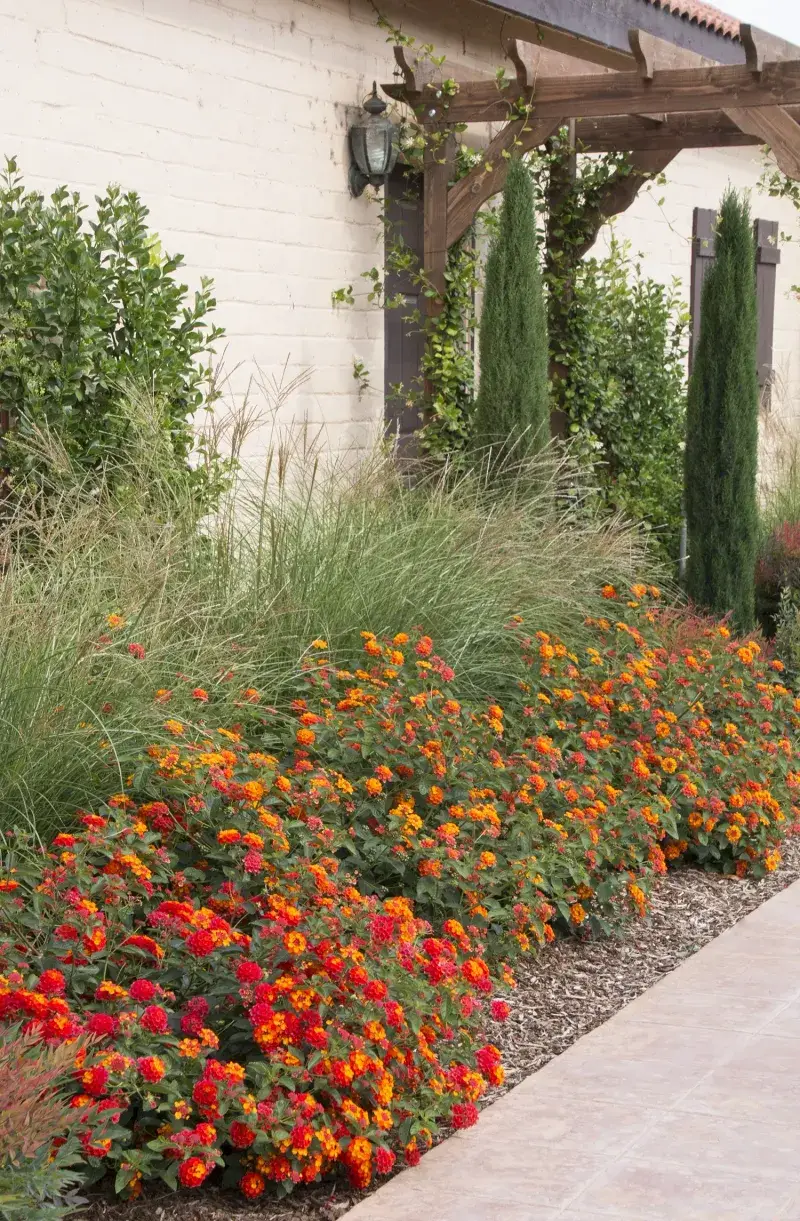
Set aside the mosquito question for a moment and look at what Texas lantana actually delivers.
For a sunny, well-drained fence line in parts of Central or South Texas, it is a genuinely hard plant to beat on pure landscape merit.
Texas A&M AgriLife Extension highlights lantana as a Texas Superstar plant, recognized for its ability to thrive in conditions that flatten less adapted ornamentals.
Full sun means at least 6 hours of direct sunlight daily, and Texas lantana leans into every hour of it.
The bloom period runs from approximately April through October in the cited AgriLife guidance, which covers the entire stretch of Texas summer when you most want color and life in the yard.
Butterflies find it irresistible.
Hummingbirds work the flower clusters on their way through during migration.
If you are in Central Texas during the fall monarch migration, a healthy lantana in full bloom can become a small spectacle along your fence line, with orange-winged visitors stopping for fuel before moving south.
Drought tolerance after establishment is the trait that makes it practical for Texas conditions.
Once the roots are settled, the plant can handle long dry stretches without supplemental water, which matters during summer water restrictions across much of the state.
It is low-maintenance in the right location, not fussy, and does not demand the kind of care that burns out a homeowner by August.
Treat it as a drought-tough ornamental and pollinator plant that improves screening and habitat along your fence.
That framing is accurate and useful.
Calling it a pest-control device is where the story goes sideways.
Choose Sun, Space, And Fast Drainage
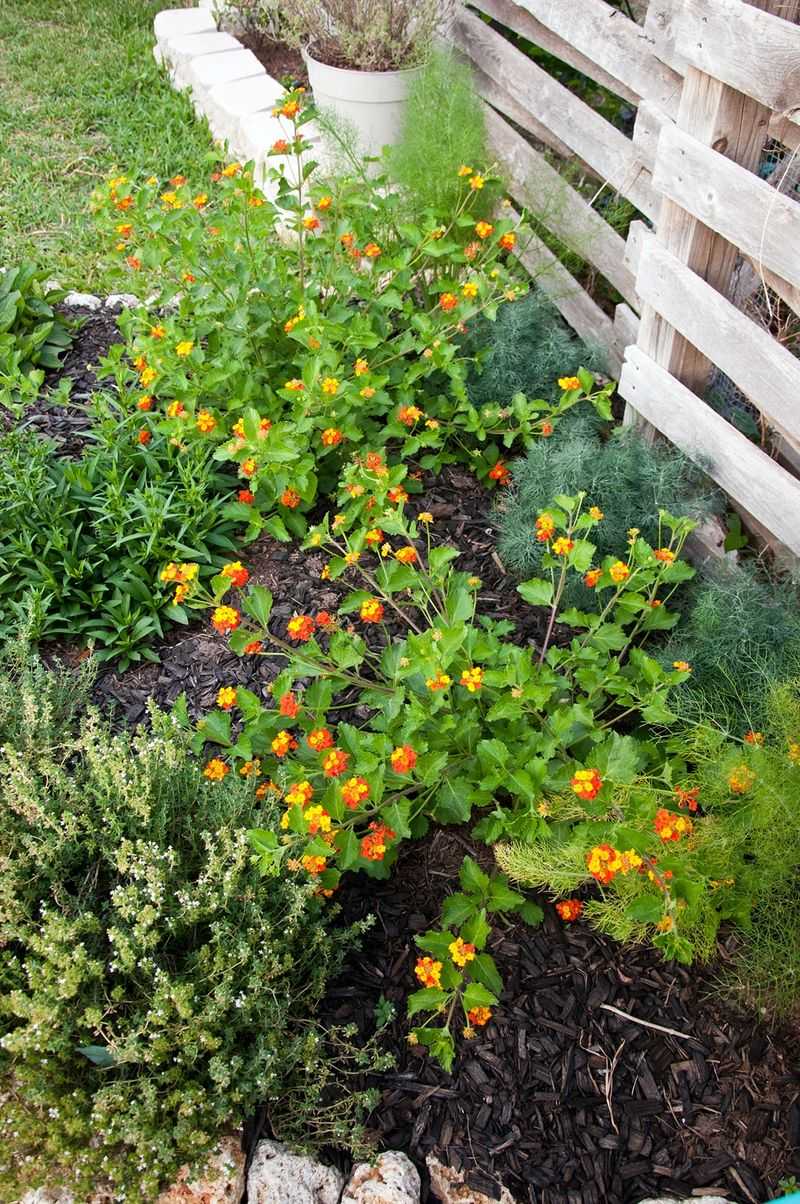
Getting Texas lantana right along a fence line comes down to three things: enough sun, enough space, and soil that does not hold water.
Nail all three and the plant will mostly take care of itself.
Miss one and you will wonder why it looks rough by midsummer.
Texas A&M AgriLife Extension recommends spacing plants at least 4 feet apart to allow for the mature spread of roughly 4 to 6 feet.
Along a fence, that spacing also keeps air moving between plants, which matters more than it sounds when summer humidity climbs.
Choose the sunniest strip of fence you have, not the shaded corner where nothing else wants to grow.
Soil is where Texas gets complicated.
Blackland clay in North and Central Texas holds water long after a rain, and lantana roots sitting in wet clay can decline quickly.
If your fence line sits in heavy clay, raise the planting area a few inches or amend aggressively with coarse material before planting.
In the Hill Country and West Texas, shallow caliche can stop roots from going deep, limiting the plant’s ability to find moisture during dry spells.
East Texas and the Gulf Coast bring high humidity and periodic heavy rain, so drainage becomes even more important in those regions.
During the first season, deep watering every 7 to 10 days helps roots establish.
Once the plant is settled, a deep weekly watering during extreme summer heat can support performance without pushing it into constantly wet soil.
Overwatering is a real risk.
Permanently wet soil will damage or kill the plant faster than a Texas drought will.
Keep stems from pressing directly against the fence when airflow is limited, and avoid planting in a low spot that collects runoff from the lawn or from a downspout.
Good drainage is not optional for this plant, it is the whole game.
Prune In Early Spring And Assess Freeze Damage First
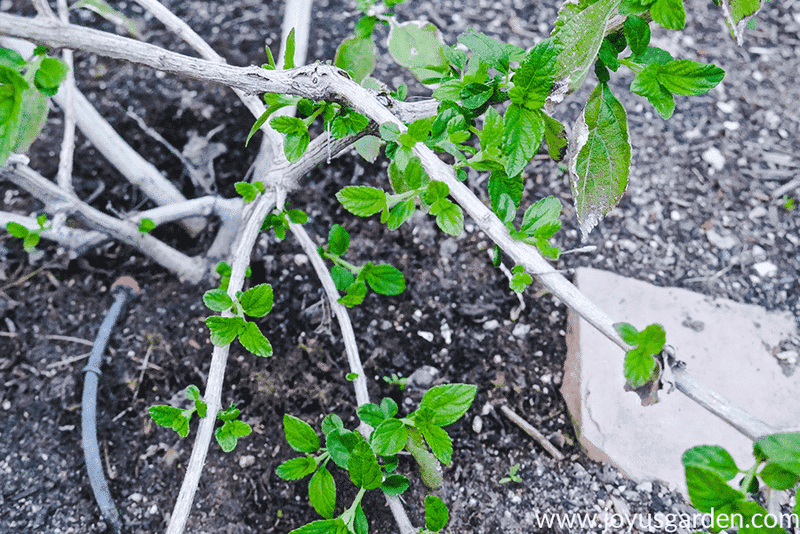
Pruning Texas lantana is straightforward once you know the timing, and the timing is the part most people get wrong.
Many gardeners see a freeze-damaged, brown, woody mess in January and reach for the loppers immediately.
That is worth slowing down on.
Texas A&M AgriLife Extension recommends cutting Texas lantana back to about 8 inches in early spring to encourage fresh growth from the base.
That is the standard annual reset, and it works well for most Texas locations.
Long stems that make the plant look unruly during the growing season can be shortened as needed to maintain a manageable shape without waiting for the full spring cutback.
After a hard freeze, the approach changes.
Wait until the freeze damage is clearly visible and the threat of additional freezes has passed before cutting back damaged growth.
A late cold snap in February or early March can follow a warm spell, and cutting back too early removes the top growth that was insulating the crown.
Let the plant tell you what survived before you decide how far to cut.
Zone 8 through 11 is the general hardiness range cited for Texas lantana, but that covers an enormous amount of Texas geography.
Panhandle and northern Texas gardeners may see significant freeze-back or occasional plant loss in a hard winter, while South Texas and the Lower Rio Grande Valley can keep plants growing through much of the year with little cold damage.
Microclimate, plant age, soil drainage, and how long the freeze lasts all affect the outcome.
Also verify what you planted.
Common lantana, Lantana camara, and various hybrids behave differently from Texas lantana in cold hardiness and growth habit.
Do not assume a nursery lantana is Lantana urticoides without checking the tag.
Keep The Planting Open, Not Damp
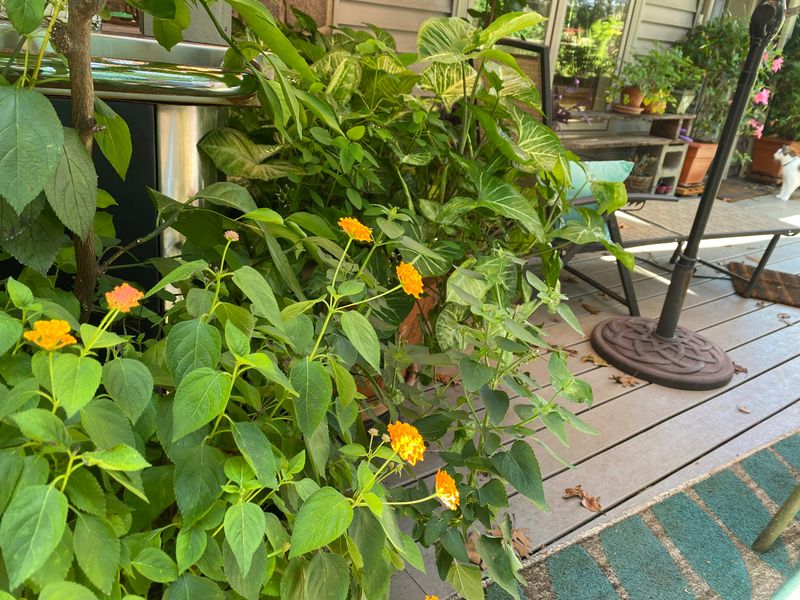
Here is where the mosquito story takes an unexpected turn.
A dense, shaded, constantly damp planting along a fence is not mosquito-hostile territory.
Adult mosquitoes actually seek out cool, dark, humid spots to rest during the heat of the day, and thick vegetation is one of their preferred hangouts.
Texas A&M AgriLife Extension mosquito guidance recommends reducing brush, dense foliage, and other shaded resting cover when adult mosquitoes are a problem around the home.
A wall of lantana that is thick, poorly ventilated, and sitting over damp soil could provide exactly the kind of resting habitat that keeps adult populations comfortable near your patio.
The fix is in the planting design.
Space plants far enough apart that air moves freely between them.
Keep the soil under the planting dry between watering cycles.
Texas A&M backyard mosquito control guidance and CDC home mosquito control recommendations both point toward reducing resting sites as a practical adult-mosquito measure.
An open, well-maintained lantana planting is far less useful to a resting mosquito than a dark, tangled thicket.
One more subject worth handling carefully: plant safety around children and animals.
Toxicity concerns for certain lantana species, particularly largeleaf lantana and Lantana camara, which Texas A&M range plant resources identify as containing lantadene A and B with documented livestock toxicity, are real.
Whether those findings apply equally to Lantana urticoides has not been conclusively established in the sources reviewed here.
Treat any unfamiliar lantana as a plant that should not be eaten, keep children from snacking on the berries or leaves, and consult your veterinarian or local extension office before planting near grazing animals.
Verify the botanical name of whatever you plant so you can get species-specific guidance if you need it.
Start Mosquito Control With Water
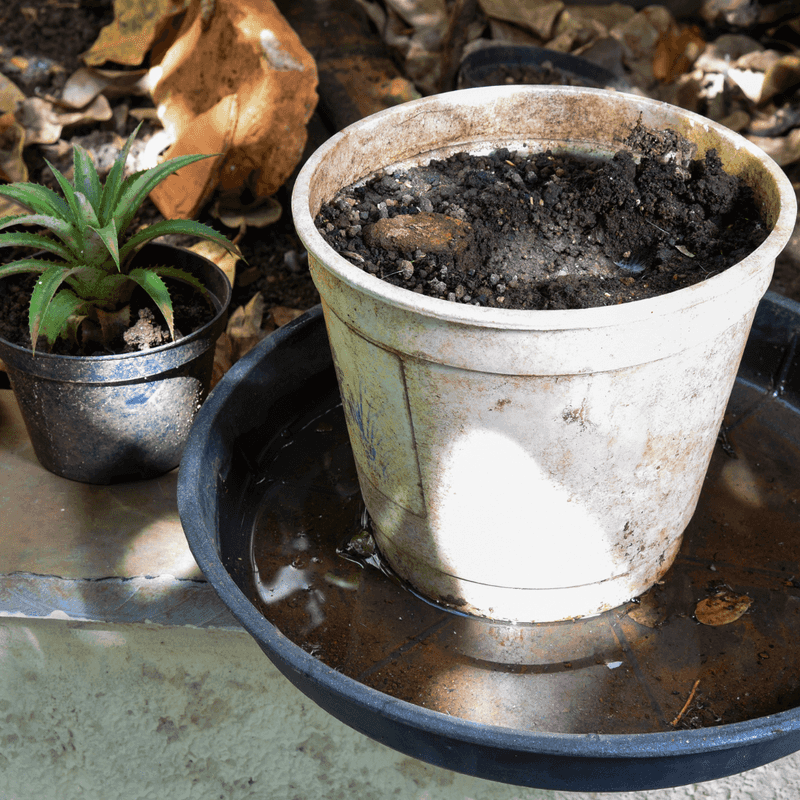
Every reliable mosquito-control authority points to the same starting place, and it is not a plant.
Standing water is where Texas backyard mosquito problems actually begin, and removing it is the most direct action you can take.
Texas DSHS notes that mosquitoes can breed in as little as 1 tablespoon of standing water, which means the saucer under a potted plant, the low spot in a tarp, and the clogged gutter section above your back door are all potential production sites.
Check and empty containers, saucers, pet dishes, birdbaths, pool covers, and any other water-holding object at least once a week.
Texas A&M backyard mosquito guidance identifies water that sits for about 7 days as a common breeding risk for several backyard mosquito species in Texas.
Water you cannot dump or drain can often be covered or treated.
Bacillus thuringiensis israelensis, commonly called Bti, is a larvicide that Texas A&M identifies as remaining effective for up to 30 days depending on the formulation.
The product label controls the legal application rate and the permitted uses, so read it before you treat a birdbath or a rain barrel.
For personal protection, CDC recommends EPA-registered skin repellents as the reliable option for reducing bites during outdoor activity.
Do not substitute homemade lantana preparations, crushed leaves, or DIY plant oils for a registered repellent.
Lantana can cause skin irritation, experimental repellency results do not make homemade preparations safe, and the concentration you can achieve by rubbing a leaf bears no relationship to what the laboratory studies actually tested.
Automatic mosquito misting systems are another option that comes up in Texas, but CDC does not recommend residential misting systems as routine control because of concerns about pollinator harm, repeated insecticide exposure, environmental effects, and resistance development.
Weekly water removal, larvicide where appropriate, and a registered repellent on your skin are the tools that actually work.
Use Texas Lantana As One Landscape Layer
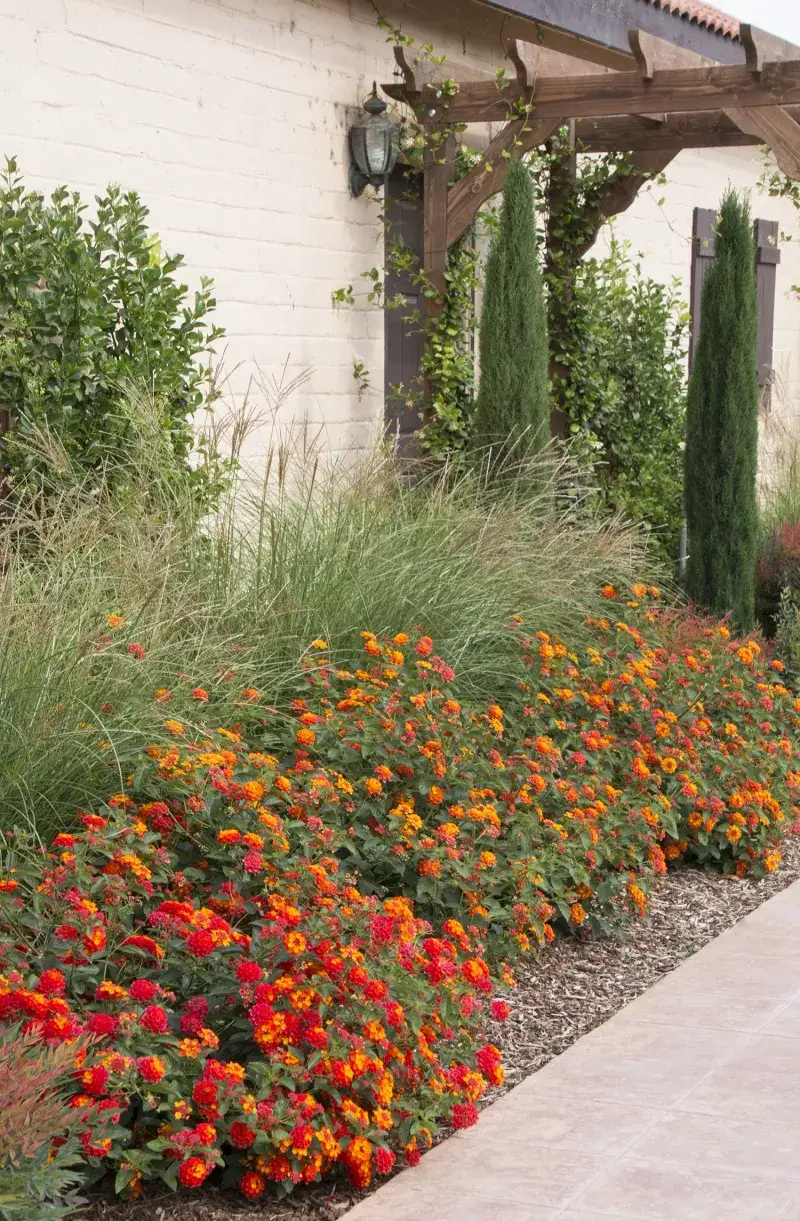
Texas lantana earns a place along a sunny, well-drained fence line on its own merits.
Texas A&M AgriLife Extension guidance supports it as a heat-tough, drought-tolerant ornamental with a long bloom period and genuine value for pollinators.
Those are real benefits that hold up even after the mosquito claim is set aside.
What it does not do is replace the practical work of mosquito management.
Water removal, airflow, resting-habitat reduction, properly labeled larvicide, and an EPA-registered repellent on your skin are the measures with evidence behind them.
Planting any shrub near a home as a standalone mosquito solution has not been shown to work reliably, and Texas lantana is not an exception to that finding.
Plant it for the benefits it can actually deliver.
Choose a fence line with full sun and fast drainage.
Space plants at least 4 feet apart, keep the planting open enough for airflow, and verify the botanical name on the tag before you apply species-specific care advice.
Prune to about 8 inches in early spring, wait on freeze damage until the risk is clear, and let the plant do what it does best through the long Texas warm season.
Handle mosquito control as a separate management task with tools matched to the actual problem.
A yard with a healthy, open lantana planting along the fence and a weekly water-removal habit is a yard working on two good things at once.
That is a better promise than the headline made, and it is one you can actually keep.