
You Have Never Actually Seen One Sunflower, You Have Seen A Stadium Of 2,000 Flowers Doing Math
Follow us on Google
Look closely at a sunflower head sometime, and you will notice the center is not smooth at all.
It is packed with tiny, tightly packed structures arranged in curving rows that spiral in two directions at once.
What looks like one flower from across the yard is actually a composite flower head, a dense cluster of hundreds or even thousands of individual florets working together.
Once you understand what is really going on inside that yellow disk, you will never look at a sunflower the same way again.
The Familiar Sunflower Is a Composite Flower Head
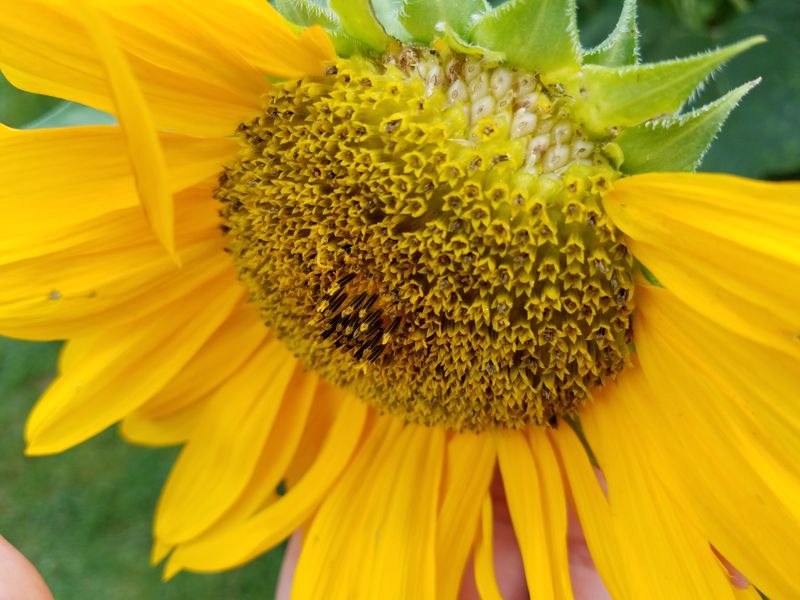
Pull a sunflower stem out of a garden bed and hold the head at eye level.
Around the outside, you will see the broad, bright yellow structures most people call petals.
Closer to the center, the surface shifts into a packed, slightly domed field of tiny tube-shaped buds and open flowers.
Those two zones are doing completely different jobs, and they are not the same kind of flower.
The common sunflower, Helianthus annuus, is an annual plant in the daisy family, and NC State Extension identifies it as a composite, meaning its visible head is not one flower but a flower cluster called a capitulum.
The large outer structures are ray florets.
They mainly serve as visual signals, the bright flags that catch the eye of passing bees and butterflies.
Ray florets generally lack the normal reproductive structures found in the central disc florets, so they are not contributing much to seed production.
The real action happens in the center.
Research on sunflower inflorescence development confirms that the central disc florets are each capable of producing pollen, receiving fertilization, and eventually forming a seed.
The orderly appearance of the head comes from the way those florets are packed and spaced during development, not from one giant flower organizing its own interior.
What looks like a single bloom from the sidewalk is actually a coordinated field of many separate flowers, each at its own stage of opening.
One Head Contains Hundreds or Thousands of Florets
The scale of what is packed into a single sunflower head is genuinely surprising.
University of Wisconsin Extension notes that a cultivated sunflower head may contain roughly 700 to 3,000 individual disc florets depending on the variety and growing conditions.
A practical range of 1,000 to 2,000 is commonly cited for cultivated heads, but that is an estimate, not a fixed count every plant will hit.
Head size and floret count shift with genetics, soil nutrition, how crowded the plants are, and the weather during development.
A compact ornamental variety grown in a pot will land at the lower end of that range.
A well-fed giant variety with plenty of root space can push toward the top.
The headline’s number is a useful illustration, not a guarantee printed on the seed packet.
Watch a sunflower head closely over several days and you will see the florets do not all open at once.
Studies on floret development show that disc florets open progressively from the outer ring inward toward the center, like a slow wave moving across a crowded stadium.
On any given day, the outermost ring may be releasing pollen while the innermost florets are still closed buds.
The head is less a static yellow disk and more a timed sequence of openings, each floret taking its turn.
Fibonacci-Like Spirals Emerge From Growth

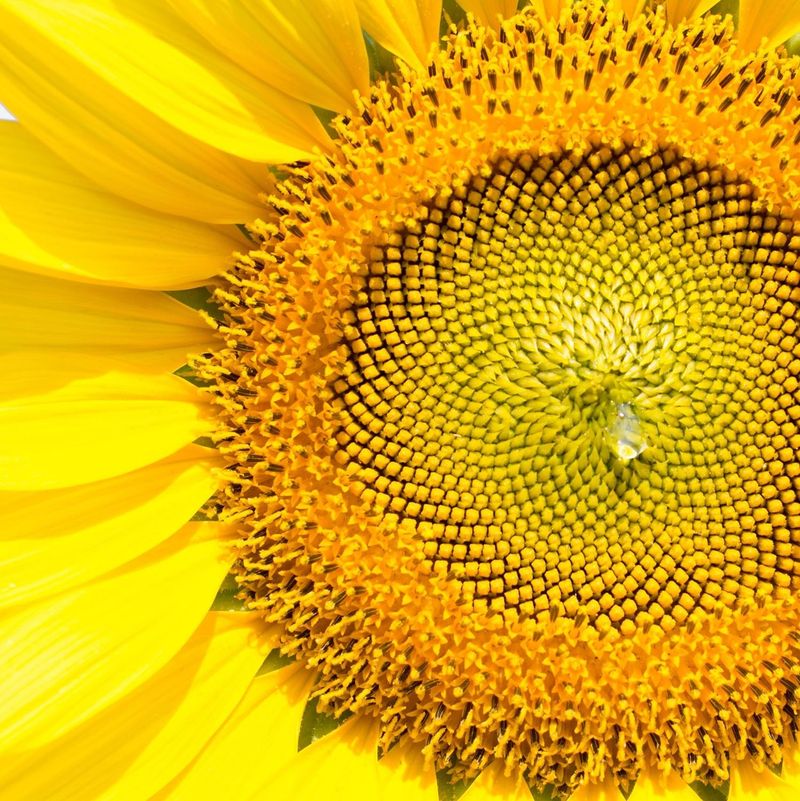
Stare at the center of a sunflower head and the spirals become impossible to ignore.
Rows curve one way, then cross rows curve the other way, creating a woven pattern that looks almost too precise to be accidental.
It is not accidental, but it is also not calculated in any conscious sense.
The pattern comes from a developmental process called phyllotaxis, the way growing structures are placed as a plant builds itself.
Each new floret primordium forms at roughly 137.5 degrees from the previous one, an angle sometimes called the golden angle.
Botanical research on phyllotaxis shows that this spacing distributes developing florets across a crowded, expanding head without overlap, fitting more structures into the available space than almost any other arrangement could.
When you count the spirals curving in one direction and then the other, the totals often land on consecutive numbers from the Fibonacci sequence, such as 34 and 55, or 55 and 89.
A study in New Phytologist confirmed that Fibonacci-related spiral counts appear commonly in sunflower heads, though the numbers can vary with cultivar, which region of the head you examine, and how the spirals are counted.
The plant does not compute anything.
The pattern emerges from a simple, repeated growth rule, the same way ripples on water form rings without the water deciding to make circles.
Smith College’s phyllotaxis resource notes that the golden angle arrangement is not unique to sunflowers.
Pinecones, pineapples, and many other plants show related patterns.
In sunflowers, the large head size and dense packing simply make the spirals easier to see and count.
Young Plants Track the Sun; Mature Heads Usually Stop
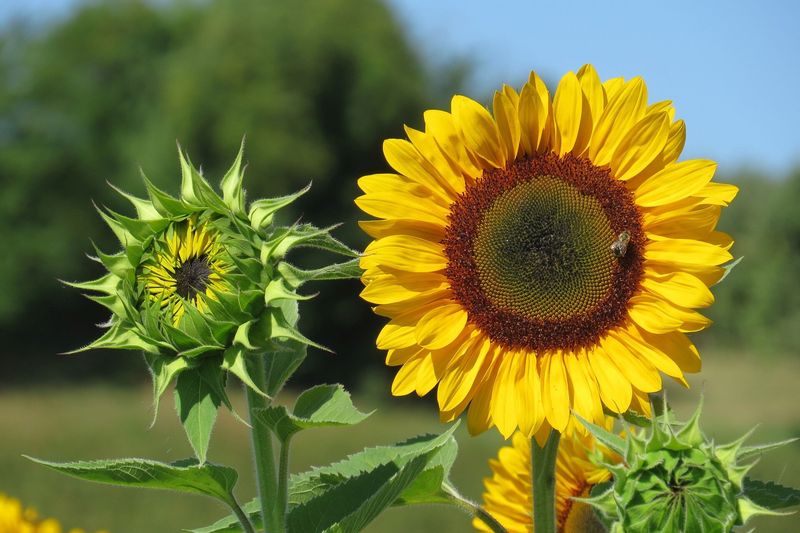
The idea that sunflowers follow the sun is true, but only for part of a plant’s life.
Young shoots and developing buds genuinely do track the sun, turning from east to west as the day moves and then reorienting overnight so they face east again by morning.
A study published in Science found that this daily movement in young sunflowers is driven by growth hormones, with the shaded side of the stem growing faster than the lit side, causing the plant to lean toward the light.
Once a sunflower head reaches full maturity and opens, the stem generally stiffens and the tracking stops.
Most mature heads settle approximately facing east, the direction they were pointed when the stem locked in place.
Do not expect an open flower to swing visibly across your yard during an afternoon cookout.
That movement belongs to the seedling stage, not the blooming stage.
The mature eastward orientation is not a quirk.
Research on sunflower circadian rhythms links the tracking behavior to internal growth clocks that coordinate with light cues.
By the time the head opens, those growth clocks have done their work and the stem no longer responds the same way.
Additional work on floral orientation confirms that the eastward position affects how quickly the flower warms in the morning, which turns out to matter more than most gardeners expect.
East-Facing Heads May Help Morning Pollinators
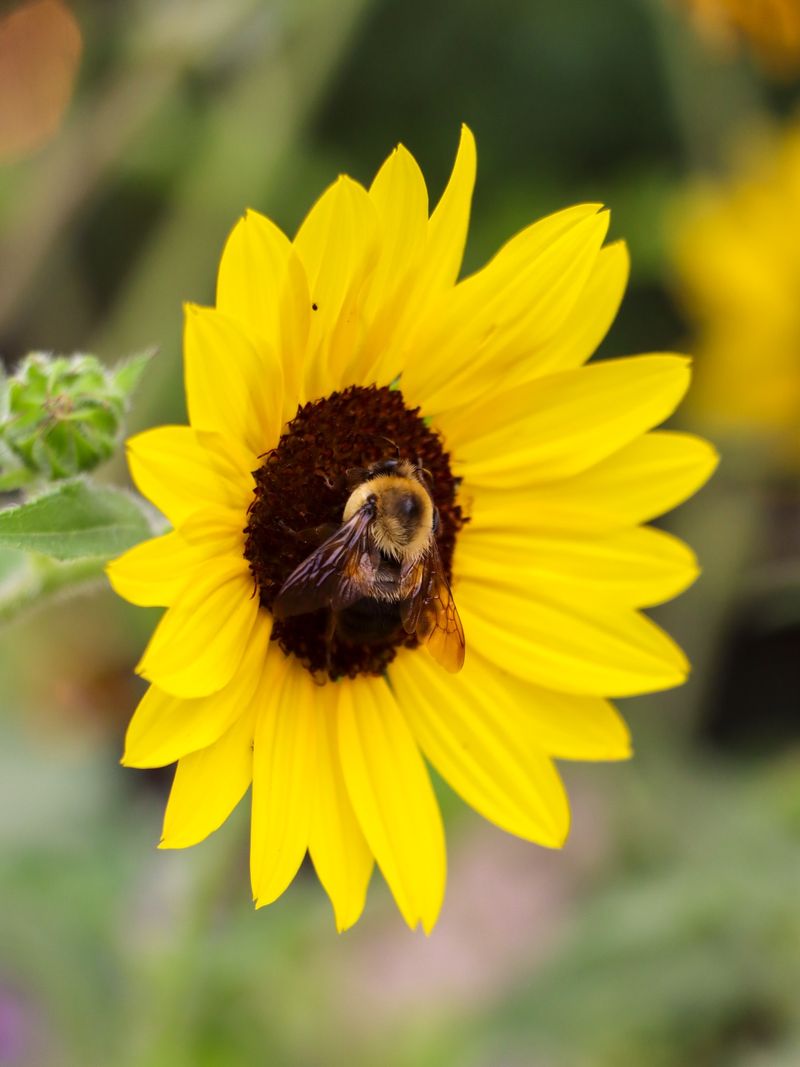
An east-facing sunflower head catches the first direct light of the day, and that early warmth turns out to have real consequences.
Warmer flowers release pollen sooner, and pollinators tend to show up where pollen is available.
Field research on sunflower head orientation and pollinator visits found that east-facing heads warmed earlier in the morning, released pollen earlier, and received more pollinator visits during a limited early-morning window compared with west-facing heads.
The researchers also found that artificially warming a west-facing head could partly reproduce the same effect, which points to temperature as a key part of the mechanism rather than compass direction alone.
So the morning advantage is real, but it has limits.
A 2024 field study took a harder look at whether the orientation benefit held all day.
That research, also summarized by the Centre for Ecological Research, found that all-day pollinator visits in sunflower plantations were independent of head orientation.
East-facing heads did not attract more bees across the full day.
The early-morning window matters, but it does not make an east-facing head a superior bee magnet from dawn to dusk.
Some sources also suggest that eastward orientation may help flowers dry out faster after morning dew, potentially reducing conditions that favor fungal problems.
Research on sunflower microclimate raises this as a plausible benefit, though it remains a hypothesis rather than a tested disease-control recommendation.
The honest takeaway is that east-facing heads offer a real but time-limited morning advantage for pollinators.
Treat it as one small piece of the picture, not a guaranteed outcome you can engineer by choosing where to dig a hole.
Grow for Sunlight and Strength, Not a Compass Direction
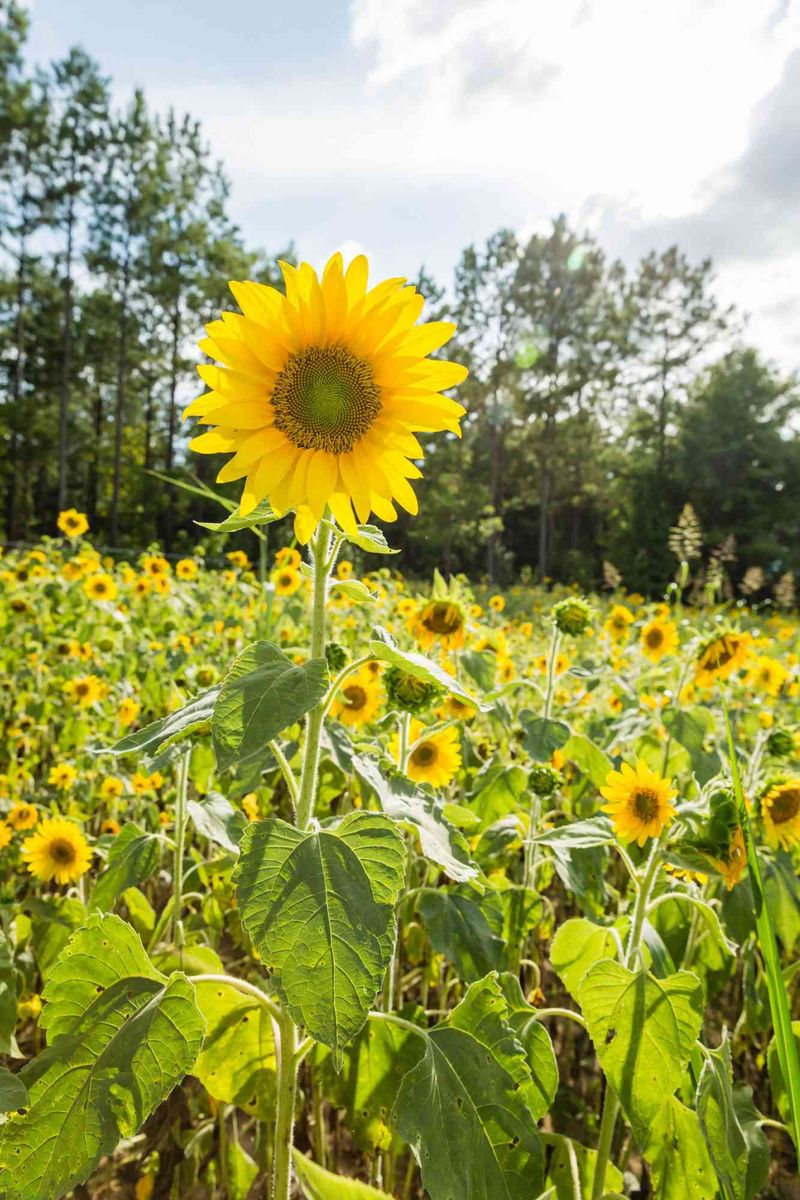
Most gardeners want to know where to put a sunflower so it faces the patio or looks good from the kitchen window.
Here is the honest answer: you generally cannot force a mature head to face a specific direction by choosing a planting spot.
Orientation is largely set during development, and mature heads commonly settle toward the east.
Plant for sunlight, airflow, and access to the plant, and let the head land where it lands.
The practical steps are straightforward.
Sow seeds directly outdoors after the danger of frost has passed in your local area, about 1 inch deep in full sun and well-drained soil.
University of Minnesota Extension recommends a soil pH of roughly 6.0 to 6.8, and seeds typically germinate in 7 to 10 days under suitable conditions.
Medium varieties do well spaced around 6 inches apart, taller types need at least 12 inches, and giant varieties benefit from about 24 inches of room.
Always check the seed packet first, because cultivar recommendations vary and the packet reflects what the breeder actually tested.
For tall or top-heavy varieties, consistent watering during the roughly 20 days before and after flowering can support root development and help the plant carry a heavy head without tipping.
That is not a universal prescription.
Heat, rainfall, soil type, and whether you are growing in a container or an open bed all change what the plant actually needs.
Good airflow around the stems reduces humidity at the base, and staking tall varieties before they lean saves you from trying to straighten a plant that has already decided which way it wants to go.
The same Science study on sun tracking notes that the developmental process sets the final orientation before the head opens fully, which is why related research on mature head position finds gardeners have little reliable control over where a fully open head points.
Choose your planting spot for the plant’s health first, and enjoy whichever way it ends up facing.
Make the Flower Part of a Larger Pollinator Plan
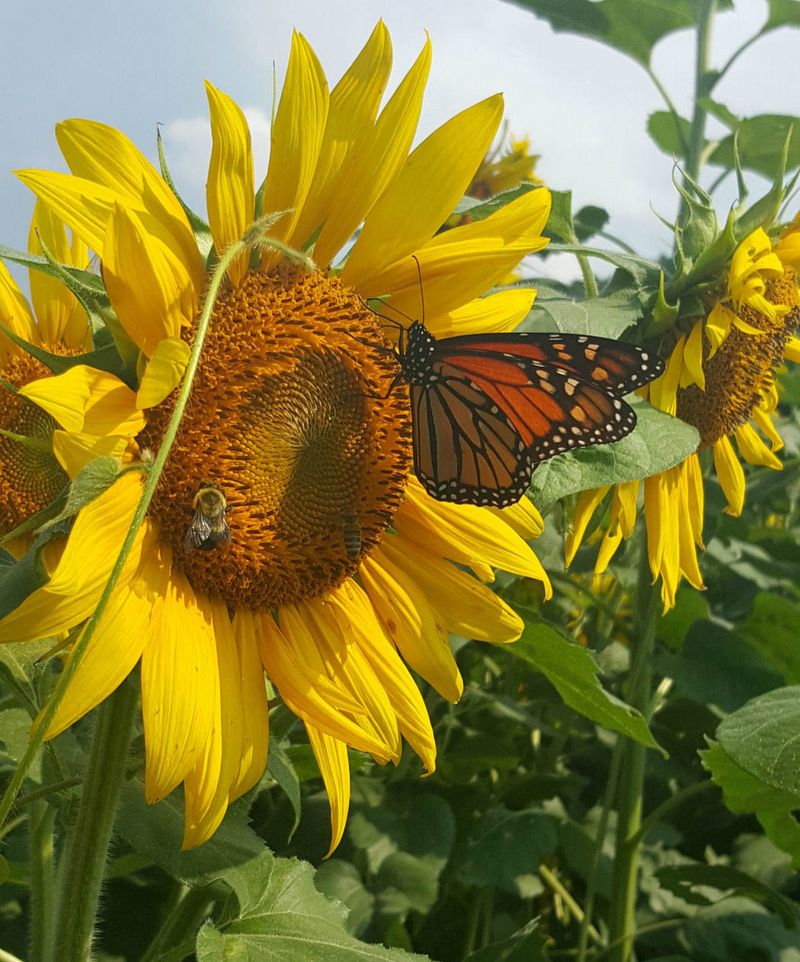
Honey bees and wild bees both visit sunflowers, and the specific mix of visitors in your yard depends on your region, the surrounding habitat, the weather, and what else is blooming nearby.
Modern sunflower hybrids vary in how much they depend on insect pollination.
North Dakota State University’s sunflower production guide notes that many commercial hybrids are substantially self-compatible, though insect visits can still improve seed set, seed weight, and overall yield.
Older and more self-incompatible varieties may rely more heavily on bee visits to produce full heads of seeds.
If you want pollinators in your yard, do not spray blooming sunflowers casually.
Texas A and M Extension’s sunflower pest management guidance recommends integrated pest management practices, which means scouting for actual problems before reaching for a product, following label directions carefully, and avoiding any insecticide application while bees and other pollinators are actively foraging on the flowers.
Penn State Extension’s pollinator and pesticide resource reinforces that timing and product choice matter as much as the decision to treat at all.
A sunflower provides pollen and nectar, which are real and useful contributions to a pollinator-friendly yard.
But a single sunflower is not shelter, and it is not nesting habitat.
Bees nest in the ground, in hollow stems, or in purpose-built structures, and a patch of sunflowers alone does not solve a pollination problem if nesting sites, water, and a longer bloom sequence are missing from the picture.
Penn State’s profile of related Helianthus species points toward pairing sunflowers with other native bloomers to extend the season beyond a single flush of flowers.
The most useful thing to remember is what that familiar yellow head actually is: hundreds or thousands of individual florets, each one opening in sequence, each one offering something to the insects that find it.
A yard that supports those visitors before and after the sunflowers bloom will get far more from that coordinated crowd of tiny flowers than a yard that relies on them alone.