
If You See These Sawdust Piles At The Base Of Your Pennsylvania Tree, Act Fast
Follow us on Google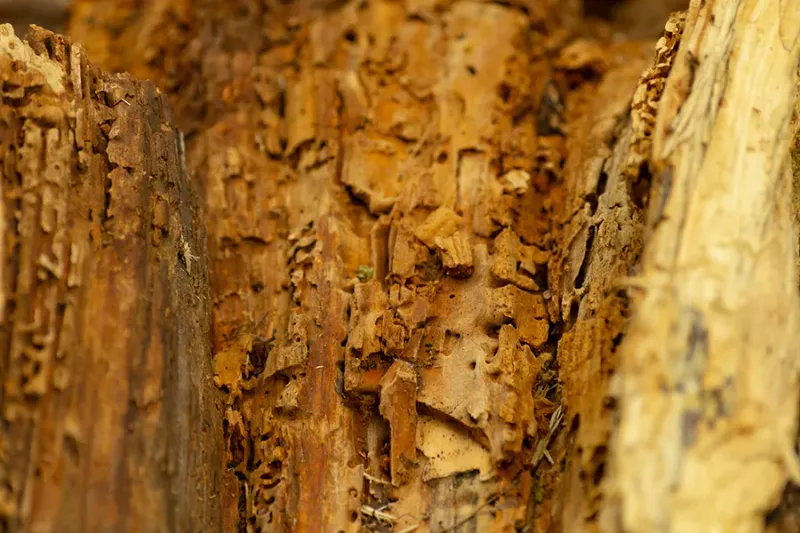
You step out on a quiet morning and notice a small pile of what looks like sawdust sitting right at the base of your oak or maple.
Before you sweep it away, stop, because that material is telling you something worth hearing.
It could mean carpenter ants have found a soft spot in the wood, or it could be a sign of something that warrants a call to state officials.
This article will help you read the clues, figure out how urgent your situation actually is, and take the right next step without guessing.
Frass Is the Clue, Not the Verdict
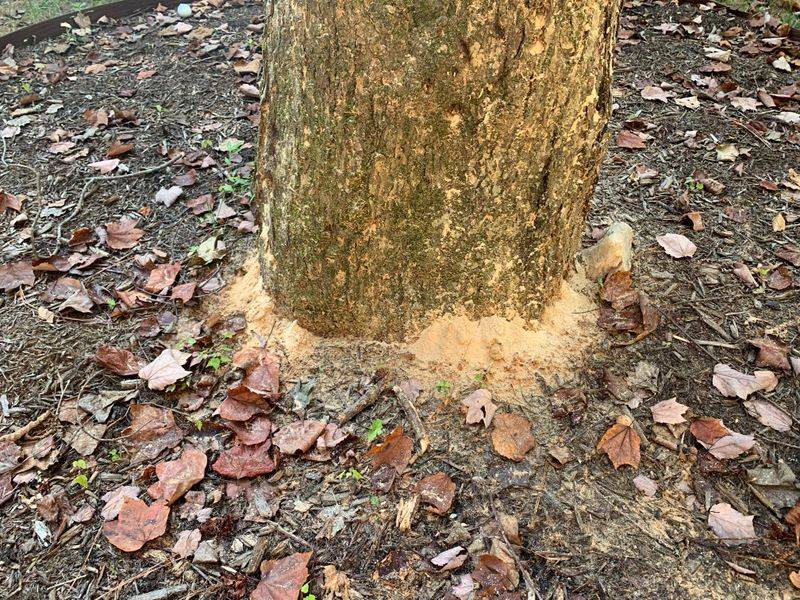
That sawdust-like material has a name: frass.
Technically, frass refers to wood particles mixed with insect waste or other boring debris, and it can come from a surprising range of sources.
Carpenter ants, beetle larvae, moth borers, bark beetles, carpenterworms, old injuries, and plain old decay can all produce material that looks nearly identical on the ground.
So the pile is a clue, not a verdict.
As Ask Extension’s diagnostic guidance on sawdust at the base of a tree makes clear, a photograph of the pile by itself is usually not enough to identify the source.
You need to trace where it is coming from and look for other signs before drawing any conclusions.
The University of Minnesota Extension sawdust diagnostic guide lists carpenter ants, carpenterworms, and decay as common explanations for material found at a trunk’s base.
None of those possibilities can be ruled in or out just by looking at the pile from a few feet away.
What the pile does do is open a question worth answering.
Is the debris fresh or old and weathered?
Is there an opening in the bark nearby?
Are there any holes, sap, or dying branches above?
The sections ahead will walk you through each of those checks in order, help you recognize the signs that genuinely raise urgency, and point you toward the right response for your specific situation, whether that is monitoring, reporting, or calling a qualified arborist.
Start Where the Sawdust Came From
Gravity is working against you here.
Material that exits a hole 10 feet up the trunk can drift down and land in a neat pile at the base, which means the pile’s location on the ground and the insect’s actual location in the tree can be two very different places.
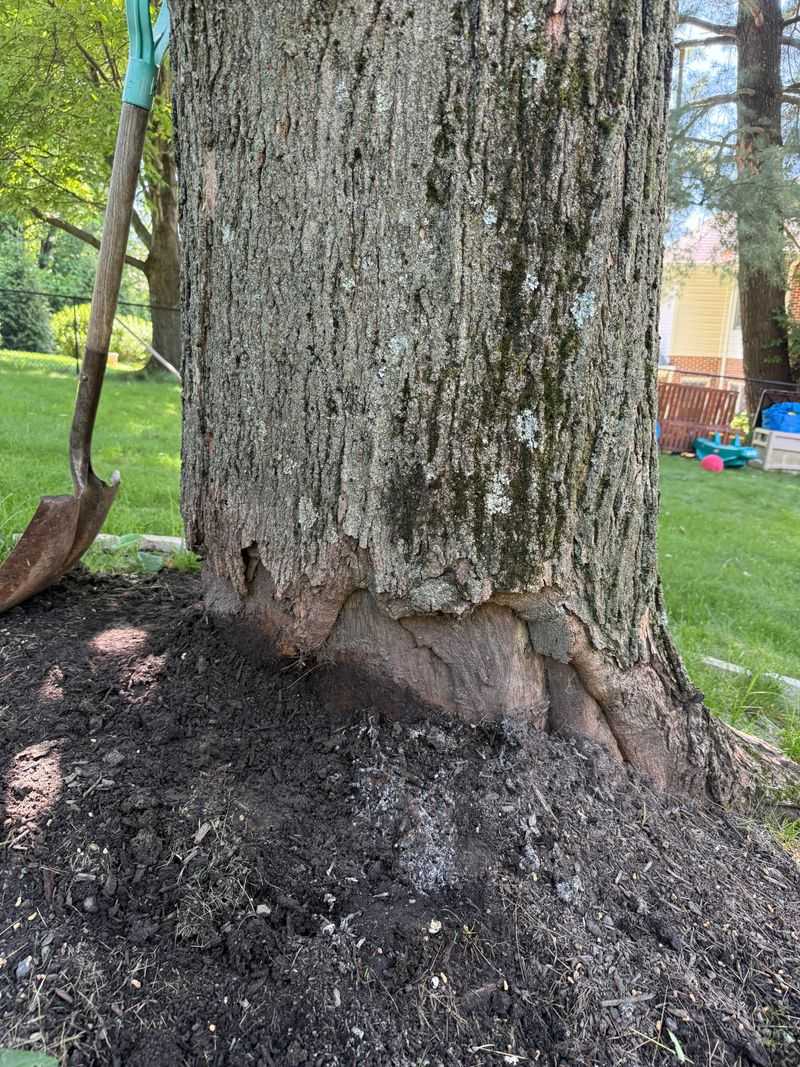
Start your inspection at the trunk flare, the widest point right where the tree meets the soil.
Look for any cracks, cavities, old pruning wounds, or sections where the bark feels soft or is pulling away.
Then work your way up, checking branch junctions, dead limbs, and any spots where the bark looks discolored or sunken.
Ask Extension’s tree sawdust guidance specifically advises checking the trunk flare, bark wounds, branch junctions, and the canopy, because the visible pile may not mark the insect’s location.
Finding the actual opening is the step that turns a vague worry into useful information.
Keep the inspection noninvasive.
You are looking, not probing.
Do not peel bark, poke into cavities, or disturb anything you are not sure about.
If you find a hole or a crack with fresh material around it, that is your focal point.
Penn State Extension’s guidance on decay in trees notes that decay can spread from a wound or cavity inward, so locating the opening also helps you understand whether the concern is local or something that may involve more of the tree’s structure.
Write down or photograph where you found the opening before you move on.
Carpenter Ants Can Reveal Decay
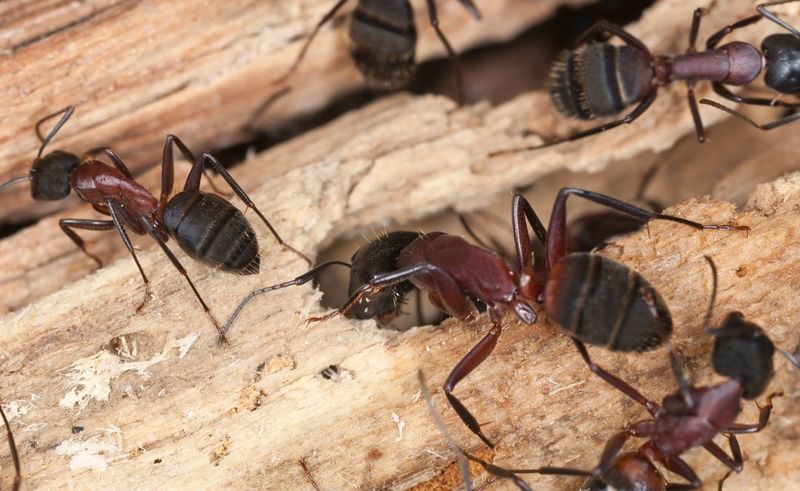
Finding large black ants streaming from an opening near the frass pile shifts the interpretation in a specific direction.
Carpenter ants are a plausible explanation when debris appears beside a wound, cavity, dead limb, or section of softened wood, and their presence around a Pennsylvania tree is worth understanding clearly.
Penn State Extension’s guidance on carpenter ants in trees explains that these insects excavate galleries for nesting rather than eating wood as food.
They push the coarse wood particles outside the gallery, which is what produces the pile you see.
Their presence is often an indicator that decay already exists in that section of the tree, not evidence that the ants attacked healthy wood on their own.
That distinction matters, but it does not eliminate concern.
Penn State’s broader carpenter ant resource and University of Minnesota Extension’s carpenter ant guide both confirm that these ants commonly nest in moist, hollow, or decaying wood, particularly in the Northeast.
The ants did not create the rot, but their galleries can expand a weakened area.
True wood borers behave differently.
Beetle and moth larvae feed within the wood or beneath the bark, and their tunneling can be the direct cause of structural damage rather than a secondary effect of preexisting rot.
If you see ants and the debris is coarse and stringy with dead insect parts mixed in, carpenter ants become the more likely story.
If the debris is finer and more uniform, or if there are no ants visible, keep looking.
Penn State Extension on decay in trees is clear that decay and galleries can reduce the strength of a limb or trunk, particularly where a failure could reach a house, patio, or play area.
Fresh Frass Keeps the Clock Running
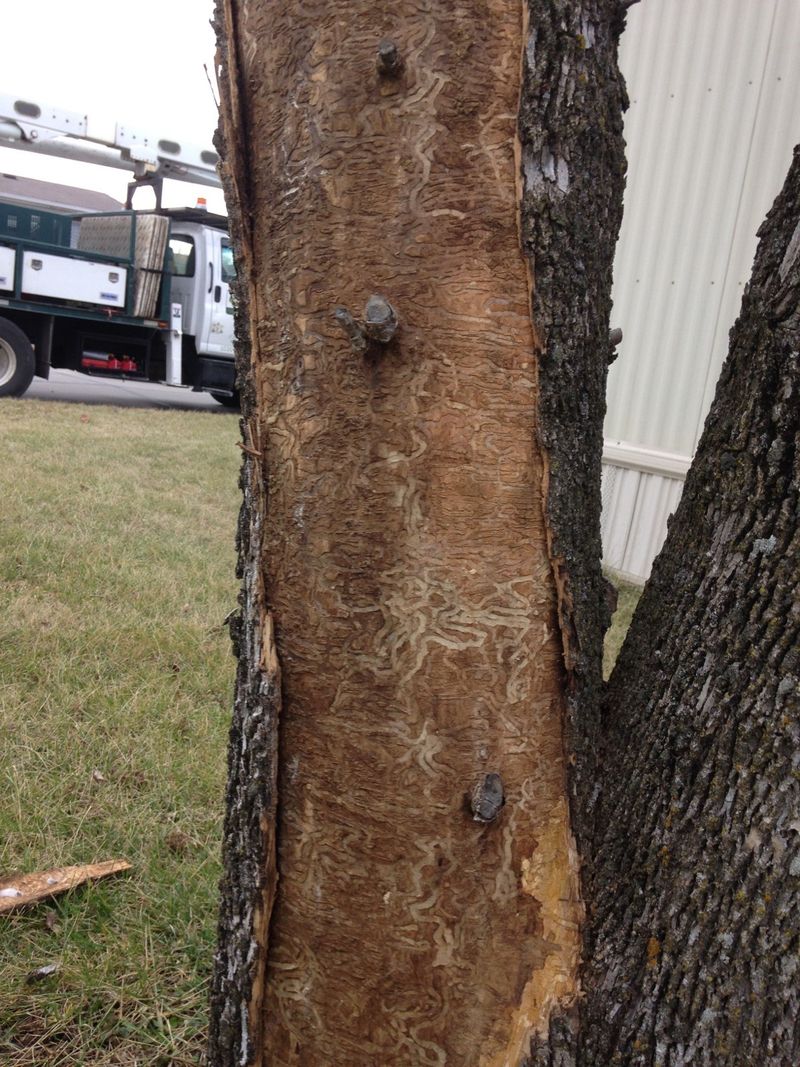
An old, weathered pile is a different situation from one that appeared overnight.
Frass that has been sitting through rain and sun will look darker, compressed, and matted into the soil.
Fresh frass looks like newly sawn wood, pale and loose, sometimes still carrying a faint wood smell.
Fresh material suggests that activity may still be occurring inside the tree right now.
That is the version that warrants a closer look and a faster response, because whatever is producing the debris has not moved on.
Penn State Extension’s integrated pest management guidance describes a practical monitoring method any homeowner can use: place a clean sheet of white paper or a piece of cardboard flat on the ground directly beneath the suspicious opening.
Leave it there for 7 to 14 days and check it regularly for new material falling from above.
If fresh frass accumulates on the paper, something is actively working in that section of the wood.
This test does not tell you what the insect is, and it does not replace a professional inspection.
What it does is answer one important question before you make any decisions: is this situation still developing, or is it a remnant of something that already ran its course?
Photograph the original pile before you set up the paper, and photograph any new material that appears.
Those images become useful evidence if you end up contacting state plant-health officials or an arborist.
Ask Extension’s sawdust guidance reinforces that documentation helps experts narrow down the source even when an in-person visit is not immediately possible.
Round Holes Raise a Different Alarm
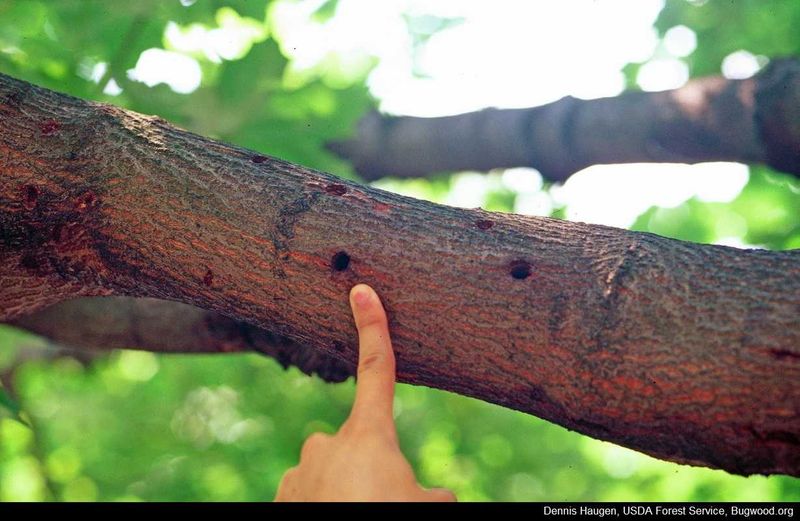
Round holes change the conversation entirely.
A perfectly circular exit hole in the bark, roughly 1/4 inch or larger, is associated with Asian longhorned beetle, or ALB, one of the most destructive invasive wood-boring insects in North America.
Seeing one alongside fresh frass is the combination that justifies picking up the phone.
According to USDA APHIS guidance on signs of Asian longhorned beetle, the full set of warning signs includes round exit holes about 1/4 inch or larger, shallow oval or round egg-laying sites chewed into the bark, sap bleeding from those wounds, coarse frass on the ground or caught in branches, and branches dying on an otherwise healthy-looking tree.
Adult beetles are shiny black with white spots, about 1 to 1 1/2 inches long, with distinctly black-and-white banded antennae.
The APHIS host tree guide for Asian longhorned beetle lists maples, birches, elms, willows, and several other common Pennsylvania hardwoods as susceptible species.
Here is where the situation requires a careful reading.
Pennsylvania DCNR states that ALB has not been found in the Commonwealth.
And USDA APHIS confirms that active federal eradication work is currently focused on Massachusetts, New York, Ohio, and South Carolina.
APHIS notes that Pennsylvania is among the states where ALB could survive and cause damage if it arrived, which is exactly why suspicious signs deserve prompt reporting rather than a wait-and-see approach.
These signs warrant a call to state officials, not a conclusion.
Round holes plus fresh frass plus a matching beetle is a combination to report, not a verdict to act on alone.
Pennsylvania Has a Safe Reporting Step
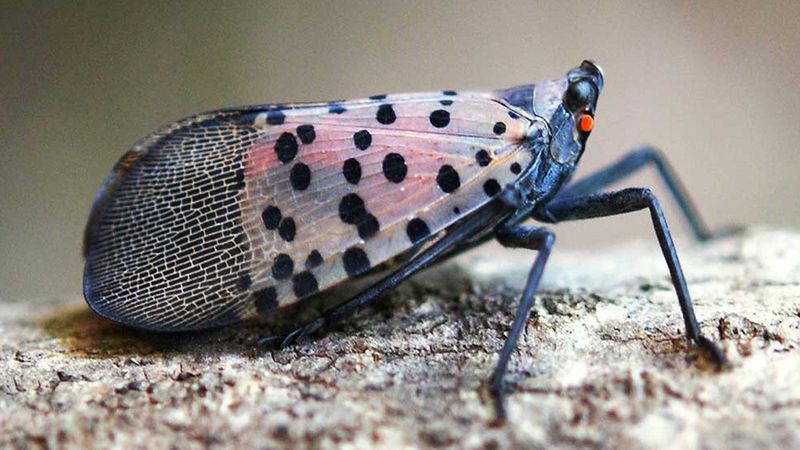
Credible suspicion has a clear, simple next step in Pennsylvania, and it takes about five minutes.
Before you call anyone, photograph everything you can see: the frass pile, any holes in the bark, egg-laying sites, sap, canopy symptoms, and especially any beetle you spot nearby.
Good photos give plant-health officials something to work with even before they visit.
Then contact the Pennsylvania Department of Agriculture at 1-866-253-7189 or [email protected] when you have fresh frass combined with suspicious round holes, a matching beetle, or unexplained branch dieback.
You do not need to be certain.
Reporting a credible concern is exactly what the system is designed for.
If you actually see a beetle that might be ALB, USDA APHIS guidance says to capture it only if you can do so safely, place it in a rigid, durable container, and freeze it for identification.
Do not handle it roughly or crush it, because physical condition matters for a positive ID.
The wood-movement rule is equally important.
Do not move firewood, branches, logs, stumps, chipped material, or any other questionable wood away from the property until plant-health officials tell you it is safe to do so.
USDA APHIS notes that moving infested wood is one of the primary ways invasive wood-boring insects spread to new areas.
Leaving the wood in place is not doing nothing, it is genuinely protecting your neighbors and the surrounding woodland.
Other Holes Point to Other Pests
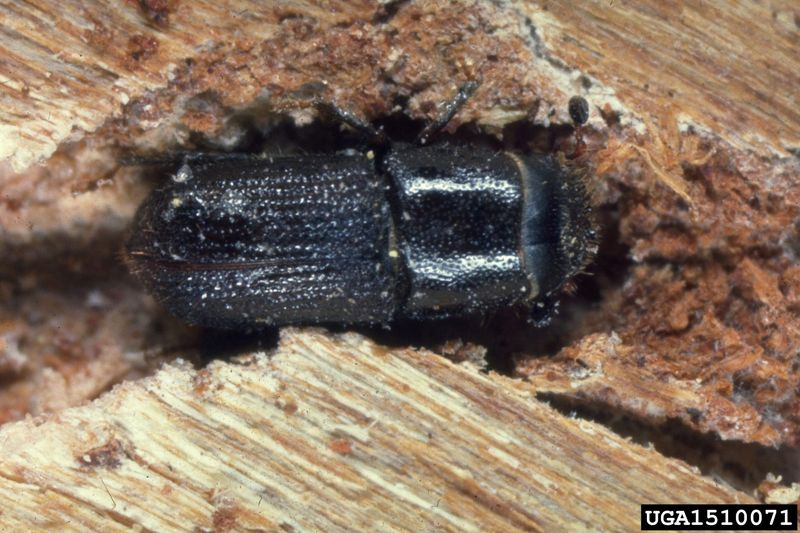
Not every hole in a Pennsylvania tree trunk belongs to Asian longhorned beetle, and learning the differences saves you from either overreacting or missing a separate problem that needs its own response.
Emerald ash borer is already established throughout Pennsylvania, so if the damaged tree is an ash (Fraxinus species), the hole shape is the first thing to check.
Penn State Extension’s emerald ash borer resource describes the exit holes as small and distinctly D-shaped, not round, often accompanied by serpentine galleries beneath the bark, vertical bark splits, a thinning canopy, and heavy woodpecker activity where the birds have been prying bark to reach larvae.
If your ash tree shows those signs, that situation calls for its own separate diagnosis and response, distinct from the ALB reporting pathway.
Fruit trees, especially peaches and their relatives, can show a very different pattern.
Penn State Extension’s peach tree borer guidance describes the symptom as gum mixed with sawdust and frass near the lower trunk, typically from about 3 inches below the soil line up to about 12 inches above it.
That gummy, resinous mass near the root crown is not the same as the large, round, clean exit holes associated with ALB.
Carpenterworm is another possibility worth knowing.
University of Minnesota Extension’s sawdust diagnostic guide lists carpenterworm as a source of substantial piles at the base of a trunk, with exit holes about 1/2 inch wide, noticeably larger than ALB holes.
A big pile beneath an older oak or elm with half-inch openings points toward carpenterworm rather than a new invasive arrival.
Each of these pests has its own diagnostic trail, and following the right one gets you to the right answer faster.
The Tree’s Location Changes the Risk
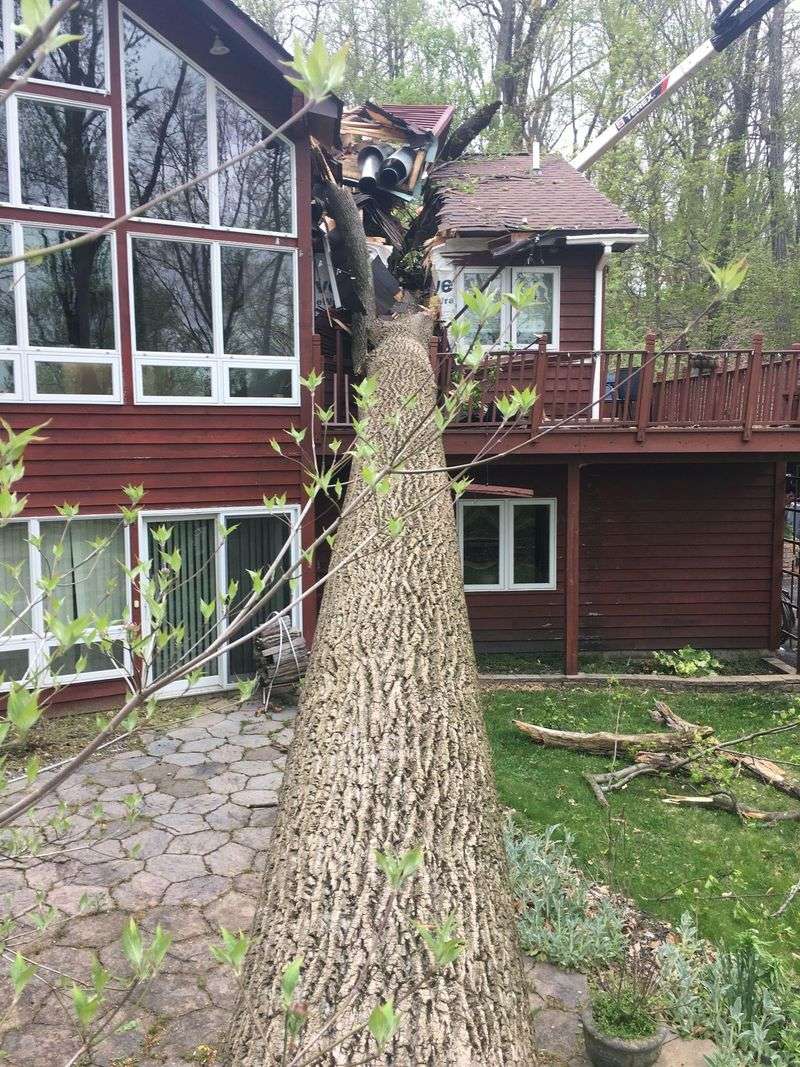
Two trees with identical frass piles can represent two very different situations depending entirely on where they are standing.
A decaying trunk deep in a wooded corner of a Poconos property is a different risk from a maple with a cavity hanging directly over a back porch in the Susquehanna Valley.
The question that actually drives urgency is not just whether an insect is present, but what happens if a limb or the trunk fails.
Penn State Extension’s resource on decay in trees explains that the risk depends on how much sound wood remains and what could be struck if the tree or a limb came down.
Decay alone does not automatically require removal, but the calculation changes when a house, driveway, patio, play area, or power line sits within reach.
When you see cavities, major cracks, extensive decay, hanging limbs, or a noticeably thinning canopy on a tree near people or property, that is the point to bring in an ISA Certified Arborist with a Tree Risk Assessment Qualification.
That credential means the arborist has specific training in evaluating structural failure risk, not just tree health in general.
Penn State Extension’s carpenter ant in trees guidance reinforces that even carpenter-ant galleries, which reflect preexisting decay rather than a new attack, can reduce a branch’s load-bearing capacity enough to matter when ice, wind, or a late-season storm applies pressure.
Pennsylvania winters and summer thunderstorms do apply that pressure, and a limb that held through ten quiet years can fail in one bad night.
Location is the factor that turns a monitoring situation into a same-week phone call.
Replace Guesswork With Safe Next Steps
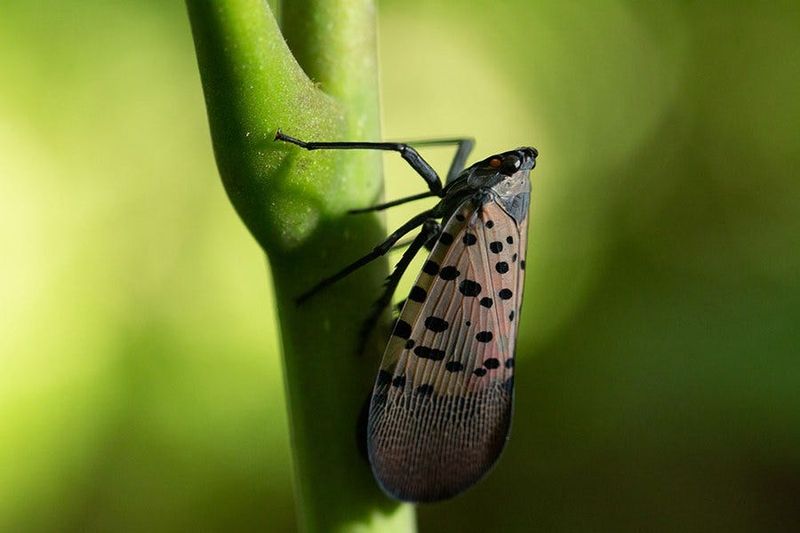
A few actions feel intuitive when you find suspicious debris at a tree’s base but can actually make things worse.
Reaching for a general pesticide and spraying the trunk is one of them.
Treatment must match the identified pest, the tree species, the product, and the legally enforceable label, as EPA guidance on pesticide labels makes plain.
Spraying a broad household insecticide may miss larvae feeding deep inside the wood entirely, while creating unnecessary exposure for people, pets, and beneficial insects nearby.
Drilling into the trunk to reach an insect or filling a cavity with foam, cement, or caulk are also approaches to avoid.
Penn State Extension’s decay guidance and Penn State’s bacterial wetwood resource both advise against filling cavities.
Filling does not restore structural strength, and it can block drainage, trap moisture, and interfere with future assessment or safe removal if that becomes necessary later.
Cutting the tree down before a diagnosis is equally premature.
A suspected insect does not automatically mean the tree must go.
The right sequence is simpler and more effective than any of those shortcuts.
Document everything with photographs before you touch anything.
Leave questionable wood exactly where it is and do not transport it anywhere until Pennsylvania Department of Agriculture officials or federal plant-health staff give you the go-ahead.
Report possible invasive pest signs promptly to 1-866-253-7189 or [email protected].
And arrange a qualified tree-risk assessment whenever people or property could realistically be struck by a failure.
The tree has been quietly doing its job for years, it deserves a real answer before any final decisions are made.