
That Chipmunk Sprinting Across Your Yard Is Carrying Several Dozen Seeds on Repeated Trips to a Substantial Underground Store
Follow us on Google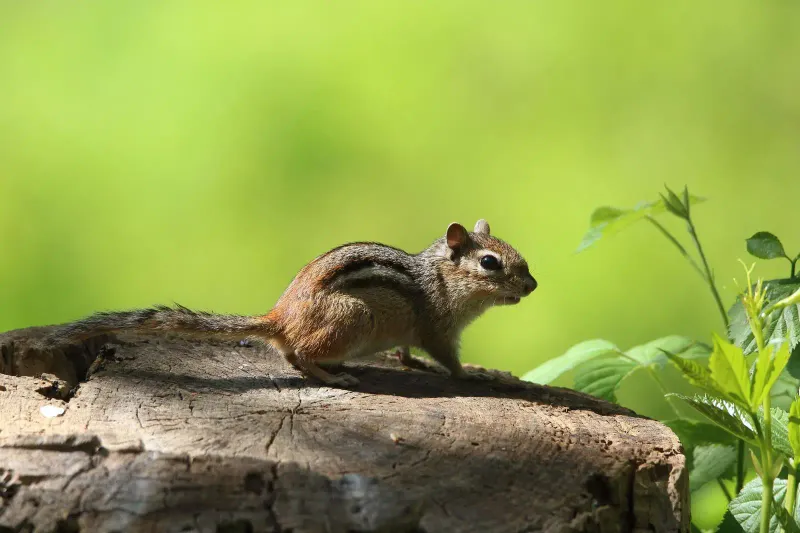
Something small and striped just blurred across your patio, cheeks puffed out like a tiny grocery bag, and then vanished into a gap near your stone wall.
That is an eastern chipmunk, Tamias striatus, doing what it does every late summer and fall across yards from Maine to Georgia and west into the Midwest.
The sprint you just watched is one delivery in a much longer hauling operation, and understanding what is actually happening makes the little animal a lot more interesting than the headline suggests.
Meet the Eastern Chipmunk Behind the Sprint
Slow that sprint down for a second and look at what you are actually seeing.
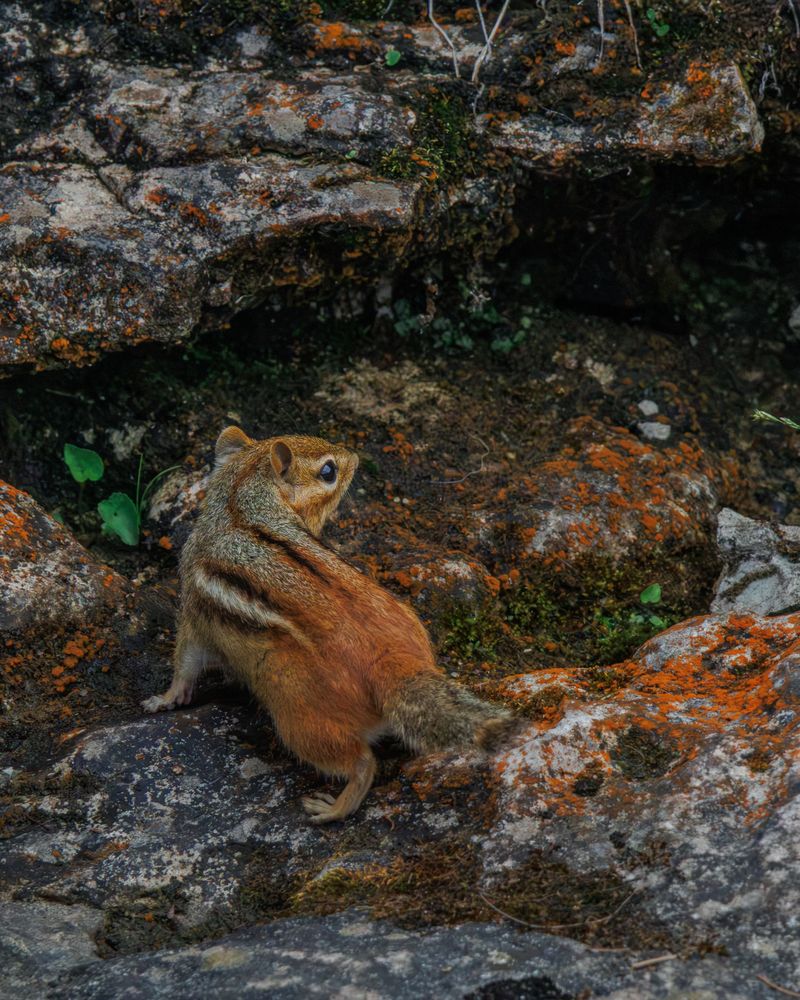
The animal is an eastern chipmunk, Tamias striatus, a small ground-dwelling squirrel roughly five to six inches long with a body built low to the earth, five dark stripes running from nose to tail, and cheek pouches that can balloon outward well beyond the width of its head when full.
It is not a ground squirrel, not a baby squirrel, and not a generic chipmunk that behaves the same way from coast to coast.
Eastern chipmunks live across the northeastern and midwestern United States, through the Appalachians, and into parts of the Southeast.
They prefer spots where a yard meets something wilder, wooded edges, stone walls, shrub borders, brush piles, and the gaps beneath patios and deck stairs.
A suburban yard with bird feeders, garden beds, and a woodpile near the foundation is close to ideal habitat for them.
They are active during daylight, most noticeably in early morning and again in late afternoon.
Penn State Extension’s chipmunk guidance notes that the species is diurnal and most visible during those peak windows, which lines up with what most homeowners report seeing.
A crossing in late summer or fall fits the season when food gathering ramps up, but not every chipmunk you spot is carrying food.
Some are patrolling territory, drinking, or simply moving between cover.
The puffed-cheek sprint, though, is a reliable sign that this one has a destination and a payload.
Those Cheeks Can Carry Several Dozen
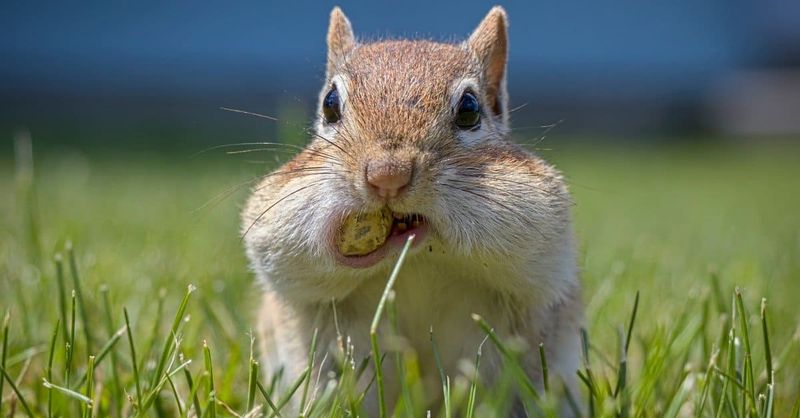
The cheek pouches are the engineering story here.
They are not inside the mouth the way a hamster’s pouches work.
They run along the outside of the jaw, lined with fur on the inside, and they can stretch to hold a load that looks almost comically large compared to the animal’s skull.
When full, the chipmunk’s head looks wider than its body.
How much fits?
The Pennsylvania Game Commission’s wildlife profile documents observed cheek-pouch loads of 31 corn kernels, 32 beechnuts, and 70 sunflower seeds in a single trip.
Those are recorded observations, not a guaranteed maximum, and they concern the combined load across both pouches rather than 30 items per cheek.
Seed size changes everything.
A sunflower seed is small and uniform, so 70 pack in neatly.
A large acorn might not leave room for much else.
The chipmunk is not following a fixed number, it is filling available space.
That single load of several dozen seeds is impressive on its own.
But the more useful image is the one after it: the chipmunk arriving at its burrow entrance, emptying both pouches into the storage chamber below, and then turning around to do it again.
One visible sprint is one chapter in a story that plays out dozens or hundreds of times before the ground freezes.
The cheeks are the delivery vehicle.
The burrow is the warehouse.
And the chipmunk is on a schedule that does not leave much room for leisurely crossing.
Repeated Trips Build an Underground Larder
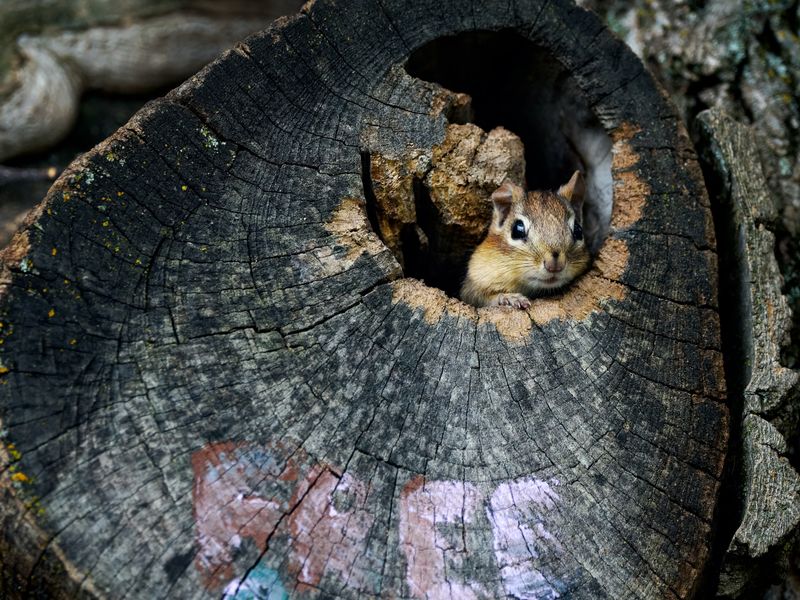
Each sprint you see is one link in a chain.
Eastern chipmunks are primarily what biologists call larder-hoarders, meaning they concentrate their stored food in one defended underground location rather than scattering individual items across a wide area the way gray squirrels do.
The burrow becomes a working pantry, and the chipmunk is the only one who knows where the door is.
Government wildlife sources describe the storage chamber of an eastern chipmunk burrow as capable of holding up to half a bushel of nuts and seeds.
The Missouri Department of Conservation’s eastern chipmunk field guide and the University of Wisconsin-Stevens Point nature guide both describe substantial underground food stores without converting that volume to a specific weight.
A half bushel of sunflower seeds weighs something very different from a half bushel of acorns or corn, so any single weight figure depends entirely on what the chipmunk has been collecting.
Some secondary educational materials and municipal fact sheets repeat a figure of eight pounds as the total cache.
One town fact sheet uses that estimate, but the stronger state wildlife sources do not establish it as a confirmed or typical amount for every animal.
Treat eight pounds as a reported estimate of a possible cumulative cache, not a number you can count on for every chipmunk in every yard.
What the evidence does support clearly is the pattern: many trips, one underground location, and a food store substantial enough to last through a long winter of intermittent activity.
Research on eastern chipmunk burrow-site selection confirms that burrow fidelity is high, meaning the animal returns to the same location repeatedly, which makes the larder-hoarding system work.
The sprint across your yard is not random.
It has a specific address.
Winter Brings Torpor, Not Complete Hibernation
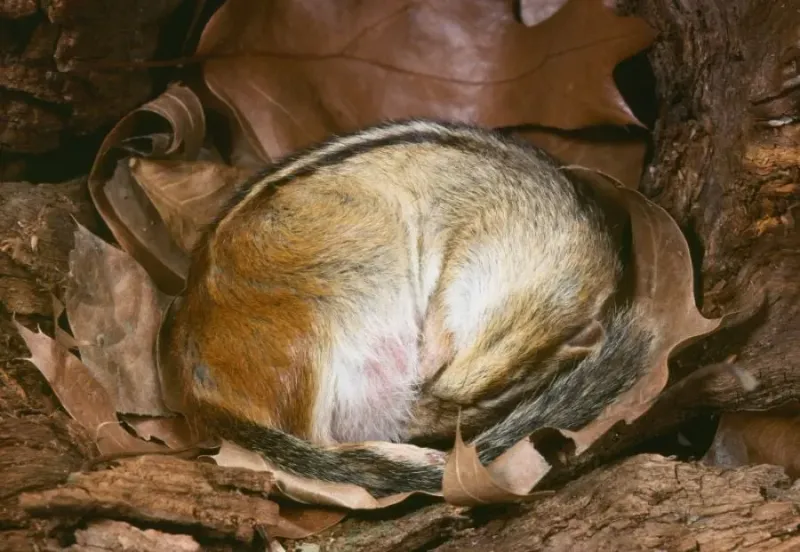
Come November across most of the eastern chipmunk’s range, the sprinting stops and the burrow entrance goes quiet.
But what happens below ground is not the deep, unbroken sleep most people picture when they hear the word hibernation.
Eastern chipmunks enter extended periods of inactivity called torpor, during which their body temperature drops and their metabolism slows.
Then they wake up, eat from the larder, and go back to sleep.
Penn State Extension and the Missouri Department of Conservation both describe this pattern of periodic waking and eating rather than one continuous winter sleep.
On an unusually warm January day in Pennsylvania or Ohio, you might actually spot a chipmunk above ground for a short time before it retreats again.
That is normal behavior, not a sign that something is wrong.
The burrow is doing the work that a fat reserve does for a true hibernator.
Instead of burning stored body fat through a months-long sleep, the eastern chipmunk runs on stored food, waking periodically to refuel from the larder it spent the fall building.
The pantry has to be stocked before the ground freezes, which is exactly what those late-summer and fall sprints are about.
One more qualification worth making: this behavior belongs specifically to the eastern chipmunk.
Rocky Mountain National Park’s wildlife notes and Olympic National Park’s profile of the Olympic chipmunk show that western species follow different strategies shaped by their own climates and food sources.
If you live west of the Great Plains, the chipmunk in your yard may not behave this way at all.
A Chipmunk’s Diet Can Help and Complicate a Yard
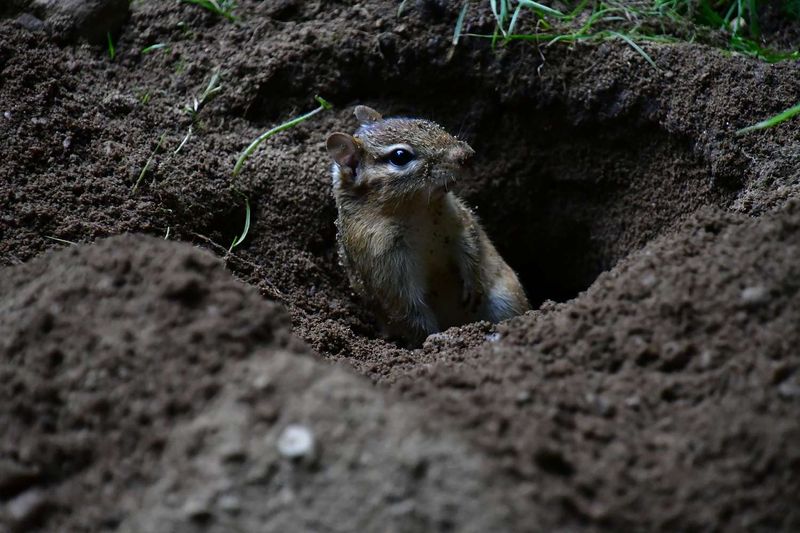
Seed-hauler is only part of the story.
Eastern chipmunks are genuine omnivores, and their menu is wide enough to surprise most people who think of them as harmless nut collectors.
The Missouri Department of Conservation’s field guide lists acorns, hickory nuts, beechnuts, walnuts, corn, wheat, berries, mushrooms, garden vegetables, insects, earthworms, snails, salamanders, frogs, small snakes, young mice, bird eggs, and occasionally young birds as documented food sources.
Pennsylvania’s Game Commission profile confirms a similarly broad diet.
That omnivorous range means chipmunks do eat some insects and other small garden pests, but the available evidence does not support calling them reliable pest-control workers.
They eat what is available and convenient, not what you most want removed.
Treat the insect-eating as a side benefit of their presence, not a service you can count on.
On the seed-dispersal question, the picture is also more complicated than it looks.
Eastern chipmunks are primarily larder-hoarders, so most of what they bury ends up consumed rather than sprouting.
Research comparing eastern and western chipmunk effects on plants notes that eastern chipmunks have a much more limited role in seed dispersal compared to species that scatter-hoard more widely.
Occasional scatter-hoarding does happen, but it is not the norm.
The conflicts are real and worth naming plainly.
UNH Extension’s garden guide and Penn State Extension both document chipmunk damage to bulbs, seedlings, flowers, berries, tomatoes, birdseed, and pet food left outdoors.
Burrowing under patios, stairs, retaining walls, and foundations is also possible.
But one chipmunk crossing your yard is not evidence of structural risk.
Documented, repeated damage is the signal that action makes sense.
Reduce Food Access and Protect Small Plantings
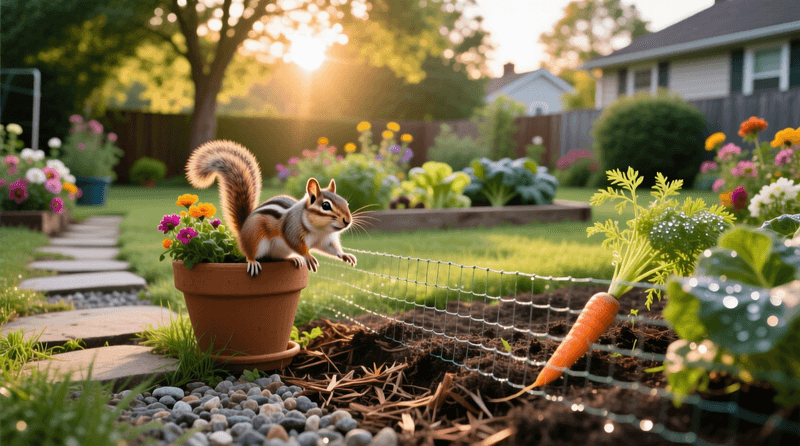
Before you rearrange the whole yard, start with the easiest fix: reduce what the chipmunk is coming for.
Bird feeders are often the main draw.
Spilled seed on the ground is essentially a free buffet placed at chipmunk nose height, and it concentrates animals close to your house.
Penn State Extension recommends placing feeders 15 to 30 feet from buildings to reduce chipmunk access near foundations and entry points.
That distance does not eliminate chipmunks from the yard, but it moves the activity away from places where burrowing causes real problems.
A seed catcher tray under the feeder, more careful filling to avoid overflow, or temporarily pulling the feeder down during peak fall gathering can also make a meaningful difference.
Colorado State University Extension’s feeder placement guidance makes the same point about distance from structures, connecting feeder position to wildlife management rather than just bird-watching convenience.
For garden beds, bulbs, and newly seeded areas, physical barriers are more dependable than repellents.
Repellents require repeated applications, wear off in rain, and rarely provide complete protection across a whole season.
Hardware cloth with a quarter-inch mesh is the more reliable tool.
UNH Extension’s chipmunk garden guide and Penn State both recommend laying the cloth flat over the planting area, extending it at least one foot beyond each margin, and covering it with soil.
The mesh lets water and air through while blocking digging.
For tulip or crocus bulbs, which chipmunks find particularly appealing, this approach applied at planting time saves a lot of frustration come spring.
Intervene When Damage Is Documented
A burrow entrance near your foundation looks alarming, but knowing what to look for helps you assess it calmly.
Eastern chipmunk entrances are typically neat and round, about two inches across, with little or no soil mound around the opening because chipmunks often carry excavated dirt away in their cheek pouches.
Penn State Extension notes that burrows can extend roughly 20 to 30 feet, with multiple chambers for sleeping and food storage, though size and layout vary considerably.
If a burrow is positioned under a patio, retaining wall, or close to a foundation and you are seeing active use, a few habitat changes can reduce the appeal of that location.
Seal gaps and small openings in foundations with caulk or quarter-inch hardware cloth.
Move woodpiles, brush piles, and dense ground cover away from the house, because those features give chipmunks covered travel routes and protected spots to start a burrow.
These changes address the conditions that make a spot attractive rather than targeting the animal directly.
Do not feed chipmunks to try to redirect them, and do not use poison.
UNH Extension’s guide to wildlife-safe rodent control explains that rodenticides can harm chipmunks, squirrels, and other nontarget animals that share the yard.
Penn State’s guidance confirms that no toxic baits or fumigants are registered specifically for chipmunk control.
If trapping seems necessary after other steps have failed, check your state and local wildlife regulations before setting anything.
UNH Extension warns that releasing a chipmunk into unfamiliar habitat can expose it to predators and starvation, and relocation rules vary by state and municipality.
A licensed wildlife professional can help you navigate both the legal and practical sides of that decision.
And if the animal you are watching appears injured, disoriented, or is moving in an unusual way rather than the purposeful sprint of active foraging, that warrants a call to a wildlife rehabilitator rather than a trap.
CDC guidance on wildlife contact advises observing wild animals from a distance rather than handling or approaching them.
Keep Your Distance After a Bite or Scratch

Most people who share a yard with eastern chipmunks never get closer than a few feet, and that distance is the right one to maintain.
Do not hand-feed them, do not let children try to catch them, and do not corner one near a wall or fence where it feels trapped.
A chipmunk that cannot escape will bite, and even a small bite or scratch from a wild animal deserves attention.
Chipmunks are not commonly associated with rabies.
CDC historical guidance on rabies prevention has long identified small rodents as rarely implicated in human rabies cases in the United States.
That does not mean you can ignore a bite.
Current CDC rabies prevention guidance recommends washing any bite or scratch wound with soap and running water for at least 15 minutes, then contacting a healthcare provider or your local public health department promptly for further advice.
The CDC clinical overview of rabies notes that a public health assessment can determine whether post-exposure treatment is needed based on the specific animal and circumstances.
That assessment is a quick call, not a crisis, but skipping it is not the right move.
Wash the wound, make the call, and follow the guidance you receive.
Watching an eastern chipmunk sprint across your yard in September, cheeks packed and purpose clear, is one of those small yard moments that rewards a second look.
The animal is doing something genuinely impressive on a tight schedule, and knowing what it is actually hauling makes the blur across the patio feel a little less like a pest problem and a little more like a neighbor with a very full grocery list.