
The Invasive North Carolina Tree That Tells You Where to Look for Spotted Lanternfly
Follow us on Google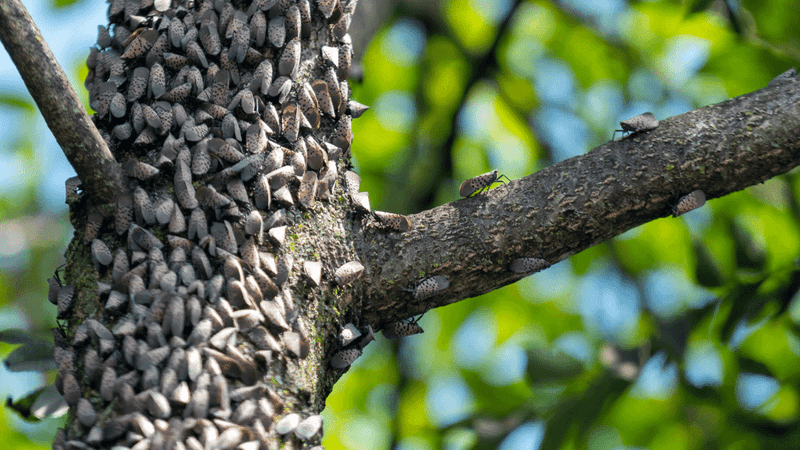
Something about your backyard might already be working against you, and most North Carolina homeowners have no idea what it looks like. A fast-growing tree called tree-of-heaven has spread quietly across the state, and it happens to be the insect pest spotted lanternfly’s favorite place to gather.
Knowing how to spot this tree, and what to do when you find it, puts you ahead of a problem that is still spreading across the Piedmont and beyond.
Tree-of-Heaven Gives Homeowners a Place to Look
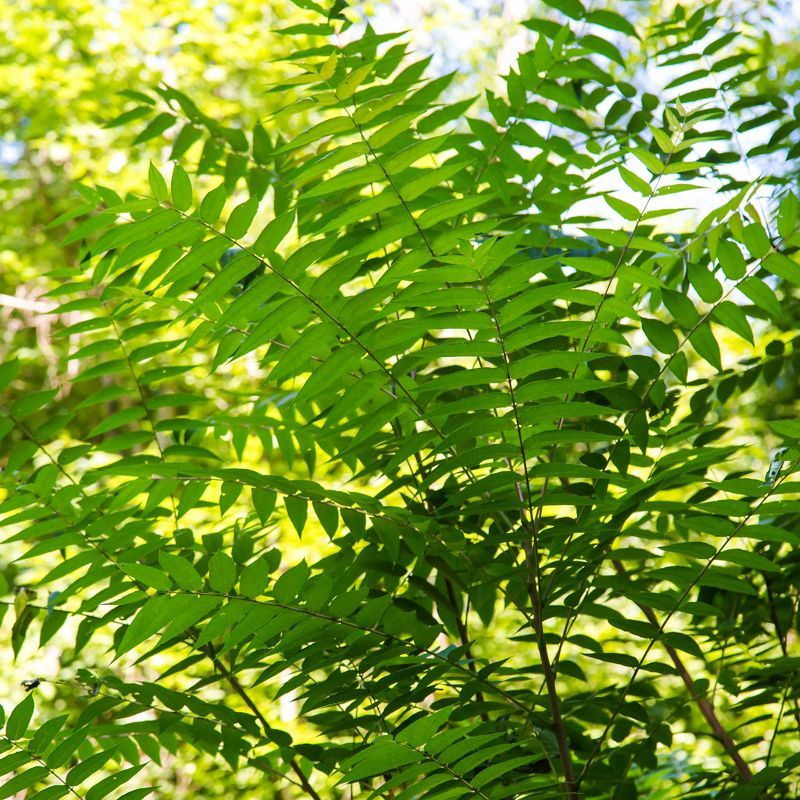
Most people walk right past tree-of-heaven, Ailanthus altissima, without a second glance. It blends into fence lines, vacant lots, and the edges of driveways so easily that it can reach 40 or 50 feet before anyone notices it does not belong.
According to NC State Extension’s tree-of-heaven profile, the tree can grow to roughly 80 feet tall, and its compound leaves can stretch 2 to 4 feet long, each carrying anywhere from 10 to 40 leaflets.
The leaflet edges are the first thing to check. On tree-of-heaven, those edges are mostly smooth, which separates it from black walnut and sumac, two common look-alikes whose leaflets have clearly toothed or serrated margins.
Run your finger along the edge of a leaflet, and if it feels almost like the edge of a piece of paper rather than a tiny saw blade, that is one mark in tree-of-heaven’s column.
Crush a leaf or snap a small stem and take a sniff. The smell is distinctive, often compared to rancid peanut butter or something burnt, and it is hard to forget once you have experienced it.
Bark on older stems tends to be gray or brown with lighter vertical streaks, almost like pale lines painted on a gray wall.
Here is the part that matters most for lanternfly surveillance: spotted lanternflies, especially later-stage nymphs and adults, strongly prefer this tree as a feeding site, making it a genuinely useful place to inspect. But finding tree-of-heaven in your yard does not mean lanternfly is already there.
Confirm the tree using several traits together, not just one, and look for the insect separately before drawing any conclusions.
A Preferred Host Is Not the Source of Spread
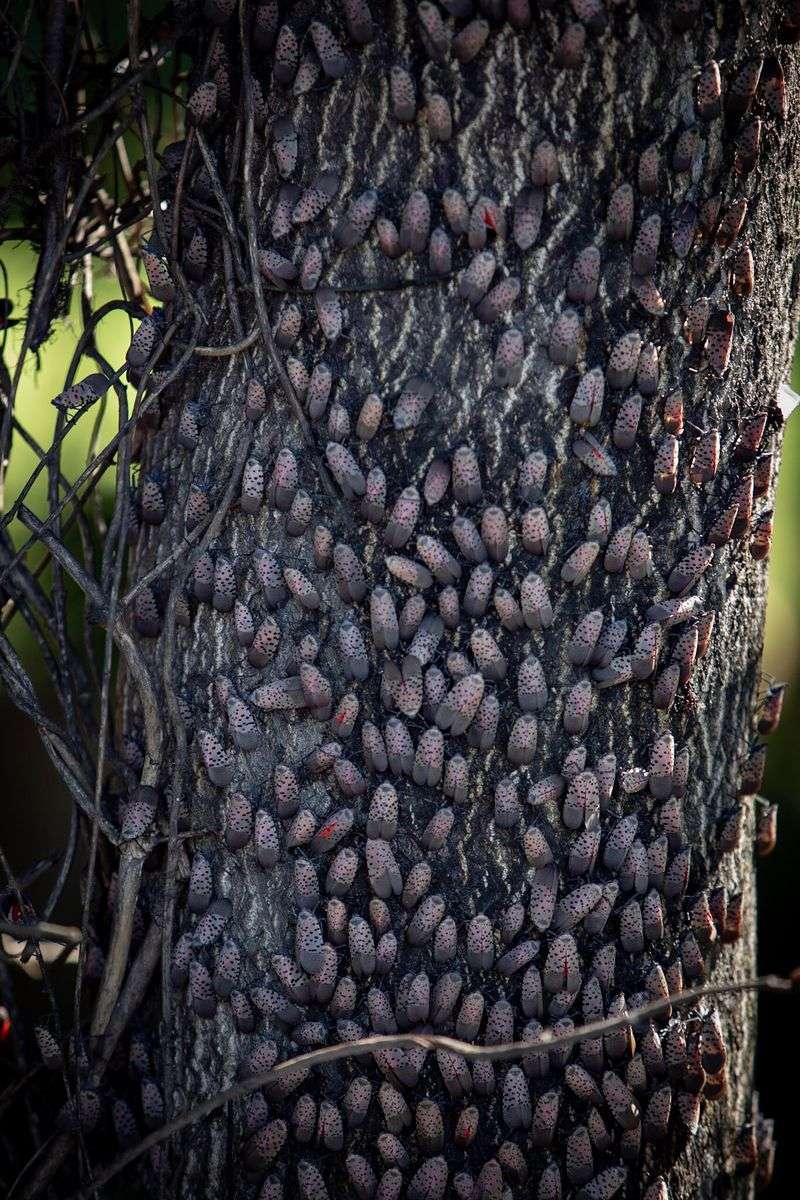
Spotted lanternfly does love tree-of-heaven. Later-stage nymphs and adults gather on it in numbers that make the tree look almost polka-dotted some mornings.
That preference is real, and it is exactly why the tree makes a practical inspection point in any yard where it grows.
What the tree does not do is spread the insect on its own. NC State Extension’s spotted lanternfly page makes clear that this pest feeds on more than 100 plant species, including grapes, apples, peaches, maples, oaks, walnuts, sycamores, dogwoods, and many others.
The insect can actually complete its entire life cycle without ever touching a tree-of-heaven. So even a yard with no tree-of-heaven at all is not automatically protected.
The bigger driver of long-distance spread is people. Lanternflies and their egg masses hitchhike on vehicles, trailers, outdoor furniture, firewood, bikes, camping gear, and almost any hard surface left outside near an infestation.
A family returning from a mountain trip or a load of firewood bought at a campground can carry egg masses home without anyone realizing it.
Removing a tree-of-heaven from your yard removes one preferred feeding site, and that can reduce the number of insects you see in that spot. But it cannot keep lanternflies out of the yard entirely, because the insect has too many other host options and too many ways to arrive.
The tree is best understood as a surveillance target, a place that concentrates the pest and makes it easier to find, not the reason the pest shows up in the first place.
Seasonal Signs Make the Insect Easier to Confirm
Timing your inspections correctly makes all the difference. The NCDA&CS spotted lanternfly page outlines the general North Carolina windows this way: egg masses persist from September through May, early nymphs appear from late March through June, late nymphs run from late May through July, and adults are active from July through December.
Weather and local conditions can push any of those windows earlier or later, so treat them as guides rather than guarantees.
Start your search on the trunk and lower stems of any tree-of-heaven you have confirmed. Early nymphs are small and black with white spots, easy to miss against rough bark.
Late nymphs are larger, red and black, and harder to overlook once you know what you are seeing. Adults reach about 1 inch long and fold their wings flat when resting, showing a gray-tan surface with black spots.
Catch one with wings open and you will see the red hindwings underneath, which is a reliable identification marker.
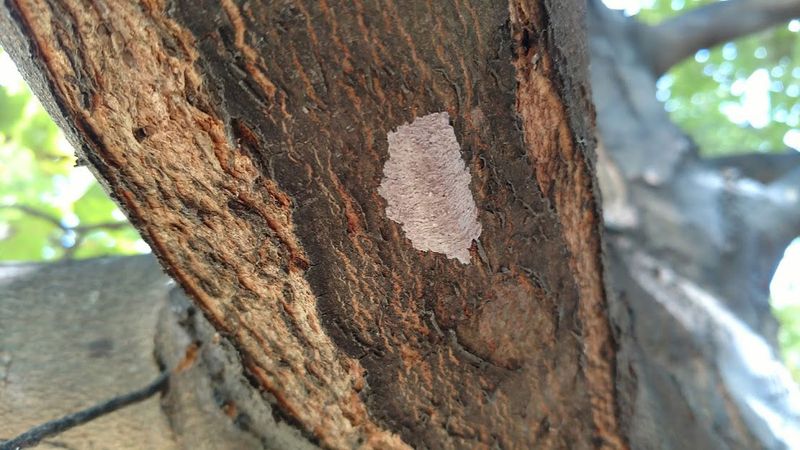
Check also for egg masses described by USDA APHIS as gray and mud-like, roughly 1 inch long, each containing around 30 to 50 eggs arranged in rows beneath a waxy coating. Fresh masses look almost like cracked mud drying in the sun.
Look on smooth bark, patio furniture, fence posts, and even outdoor grills.
Sticky honeydew dripping from branches and a coating of black sooty mold on leaves or surfaces beneath the tree are indirect signs worth noting. Large clusters of adults on a single trunk on a warm afternoon can be striking enough to stop you mid-step.
Any of these signs warrants a photograph and a report, not an immediate treatment response.
Document and Report Suspicious Finds
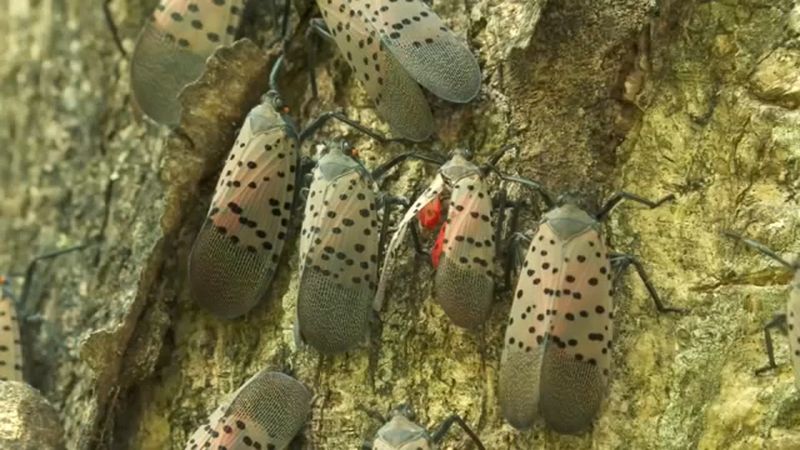
The moment you think you are looking at a spotted lanternfly or an egg mass, stop and take a photograph before doing anything else. Place a quarter or a pen beside the subject so the image has a clear size reference.
Note the date, the location, and the county, because that information determines whether your sighting is inside an already-documented area or somewhere new.
Report the sighting through the NCDA&CS system, especially if you are outside one of the counties with a confirmed established population. As of the February 10, 2026 NCDA&CS press release, established populations had been confirmed in seven counties: Forsyth, Guilford, Caldwell, Rockingham, Davidson, Rowan, and Caswell.
That count may have grown since then, so check the current NCDA&CS spotted lanternfly page for the latest map before acting on that number. Your county Cooperative Extension office can also help you confirm the identification and figure out the right next steps for your specific situation.
Before you move anything out of the yard, or load up the truck for a weekend trip, check hard surfaces carefully. Vehicles, trailers, grills, outdoor furniture, firewood, bicycles, and kids’ toys can all carry egg masses or live insects according to USDA APHIS guidance.
Spotted lanternfly can hitchhike at any time of year, not just during the adult season.
If you scrape or crush egg masses, follow the current NCDA&CS instructions for disposing of the material properly. Do not assume that scraping alone is sufficient, and do not carry scraped material to a new location.
Moving infested material is one of the fastest ways to spread the pest to a yard or neighborhood that does not yet have it.
Established Trees Need Deliberate Removal
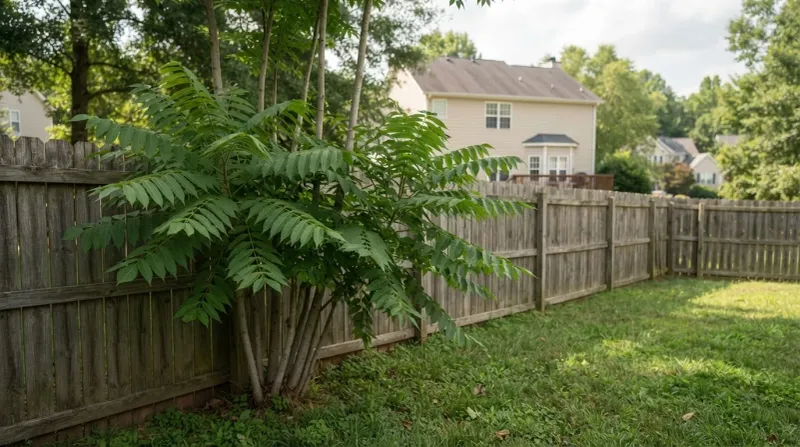
Grabbing a chainsaw the moment you identify a tree-of-heaven is one of the most common mistakes homeowners make, and it can genuinely make the situation worse. NC State Extension explains that cutting an established tree-of-heaven without treating the stump often triggers a flush of new growth from the base and from lateral roots that can spread several feet in every direction.
One tree becomes a thicket, and that thicket is actually harder to manage than the original single trunk.
The approach depends entirely on the size of the plant. Very young seedlings, the ones that came up this spring and are still small enough to pull by hand, can be removed if you can get the entire root system out of the ground.
Even a small piece of root left behind can resprout. Pull after a rain when the soil is loose, and check back in a few weeks for any regrowth.
Larger established trees are a different problem. Research on Ailanthus altissima documented by the USDA Forest Service confirms the species’ strong tendency to resprout after mechanical removal, which is why professional guidance matters so much here.
A certified arborist, your county Extension office, or a qualified invasive-plant professional can assess the site and recommend the right approach, whether that is basal-bark treatment, cut-stump treatment, foliar application, or a hack-and-squirt method.
Each of those techniques exists for a reason, and each one requires following the product label exactly to avoid harming nearby desirable trees and shrubs. Near utilities, structures, roads, or play areas, a tree removal also carries real physical hazards that call for professional equipment and training.
After any removal, monitor the area for new sprouts and seedlings every few weeks through the growing season, because follow-up is not optional with this species.
Use Traps Without Trading Insects for Wildlife
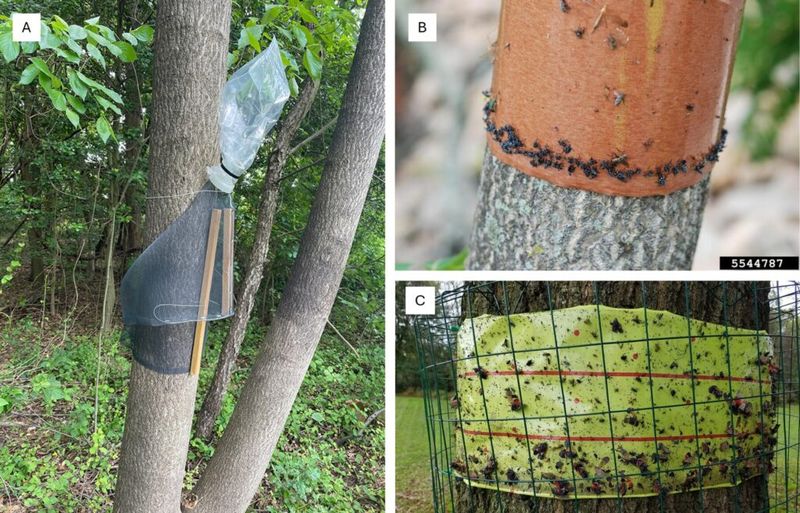
Sticky bands wrapped around tree trunks can intercept spotted lanternfly nymphs and adults as they climb, and some homeowners find them genuinely useful for monitoring and reducing numbers on a specific tree. The catch, and it is a serious one, is that unprotected sticky material does not distinguish between lanternflies and everything else climbing that trunk.
Birds, bats, squirrels, lizards, butterflies, and beneficial insects all move through residential yards, and exposed adhesive traps them indiscriminately. The Penn State Extension spotted lanternfly management guide recommends adding a wildlife barrier if sticky bands are used, and checking the bands daily to remove any non-target animals that do get caught.
Penn State Extension also details how to build a wildlife barrier for a sticky band trap using a mesh sleeve that lets lanternflies through while keeping larger animals out. Funnel-style circle traps, when properly installed, offer a potentially less damaging residential option because they rely on the insect’s climbing behavior without exposing open adhesive to wildlife.
On the chemical side, Penn State Extension warns clearly against homemade remedies including dish soap, vinegar, salt, oil, boric acid, and chili sprays. These mixtures may harm people, pets, plants, and wildlife, they often do not work reliably, and some applications may actually violate pesticide law.
Broad spraying of every tree in the yard is not a recommended starting point either. According to Penn State Extension’s guidance on pesticide safety, any pesticide decision should account for the insect’s current life stage, the host plant involved, the actual infestation level, and the specific product label.
Scout first, then seek local professional advice before reaching for any treatment product.
Keep Scouting After the First Response
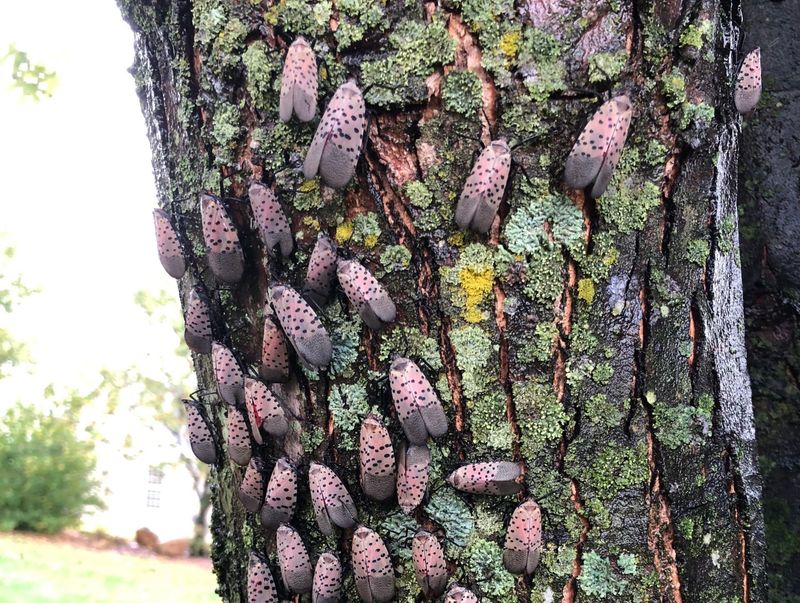
One inspection is a starting point, not a finish line. Monitor tree-of-heaven and any nearby plants you have identified as possible hosts from late spring through fall, working through the seasonal windows for each life stage.
The USDA Forest Service species review for Ailanthus altissima documents how vigorously this tree resprouts after cutting, which means cleared areas need follow-up checks every few weeks through the growing season for new root sprouts and seedlings.
After any travel or transport, inspect vehicles, trailers, and anything that spent time near an infested area before bringing it home. This habit matters year-round, not just during adult season, because egg masses overwinter on hard surfaces and are easy to miss.
Replanting cleared ground with appropriate native or noninvasive vegetation can help close the gap that tree-of-heaven removal leaves behind. That step reduces the chance of reinvasion by the same plant, but it does not eliminate the need for continued monitoring.
Penn State Extension’s pesticide safety guidance reminds homeowners that a few lanternflies feeding on a large, healthy tree do not automatically signal that the tree will die. Heavy populations are a different matter, creating honeydew, sooty mold, nuisance clusters, plant stress, and serious impacts in vineyards, orchards, and nurseries, but a backyard with light pressure is a manageable situation, not a crisis.
The practical sequence comes down to four steps: identify carefully using multiple traits, report clearly with a photograph and location details, move nothing that could carry hitchhikers, and manage the host tree deliberately with professional guidance. Check the NCDA&CS spotted lanternfly page regularly for updated county maps.
Knowing what you are looking at, and who to call, turns a backyard tree into a useful early-warning system rather than a source of panic.