
More Purple Martins Near Your North Carolina Home Means Quieter Mosquito Evenings Around The Porch
Follow us on Google
Purple Martins are one of the most exciting birds you can attract to a North Carolina yard, swooping and chattering through warm evenings while you sit on the porch.
The idea that they eat mosquitoes by the thousands sounds almost too good to be true, and honestly, it is.
These birds are genuine aerial hunters with real conservation value, but the science does not back up the promise of a quieter, bite-free evening just because a martin house is in the yard.
What follows is an honest look at what Purple Martins can do for your outdoor space, what they cannot, and which steps will actually help you enjoy that porch after sunset.
What Purple Martins Can—and Cannot—Do For A North Carolina Porch
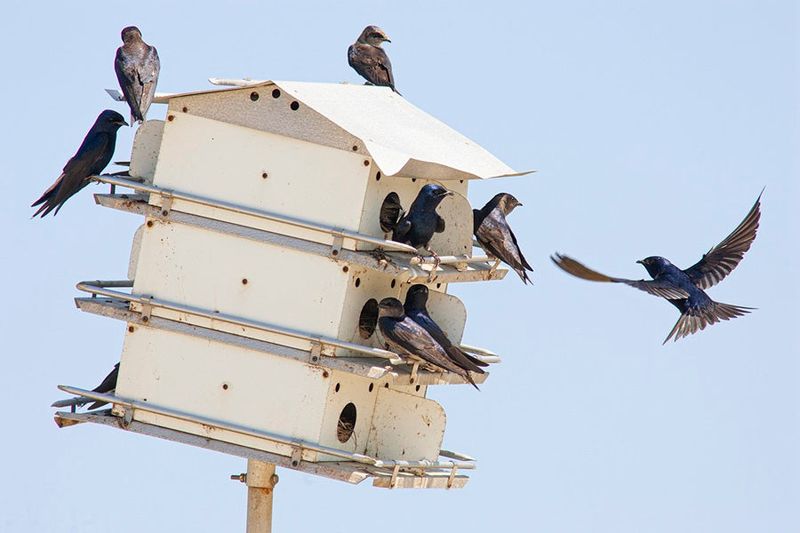
Purple Martins (Progne subis) are real showstoppers.
Watch a colony work the air above an open yard on a June evening in the Piedmont and you will understand immediately why so many North Carolina homeowners want them close.
The birds are fast, social, and vocal, and they spend their days catching insects on the wing in ways that feel almost theatrical from a porch chair.
Here is where things get complicated, though.
A peer-reviewed review published in The Auk concluded that Purple Martins do not play a meaningful role in mosquito control, and wildlife agencies across the country agree.
The Audubon Society’s field guide describes their diet as a broad mix of flying insects, with mosquitoes making up only a minor share.
The widely repeated claim that one martin eats 2,000 mosquitoes per day has no solid evidentiary foundation, and responsible sources reject it outright.
That does not make a martin house a bad idea.
Far from it.
In eastern North America, Purple Martins now depend heavily on human-provided housing to nest successfully, so putting up a well-placed house is a genuine conservation contribution.
The birds bring seasonal wildlife activity, color, and sound to a yard that nothing else quite matches.
The honest framing is this: a martin house is a conservation and birdwatching project, not a mosquito-prevention device.
Enjoy the birds for what they genuinely are, then use proven methods to actually protect your family on the porch.
Both goals can share the same yard, and the rest of this article shows you how to pursue each one clearly.
Purple Martins Eat A Broad Mix Of Flying Insects
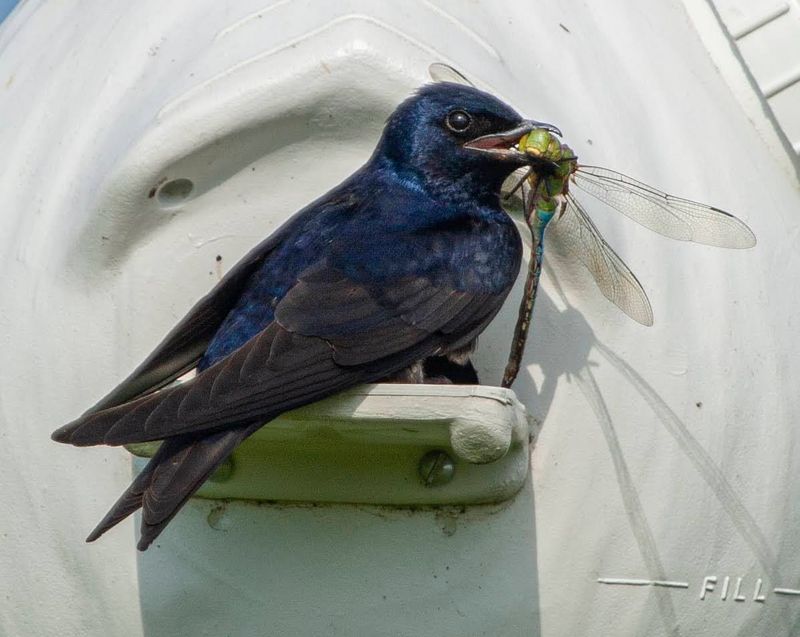
Spend a morning watching a martin colony and you will see birds that are clearly built for catching things in the air.
Their wings are long and swept back, their bills open wide, and they rarely land except to rest or tend the nest.
Everything about their body says “aerial hunter,” and they are very good at it.
What they are hunting, though, is a long and varied list.
Audubon’s field guide describes their diet as including flies, beetles, wasps, winged ants, dragonflies, true bugs, moths, butterflies, grasshoppers, and other flying insects.
Cornell Lab of Ornithology confirms that martins are opportunistic, taking whatever flying prey is available at the altitude where they are working that day.
Mosquitoes do appear in that diet, but the older research summarized by sources like the Missouri Department of Conservation suggests mosquitoes make up a small fraction of what martins eat, sometimes cited as less than 3 percent.
That figure is a limited older summary, not a universal measurement that applies to every bird in every habitat at every life stage.
More recent DNA-based research shows diet composition shifts depending on whether a bird is an adult or a nestling, what habitat surrounds the colony, and what insects happen to be flying locally.
The practical takeaway is straightforward. “Eats flying insects” and “controls mosquitoes” are not the same sentence.
A bird that occasionally catches a mosquito while working through a cloud of dragonflies and beetles is not delivering household-level mosquito reduction.
The peer-reviewed Auk review makes that distinction plainly, and it holds up whether your yard is on the Coastal Plain or in the Piedmont red clay.
Their Foraging Pattern Does Not Equal Porch Mosquito Control
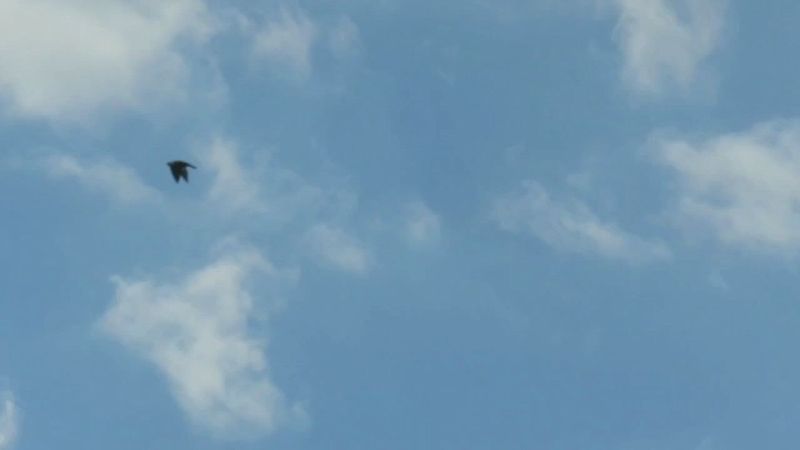
Picture a martin working the sky above your yard at two in the afternoon.
It is probably 40 or 50 feet up, banking and rolling through whatever insect activity the warm air is carrying.
That is a beautiful thing to watch, and it is also a long way from your ankles.
Cornell Lab notes that Purple Martins may fly lower near nesting sites during afternoon and evening hours, which is an interesting observation.
But flying lower than usual and flying at patio height are not the same thing, and lower flight near a nest box does not mean the birds are targeting the mosquitoes that are biting you in your chair.
Mosquitoes and Purple Martins tend to operate on different schedules and at different altitudes.
The Missouri Department of Conservation’s field guide points out that mosquitoes typically fly much lower than martins and are often most active around dawn and dusk or after dark, while martins are daytime foragers that roost before full dark.
That pattern holds for many common mosquito species, though weather, habitat, and species differences can shift things in either direction.
The gap matters because even if a martin occasionally catches a mosquito, the insects biting people on a Piedmont porch at 8 p.m. are operating in a time and space the birds have largely left for the day.
A review of Purple Martin and mosquito research found no measurable reduction in mosquito abundance near homes with martin colonies.
The birds are doing real work up there, just not the specific work the popular story assigns them.
A North Carolina Sighting May Not Mean A Nesting Colony
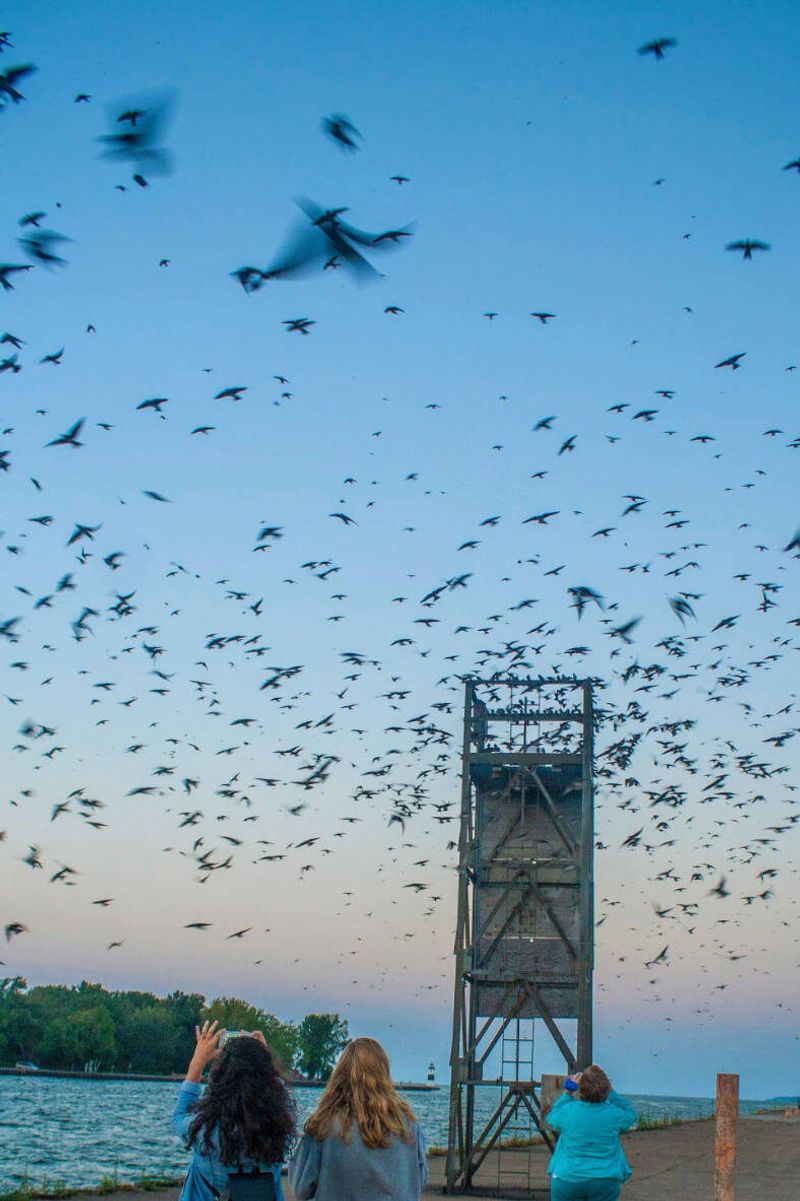
North Carolina is genuine Purple Martin country.
The species nests across the state, from the barrier islands on the coast to the foothills, and NC State Extension lists Purple Martins among the state’s notable wildlife that homeowners can support with appropriate habitat.
If you have watched a swirling mass of dark birds funnel into a roost tree on a late August evening, you have already seen one of North Carolina’s most spectacular wildlife events.
What that roost does not tell you is whether those birds are nesting in your yard or eating insects near your porch.
Purple Martins migrate through North Carolina in spring and fall, and large pre-migration roosts can gather tens of thousands of birds in a single location for a few weeks in late summer.
Cornell Lab’s range and behavior information makes clear that migratory and roosting birds are a separate phenomenon from an established nesting colony using a homeowner’s house.
Seeing martins overhead, even regularly, does not mean they are using your housing, feeding over your property specifically, or reducing insect pressure in your yard.
A bird passing through the Sandhills in September on its way to South America is not the same as a nesting pair raising chicks in the house you put up by the garden.
That distinction matters for setting expectations honestly.
Attracting a nesting colony takes the right site, the right housing, patience, and often proximity to an existing colony.
Overhead sightings are a pleasure, but they are not a sign that your yard is already doing the conservation work or receiving the wildlife benefits of an active colony.
Assess The Yard Before Buying A Martin House
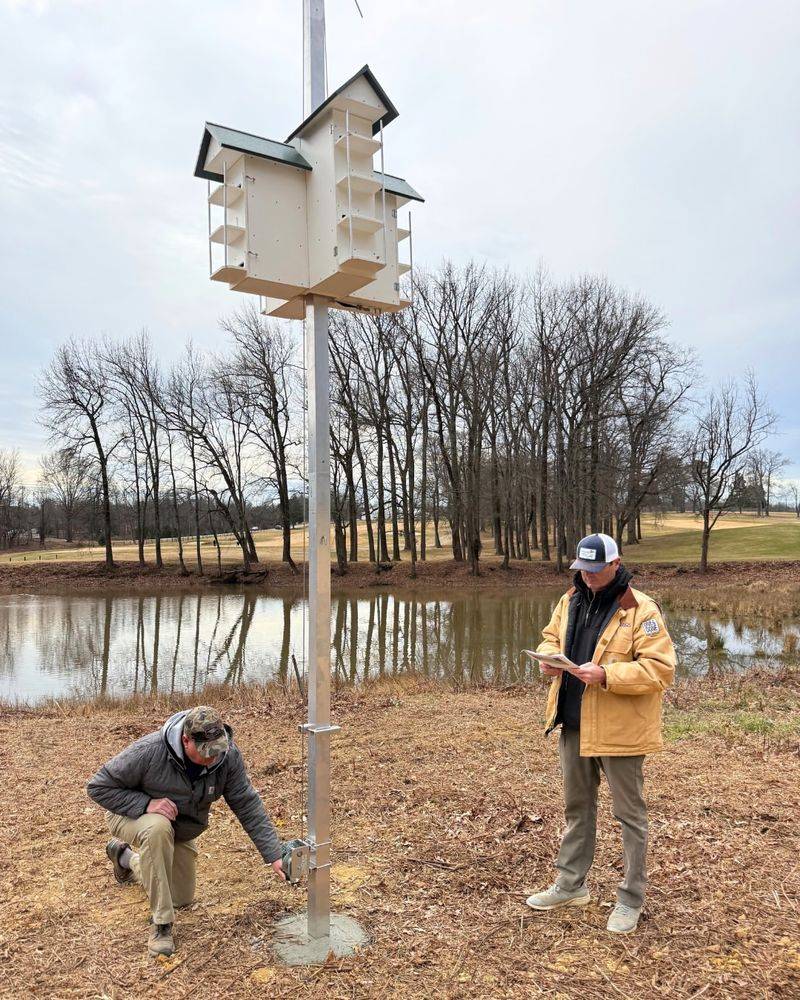
Before you order a martin house, walk the yard and look up.
Purple Martins need open sky, and a lot of it.
A wooded lot with tall oaks pressing in from three sides, a narrow suburban yard hemmed in by privacy fencing and mature pines, or a landscape where power lines and tall shrubs clutter the airspace is going to make it very hard for martins to feel comfortable enough to move in.
The Purple Martin Conservation Association’s getting-started guidance recommends placing housing roughly 30 to 120 feet from your home and at least 40 feet from tall trees, with 40 to 60 feet of clearance preferred where space allows.
The most open corner of a large lawn, a pasture edge, or a yard that backs up to a field or pond gives you the best shot.
Avoid placing the pole near tall shrubs, vines, overhead wires, or anything that gives predators an easy approach path.
The housing system itself matters too.
A pole with a pulley or winch that lets you lower the house to ground level is not optional; it is how you perform the monitoring and maintenance that keeps the colony healthy and safe.
A house you cannot reach safely is a house you cannot manage properly.
Set realistic expectations before you spend money.
Attracting a first-year colony can take two or three seasons, especially if there is no established martin colony within a mile or two.
Some yards in the right location fill up quickly; others wait years.
If your lot is heavily wooded or the open area is smaller than about 40 feet in any direction, the honest assessment is that your yard may not be a good martin site, and that is useful information to have before you invest in housing.
Check the PMCA’s attracting guidance to evaluate your specific situation before purchasing.
A Martin House Requires Periodic Monitoring And Maintenance
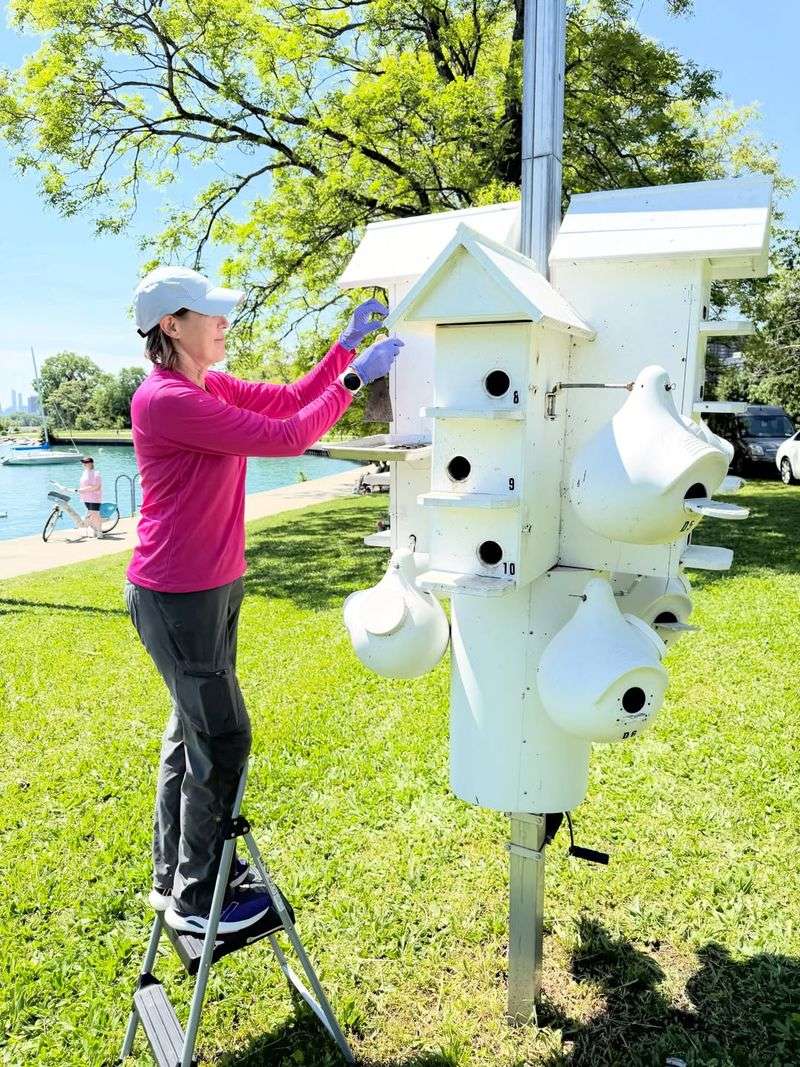
A martin house that goes up in April and comes down in September without anyone checking on it is not a conservation project.
It is a cavity hotel that House Sparrows and European Starlings will be delighted to run.
Both species are invasive, and both can occupy martin compartments, destroy eggs, and injure or kill adult martins if nest checks are not part of the routine.
Managing that pressure is the core active commitment a martin landlord takes on.
The Purple Martin Conservation Association recommends housing that can be lowered safely so owners can inspect nest compartments, remove invasive-species nests, and monitor the colony’s progress through the season.
For specific guidance on how often to check, what safe access looks like for your particular housing model, and what a healthy nest should contain, the PMCA and your housing manufacturer are the right places to look, not general articles.
Their guidance is detailed, species-specific, and updated regularly.
Native birds sometimes compete for martin cavities too.
Tree Swallows, Eastern Bluebirds, and Carolina Wrens may investigate open compartments, and none of them should be treated as pests or casually evicted.
The Cornell Lab and the Purple Martin landlord community both suggest offering native cavity nesters a separate single-unit box about 30 to 50 feet from the martin structure rather than trying to exclude them.
The decision rule here is simple.
Install a martin house only if you have a suitable site and you are genuinely willing to monitor and maintain it through the nesting season.
A well-managed house supports a species that now depends on human landlords across most of eastern North America.
An unmanaged one does more harm than good.
Combine Habitat With Proven Mosquito Prevention

The martin house goes up on the pole, the birds arrive in April, and you still get bitten on the porch in July.
That is not a failure of the birds; it is just the reality that mosquito prevention requires a different set of tools.
The good news is that those tools are straightforward and genuinely effective when you use them consistently.
CDC guidance on preventing mosquito bites starts with one weekly habit that makes a real difference: empty, scrub, and either refill or cover anything in your yard that holds water.
That means flowerpot saucers, buckets, kids’ toys, old tires, birdbaths, trash container lids, tarps with low spots, and any decorative container that collects rain.
Mosquitoes can complete their larval stage in as little as a week in standing water, and a Piedmont yard after an afternoon thunderstorm can produce new breeding sites faster than most homeowners realize.
Screens matter as much as standing water.
CDC’s mosquito control at home page recommends repairing gaps and tears in window and door screens, using air conditioning when practical, and favoring screened outdoor spaces for evening gatherings.
An EPA-registered repellent applied as directed on the label adds direct personal protection when you are outside.
For water features, rain barrels, or ornamental ponds that cannot be drained or covered, EPA identifies Bti larvicide as a targeted option for controlling mosquito larvae where the product label approves that specific use.
Always read the label first, because approved uses differ by formulation and water type.
Routine outdoor misting systems are a different matter.
CDC notes that automated pesticide misting systems can have unintended effects on beneficial insects and are not a recommended first-line approach.
Integrated prevention, starting with water management and direct protection, does more with less risk.
Judge The Project By Wildlife Value, Not Mosquito Counts
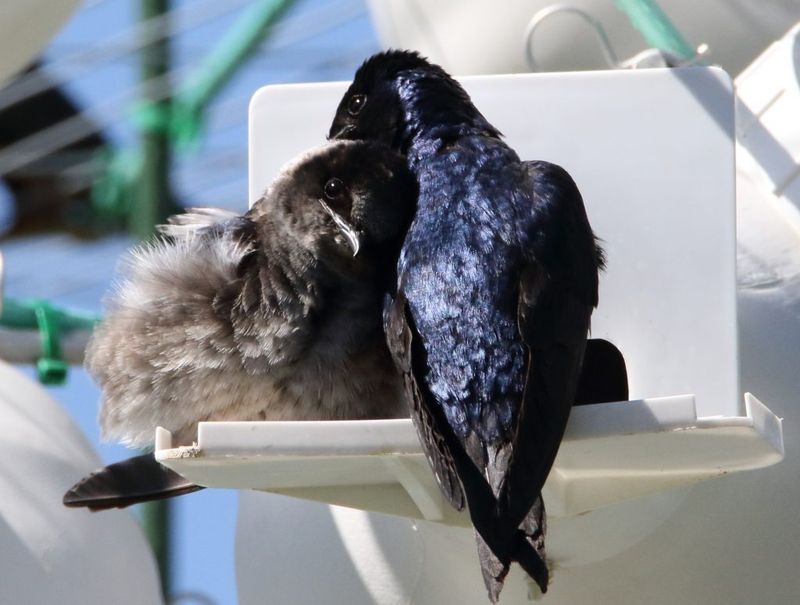
A martin house earns its place in a North Carolina yard by what it genuinely delivers: a front-row seat to one of the most active, social, and vocal nesting birds in the eastern United States.
From late March, when the first scouts arrive, through late summer, when the colony begins to quiet down before migration, a well-managed house brings a season of wildlife activity that most yards simply do not have.
That is worth something real.
Cornell Lab notes that Purple Martins in eastern North America now rely heavily on human-provided housing, which means a well-placed, well-managed house is a genuine contribution to a species that needs it.
Measure the project by whether the site is open enough, whether the housing is manageable, and whether you are willing to monitor it through the season, not by whether the mosquito count drops.
At the same time, CDC’s mosquito prevention steps sit alongside the martin house, not in competition with it.
Empty the saucers, fix the screens, apply repellent when you need it, and enjoy the birds for the aerial show they actually put on.
If your yard cannot support a colony, the PMCA’s site guidance will tell you that honestly, and you can still enjoy martins passing overhead during migration without feeling like you missed out.
The porch evening you are after is entirely possible.
It just takes the right birds appreciated for the right reasons, and the right prevention steps doing the actual work.