
Why The Carpenter Bees Buzzing Your North Carolina Porch Are Not The Ones To Fear
Follow us on Google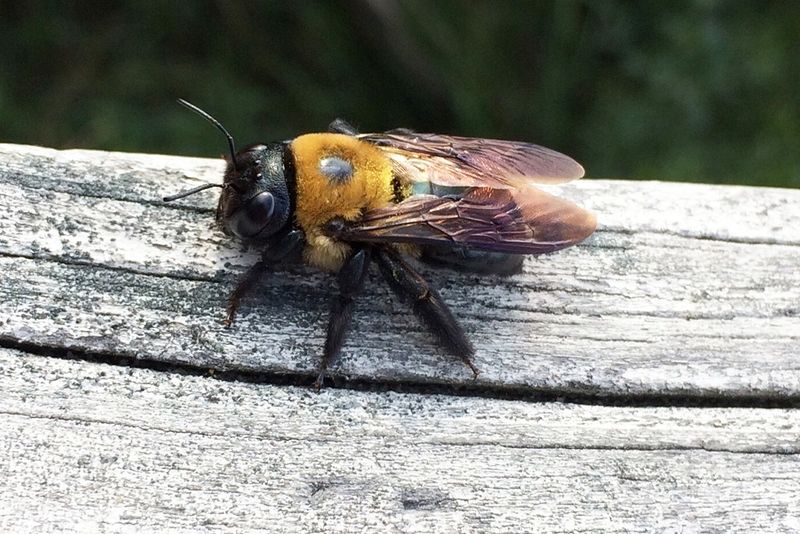
Every spring, large bees start hovering and buzzing around North Carolina porches, and plenty of homeowners back right through the door. The good news is that the boldest, most in-your-face bee out there is often a male, and males cannot sting. That said, there is more to the story than “relax” – females are usually nearby, they can sting, and those round holes in your wood deserve a closer look than most people give them.
The Porch Buzz Often Comes From a Male
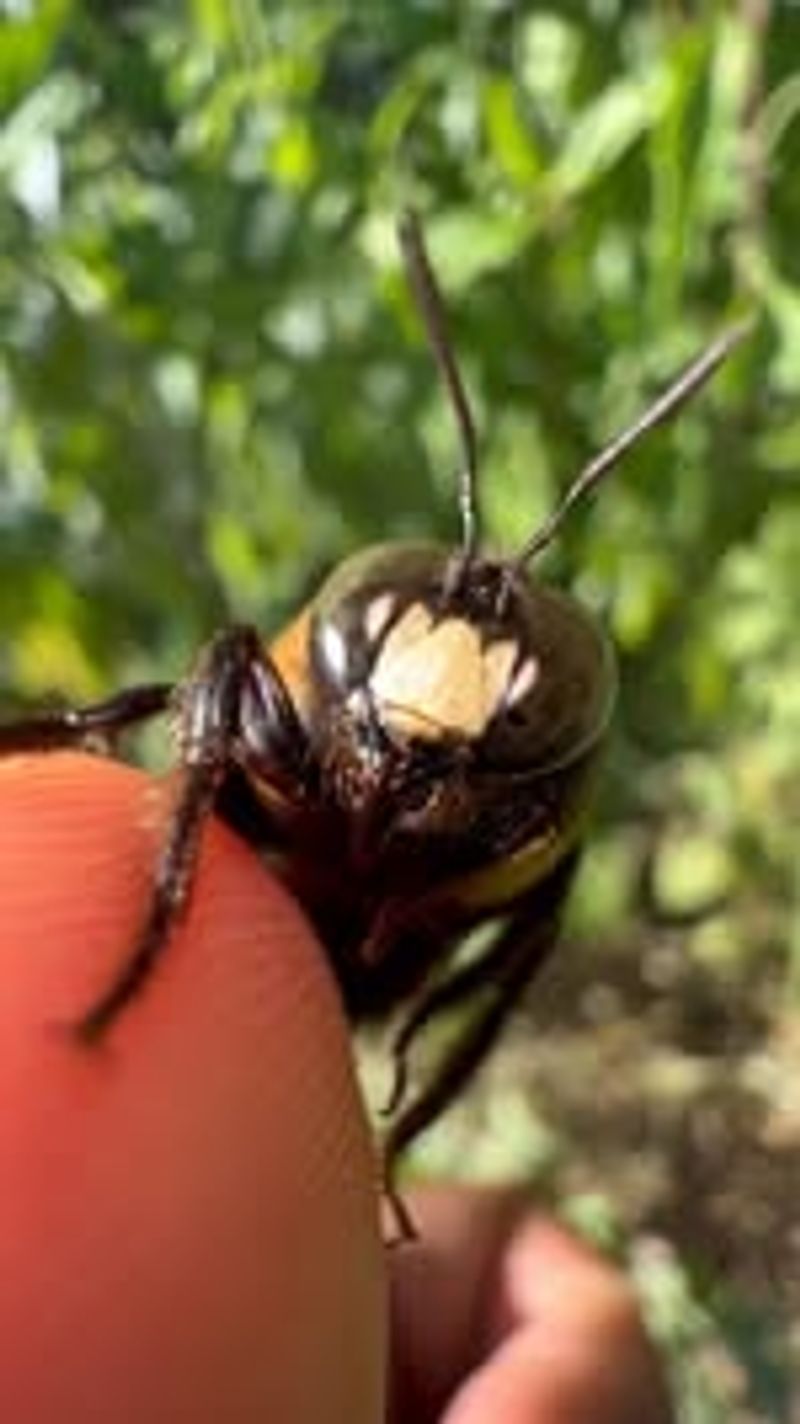
Spot a large, jet-black bee hovering at eye level on your porch and your first instinct might be to run. Before you do, look at the face. Male carpenter bees generally carry a pale ivory or light-yellow patch right in the center of their face, a field mark that sets them apart from the females at close range. The NC State Bees of North Carolina identification guide notes that females have an entirely black face, so that small color difference is one of the quickest ways to sort out who you are dealing with.
The abdomen is the other giveaway. Large carpenter bees have a relatively hairless, shiny abdomen, which looks noticeably bare and glossy compared to a bumblebee’s fuzzy, densely hairy midsection. Both insects are big and buzzy, but the shiny belly almost always points to a carpenter bee. North Carolina is home to two large carpenter bee species, and while their habits are similar, not every carpenter bee behaves identically, so resist the urge to make sweeping assumptions based on one encounter.
Here is the fact that changes the whole picture for most homeowners: male carpenter bees have no stinger. They are physically incapable of delivering a sting, no matter how dramatically they hover or dart. NC State Extension’s guide to non-honeybee stinging insects confirms that females rarely sting unless confined or highly agitated, but they absolutely can sting. The hovering male in your face is intimidating, not dangerous in the way a sting would be.
The female, who tends to stay closer to the nest entrance and is less likely to put on a dramatic aerial show, is the one to treat with genuine respect.
Keeping both sexes in mind matters because the porch is rarely home to just one bee. Males are conspicuous because they patrol and posture. Females may be working quietly nearby. Knowing which bee you are watching is the first step toward a calm, informed response rather than a panicked one.
Why They Dive-Bomb People on the Porch
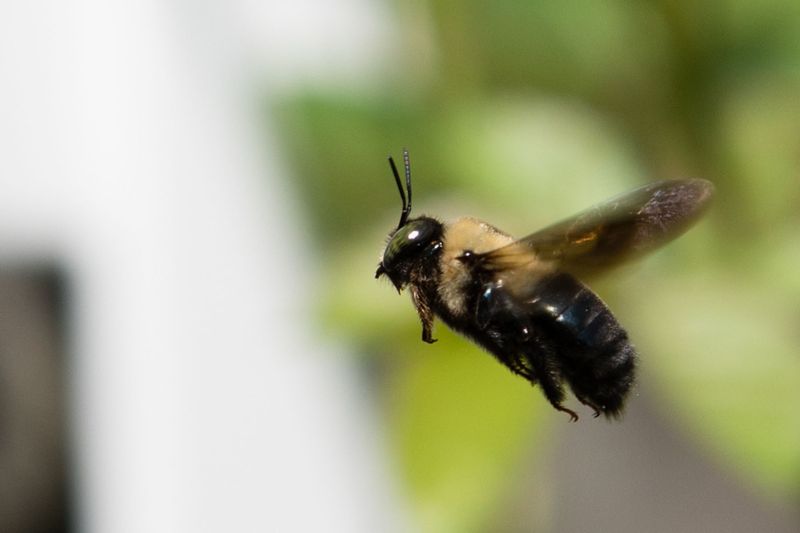
That sudden, close-range hover right in front of your face is not an accident. Male carpenter bees claim territories around potential nest sites, and a porch with good wood is exactly the kind of real estate they compete over. When a person walks into that territory, the male reads it as a rival or a threat and responds with the only tool he has: an intimidating aerial display. He may dart forward, hold position a few inches from your nose, circle, and repeat the whole routine until you retreat or he decides you are not worth the effort.
Loud buzzing is part of the performance. The sound a hovering carpenter bee produces can feel genuinely threatening, and that reaction is understandable. NC State Extension advises against spraying bees simply because they are hovering, describing that response as neither sensible nor particularly safe. The bee is not mounting a colony defense the way a yellowjacket or social wasp might.
Carpenter bees nest solitarily or in loose groups, with each female maintaining her own gallery. There is no large worker force mobilizing to protect a hive.
The safest thing to do when a male charges is to stay calm and move away slowly. Do not swat at the bee, wave your arms, or try to grab it. Sudden movements escalate the encounter and bring you closer to the nest entrance, where a female may be working. Give the bee a clear path away from you and give yourself a clear path away from the porch for a minute or two.
The male will almost certainly return to his patrol route once you are gone.
Keeping children and pets from chasing or swatting at hovering bees is worth the conversation. A male cannot sting, but a disturbed female near a nest entrance can. The immediate sting risk from the dramatic hovering bees is low, but that reassurance applies most directly to the conspicuous males putting on the show, not to every carpenter bee in the area.
The Female Excavates a Nursery in the Wood
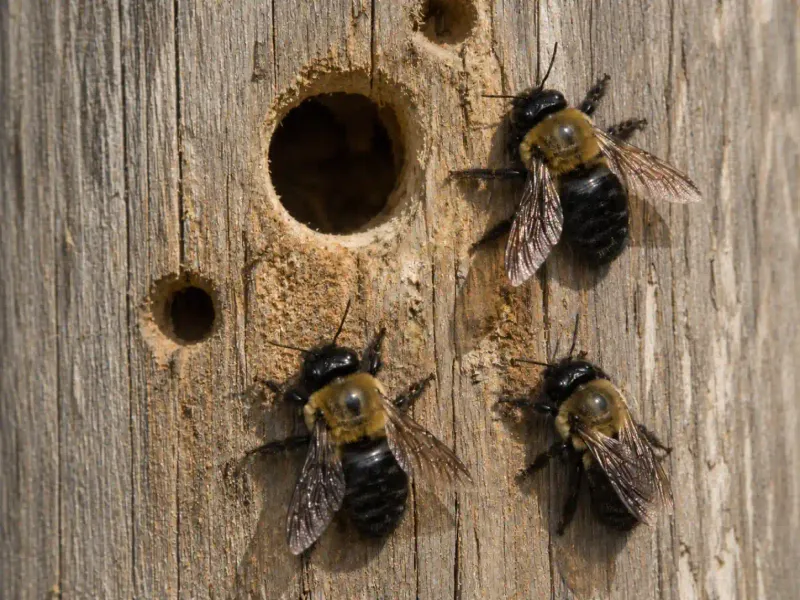
A nearly perfect circle in your porch board, roughly half an inch across, with a small pile of fresh sawdust or yellowish waste below it – that is a carpenter bee nest entrance. The female made it, and the process took real effort. She chews through the wood grain with her mandibles, creating an entry shaft that typically goes straight in for about an inch before turning and running parallel to the wood grain for several more inches. She does not eat the wood she removes; she pushes it out, which is why the sawdust pile appears.
Inside that tunnel, she constructs individual brood chambers, each stocked with a ball of pollen and nectar and sealed with a single egg. NC State News explains that this is solitary nesting behavior, not the honeybee-style colony that many homeowners picture. There is no queen directing workers, no honey production, and no swarming force ready to defend a hive. The female is building a private nursery for her own offspring, one chamber at a time.
Several females may share a single entrance hole or gather loosely in the same piece of wood while still maintaining completely separate galleries inside. NC State Extension notes that this loose grouping can make an infestation look more organized than it is. Each female is working independently, not as part of a coordinated colony. Calling the situation a hive or a swarm would overstate it considerably.
Understanding what the hole actually represents changes how you respond to it. A single entrance is not automatically a structural crisis, but it is a signal that a female has chosen your wood as a nesting site. That choice has consequences worth tracking, particularly if the same wood gets selected again next spring and the tunnels begin to multiply.
North Carolina’s Spring Activity Follows a Pattern
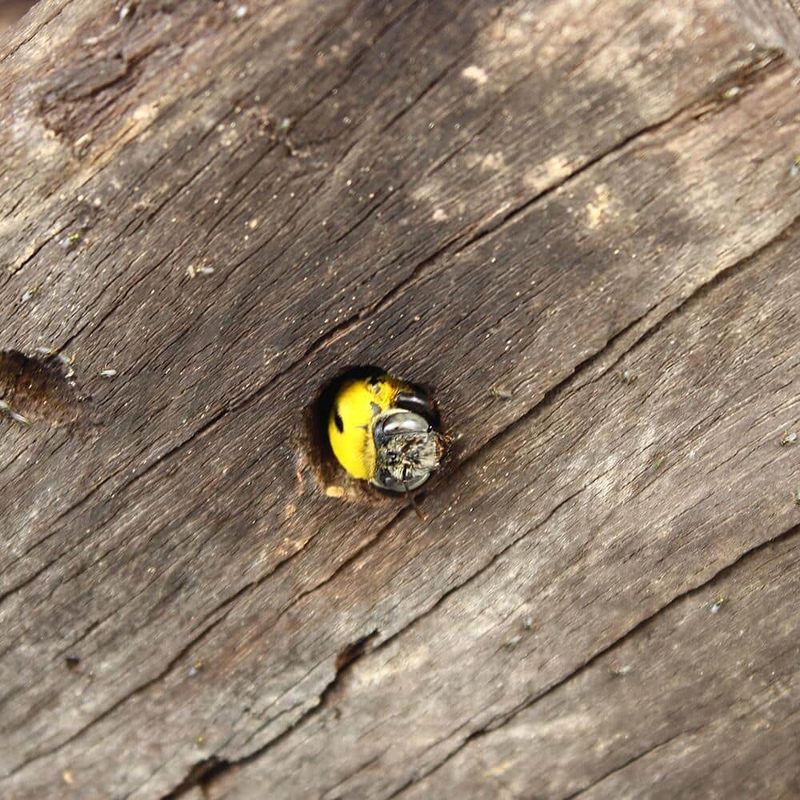
Carpenter bees in North Carolina follow a fairly predictable seasonal rhythm, and knowing it helps homeowners put the spring buzz in context. Adults typically emerge in April and May. Males usually show up first, which is why the territorial hovering often begins before homeowners have spotted any holes in the wood. NC State Extension confirms that new tunnel excavation is most noticeable in late spring and early summer, when females are actively selecting and preparing nest sites.
By midsummer, the picture shifts. Newly emerged adults from that season’s brood focus on feeding and staying close to existing nest sites rather than drilling fresh galleries. Existing tunnels may be used for overwintering, which means a hole that looked quiet in August could be reactivated the following April. That reuse pattern is one of the reasons a small problem can quietly grow over several seasons.
Knowing this timeline is useful for homeowners who want to act without causing more harm than good. Spraying or sealing holes during peak spring activity, when females are actively nesting and brood may already be inside, can backfire. Waiting until late summer or fall, after adults have emerged and tunnels are empty, gives homeowners a much better window for filling holes and making repairs that actually hold. The spring surge can feel alarming, but the seasonal pattern also provides a clear and predictable opening for well-timed action.
A Few Holes Are Not Always a Structural Emergency
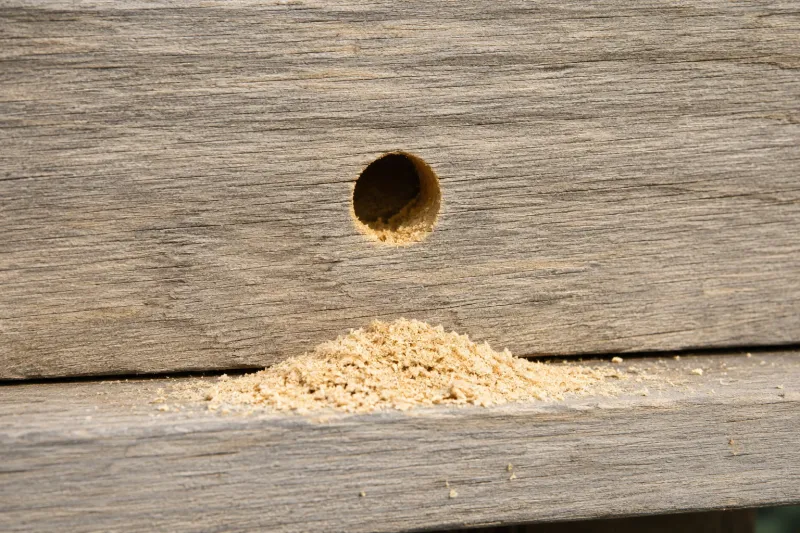
Reacting to the number of bees in the air is less useful than actually looking at the wood. Pull out a flashlight and check the boards, railings, fascia, and overhangs for nearly round entrance holes about half an inch across. Fresh sawdust or yellowish frass directly below a hole is a reliable sign of current activity. Older, inactive holes may have darkened edges and no fresh debris underneath.
A handful of holes in a thick, sound structural beam is a different situation from a dozen holes concentrated in thin decorative trim or siding. NC State Extension notes that individual carpenter bee damage is often limited at first, but tunnels that get reused, extended, and branched over multiple seasons can weaken vulnerable wood, stain surfaces with waste and pollen, and attract woodpeckers that peck aggressively at the wood to reach the larvae inside. Decay organisms can also take hold once moisture enters through open galleries.
Staining on the wood surface below an entrance is worth noting. That yellowish or brownish streak comes from pollen, waste, and weathering inside the tunnel, and it tends to get darker and wider as activity continues over the years. Thin siding, decorative fascia, and older softwood boards that already show weathering are especially vulnerable to repeated tunneling. NC State News points out that damage can become significant when tunnels concentrate in vulnerable or load-bearing wood.
Observation is a reasonable first response when holes are few, the wood is sound and substantial, and no structural members are involved. Professional attention makes more sense when tunnels are concentrated in thin or critical wood, when you can hear or see active woodpecker damage, or when the extent of the damage makes it difficult to assess or repair safely on your own. The goal is an accurate read on the wood, not a count of bees in the air.
Repair and Timing Beat Spraying
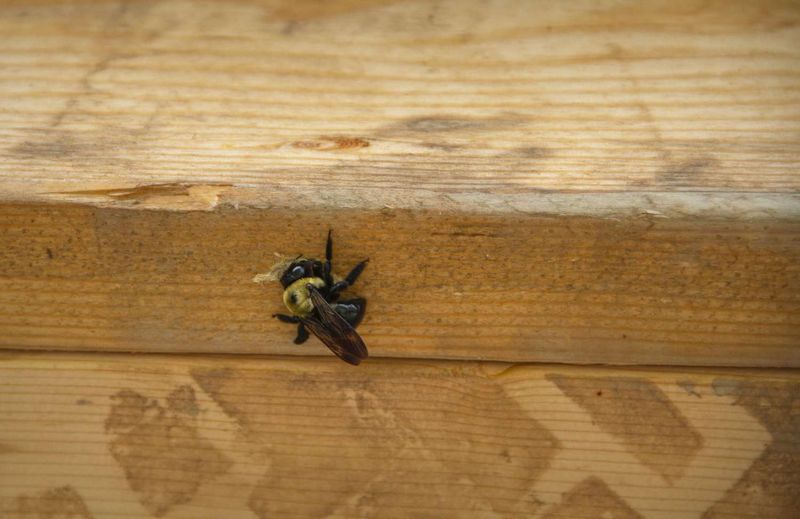
Reaching for a spray can every time a carpenter bee appears on the porch is not the answer, and it can create problems of its own. Broad insecticide applications aimed at hovering bees miss the brood already protected inside sealed tunnels, expose residents and pets to unnecessary chemicals, and can harm other pollinators and beneficial insects visiting nearby plants. NC State Extension describes spraying hovering bees as neither sensible nor particularly safe, and that guidance is worth taking seriously before opening a can of anything.
Prevention and repair are the more durable approach. UC Integrated Pest Management recommends repairing exposed or weathered wood, filling unoccupied holes with steel wool packed tightly into the gallery and then sealed with exterior caulk, and repainting or varnishing the repaired surfaces. The timing of that repair matters considerably. Filling an active tunnel while bees are still inside traps developing brood and does not prevent future reuse unless the repair is properly completed.
Waiting until late summer or fall, after adults have emerged for the season, gives the best chance of sealing an empty gallery.
Paint and varnish on exposed wood surfaces may reduce the attractiveness of that wood to nesting females, but treated wood can still be drilled. Present those surface treatments as risk-reduction measures rather than guarantees. The same honest framing applies to screening, wood replacement with hardwood or composite materials, and other physical barriers: they lower the odds but do not eliminate them entirely.
When damage is extensive, concentrated in load-bearing members, or located somewhere that makes safe access difficult, a licensed pest-management professional is the right call. NC State News notes that some treatment products are restricted to licensed applicators, and pesticide labels carry legal requirements about where, when, and how they may be applied. Getting professional help for a serious infestation is not an overreaction; it is the measured choice that protects both the structure and the broader pollinator community around your yard.
Low Immediate Risk Does Not Mean No Sting Risk

The reassurance that hovering males cannot sting is real and worth holding onto, but it should not be extended to every carpenter bee in the area. Females are capable of stinging and may be working near the same entrance that a male is patrolling. NC State Extension explains that females rarely sting unless confined or highly agitated, which means the practical risk is low for a calm adult who gives the bees space. Children and pets are a different story: a child who swats at a bee, a dog that snaps at one, or anyone who picks up or corners a female near her nest entrance is genuinely at risk of a sting.
Make it a house rule that nobody chases, swats, or handles the bees, regardless of sex. The male’s bluster is harmless, but the habit of treating large bees as safe to mess with can lead to an encounter with a female. Setting that boundary clearly for kids is a small step that removes most of the practical sting risk from the equation.
Any bee sting can trigger a severe allergic reaction in a person who is susceptible, even a first sting with no prior history. Mayo Clinic lists the warning signs of anaphylaxis as trouble breathing, swelling of the throat or tongue, chest tightness, widespread hives, and dizziness. If any of those signs appear after a sting, use prescribed epinephrine immediately and call 911. A local sting reaction – pain, redness, and swelling at the site – is uncomfortable but not an emergency for most people.
The systemic signs listed above are the ones that require immediate action, and waiting to see whether they resolve on their own is not safe.
Give the Buzz Space, Then Check the Wood
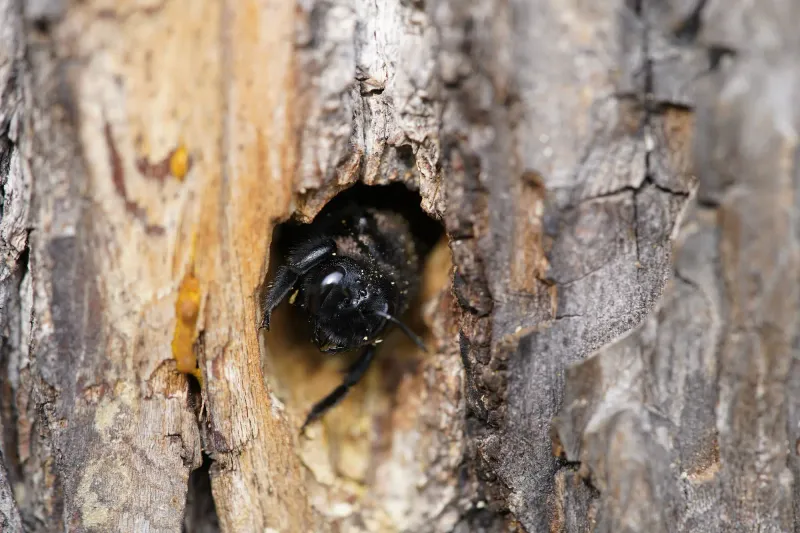
A carpenter bee hovering at face level on a North Carolina porch is usually a male running his territorial patrol. He cannot sting, and his dramatic display is far more startling than it is dangerous. Giving him a few feet of space and moving calmly away ends the encounter quickly and without harm to anyone. That is the first, simplest action available to any homeowner, and it works almost every time.
After the bee moves on, walk back and look at the wood. NC State Extension recommends inspecting for active holes, fresh sawdust, staining, and signs of repeated use. A few holes in sound, thick wood with no structural role may only need monitoring and a well-timed repair after adults emerge. Tunnels concentrated in thin siding, decorative trim, or any load-bearing member deserve more urgent attention, and UC IPM advises waiting until bees have emerged before sealing galleries, then completing the repair properly with a licensed professional when the damage warrants it.
Carpenter bees are real pollinators that visit North Carolina flowers throughout the season, and that benefit is genuine. It does not cancel out the case for protecting vulnerable wood when nesting becomes concentrated or repeated. The practical decision comes down to this: leave active bees alone, read the wood honestly, repair at the right time, and call for licensed help when the damage goes beyond what a weekend fix can address. Most spring encounters end with a startled homeowner and an unbothered bee – and that is exactly how it should go.