
Why Texas Scorpions May Be Showing Up In More Yards This Year
Follow us on Google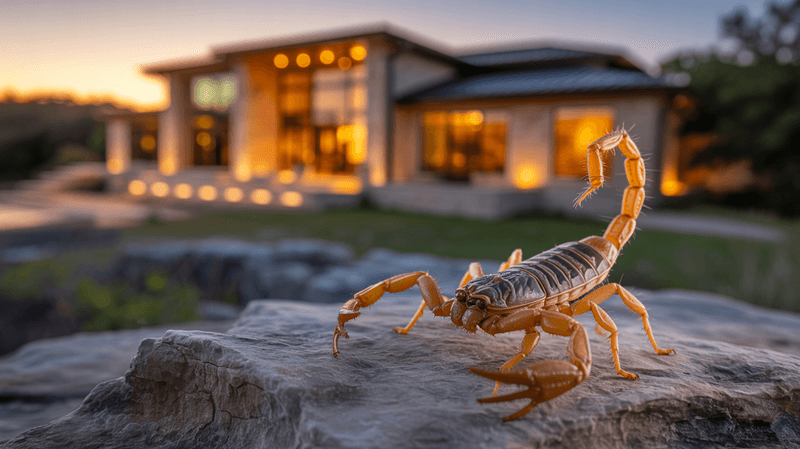
Flip on the porch light after dark and you might spot one clinging to the wall before you even reach for your iced tea.
Scorpions have always been part of life in Texas, but some homeowners this year feel like they’re seeing them more often than before.
That feeling deserves a straight answer, not a scary headline.
This article explains what actually drives scorpion encounters, what the evidence does and doesn’t say, and what you can do today to make your yard and home less inviting to them.
The “More Than Ever” Claim Needs a Rewrite
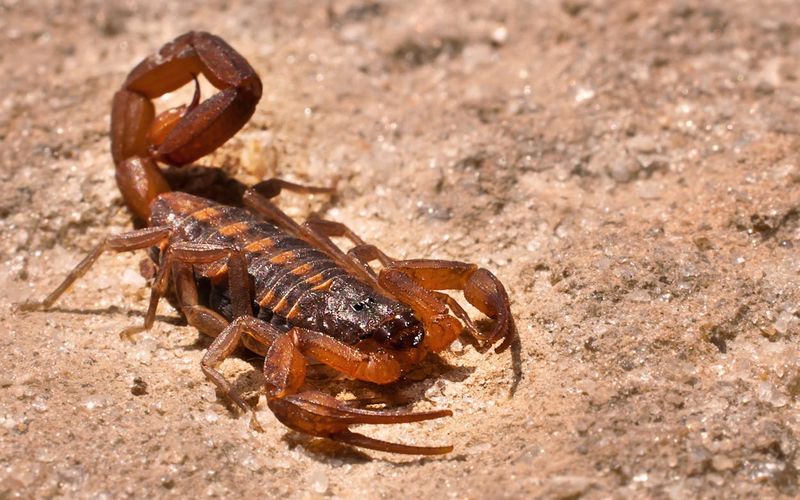
Scroll through any Texas neighborhood Facebook group this summer and you will find posts about scorpions showing up in garages, on back patios, and inside shoes left by the door.
The posts are real.
The fear is real.
But the idea that Texas is experiencing a scorpion surge “more than ever” is a claim that no authoritative statewide source has actually proven.
No 2026 Texas population survey, university monitoring dataset, or poison-control trend report has confirmed a record-breaking statewide spike in scorpion numbers.
Homeowner sightings are genuine observations, but they are not a population count.
A neighborhood full of alarmed posts can reflect changes in awareness, outdoor activity, or local conditions just as easily as it reflects more scorpions in the ground.
What the evidence does support is that some Texas homeowners may be noticing more scorpions in yards and around homes this season because of a combination of nighttime behavior, available shelter, prey, and genuinely uneven weather.
National Weather Service Fort Worth drought and precipitation records show that parts of North and Central Texas received roughly 150 to 300 percent of normal rainfall during portions of May and June, including more than 8 inches at DFW in June alone.
A late-July Southern Plains drought update also documented temperatures above 100 degrees Fahrenheit in parts of northern Texas, high evaporation rates, and heavy mid-July flooding in the Hill Country.
Those are real conditions that can shift where scorpions shelter, what prey is available, and when people spend time outdoors.
They do not prove the scorpion population exploded statewide.
Texas A&M AgriLife Extension’s guide to venomous terrestrial animals identifies 18 scorpion species in Texas, most concentrated around Big Bend, with the striped bark scorpion found throughout the state.
The better question to ask is not whether numbers are at a record high, but why encounters feel more frequent in particular yards and what you can do about it.
That is what the rest of this article answers.
The Striped Bark Scorpion Is Widespread, Not the Whole Story
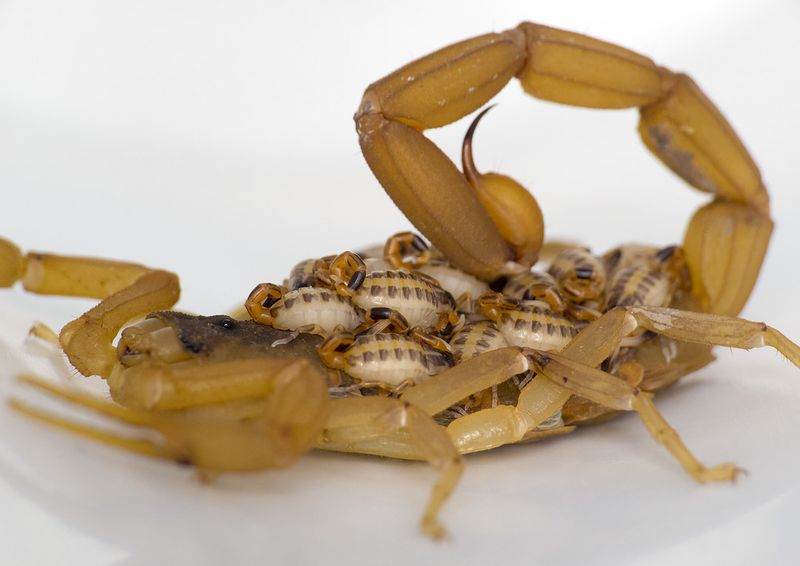
Centruroides vittatus, the striped bark scorpion, is the species most Texas homeowners encounter because it genuinely lives across the entire state.
Texas A&M AgriLife Extension describes it as occurring throughout Texas, with the eastern part of the state having fewer scorpion species overall.
It is mostly active at night, it climbs trees and house walls with ease, and it can squeeze through cracks and crevices that look far too small to matter.
Females carry about 25 young on their backs for several days after birth, which means a single female finding a comfortable spot near your foundation can quickly become a visible family situation.
That is alarming to find under a flowerpot, but it does not automatically mean the regional population has grown.
It means one scorpion found good shelter close to your house.
Saying the striped bark scorpion is found throughout Texas does not mean it accounts for every encounter or that all Texas yards face the same level of activity.
Texas is genuinely diverse in landscape and species mix.
Texas Parks and Wildlife’s ecoregion overview makes clear that the state covers dramatically different habitats, from the humid Pineywoods of East Texas to the Chihuahuan Desert of West Texas.
A North or Central Texas homeowner dealing with blackland clay and suburban landscaping faces a different scorpion picture than someone in the Hill Country with caliche outcroppings, rocky retaining walls, and dry creek beds nearby.
Gulf Coast yards with sandy mixed soils and high humidity carry yet another species mix.
The striped bark scorpion is a useful starting point, but your region shapes the full story.
Nighttime Activity Makes Hidden Scorpions Easier to Notice
Scorpions spend the daylight hours hiding.
Rocks, boards, wood piles, leaf litter, landscape debris, and almost any object resting on the ground can become a daytime refuge.
Come nightfall, they emerge to hunt insects, spiders, centipedes, and other small arthropods.
That behavior pattern has not changed, but your schedule might have.
More Texans are spending summer evenings outdoors later into the night because of heat that makes daytime yard work miserable.
Porch lights are on, people are moving around patios and garden edges, and phones are out.
Those are all plausible reasons people detect scorpions they would have missed on an earlier evening indoors, not necessarily evidence that more scorpions are out there.
Texas Parks and Wildlife notes that scorpions hide by day under rocks and debris and emerge at night, which is exactly the window when outdoor activity and lighting most often produce encounters.
Research backs up the complexity of what drives nighttime activity.
A Laredo study on striped bark scorpion activity found that temperature influenced movement and that scorpions of different sizes used different plants and heights, meaning activity within a single yard is not uniform.
A West Texas assemblage study found that surface density varied substantially by month and that some species peaked in spring and fall, with warmer temperatures linked to greater nighttime activity and diversity, though temperature alone did not control density.
Both studies covered limited locations and specific time periods, so neither can be applied as a rule for every Texas region or treated as proof of a 2026 statewide increase.
The practical takeaway is straightforward.
If you want to know what is actually happening around your foundation and porch, go look after dark.
That is when scorpions are moving and when a careful inspection will actually show you something.
Weather Can Shift Encounters Without Creating a Surge
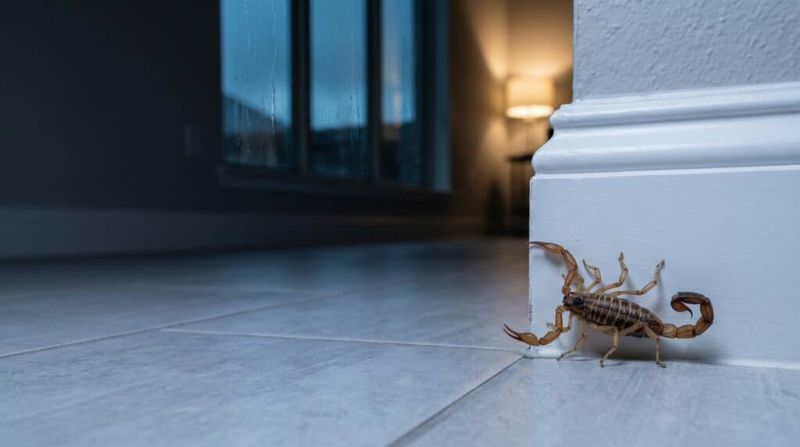
Wet and dry conditions both have the ability to change where scorpions show up, just in different ways.
A period of heavy rain can saturate soil, shift ground cover, push prey into new areas, and alter what shelter is available.
A hot, dry stretch can drive scorpions toward cooler, shaded spots closer to your house foundation, and it can also push more homeowners into evening yard time when they are more likely to spot one.
Here is where regional framing actually matters.
Bureau of Reclamation integrated pest management manual notes that buildings near arroyos or dry riverbeds may experience influxes during rain events as scorpions seek higher ground.
That guidance fits arid settings well, particularly properties in West Texas or the Hill Country near dry creek beds and caliche flats.
It does not describe the situation for a suburban yard in Plano or a Gulf Coast property with sandy mixed soils.
North and Central Texas homeowners dealt with a dramatic wet-dry swing this year.
The late-July Southern Plains drought update documented flooding in the Hill Country and temperatures above 100 degrees in parts of northern Texas within the same reporting period.
Rapid swings between soaking rain and baking heat can change ground conditions fast, moving prey and shelter in ways that bring scorpions into new spaces or make them more visible on hard surfaces.
Rocky Hill Country properties with shallow soils, caliche outcroppings, and retaining walls face a different dynamic than blackland clay yards in Central Texas, where saturated soil behaves completely differently.
Texas Parks and Wildlife’s ecoregion descriptions make clear how different these landscapes are from each other.
Weather may genuinely change when or where you see scorpions in your yard, but that is not the same thing as a statewide population increase.
Reduce the Shelter Around Your House
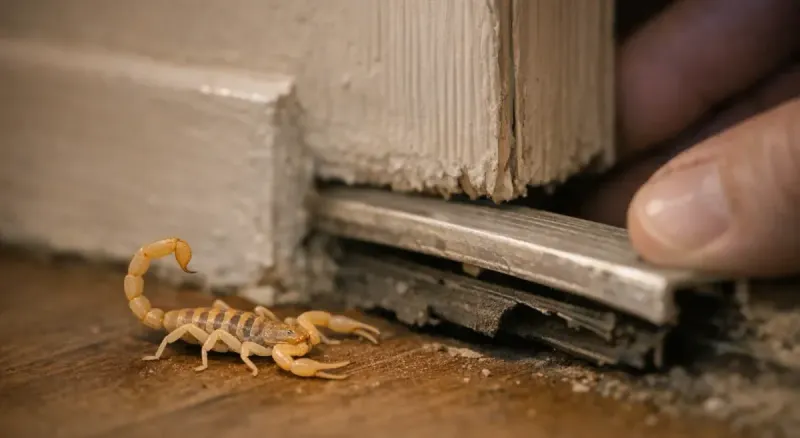
Scorpions are predators, not pests that show up because your yard is dirty or neglected.
Their presence near your foundation means they found shelter and food nearby, and that is a problem you can actually do something about.
The goal is not a perfect yard, it is a less convenient one.
Start at the edges.
Texas Parks and Wildlife’s urban wildlife guide recommends removing piles of boards, refuse, excess leaf litter, and debris near the house as a first step in reducing scorpion harborage.
Move anything that has been sitting on the ground close to your foundation: stacked flowerpots, old lumber, spare pavers, bags of soil, and decorative rock borders that have not been disturbed in months.
Each of those is a potential daytime hiding spot.
Texas Parks and Wildlife also highlights that scorpions hide under objects on the ground at night before retreating at dawn, so clutter along fence lines, garage walls, and garden edges is genuinely worth clearing.
Keep grass and low vegetation trimmed close to the structure.
Overgrown edges right against the house give scorpions both cover and a hunting corridor.
Firewood storage deserves its own sentence.
Store firewood away from the house, not stacked against the back wall of the garage or piled against the siding.
CDC guidance for outdoor workers recommends bringing firewood indoors only when it will go directly into the fire.
Carry a piece at a time and shake it out before you bring it inside.
Habitat reduction lowers the number of comfortable spots near your home, but scorpions can still move through surrounding landscape and enter through very small openings.
Think of this step as narrowing the welcome mat, not locking the door.
Seal the Routes Into the House
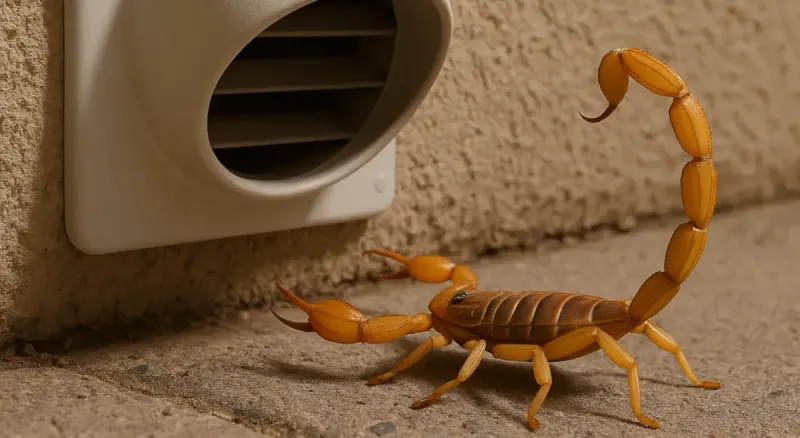
A striped bark scorpion can fit through a gap roughly the width of a credit card.
That means door sweeps, garage thresholds, torn window screens, foundation cracks, utility penetrations, gaps around pipes, and unsealed vent openings are all legitimate entry points worth inspecting.
Texas A&M AgriLife Extension specifically calls out cracks and crevices as entry routes and recommends sealing them as part of a layered prevention approach.
Walk the exterior of your house and check where anything passes through the wall or foundation: dryer vents, water lines, electrical conduit, AC refrigerant lines, and gas pipes.
Each one is a potential gap.
Weather-stripping on the bottom of exterior doors and garage thresholds is worth replacing if it has flattened or cracked.
A door that lets in a slice of light also lets in something that hunts at night.
After dark is the best time to find what you missed during the day.
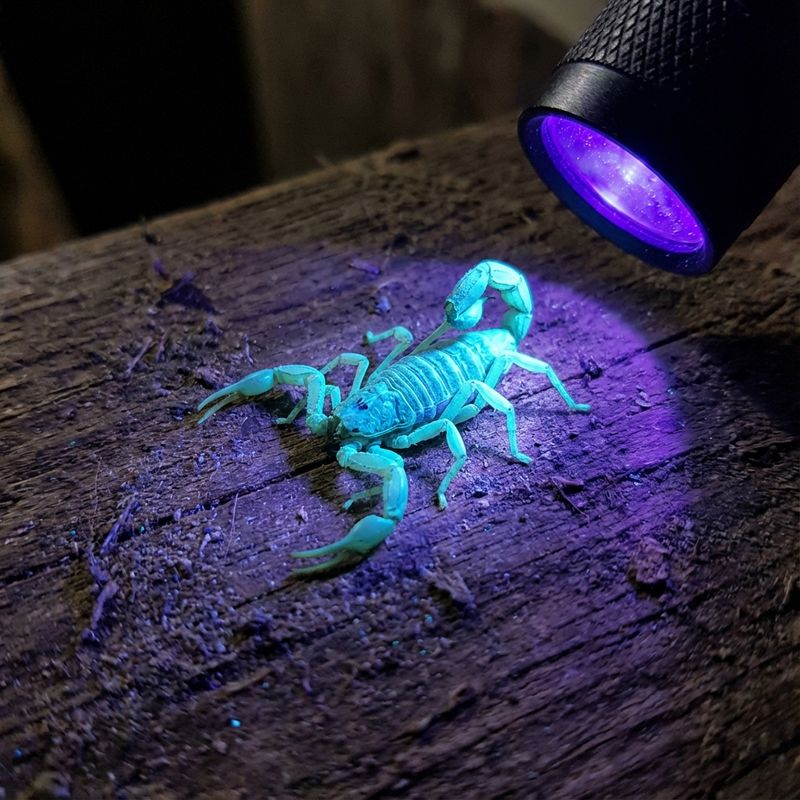
Many scorpions fluoresce under ultraviolet light, glowing a pale blue-green when exposed to a UV black light.
The National Capital Poison Center and Utah State University Extension’s scorpion guide both note this property as a useful detection tool.
A slow walk around the foundation, porch, stored materials, and rock borders with a UV flashlight can reveal activity you would never spot otherwise.
Do not handle any scorpion you find during that inspection.
Photograph it from a safe distance if you want to identify it, and focus this nighttime walk on locating gaps and entry points rather than attempting removal.
Sealing is the priority here, and it works as one layer of a broader approach, not a complete barrier on its own.
Remove Scorpions Without Taking Unnecessary Risks
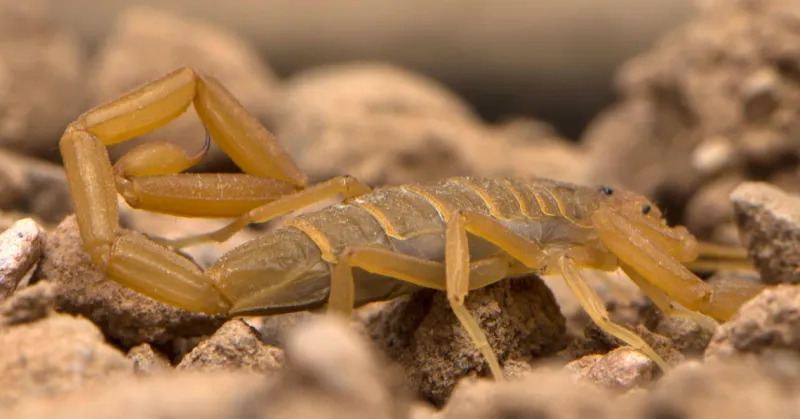
Never grab a scorpion with your bare hands.
That rule applies whether you find one on the garage floor at midnight or clinging to the inside of a boot you left by the back door.
The sting is fast and the pain is real, and there is no reason to take that risk when safer options exist.
If you need to identify the scorpion, photograph it from a safe distance.
A clear phone photo is enough for most identification purposes.
If removal is necessary and you can do it safely, use thick protective gloves, sturdy boots, a long tool such as tongs or a broom handle, and a sealable container.
The National Capital Poison Center specifically recommends avoiding direct contact and using protective equipment when handling is unavoidable.
Build the habit of shaking out shoes, work gloves, gardening gloves, clothing, bedding, and towels that were left in the garage, on the porch, or outdoors overnight.
CDC guidance and Utah State University Extension’s scorpion resource both recommend this check as a routine precaution, not an overreaction.
A scorpion inside a shoe left on the back porch overnight is a genuine possibility in many Texas regions.
These habits reduce encounters, but they do not make a property scorpion-proof.
Scorpions are venomous, not poisonous, meaning they inject venom through a stinger rather than being harmful to touch or eat.
Texas A&M notes that none of Texas’s scorpion species are considered deadly, but that does not mean every sting is minor.
Stings cause sharp, immediate pain and localized swelling that can last for days.
If a sting happens, wash the area with soap and water and use ordinary pain relief if appropriate.
Call Poison Control at 1-800-222-1222.
Seek emergency care immediately for severe or spreading pain, trouble breathing, difficulty swallowing, muscle twitching, unusual eye movements, slurred speech, widespread symptoms, or any sign of a severe allergic reaction.
Young children face greater risk from serious venom effects and should be seen by a medical professional after any sting.
Use Layers Before You Reach for Pesticides
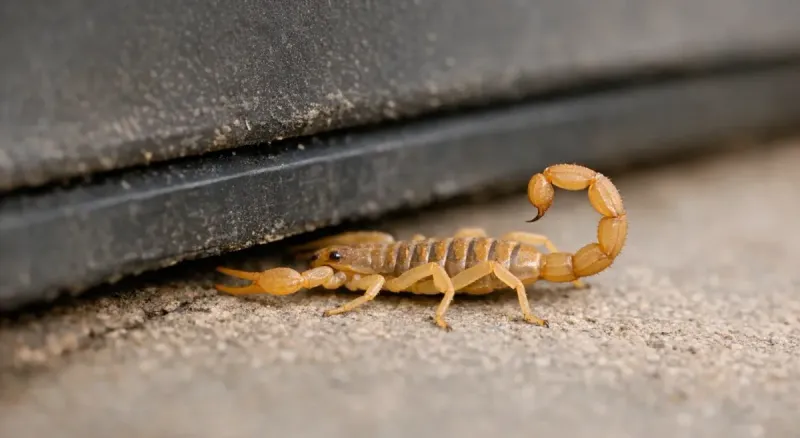
A layered approach works better than a single fix, and pesticides are near the end of that list, not the beginning.
Start with what you can do tonight: walk the foundation and porch after dark, move debris away from walls, check firewood storage, and shake out anything left outdoors.
Those actions cost nothing and address the conditions that actually make your yard attractive to scorpions.
Texas Parks and Wildlife states that chemical control of scorpions is difficult and recommends habitat modification as the primary step.
The National Capital Poison Center is more direct, stating that preventative pesticide spraying probably will not work.
Routine whole-yard spraying should not be your default response.
If chemical control seems necessary after habitat and exclusion steps have been completed, any product must be used strictly according to its label, with the required protective equipment, and in compliance with applicable Texas regulations.
When in doubt, a licensed pest control professional is the right call.
Texas A&M AgriLife Extension confirms that no Texas scorpion species is considered deadly, which is genuinely reassuring.
Serious symptoms, allergic reactions, and greater risks for young children are still real possibilities, so take stings seriously even when the overall danger is lower than what you might associate with Arizona species.
Particular yards and regions may produce more noticeable encounters this year because of weather swings, habitat changes, or simply more time spent outdoors after dark.
That is worth addressing with real steps.
A statewide record infestation is not what the evidence shows, and eradication is not a promise anyone can honestly make.
What you can do is make your yard a harder place to live in, one layer at a time.