
Why Texans Are Growing Star Jasmine Along Every Fence That Bakes All Summer
Follow us on Google
Star jasmine has been showing up on fences across Texas, and it’s easy to see why homeowners are drawn to it.
The glossy leaves, the white pinwheel flowers, and that sweet fragrance drifting across a hot patio on a May evening make a compelling case.
But the headline you just clicked overstates things a bit, and understanding exactly where and how this vine performs well could save you a summer of frustration.
Here is what the plant actually offers, where it fits in Texas, and how to give it a real shot at covering that baking fence.
The Headline Overstates the Trend
Nobody has counted the fences.
There is no survey, no nursery-sales report, and no statewide count of Texas yards where star jasmine is climbing a fence right now.
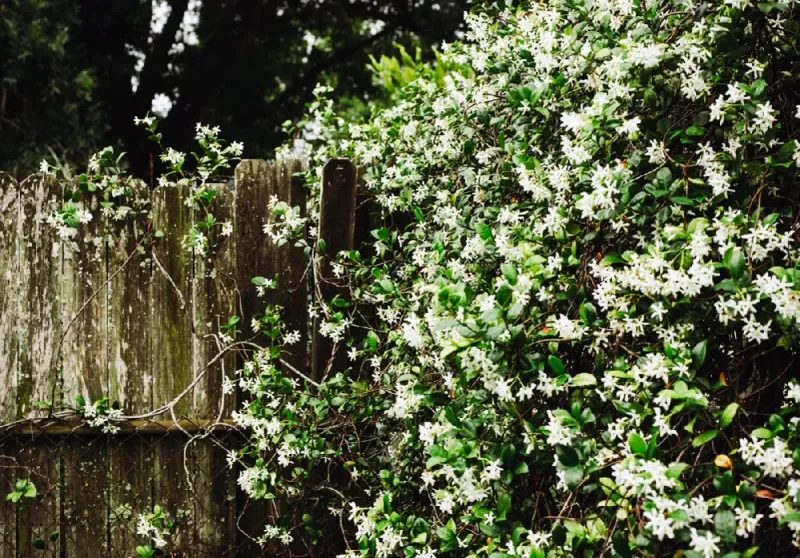
The plant is genuinely used on fences, trellises, arbors, and screens across the state, and the City of Austin’s plant guide lists it as a low-water landscape vine suited to those exact uses.
But “every fence” is a story, not a fact.
The actual subject worth your time is this: star jasmine, also called Confederate jasmine and known botanically as Trachelospermum jasminoides, can be a solid fence vine in suitable Texas locations.
Texas A&M AgriLife’s plant selection guide includes it among adapted landscape plants, and that endorsement carries weight in a state where the wrong vine can look like a pile of straw by July.
The practical question is whether it fits your specific situation.
Your local winter temperatures, microclimate, fence type, soil drainage, available light, and willingness to water during establishment all matter more than any statewide trend.
NC State Extension’s plant profile describes it as an evergreen twining vine that can reach roughly 20 feet with support, which is genuinely useful coverage for a backyard fence.
Think of this article as a regional fit test.
Read through it, match the conditions to your own yard, and decide whether star jasmine belongs on your fence or whether a different vine would serve you better.
That is a more honest promise than the headline made, and a more useful one.
What Star Jasmine Actually Offers
Picture stepping onto your back porch on a warm evening in late April and catching a wave of sweetness you did not expect.
That is the moment star jasmine earns its place.
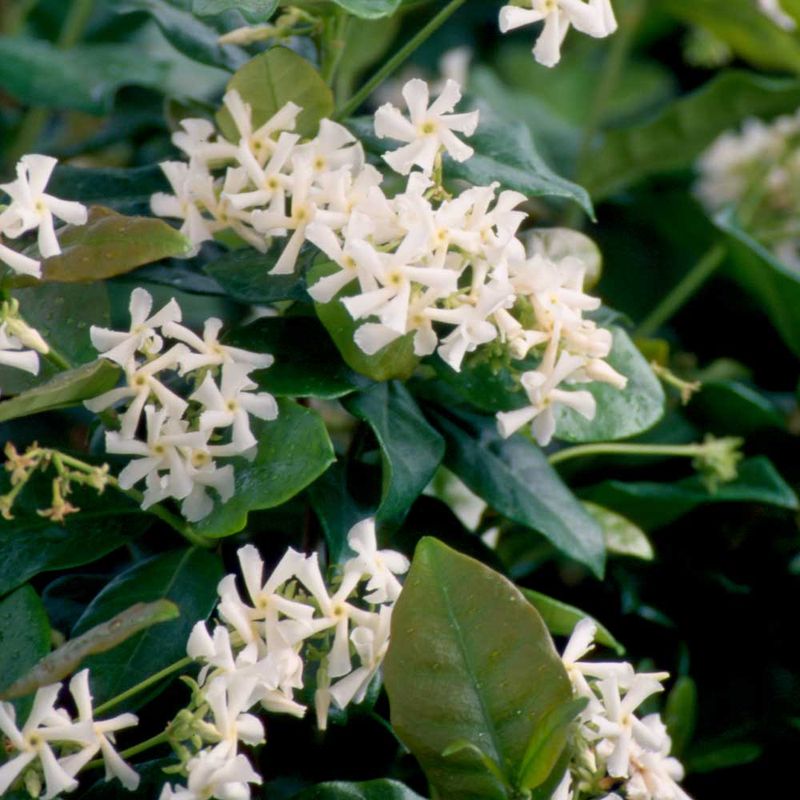
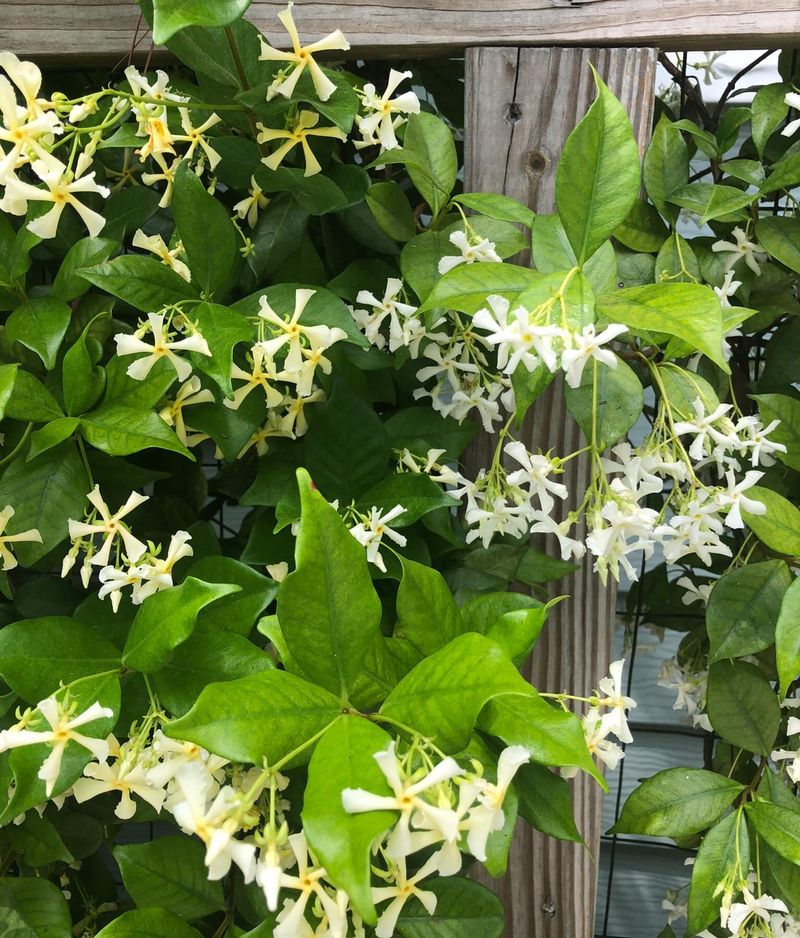
The flowers are small, white, and shaped like five-pointed pinwheels, and their fragrance is strong enough to carry across a patio without being overwhelming.
The bloom period runs through spring and into early summer, roughly April through June in most of Central Texas, with some sporadic flowers possible later in the season.
Missouri Botanical Garden’s plant finder describes the primary flowering as late spring, and that framing is more accurate than any promise of blooms all summer.
After the flowers fade, the glossy dark green foliage takes over, and that foliage is actually what gives you the fence screen for the other ten months of the year.
The plant is a twining vine, meaning it wraps its stems around a support rather than gripping with adhesive rootlets.
It is native to China and Japan, and it is not a true jasmine in the genus Jasminum.
University of Florida IFAS places it in the dogbane family, Apocynaceae, which also includes oleander and periwinkle.
The evergreen quality is real but conditional.
UF/IFAS horticulture records note that the vine holds its leaves in mild climates, but a hard freeze can strip foliage and damage stems.
In mild South Texas winters, the screen stays intact.
In an exposed North Texas yard during a severe cold snap, you may lose a season’s worth of coverage.
The fragrance and glossy foliage are real assets, as long as you plant where the vine can actually survive the winter.
Test the Site Against Texas Winters
Texas is not one climate.
A gardener in Brownsville and a gardener in Amarillo are both in Texas, but they might as well be gardening on different continents when it comes to winter lows.
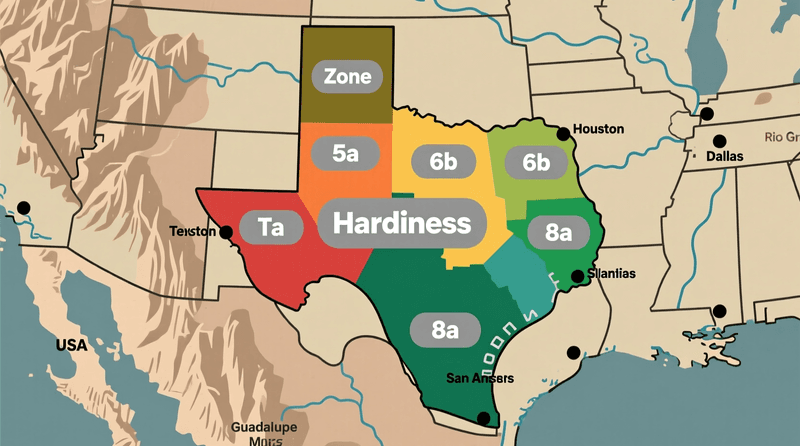
The 2023 USDA Plant Hardiness Zone Map shows the state spanning approximately Zone 6b in parts of the Panhandle all the way to Zones 9 and 10 along the Gulf Coast and in southern areas near the Rio Grande Valley.
Star jasmine performs most reliably in the warmer end of that range.
Warm, protected parts of Central Texas, East Texas, the Gulf Coast, and South Texas give it the best shot at staying evergreen and covering a fence through multiple seasons.
In those locations, a south-facing or east-facing fence with some shelter from north winds can make a meaningful difference in how the vine handles January.
Here is where it gets tricky.
USDA guidance on reading the zone maps makes clear that zones describe average annual extreme minimum temperatures, not a ceiling on every unusual freeze.
February 2021 reminded every Texas gardener that unusual freezes happen, and a zone rating does not guarantee the vine survives an outlier winter.
Texas A&M AgriLife’s freeze-damage guide specifically names Confederate jasmine as a plant that can suffer damage from hard freezes.
In North Texas, the Panhandle, and exposed West Texas sites, the risk is higher and the recovery less predictable.
Before you buy, check your local zone and think honestly about your microclimate.
A fence on the south side of a brick house in San Antonio sits in a different world than an open fence on the north side of a property in Abilene.
Bexar County AgriLife Extension notes how much local conditions shape plant performance even within a single metro area.
Shelter, proximity to structures, and prevailing wind direction are all worth evaluating before you commit to a vine that could lose its foliage in a cold snap.
Build the Fence Plan Before Planting
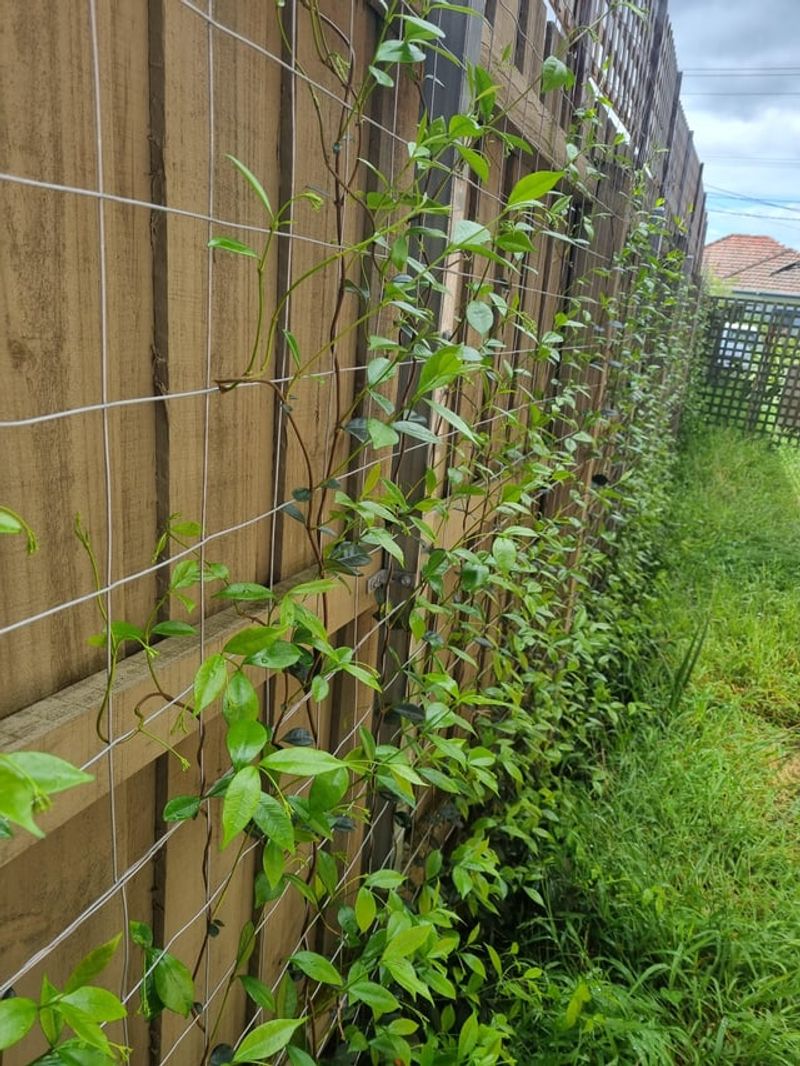
A bare wooden privacy fence and a chain-link fence are not the same proposition for this vine.
Star jasmine twines, which means its stems wrap around whatever you give them.
UF/IFAS guidance on ornamental vines explains that twining vines need upright supports they can actually grab: wires, chain-link mesh, a trellis, or a lattice panel attached to a fence face.
A flat board gives the vine nothing to hold.
On a wooden privacy fence, attach horizontal wires or a trellis panel before planting.
Space wires about 12 inches apart vertically so young shoots have something to reach.
Clemson Extension’s jasmine factsheet recommends weaving young shoots sideways through the support structure to encourage lateral spread rather than letting the vine race straight up and leave the bottom bare.
Once a shoot reaches the top of the fence, you can redirect it downward or sideways to fill gaps.
Plan for the plant’s mature size before you decide how many vines to buy.
Austin’s plant guide and the city’s Grow Green plant guide both describe star jasmine reaching heights around 20 feet with support and spreading 12 to 16 feet wide under good conditions.
Placing two vines 6 inches apart because you want instant coverage is a mistake you will spend years managing.
A reasonable spacing for a fence planting is one vine every 8 to 10 feet, with the understanding that full coverage takes two to three growing seasons rather than one.
Patience here saves you from an overcrowded tangle that becomes difficult to prune without losing the flowering wood.
The fence plan is not an afterthought; it is actually the first decision you make.
Water for Establishment and Recovery
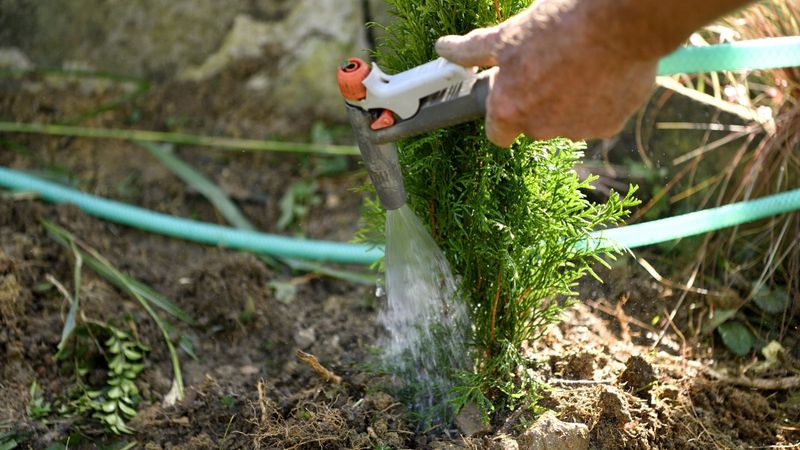
Here is the version of drought tolerance that does not get people in trouble: star jasmine can handle dry spells reasonably well once its root system is established, and established usually means two full growing seasons in the ground, not two months.
Until then, the vine is depending on you every time it does not rain.
During the first summer, water deeply enough to wet the root zone at least 12 inches down, and do it consistently enough that the soil never dries out completely between waterings.
Texas A&M AgriLife’s Water My Yard program offers region-specific irrigation scheduling based on local evapotranspiration rates, which is far more useful than any one-size-fits-all watering calendar.
A vine in the sandy East Texas soil near Nacogdoches needs water more frequently than the same vine growing in the heavier clay soils of North Texas, where water lingers longer but drainage can become a problem.
The Texas Urban Landscape Guide from AgriLife Extension reinforces that soil type, local rainfall, sun exposure, and root competition from nearby trees all shape how much supplemental water a planting actually needs.
A star jasmine growing 3 feet from a mature live oak is competing with an established root system and will need more attention than one planted in open soil.
NC State’s plant profile and UC ANR’s star jasmine IPM page both note that overwatering and poor drainage can cause root and crown problems just as serious as drought stress.
The goal is consistent moisture without saturated soil.
In blackland clay, that balance requires more monitoring than in well-drained sandy loam.
Get the watering right during establishment, and the vine genuinely does become more self-sufficient over time.
Manage Growth, Flowers, and Common Problems
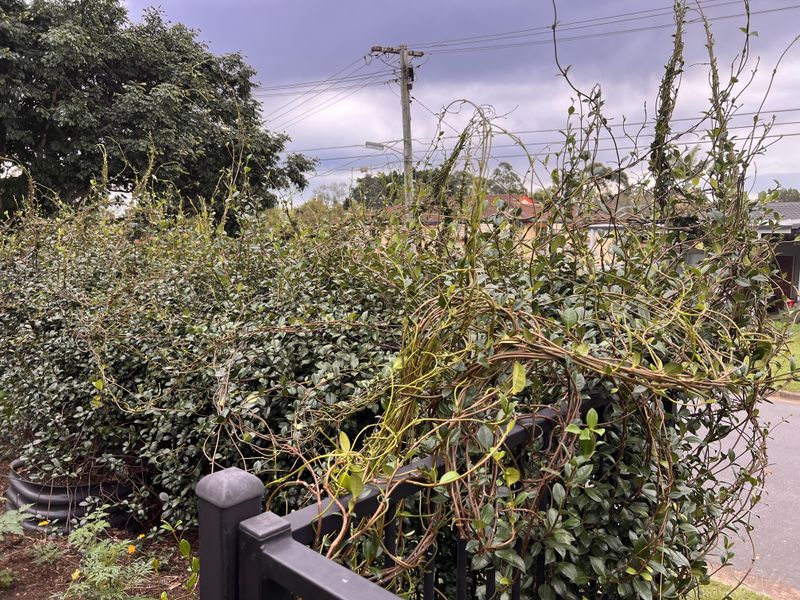
The best time to prune star jasmine is right after the spring bloom finishes, typically in late May or June across most of Central Texas.
UF/IFAS recommends pruning after flowering specifically to protect next season’s blooms, since the plant sets flower buds on what gardeners call old wood, meaning stems that grew the previous season.
Cutting hard in fall or winter removes the wood that would have bloomed in spring.
Always wear gloves.
Cut stems release a sticky, milky sap that is difficult to remove from skin and clothing.
NC State’s profile confirms the sap issue and recommends clean, sharp tools to make cuts that heal cleanly.
After pruning, train new growth by weaving it through the support structure rather than letting it pile up in one spot.
Keep the vine below a height you can safely reach with a ladder, typically no more than 10 to 12 feet for most homeowners.
Star jasmine is vigorous enough to climb into a nearby tree if you let it, and once it is 18 feet up an oak limb, pruning becomes a project.
UF/IFAS’s plant assessment notes that the vine can spread into shaded areas and become difficult to manage if neglected.
Spider mites are the most common pest concern in Texas, especially during hot, dry stretches when dusty conditions favor them.
UC ANR’s IPM resource for star jasmine lists mites and scale as documented problems and advises inspecting stressed foliage carefully before reaching for a pesticide.
Scale insects, nutrient deficiencies, and freeze injury can all produce symptoms that look similar at first glance.
AgriLife’s freeze-damage guidance recommends waiting until new growth emerges before cutting back cold-damaged stems, so you can see exactly how far back the damage actually went.
Avoid the Asiatic Jasmine Mix-Up
Walk into a Texas nursery and ask for jasmine, and there is a real chance the employee points you toward a flat of Asiatic jasmine, Trachelospermum asiaticum.
It is in the same genus, it has a similar common name, and it is everywhere in Texas landscapes.
It is not what you want for a fence screen.
NC State’s profile of Trachelospermum asiaticum describes it as a low-growing groundcover that typically stays under 2 feet tall without training.
It does not climb a fence with any purpose.
Its flowers are smaller and less showy than those of star jasmine, and it does not produce the same fragrant spring display that makes the taller vine worth planting along a fence in the first place.
Star jasmine, Trachelospermum jasminoides, is the taller, flowering, fence-climbing choice.
UF/IFAS distinguishes the two plants clearly, noting that star jasmine is the vine form while Asiatic jasmine is the groundcover form, and that mixing up the two leads to exactly the wrong plant for the job.
NC State’s star jasmine page confirms the height difference: Trachelospermum jasminoides can reach 20 feet with support, while Asiatic jasmine hugs the ground.
Before you buy, check the botanical name on the tag, not just the common name.
If the tag says Trachelospermum asiaticum, that plant belongs in a bed as a groundcover, not on your fence.
If it says Trachelospermum jasminoides, you have the right vine.
A 30-second check at the register saves you a full growing season of confusion.
Choose It as a Site-Specific Screen
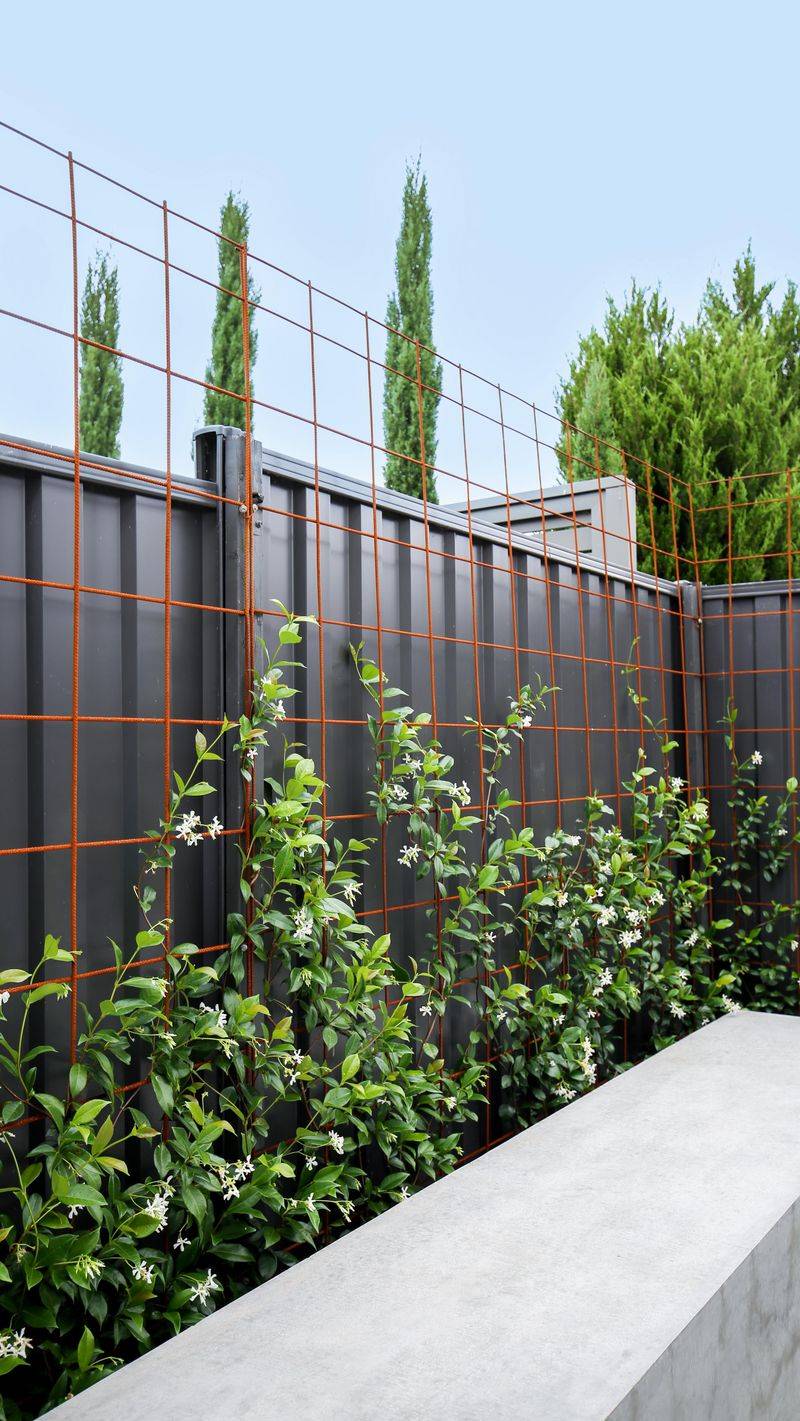
Star jasmine earns its place on a fence that gets full sun or partial shade, sits in well-drained soil, has a sturdy support structure, and belongs to a yard where the winters stay relatively mild.
Those conditions exist in a lot of Texas yards, particularly along the Gulf Coast, in protected Central Texas gardens, and across much of East and South Texas.
They do not exist everywhere, and the plant is not a guaranteed solution for every situation.
Austin’s plant guide and the Grow Green guide both recommend star jasmine for adapted Texas landscapes with those characteristics, and that endorsement reflects real-world performance in a climate that does not forgive bad plant choices easily.
Plan for mature dimensions of 10 to 20 feet tall and 12 to 16 feet wide, give it room to reach that size, and set up a realistic establishment-watering routine for the first two growing seasons.
On the safety side, toxicity references for this plant are genuinely conflicting.
Cornell’s poisonous plants database could not verify the plant in its references, while other sources list it as potentially harmful if ingested.
The safe and simple approach is to treat it as you would any unverified ornamental: do not eat any part of it, and prevent children or pets from chewing on the stems or leaves until you have authoritative guidance specific to your situation.
Gloves during pruning are about the sticky sap, not a skin-poisoning risk.
AgriLife’s freeze-damage resource is worth bookmarking now, before winter, so you know what to do if a cold snap hits.
A freeze can interrupt the evergreen screen temporarily, and knowing how to assess and recover the plant makes the difference between losing a season and losing the vine.
Star jasmine on the right fence, in the right Texas location, with honest expectations, is a genuinely rewarding choice.
It just works best when the site earns it first.