
Before You Guess That Garden Favorite Wrong, Look At The One Leaf Detail That Gives It Away
Follow us on Google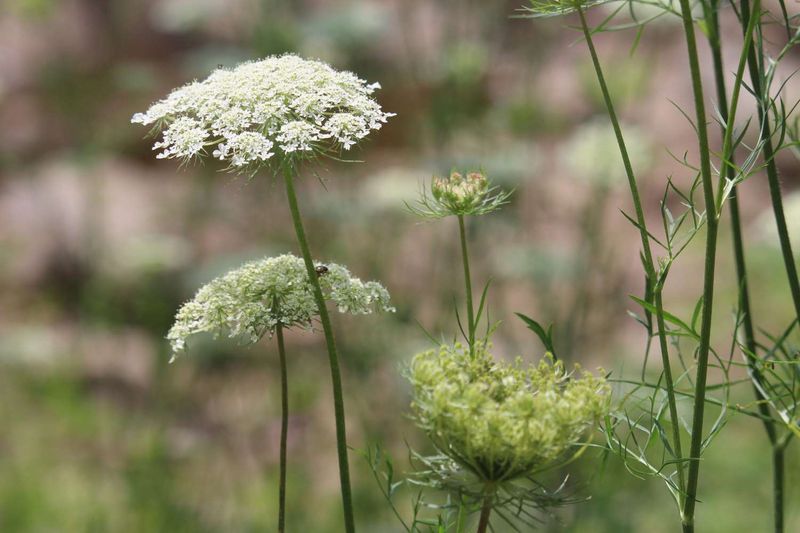
That tall, lacy white flower growing along your back fence or near the garden path looks harmless enough, maybe even pretty.
But gardeners across the country have been surprised to learn that a common lookalike, poison hemlock, can grow right alongside familiar wildflowers like Queen Anne’s lace.
The shape of a single leaf can point you toward which plant you’re looking at, though it cannot settle the question on its own.
Knowing what to look for, and what to do next, could genuinely matter for your family, your pets, and anyone who uses that corner of your yard.
The Leaf Is a Clue, Not a Verdict
Somewhere between a quick glance and a confident guess is where most misidentifications happen.
A gardener spots a tall, ferny-leaved plant with flat white flower clusters and thinks, Queen Anne’s lace, no problem.
But the plant that most often causes that moment of confusion is poison hemlock, Conium maculatum, a flowering member of the carrot family that shares the same general look without sharing the same safety record.
The leaf is the first useful clue, though calling it a verdict would be going too far.
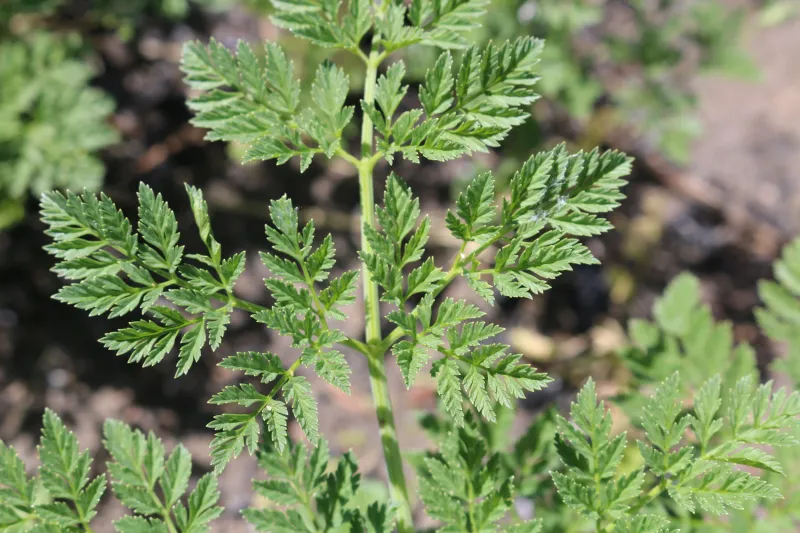
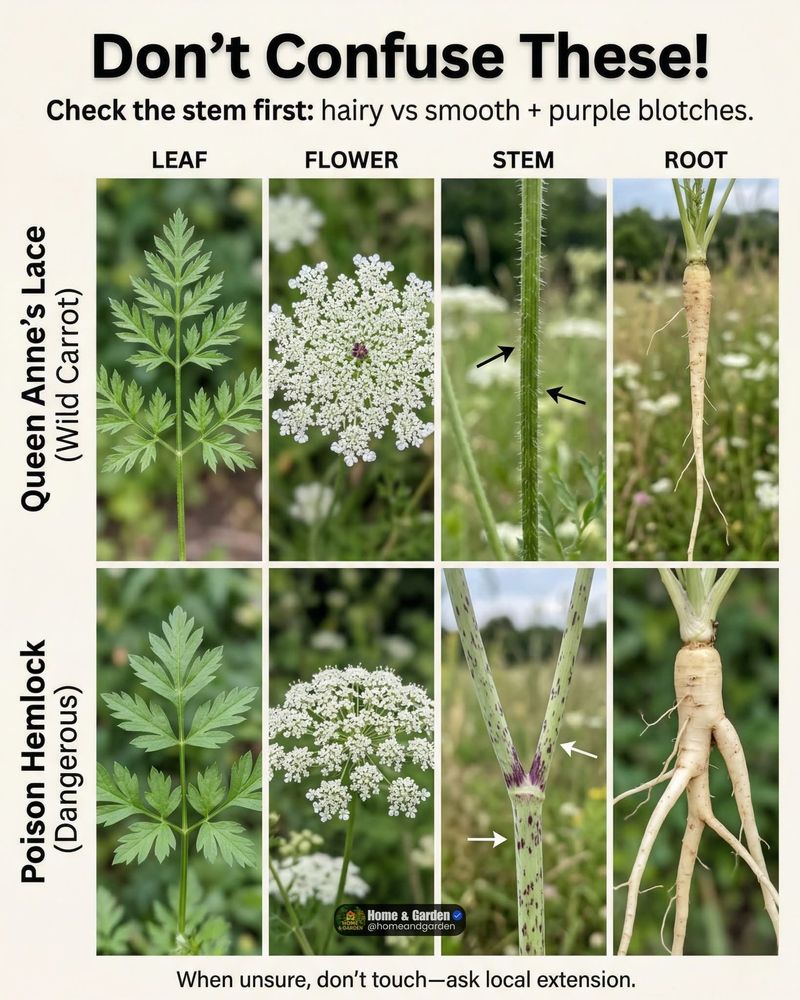
Poison hemlock leaves often form a broader, more triangular overall outline with fern-like divisions that repeat several times across the leaf surface.
Wild carrot, Daucus carota, tends to have finer segments and a more linear shape, with the leaf’s outline running more nearly parallel from base to tip.
Iowa State Extension’s wild carrot profile identifies this triangular-versus-linear distinction as a useful separating feature between the two plants.
That difference in silhouette is worth noticing, but it is a directional signal, not a diagnosis.
Leaf shape can vary with the plant’s age, growing conditions, and the part of the plant you are examining.
A young rosette looks different from a mature second-year plant.
Some specimens fall in a middle range that makes the outline comparison genuinely ambiguous.
What the leaf clue actually does is sharpen your attention and push you toward checking more traits.
Penn State Extension’s poison hemlock identification guide consistently recommends combining leaf shape with stem characteristics rather than relying on any single feature.
Think of the leaf as the detail that raises the question, not the one that answers it.
Compare the Whole Leaf Shape
Stand back a couple of feet and look at the whole leaf, not just one leaflet.
That wider view is where the useful difference shows up.
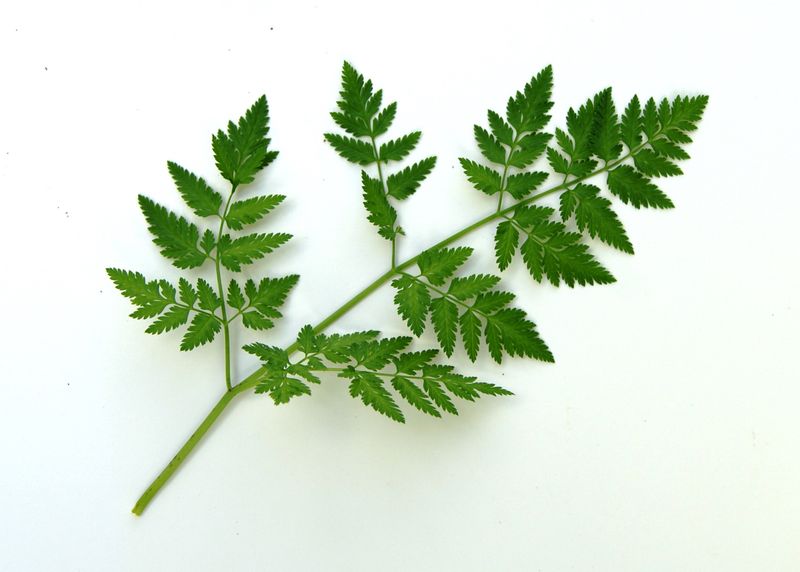
Poison hemlock tends to carry leaves with a broadly triangular silhouette, divided and subdivided into fern-like segments that spread outward in multiple directions.
The overall impression is wider than it is long, with a somewhat bushy, open architecture.
Wild carrot’s leaf tells a different story from the same distance.
The segments are finer and more feathery, and the overall leaf shape tends to run longer and narrower, with its margins staying closer to parallel.
Iowa State Extension describes this more linear outline as one of the traits that separates wild carrot from poison hemlock when you step back and read the whole leaf at once.
Young rosette plants add a complication.
A first-year poison hemlock growing low to the ground may not yet show the full triangular outline clearly, and its divisions can look similar to several other carrot-family plants at that stage.
Relying on one isolated leaf, or on a vague impression of featheriness, puts you in guessing territory rather than identification territory.
The practical move is to look at several leaves on the same plant from a safe viewing distance before drawing any conclusion.
Notice the overall silhouette, the coarseness or fineness of the divisions, and whether the leaf spreads wide or stays relatively narrow.
That whole-leaf reading is more reliable than any single segment.
And it keeps you from needing to touch, crush, smell, or harvest the plant to gather information, which matters a great deal when the stakes are what they are here.
Use the Stem as a Second Warning Sign
After you have looked at the leaf, move your eyes down to the stem without touching it.
The stem is often the clearest single supporting clue in the whole identification.
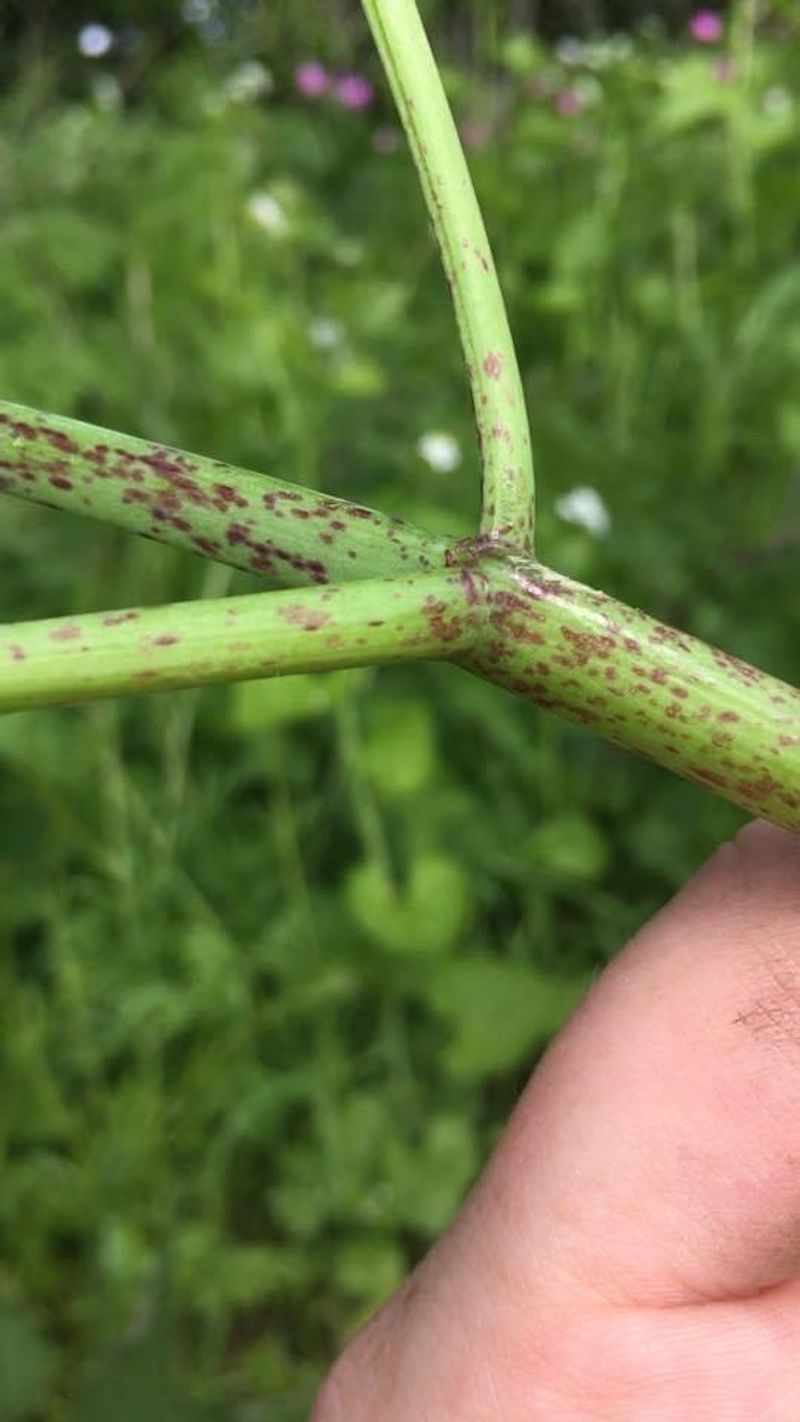
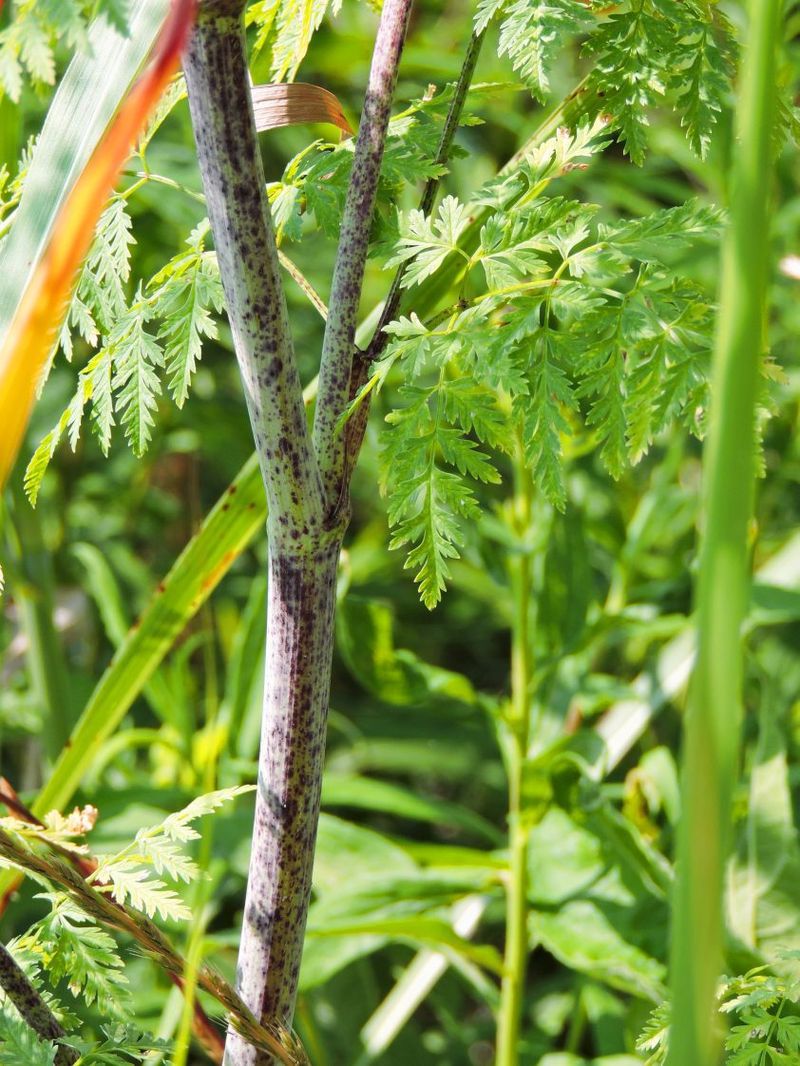
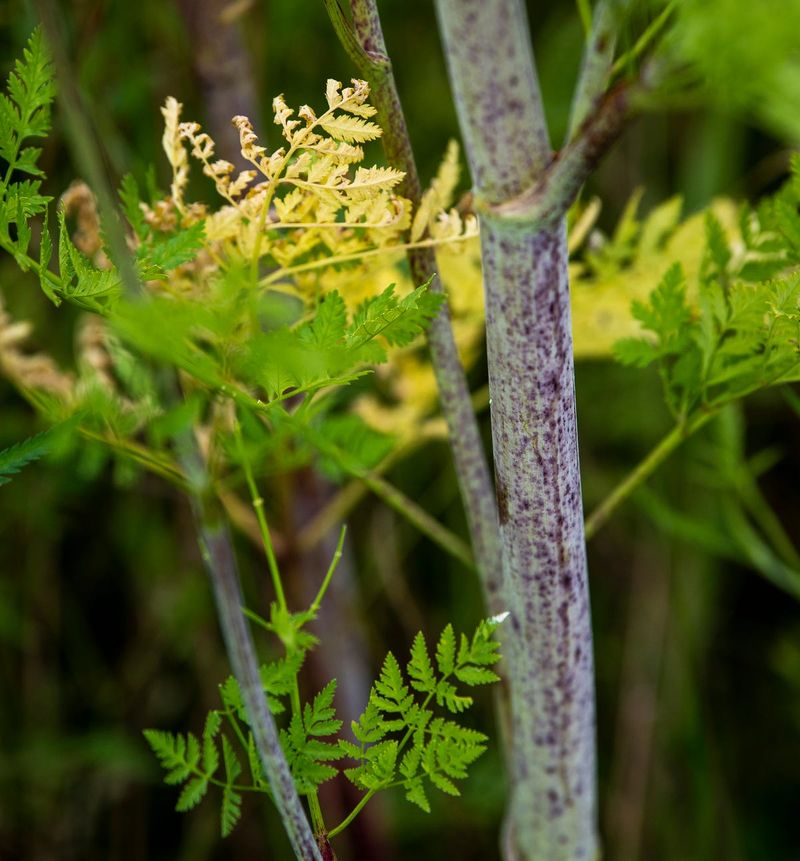
Poison hemlock typically produces a smooth, hairless stem that is hollow inside, and that stem frequently carries reddish or purple blotches, streaks, or spots scattered across a green surface.
That combination, smooth texture plus purple markings, is a strong warning flag.
Queen Anne’s lace takes the opposite approach.
Its stem is covered with coarse, bristly hairs that you can see clearly in good light, and it generally lacks the distinctive purple blotching.
Penn State Extension’s identification guide points to the hairy stem as one of the most reliable ways to distinguish wild carrot from poison hemlock at a glance.
Height adds context but cannot decide the question on its own.
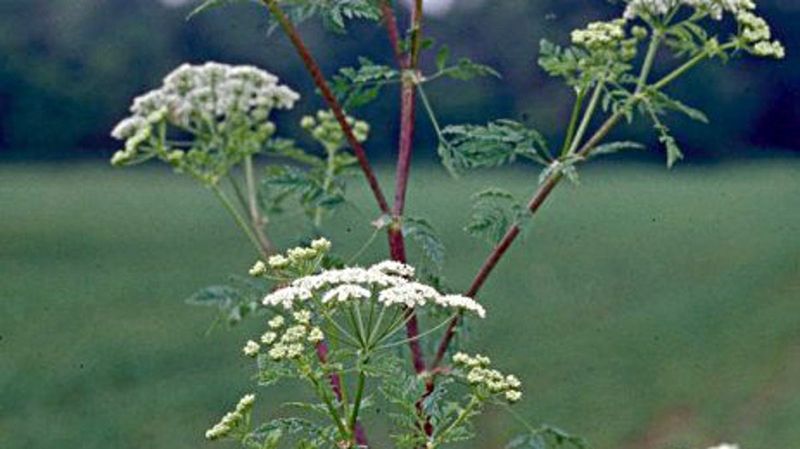
Mature poison hemlock commonly reaches 6 to 10 feet under good growing conditions, while wild carrot is generally shorter.
University of Maryland Extension notes that height varies with site conditions, and Iowa State gives wild carrot a range of 1 to 5 feet depending on where it grows.
A tall plant raises suspicion, but a shorter one does not clear it.
One important caution about the blotches: young plants, plants in shade, or plants viewed at a difficult angle may show faint or barely visible markings.
Penn State specifically warns that the purple spots can be hard to see on young plants.
So the absence of obvious blotching does not safely rule poison hemlock out.
Check visually, combine traits, and do not bend, break, pull, or smell the stem to get a closer look.
Let Growth Stage and Habitat Add Context
Poison hemlock is a biennial, meaning it spends its first year as a low, ground-hugging rosette of leaves before sending up a tall flowering stalk in its second year.
That two-year pattern matters because a first-year plant looks very different from a mature one, and a flat rosette of ferny leaves near the ground is easier to overlook or misread than a 7-foot plant in full flower.
Knowing where the plant tends to grow adds another layer of caution without proving identity.
USDA Agricultural Research Service notes that poison hemlock commonly turns up in moist or disturbed places, including roadsides, ditches, stream edges, floodplains, fence lines, and field margins.
It can also appear in home landscapes, particularly near areas where soil has been moved or disturbed.
If you find a tall, ferny-leaved plant in a wet ditch near your property line, or a flat rosette of divided leaves along a path that stays damp, those settings should increase your alertness.
Habitat is a clue in the same way the leaf is, it narrows the field without closing it.
Penn State Extension and University of Maryland Extension both recommend treating growth stage and location as supporting context rather than proof.
Growth timing varies by region, moisture levels, and local conditions, so there is no single flowering month that applies everywhere in the country.
The practical takeaway is that a plant matching several of these clues, triangular leaf outline, smooth blotched stem, moist disturbed habitat, tall second-year stature, deserves careful attention and, when in doubt, a call to your local Cooperative Extension office before you do anything else.
Why the Lookalike Deserves Caution
The practical stakes come into focus when you learn what the plant actually contains.
USDA Agricultural Research Service is direct: all parts of poison hemlock are poisonous, including the leaves, stems, fruit, and roots.
Ingestion is the major danger for people and livestock.
Poison Control’s plant safety resource notes that people have died after mistaking hemlock for wild carrot or other edible plants.
Do not taste, harvest, or cook any plant based on a partial identification, no matter how confident the comparison feels.
It is also worth setting aside the assumption that Queen Anne’s lace is the automatically safe alternative.
Wild carrot is common and widely recognized, but Cornell’s weed identification resource notes that its sap can irritate some people, particularly with sunlight exposure, and that large amounts may raise concerns for livestock.
It should not be treated as edible simply because it is not poison hemlock.
The carrot family, Apiaceae, is a large and visually similar group that includes several other plants worth knowing about.
Water hemlock, genus Cicuta, is a separate plant from poison hemlock and is also considered highly toxic.
USDA’s water hemlock profile makes clear that these are distinct species, though both deserve serious caution.
Wild parsnip, cow parsnip, wild chervil, and yarrow can also resemble one another and complicate a quick field comparison.
When you cannot make a confident identification using multiple traits, the right move is to stop handling the plant and reach out to a qualified local resource.
A single leaf detail, even a useful one, is not enough to authorize any harvest, handling, or dismissal of a plant that could be this dangerous.
Remove a Suspected Plant Carefully
A small suspected infestation near a path, play area, or food garden is worth addressing, but the approach matters as much as the action.
Before you touch anything, put on waterproof gloves, long sleeves, long pants, and closed shoes.
The plant remains toxic during handling, and keeping sap off your skin is the first line of protection.
For individual plants or a small cluster, University of Maryland Extension’s management guide supports digging out the entire taproot to reduce regrowth.
Cutting the stem at ground level without removing the root often leads to resprouting.
A hand trowel or narrow spade works well for young plants, though second-year plants with established roots require more effort.
If the plant is already flowering, preventing seed production becomes a priority.
Repeated cutting before seed forms can reduce the seed bank over time.
But mowing or using power equipment introduces a different problem: blades can spray sap and plant fragments across a wide area, which is a real concern near children, pets, livestock, or a vegetable bed.
University of Minnesota Extension notes that mowing is not a straightforward first step for home gardeners dealing with a small infestation near sensitive areas.
Do not burn removed plants.
Washington State University Extension’s poison hemlock guide warns that smoke from burning can carry toxic material.
Do not put pulled plants in your compost pile, because seeds and plant material can remain hazardous or viable.
Bag the removed material securely, and check with your county or municipal waste authority for local disposal rules before setting it out, since guidelines vary by location.
For large stands, plants growing in hard-to-reach spots, or any situation where you feel uncertain, professional help is the safer choice.
Know What to Do After Exposure
Skin contact with sap is the most common accidental exposure during yard work.
If sap gets on your skin, wash the area promptly and thoroughly with soap and water, then move out of direct sunlight, since some carrot-family plants can increase skin sensitivity to UV light.
Illinois Extension’s guide on toxic carrot-family plants recommends washing exposed skin right away and watching for irritation over the following hours.
Ingestion is a different situation entirely, and it calls for faster action.
Do not wait for symptoms to appear before reaching out for help.
In the United States, call Poison Control at 1-800-222-1222 or use Poison Control’s online contact tool as soon as you suspect someone has swallowed any part of an unidentified plant.
Specialists there can walk you through next steps based on what happened, how much, and who is involved.
Some situations require 911 rather than a phone consult.
If anyone collapses, has a seizure, cannot breathe normally, or cannot be woken up, call 911 immediately.
Those are signs that require emergency medical care, not a wait-and-see approach.
For identification questions that remain unresolved after you have looked at the leaf, the stem, the height, and the habitat, your local Cooperative Extension office is the right next call.
Many offices offer plant identification help by photo submission or in-person visit, and they know the plants growing in your specific region far better than any general guide can.
Penn State Extension’s poison hemlock page is one example of the kind of detailed regional guidance available through the Extension network nationwide.
The corrected rule the whole article points toward is this: let the leaf raise the warning, use multiple traits to guide your caution, and replace a risky guess with a conversation with someone who actually knows the plant.
A confident identification is worth the extra step, every time.