
What Crepe Myrtle Roots Actually Do To A Pennsylvania Yard Before You Plant One
Follow us on Google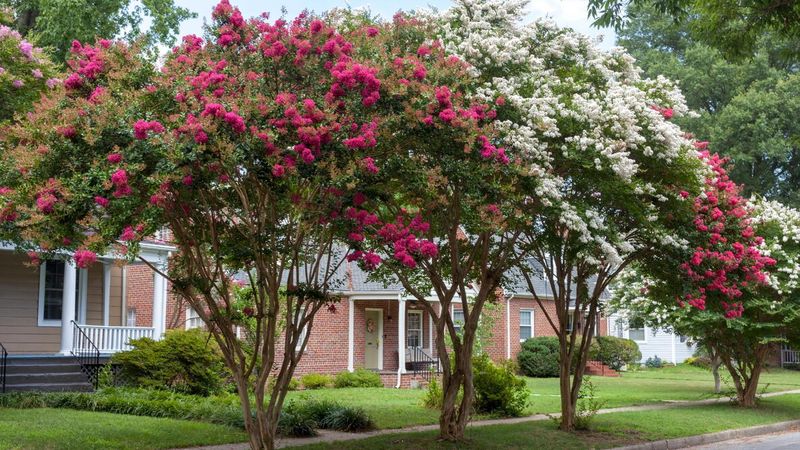
Plenty of Pennsylvania homeowners have heard the warning: plant a crepe myrtle and watch the roots tear up your sidewalk or crack your foundation.
That fear is mostly overblown, but it is not the whole story either.
What actually happens underground depends on your soil, your drainage, your cultivar’s mature size, and whether your yard is in the warm Delaware Valley or a frost-heavy hollow up in the Poconos.
Getting those details right before you dig the hole is what this article is about.
Crape Myrtle Is Not a Foundation Wrecker
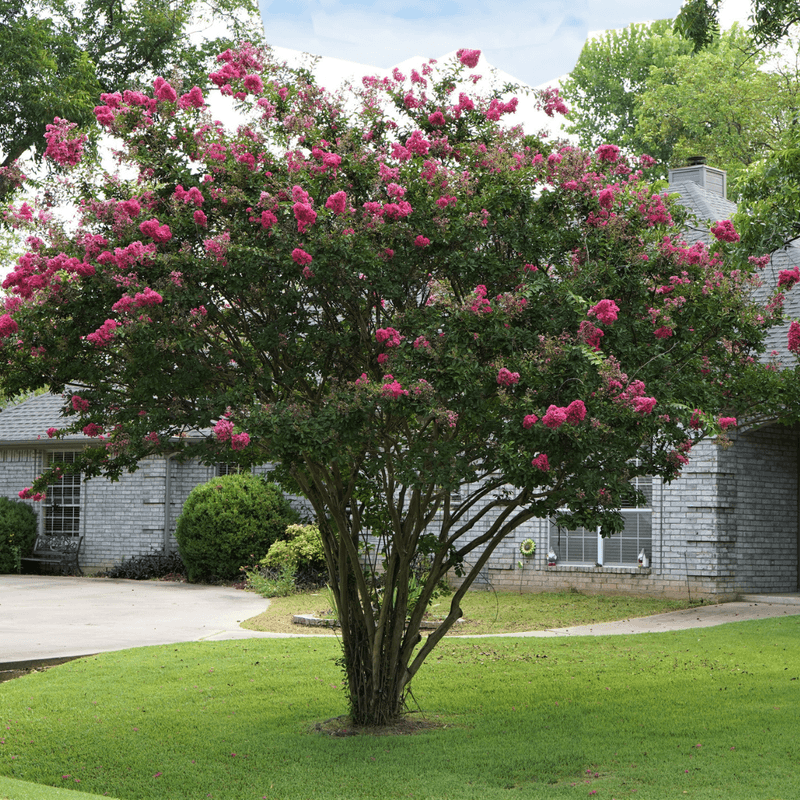
Somewhere along the way, crepe myrtle (Lagerstroemia indica) picked up a reputation it does not quite deserve.
The story goes that those roots will snake under your foundation, heave your patio, and split your sidewalk in half.
University of Florida IFAS tree fact sheet guidance describes the surface roots as “usually not a problem,” and University of California Extension notes that crape myrtles are planted near sidewalks in part because they generally do not lift them.
That is a long way from the horror story circulating in neighborhood Facebook groups.
Low invasive potential is not the same thing as a zero-damage guarantee, and it is worth being honest about that.
Site conditions, pavement quality, existing cracks, drainage, and how big the tree actually gets all factor into the outcome.
A well-chosen cultivar planted with adequate room in well-drained soil behaves very differently from a large-form tree squeezed into a narrow strip of compacted clay beside a crumbling old concrete walk.
For Pennsylvania homeowners, the more useful questions are not about whether roots will destroy infrastructure.
They are about whether the cultivar fits the space, whether the soil drains, whether the site gets enough sun, and whether the winters in your part of the state will let the tree hold its shape from year to year.
University of Maryland Extension notes that mature tree-form cultivars commonly reach 10 to 30 feet high and 15 to 25 feet wide, while shrub forms typically stay 5 to 10 feet in each direction.
Start with size, and the rest of the decision gets clearer.
Its Roots Follow Favorable Soil Conditions
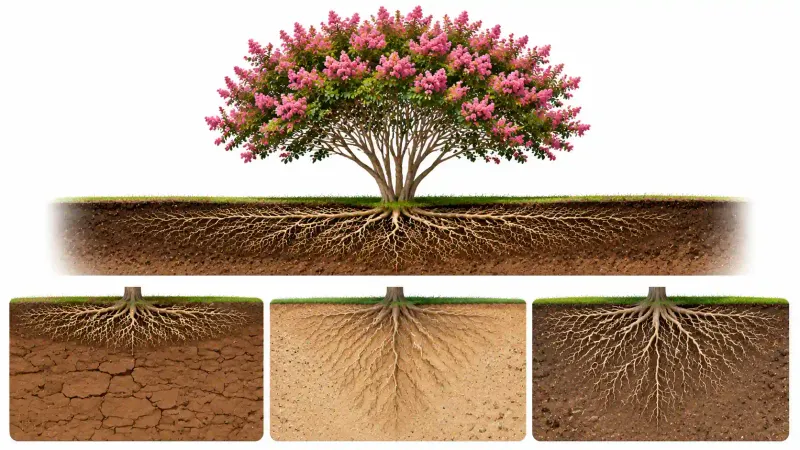
Picture the root system not as a mirror image of the canopy pointing downward, but as a wide, flat web spreading out near the surface.
Crape myrtle roots are generally shallow and fibrous, without a dominant taproot driving straight down.
Most of the active feeder roots stay in the upper 12 to 18 inches of soil, because that is where oxygen lives.
Roots need air just as much as they need water and nutrients.
UC Master Gardener tree care guidance explains that compacted or waterlogged soil cuts off the oxygen supply, which is why roots stay shallow and spread laterally rather than pushing down into dense or saturated ground.
When a crape myrtle finds a patch of loose, aerated soil with decent moisture and nutrients, it follows that path, sometimes well beyond the visible canopy edge.
That lateral spread is the part worth planning around.
Roots do not stop at the dripline just because the branches do.
They travel toward whatever conditions work, and in compacted or heavy clay soil, that often means hugging the surface layer where air and water move more freely.
The Florida IFAS fact sheet confirms that the root system is vigorous, and a vigorous shallow root system in a tight planting spot is worth thinking through before you pick up a shovel.
The roots are not aggressive in the sense of being destructive by nature, but they are persistent, and they go where conditions invite them.
Pennsylvania Soil Can Keep Roots Near the Surface
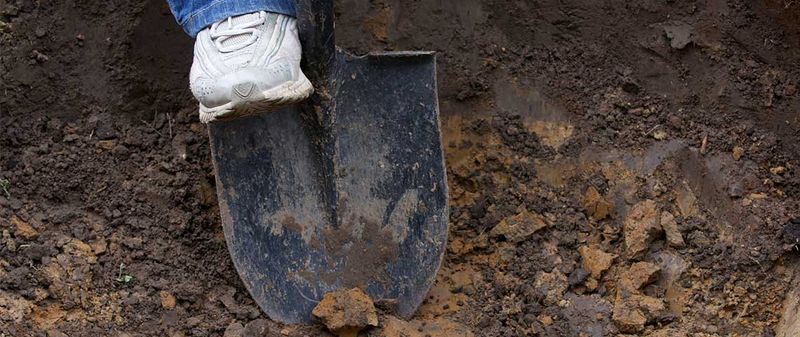
Clay soil holds water and nutrients tightly, which sounds like a good thing until you realize it also squeezes out the pore space that roots need to breathe.
Much of Pennsylvania sits on heavy clay, shale-based subsoil, or construction-graded ground that has been compacted by machinery during home building.
Penn State Extension’s guidance on construction-damaged soils describes how compaction reduces pore space and blocks air, water, and root movement, often leaving only a thin workable layer near the surface.
In those conditions, crape myrtle roots have nowhere to go but sideways.
Rocky or shallow shale sites across the central and western parts of the state can restrict rooting depth even further, and shallow limestone soils in some valleys can create drought stress surprisingly fast after a heavy rain drains away.
A yard that looks fine in May can be bone dry and hard as brick by late July, which is rough on a tree that has not had time to establish a wide root network.
NC State Extension’s profile of Lagerstroemia indica notes that the species performs best in well-drained soil with full sun.
Before planting, check whether your yard drains well after a heavy rain, probe the soil to see how deep workable ground goes, and look for signs of prior compaction like hard, crusted surface soil or sparse grass.
Soil improvement can help, but it is site-specific work, not a fix that guarantees perfect root behavior everywhere.
Know what you are planting into, not just what the tag promises.
The Dripline Is Not the Root Boundary
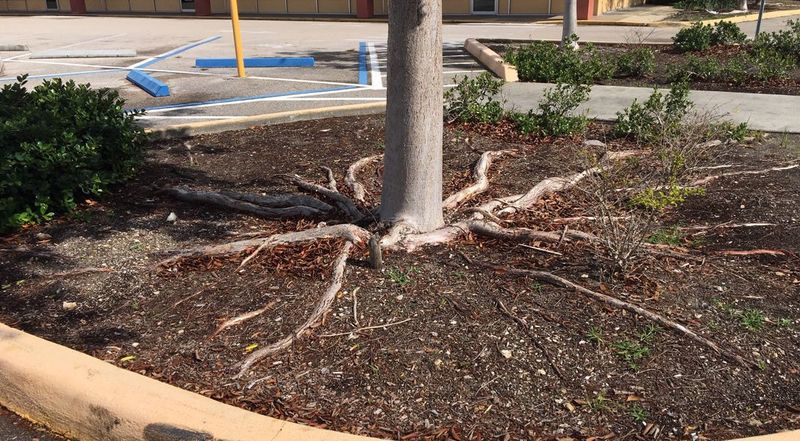
Many homeowners assume that if a tree’s canopy is 12 feet wide, the roots stop at 6 feet out.
That is not how trees work.
Roots follow moisture, oxygen, and nutrients wherever those conditions exist, and they can travel well beyond the outer edge of the canopy, especially in shallow or compacted soil where lateral spread is the path of least resistance.
For crape myrtle specifically, UC Master Gardener tree care resources and the University of Florida IFAS fact sheet do not identify it as a high-risk sidewalk-lifting species.
Any shallow-rooted tree can contribute to uneven pavement, though, when roots grow beneath a walkway that is already thin, cracked, or poorly supported.
The risk goes up when a planting strip is narrow and the pavement has no room to flex.
Sewer lines are a separate conversation.
Roots do not hunt for pipes, but they do find openings.
University of Illinois Extension guidance on roots and sewer lines explains that roots enter old or defective systems through existing cracks, failed joints, or leaking connections, then enlarge the blockage over time.
Sound modern sewer lines are much less vulnerable.
Before planting any tree near an older sewer line, it is worth having the line inspected.
A small camera inspection is far cheaper than a repair after the fact, and it tells you whether your existing infrastructure is actually at risk.
Pennsylvania Winters Change the Planting Decision
Root behavior is only part of what determines whether a crape myrtle works in your yard.
Pennsylvania winters can decide the question before the roots ever get a chance to spread.
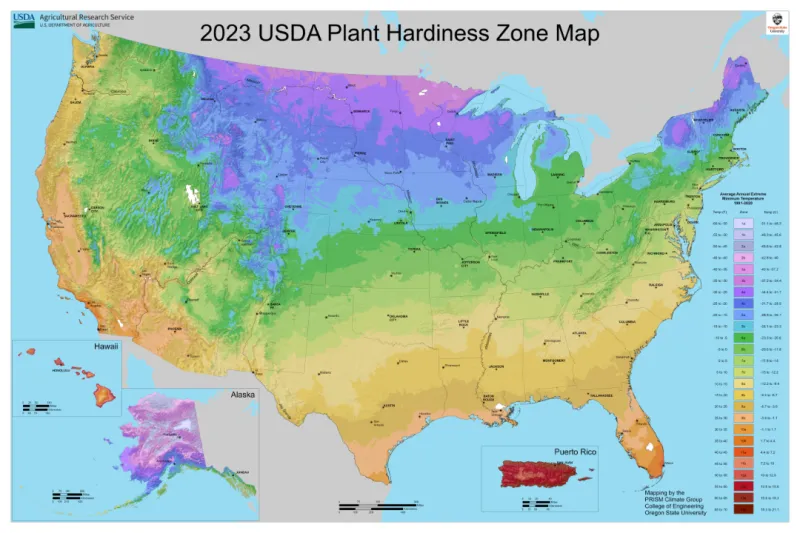
The 2023 USDA Plant Hardiness Zone Map places Pennsylvania in zones ranging from about 5b in colder northern and higher-elevation areas to 7a across much of the southeast, with a narrow 7b pocket in the warmest parts of the Philadelphia metro.
Those zones describe average annual extreme minimum temperatures, not guaranteed frost dates, drainage performance, summer heat accumulation, or flowering reliability.
Virginia Cooperative Extension’s crapemyrtle publication cautions that in zones 6a and colder, part or all of the stem and trunk structure may die back over winter, even in cultivars marketed as zone-hardy.
A plant that resprouts from the base each spring is not the same as a reliably tree-shaped, reliably flowering specimen.
Some homeowners in the Poconos or the Allegheny Plateau have found that out the hard way after a few winters.
Regional frost timing makes the difference even more concrete.
Penn State Extension frost data shows average last spring freezes around May 6 and first fall frosts around October 4 in Altoona, compared with roughly March 30 and November 17 in Philadelphia.
That is a growing season nearly six weeks shorter in the mountains.
A cultivar that blooms reliably in the Delaware Valley may barely flower before frost cuts it back in a higher-elevation yard.
Cold-hardy cultivars have the best odds in southeastern Pennsylvania, protected urban sites near Philadelphia or Pittsburgh, and south-facing spots with good air drainage.
Everywhere else, winter exposure is the real variable to plan around.
Mature Size Sets the Practical Clearance
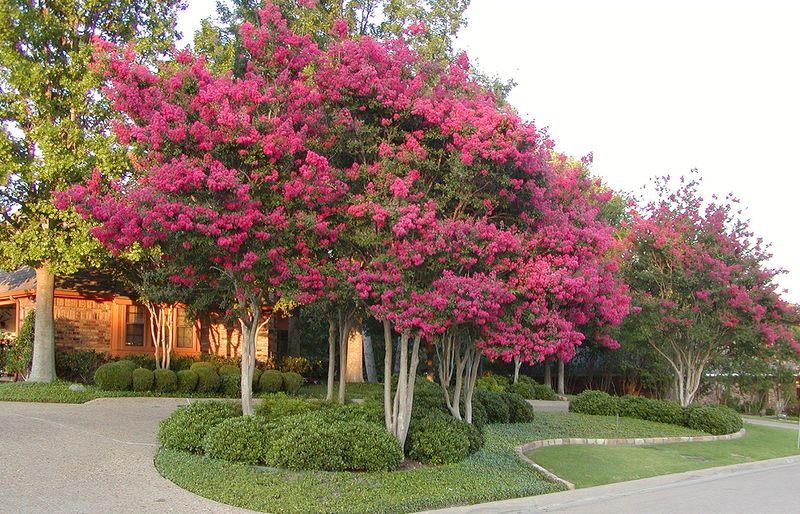
A crepe myrtle at the nursery looks like a manageable shrub in a five-gallon pot.
That pot hides the eventual planting footprint entirely.
The cultivar tag is the thing that actually matters, and many homeowners skip reading it carefully.
Virginia Cooperative Extension lists crape myrtle cultivars ranging from about 4 feet to 25 feet tall and 5 to 20 feet wide at maturity, depending on the selection.
University of Maryland Extension gives broader ranges of 10 to 30 feet high and 15 to 25 feet wide for tree-form cultivars, while shrub forms typically stay in the 5-to-10-foot range in both directions.
The common name “crepe myrtle” covers an enormous range of mature sizes, which is why the specific cultivar name on the tag tells you more than the label on the display sign.
A practical way to think about placement is to start from mature canopy width.
If a cultivar reaches 20 feet wide at maturity, its canopy radius is roughly 10 feet.
Planting it at least 10 feet from a house wall, patio edge, or walkway gives the crown room without crowding.
That is a spacing inference based on canopy size, not a species-specific root-damage standard, but it is a reasonable starting point.
Apply the same logic to driveways, utility lines, and anything overhead.
Choosing a smaller cultivar for a tight spot is always a better solution than planting a large one and hoping the roots cooperate.
Plant the Root Ball for the Site You Have
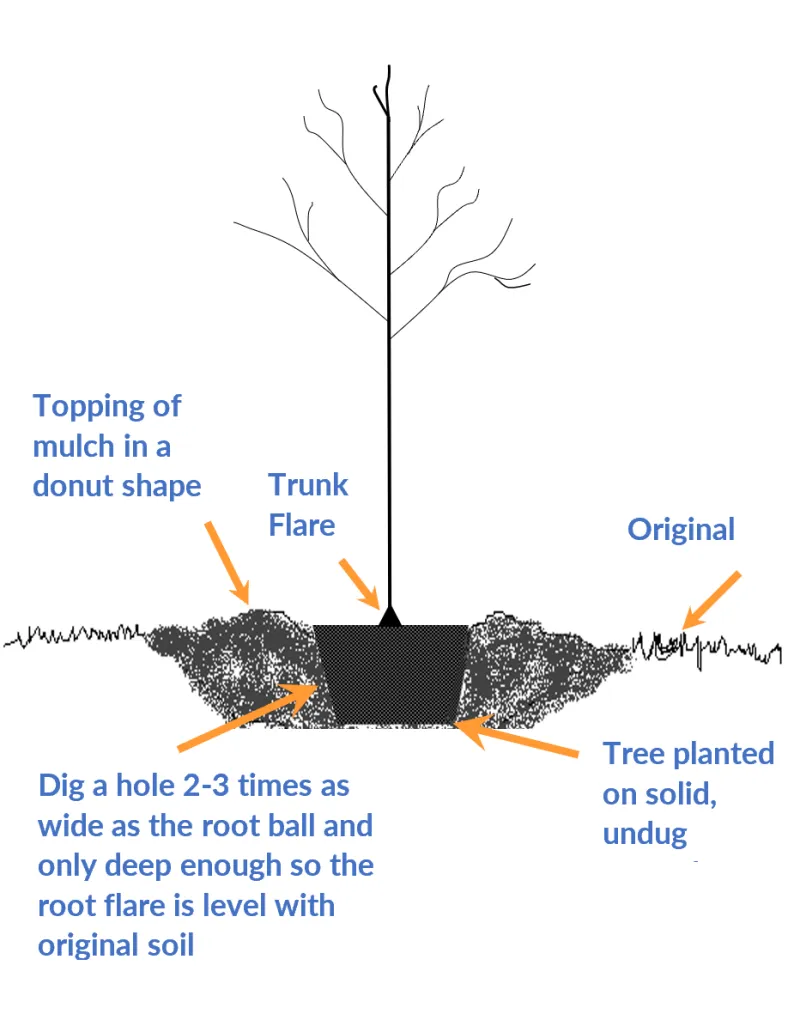
Getting the hole right matters more than most people expect.
Dig it no deeper than the root ball and about twice as wide.
The root flare, the point where the trunk visibly widens at the base, should sit right at the soil surface, not buried an inch or two below it.
The USDA plant guide for Lagerstroemia indica notes that correct planting depth is one of the factors most affecting long-term root and trunk health.
Deep planting slows root establishment and can lead to trunk rot and girdling roots years down the road.
Mulch helps, but placement matters.
Penn State Extension’s mulching guidance recommends keeping mulch 2 to 4 inches deep across the root zone, pulled back roughly 3 to 5 inches from young trunks and 8 to 10 inches from mature ones.
Mulch piled against the trunk traps moisture against the bark and creates exactly the kind of rot problem you were trying to avoid.
In poorly drained clay, use mulch on the lighter end of that range so you are not adding more water retention to an already slow-draining spot.
Watering during the first season is where many plantings go wrong.
Penn State Extension recommends applying at least 1 to 1.5 gallons per inch of trunk diameter per watering, wetting the top 6 to 9 inches of soil slowly and broadly across the root ball and surrounding ground.
A 2-inch-caliper tree may need 20 to 40 gallons per session.
Penn State also advises watering 2 to 3 times weekly during the hottest, driest stretches of July and August, continuing into September if the weather stays dry.
In clay or compacted soil, overwatering is genuinely dangerous because it fills the air pockets roots depend on.
Water deeply and then let the soil partially dry before watering again.
Choose Maintenance Over Root Surgery
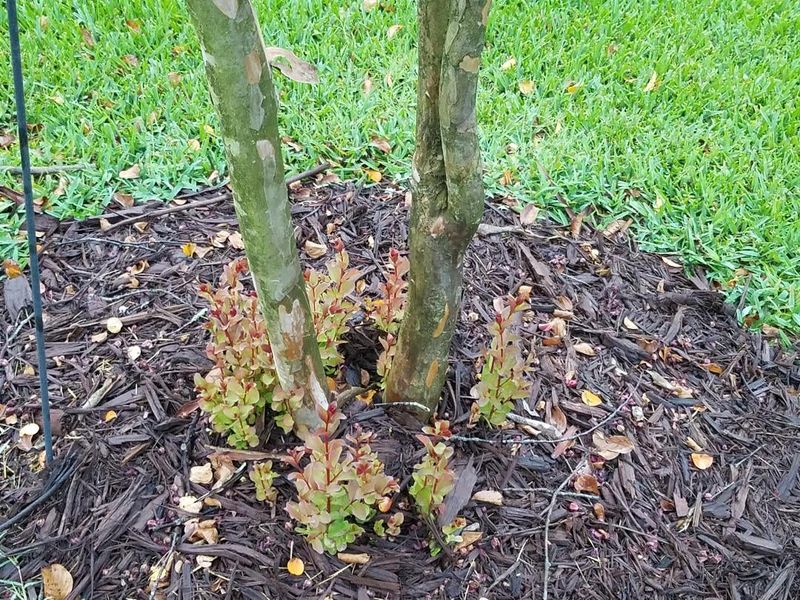
Basal suckers, those fast-growing shoots that pop up from the root zone or base of the trunk, are one of the more persistent maintenance tasks with crape myrtle.
They tend to show up more often after severe pruning or disturbance around the root zone.
University of Florida IFAS pruning guidance recommends removing suckers while they are still small, cutting them as close to the ground as possible.
Do not apply herbicide to them.
The chemical can travel back into the parent plant and cause serious injury to the root system and trunk.
Topping the tree every winter to “keep it small” is one of the worst things you can do.
Severe topping weakens the structure, triggers excessive regrowth from the cut points, and actually increases sucker production rather than reducing it.
If the tree is too large for the space, the cultivar was the wrong choice, and the right fix is selecting a smaller one next time.
Light structural pruning during late dormancy is appropriate when it is needed for shape, but it is not a substitute for choosing the right size plant upfront.
Root cutting should not be offered as a routine homeowner solution either.
Penn State Extension advises against root damage and encourages working with existing site conditions rather than against them.
Cutting roots can destabilize a tree and remove the pathways supplying water and nutrients to the canopy.
The better path runs through the decisions made before planting: cultivar size, drainage, distance from pavement and utilities, soil condition, and an honest read of your local winter exposure.
A crepe myrtle chosen and sited carefully is a genuinely low-maintenance tree.
One planted in the wrong spot becomes a recurring problem that no amount of root surgery will fully solve.