
The North Carolina Native That Turns A Weedy Full-Sun Border Into A Wall Of Blooms Instead Of Landscape Fabric
Follow us on Google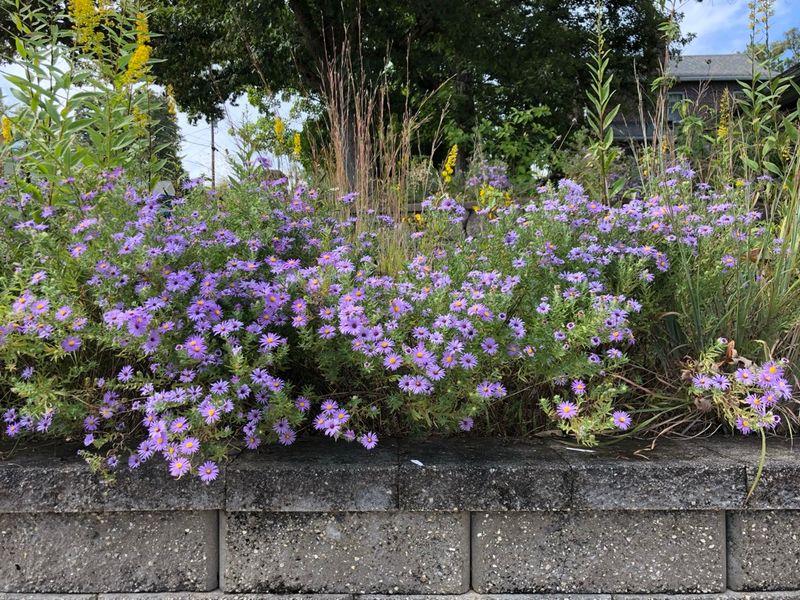
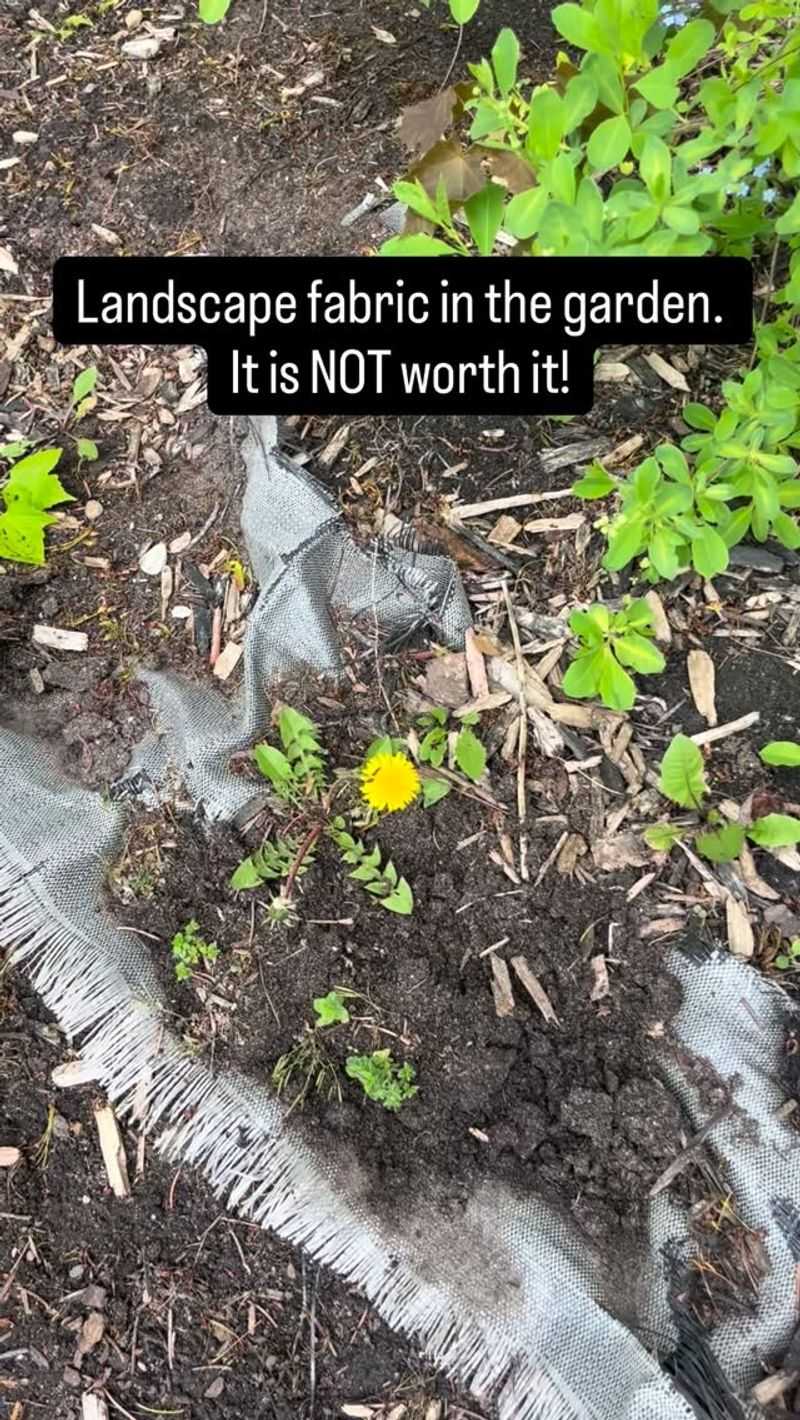
Pull back the landscape fabric on a sunny North Carolina border and you often find a mess underneath: weeds pushing through, fabric shredding into strips, and bare soil everywhere you hoped for color. Aromatic aster, Symphyotrichum oblongifolium, is a dense, low-mounding native perennial that can change that picture by late summer, filling a full-sun bed with small blue-purple flowers while shading out new weed seedlings as it fills in.
It is not a one-plant miracle, but for many North Carolina homeowners tired of fighting fabric and bare soil, it is genuinely one of the more useful tools in the border.
Meet The Native Perennial Behind The Promise
Aromatic aster, Symphyotrichum oblongifolium, grows wild across much of North Carolina and has been earning its keep in residential borders for good reason. NC State Extension lists it for the Coastal, Mountains, and Piedmont regions, and its hardiness across zones 3a through 8b means it covers every major residential gardening area in the state without complaint.
The plant forms a dense, low mound that can reach 1 to 3 feet wide and up to 3 feet tall at maturity. That mounding habit is the real story here, because a mature plant covers a meaningful patch of ground, shading the soil beneath it and leaving less open space for annual weed seedlings to grab hold.
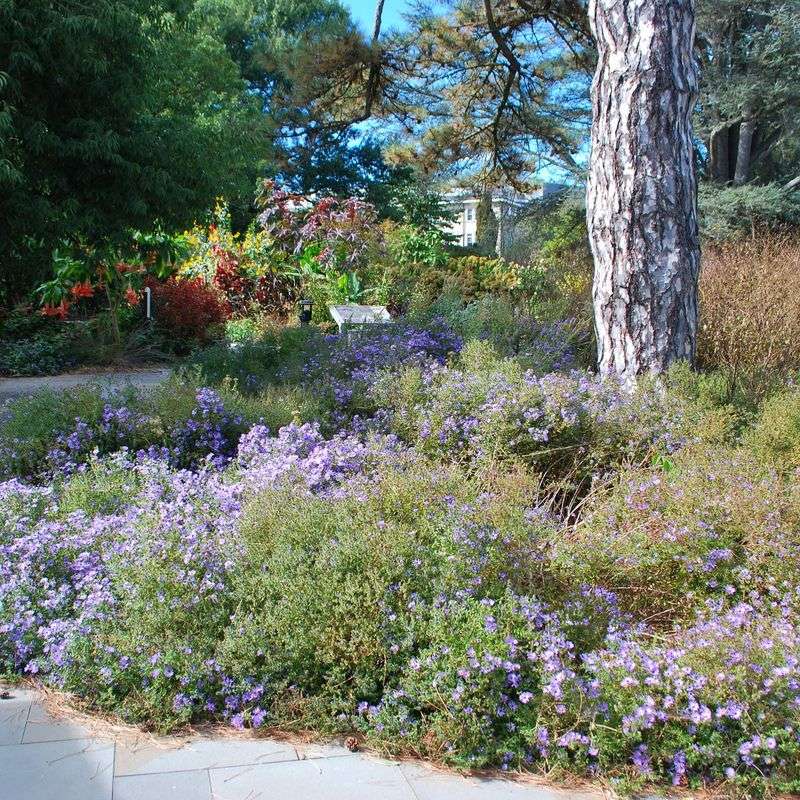
One plant alone will not close a border. Plant several together and give them a full growing season or two, and you start to see what NC State means when it recommends aromatic aster for mass plantings along walkways and sunny borders.
The dense canopy builds gradually, not overnight.
Along the Coastal Plain, it handles sandy, occasionally dry soil and tolerates the salt air that kills less adaptable plants. In the Piedmont, it manages clay and occasional moisture swings without much fuss.
NC State also reports good deer and rabbit resistance, though resistance is not the same as being completely browsing-proof in a yard with heavy deer pressure.
The practical takeaway is that aromatic aster is a plant suited to real North Carolina conditions, not a greenhouse prima donna. It will work with your soil and your sun, but it does need time and a little upfront effort to deliver the dense, weed-shading drift you are hoping for.
How A Living Canopy Reduces Weed Pressure
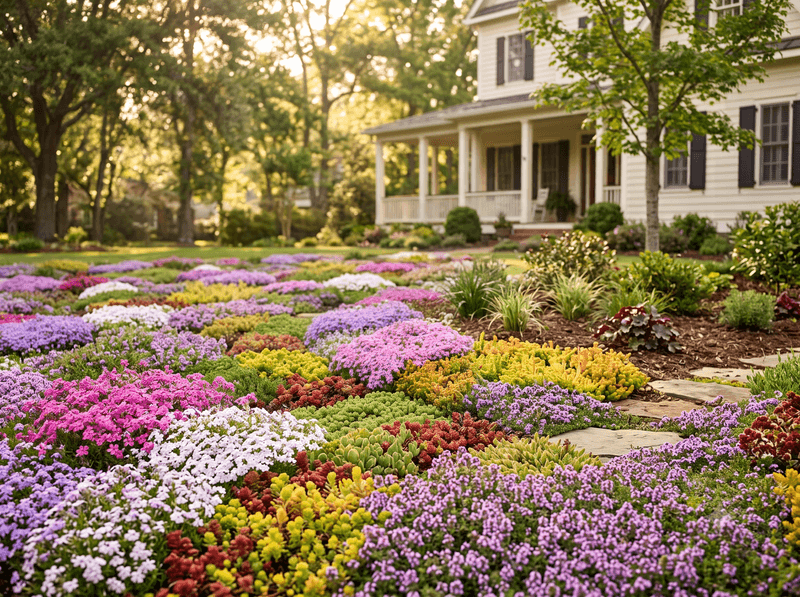
Here is the plain-language version of how this actually works. Dense perennial foliage shades the soil surface, and weed seedlings that need light to germinate or establish simply have less of it.
The plants also take up water and soil nutrients in the root zone, making it harder for annual weeds to get started in the first place.
Agricultural research on living mulches gives some useful context. One study on cover crops and living mulch systems found that plant cover above 70 percent suppressed weed growth by as much as 95 percent in certain field conditions.
That is a striking number, but it comes from an agricultural setting, not a residential border planted with aromatic aster. The same percentage does not automatically transfer to your yard.
A review of living mulch management for weed control also notes real tradeoffs, including competition between the living mulch and desired plants for water and nutrients during establishment. That competition matters most in the first season, before aromatic aster roots are deep and established.
What you can realistically expect after the planting fills in is lower annual weed pressure, not a permanently weed-free border. Windblown seeds will still land on top of your mulch.
The occasional weed will still pop up at the edges. But a dense, mature drift of aromatic aster leaves far less exposed soil than a bed held together by landscape fabric and mulch alone.
The mechanism is shade and competition, not chemistry. Aromatic aster does not kill weeds.
It simply gives them less room to work with, and that distinction matters when you are setting expectations for your border.
Where Landscape Fabric Helps And Fails
Landscape fabric is not useless, and treating it that way sets up a false comparison. NC State’s woody ornamentals guidance acknowledges that geotextile fabric can suppress many weeds germinating beneath it, particularly during its early service life.
In a long-term shrub bed where nothing needs to spread or be replanted frequently, fabric can be a reasonable tool.
The problems show up over time. Mulch decomposes on top of the fabric, dust and leaf litter accumulate, and windblown seeds germinate in that organic layer above the barrier.
Sedges and some grasses can push right through the material. University of New Hampshire Extension points out that roots from both desirable plants and weeds become entangled with the fabric over time, making later removal genuinely difficult.
Iowa State University Extension similarly notes that organic mulch on top of fabric still decomposes and creates a seedbed for weeds above the barrier, which defeats much of the original purpose. The fabric also degrades into brittle pieces that are frustrating to pull out once roots have grown through it.
Where fabric fits worst is exactly where many North Carolina homeowners want to use it: in perennial beds that need to spread, fill in, and be adjusted season to season. NC State’s planting guidance specifically advises against using geotextiles where groundcovers need to root and spread naturally.
Aromatic aster is a potential living alternative to that scenario, not a proven universal substitute. A dense, established drift can reduce exposed soil and lower the weed pressure that fabric was supposed to handle.
But it takes site preparation, time, and realistic expectations to get there.
Remove Perennial Weeds Before Planting

Skip this step and everything else you do will be harder. Bermudagrass, nutsedge, bindweed, and any weed that spreads through rhizomes, tubers, stolons, or persistent underground crowns will not be stopped by new plants sitting on top of them.
NC State’s weed management guidance is direct about this: mulch alone will not control weeds with established root systems below the soil surface.
The realistic sequence is to remove those perennial weeds before aromatic aster goes in the ground, then monitor the border edges where they tend to creep back in from adjoining turf or unmaintained areas. New foliage can shade out annual weed seedlings over time, but it cannot starve out a bermudagrass rhizome that is already 6 inches deep.
NC State’s pre-planting guidance recommends addressing soil compaction across the entire planting area, not just in individual holes. Loosening compacted soil improves root development for your new plants and makes it easier to pull weeds later.
Soil testing before adding amendments is also recommended, so you are not guessing at pH or nutrient needs.
In the Piedmont, red clay compaction is a common problem that limits drainage and root penetration. NC State’s native plant handbook suggests incorporating approximately 1 to 3 inches of compost when soil structure needs improvement, but testing first so you do not over-amend.
Along the Coastal Plain, sandy soil drains fast, sometimes too fast. That means perennial weeds may look dry on top while their roots are pulling moisture from deeper layers, and your new aromatic aster plants will need closer attention to watering during the first season.
Clearing the bed thoroughly before planting is the step that gives the living canopy a real chance to do its job.
Plant For Closure Without Crowding
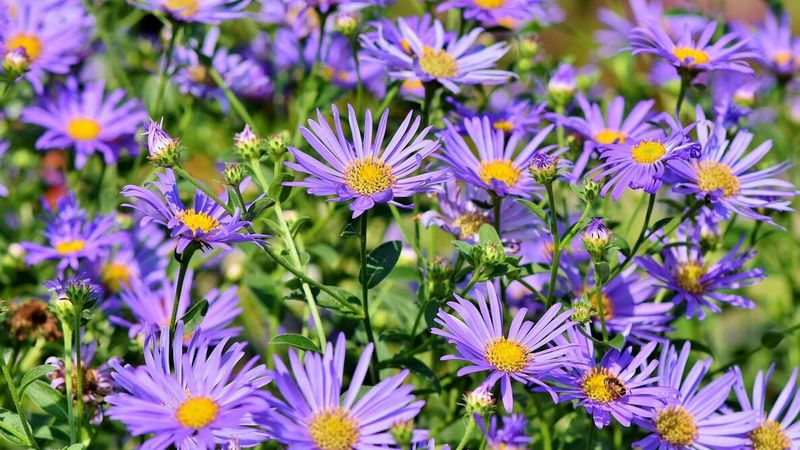
Full sun means at least 6 hours of direct sunlight daily. If your border gets that reliably, aromatic aster is a reasonable fit.
Spots that shift into partial shade by mid-afternoon, especially near fences or structures, will produce looser, less floriferous plants that do a poorer job of covering the ground.
Spring or fall planting gives the roots time to settle before summer heat peaks. NC State’s landscape management calendar supports this timing as a way to reduce supplemental watering stress during establishment compared with planting in July or August.
Spacing is where many gardeners either crowd the plants or leave too much bare ground. A practical starting point, inferred from the plant’s published mature width of 1 to 3 feet, is approximately 24 to 30 inches on center.
Closer spacing around 24 inches can speed visual closure in the first season or two. Wider spacing toward 30 inches improves airflow between plants, which matters in humid Piedmont summers when powdery mildew is a concern.
This is editorial guidance based on mature plant size, not a specific NC State planting prescription.
Avoid permanently soggy sites. NC State’s native plant guidance and the plant’s profile both point to well-drained soil as the preferred condition.
A low spot that holds standing water after rain is a poor fit, regardless of how much sun it gets.
Newly planted aromatic aster needs regular water during the first several weeks and during any hot, dry stretch afterward. Plants near pavement or buildings dry out faster than open-bed plantings because heat radiates from hard surfaces and rainfall may run off before soaking in.
NC State’s pre-planting guidance notes this extra demand near structures specifically.
Apply 2 to 3 inches of organic mulch around young plants, keeping it away from stems and crowns. For broader bed areas between plants, up to 4 inches is reasonable.
That mulch layer is temporary support while the planting fills in, not something you will never need to refresh or manage again.
Expect The Main Show In Late Summer
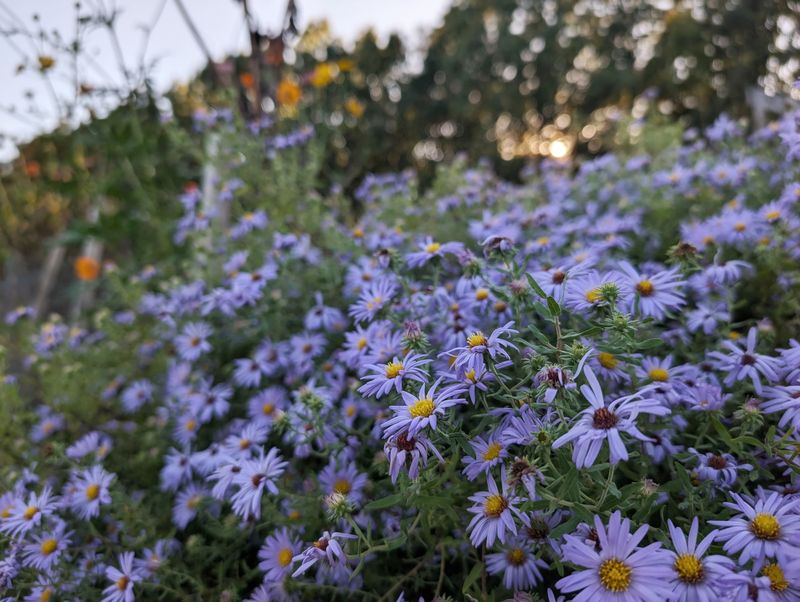
Most of the summer, your aromatic aster border will look like a tidy mound of small green leaves. That is not a problem, it is the setup.
By late August and into September, the plant shifts into its main act: hundreds of small blue-purple flowers, each about 1 to 1.5 inches wide, opening across the mounded canopy and continuing right up to the first frost.
Many spring and early-summer perennials have already gone quiet by then. NC State’s plant profile describes this late-season bloom window as one of the plant’s most useful qualities, because it provides color and pollinator habitat when much of the border has wound down.
A drift of several plants reads as a broad flowering sweep from a distance, even though the individual flowers are small.
Native bees are the real beneficiaries here. NC State specifically notes specialized native bees associated with Symphyotrichum species and recommends leaving some dead hollow stems standing after the season ends, because stem-nesting bees use them as overwintering habitat.
Cutting everything to the ground in fall removes that resource.
The honest seasonal picture is that aromatic aster is a late-summer and fall anchor, not a complete year-round design by itself. Earlier in the season, the border will be green and filling in but not particularly showy.
If your goal is color from April through October, you will need other plants alongside it. But as a single-species late-season drift that also supports pollinators and reduces open soil, it genuinely earns its space in a North Carolina full-sun border.
Fall monarchs passing through the Piedmont and Coastal Plain will find the blooms at exactly the right moment, which is a satisfying bonus for any gardener watching from the porch.
Maintain A Living Border, Not A Miracle Cure
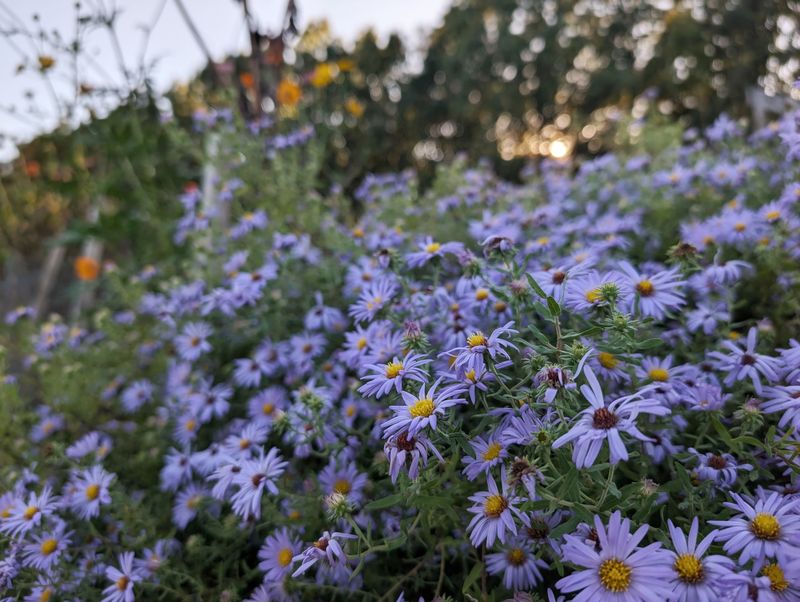
An established aromatic aster border still needs attention, just less of the losing-battle kind. Once the plants have filled in and the canopy is dense, the main job shifts to monitoring the edges, where bermudagrass or other perennial invaders tend to creep back in from surrounding turf.
Pulling those edge weeds before they advance is much easier than dealing with them after they have rooted under the canopy.
Occasional weeds will also germinate in the organic mulch and deposited soil on top of the bed. NC State’s pre-planting guidance is clear that perennial beds need multiple tools working together, including hand-weeding and mulch management, not just plant competition.
Aromatic aster reduces the workload, it does not eliminate it.
Poor drainage or weak airflow between plants can contribute to powdery mildew or aster wilt, especially in the humid conditions common across much of North Carolina in summer. NC State notes that the plant has no serious insect or disease problems under good conditions, but drainage and airflow still matter.
If plants are spaced too tightly in a low-airflow corner, mildew pressure goes up.
When it comes to seasonal cleanup, cut stems back to 12 to 24 inches rather than removing them entirely, and leave the cut stems standing until they naturally break down. Stem-nesting bees use the hollow sections for overwintering, and removing everything in fall takes away habitat that native bees genuinely rely on.
The layered strategy here is not complicated: clear perennial weeds before planting, space plants for airflow and eventual closure, mulch temporarily while the planting fills in, water during establishment and dry spells, and pull the occasional weed that lands on top. A border built that way actually improves as it matures, which is more than most landscape fabric can say after year three.