
The Big Yellow Grasshoppers Swarming Your Florida Yard By August And What Actually Stops Them
Follow us on Google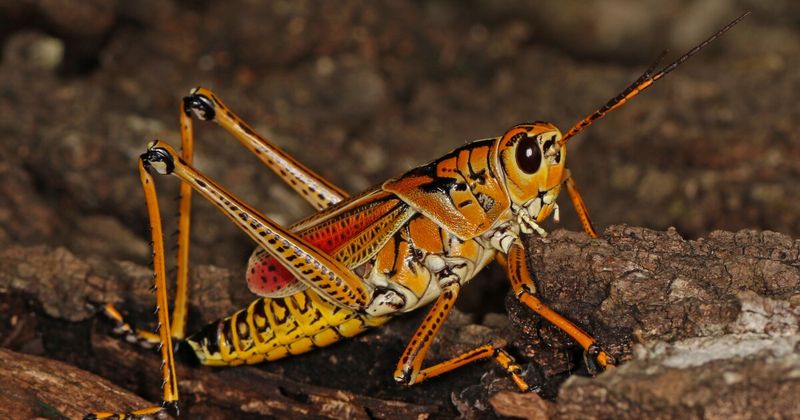
You walk out to check your crinum lilies one morning and find a chunky, slow-moving grasshopper the size of your thumb sitting right on the stem, chewing like it has nowhere else to be.
If your yard is in northern Florida or along the Gulf Coast, late summer is prime time for these insects to show up in numbers that feel impossible to ignore.
The pest you are most likely looking at is the eastern lubber grasshopper, and the spray you grabbed off the shelf may not be the fix you were hoping for.
Understanding what this insect actually is, how it moves through a yard, and what genuinely works against it can save your plants and a fair amount of frustration.
The Big Yellow Grasshopper May Be an Eastern Lubber
A grasshopper that size, moving that slowly, and eating that boldly is a useful clue on its own.
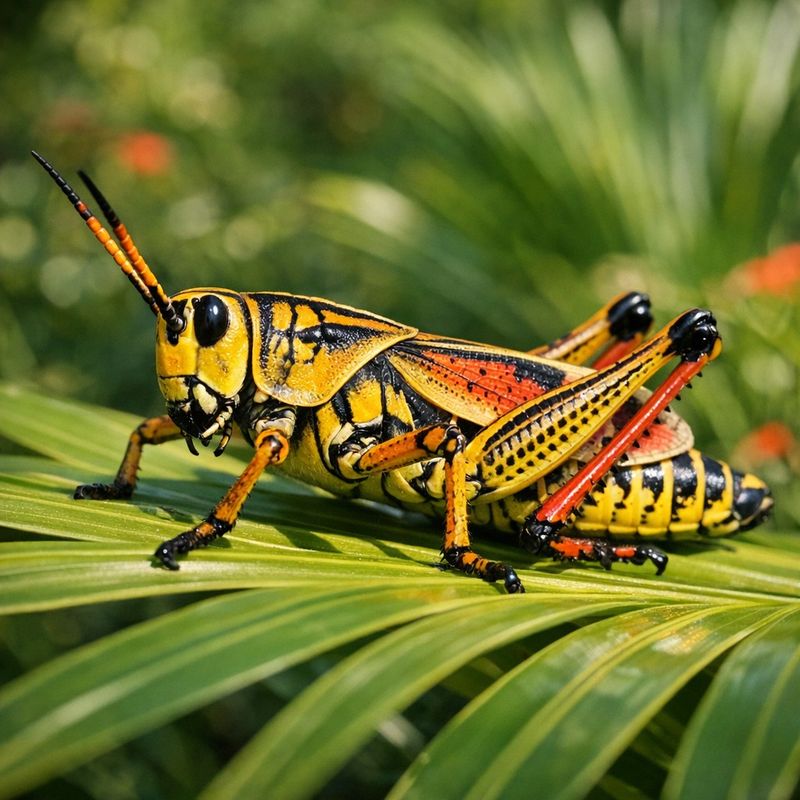
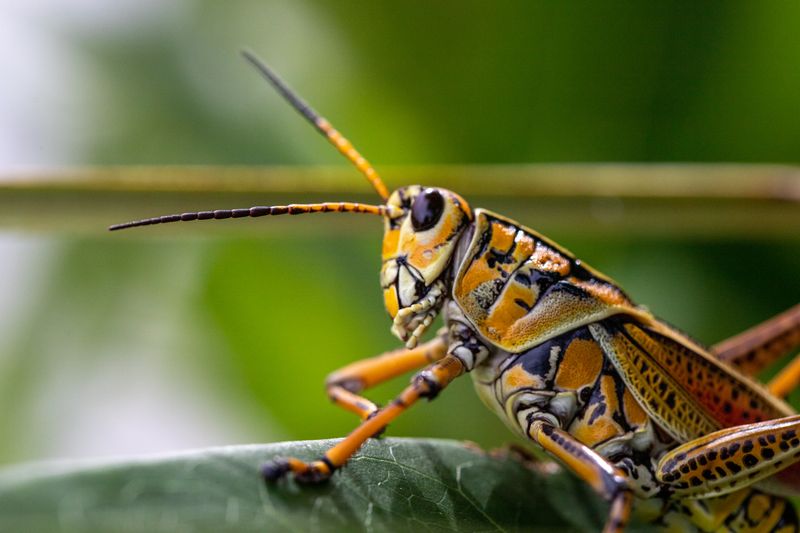
The insect you are most likely dealing with is the eastern lubber grasshopper, Romalea microptera, a native Florida species that is hard to miss once it reaches adulthood.
UF/IFAS Featured Creatures documentation on the eastern lubber describes adults ranging from roughly 1.7 to 3.5 inches long, which puts a mature lubber well above most grasshoppers you have seen before.
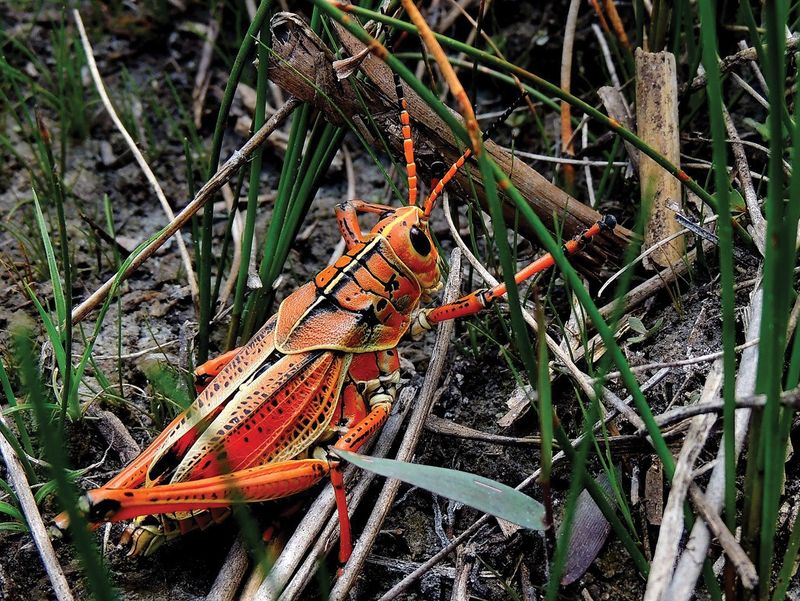
Coloration varies more than people expect.
Some adults are bright yellow or tawny with bold black markings along the wings and sides.
Others, particularly in northern Florida, are predominantly black with only a narrow yellow or red trim.
That range means a large black grasshopper and a large yellow one can both be lubbers, so color alone does not close the case.
What makes identification more reliable is behavior.
Lubbers cannot fly, and they are poor jumpers compared to most grasshoppers.
They climb well, though, and you will often find them working their way up amaryllis stalks, crinum leaves, or tender vegetable foliage to reach the softest growth at the tips.
That slow, deliberate climbing habit is a strong behavioral clue.
Young lubbers look nothing like the adults.
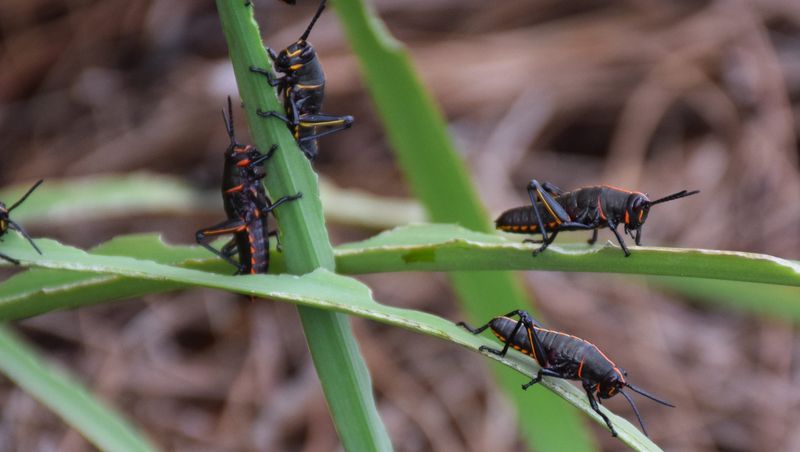
Nymphs are usually jet black with a yellow, orange, or red stripe running down the back, and they tend to cluster in tight groups near the ground or on strap-like leaves.
Spotting a group of small black striped insects low on your plants is one of the most useful early warning signs you can get.
UF/IFAS guidance on common Florida grasshoppers notes that other species, including the American grasshopper, also damage plants and behave differently, so a visual match supports a likely identification rather than a guaranteed one.
Focus removal on insects you can positively connect to the damage on plants you care about.
Why Some Florida Yards See More Adults in July and August
The eastern lubber lives on a one-generation-per-year schedule, and that cycle explains why adults seem to materialize all at once in certain parts of the state.
Females lay egg pods about 1.2 to 2 inches below the soil surface, with each pod holding roughly 25 to 50 eggs.
A single female can produce 1 to 3 pods, and those eggs spend approximately 6 to 8 months in the ground before hatching, including a cool period that triggers development.
By the time adults appear in your yard, that underground process has been running since the previous fall.
In northern Florida and along the Gulf Coast, adults are most numerous in July and August, though insects can be present from roughly March or April through October or November depending on local conditions.
UF/IFAS Gardening Solutions on eastern lubber grasshoppers confirms this seasonal pattern while noting that southern Florida can have nymphs or adults during much of the year, which means the August peak is a regional pattern, not a statewide rule.
If you are in the Panhandle or along the Gulf Coast, late July into August is genuinely the time to expect the largest adults and the most visible activity.
Central Florida gardeners may see a similar but sometimes shifted window.
In South Florida, the calendar matters less because lubbers can be active across many months.
One more thing worth knowing: lubbers do not fly in.
They walk and climb their way into yards from surrounding vegetation, drainage ditches, and weedy borders.
What looks like a sudden invasion is actually a slow ground-level migration that has been building for weeks.
Why Late Sprays Often Disappoint Against Mature Lubbers
Here is where a lot of homeowners lose time and money.
You spot a group of big lubbers on your amaryllis or your vegetable bed, you grab a broad foliar spray, you coat the leaves, and a day later the grasshoppers are still there, still eating.
That is not a product failure exactly, it is a timing and life-stage problem.
Mature lubbers are unusually difficult to kill with foliar insecticides.
Part of the reason is that their bodies are genuinely better at detoxifying plant chemicals than most grasshoppers, and that same ability extends to some insecticide exposures, especially when the spray lands on leaves rather than directly on the insect.
UF/IFAS research on the eastern lubber states that insecticide treatment is generally not necessary and is usually ineffective against adults, while early treatment of younger nymphs is more successful.
That does not mean every spray always fails.
UF/IFAS identifies active ingredients that can kill lubbers, including carbaryl, bifenthrin, cyhalothrin, permethrin, esfenvalerate, and spinosad.
The problem is that a broad yard-wide application timed for August adults is working against the hardest stage of the insect’s life, often with indirect contact rather than direct hit.
Directed spot treatment aimed at visible insects or tight aggregations performs better than blanket spraying.
The practical shift the research supports is moving from a reactive single-spray mindset to an integrated approach: scout early, act against nymphs when you find them, use physical removal as the primary tool for manageable infestations, and reserve chemical treatment for damaging groups that justify it.
Swapping one dramatic spray for a repeatable scouting routine is the real fix the title promises.
Hand Removal Is the First Step for Small Infestations
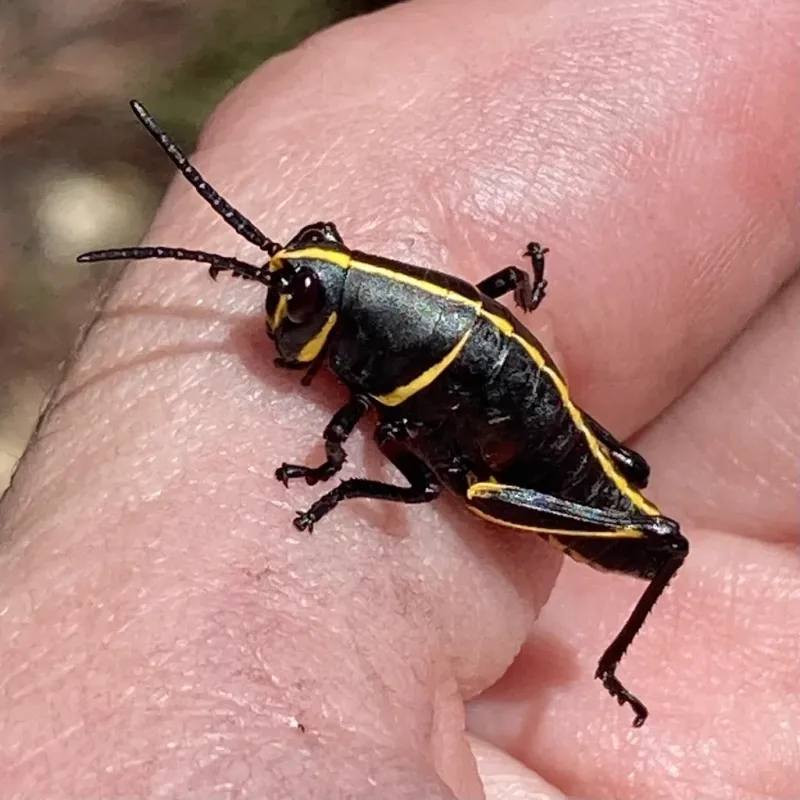
For a small or moderate infestation on landscape plants you actually care about, the most dependable practical response is also the least glamorous one: you go out and pick them off.
UF/IFAS Extension Pasco County guidance on lubber control describes mechanical removal as possibly the most effective approach for landscape infestations, which is a direct endorsement worth taking seriously.
Timing your scouting visits matters.
UF/IFAS Extension Polk County specifically reports that nymphs are lethargic and easier to hand-pick in the early morning, when cooler temperatures slow them down.
Adults are also less active in the early hours.
A quick 10-minute walk through the garden before the Florida heat builds is a better use of your time than a midday spray session.
Wear gloves and use a jar, bucket, or hand tool to collect insects.
Disturbed lubbers can release foul-smelling defensive secretions that you do not want on bare skin, and the smell alone is motivation enough to protect your hands.
Keep captured insects away from pets and children.
For disposal, place the collected insects into water containing a small amount of dishwashing soap.
That soapy water goes in the container with the insects, not on your plants.
UF/IFAS guidance on natural pest management products is clear that household detergents are not designed or labeled for plant pest control and can injure foliage.
Alternatively, seal the insects in a plastic bag and freeze them for several days.
Repeated short scouting visits outperform a single long session.
Lubbers from surrounding habitat can continue moving into the yard over days or weeks, so one thorough pass does not end the problem.
Build the habit of checking valued plants every two or three days during peak season.
Black-Striped Nymphs Give You the Best Opening
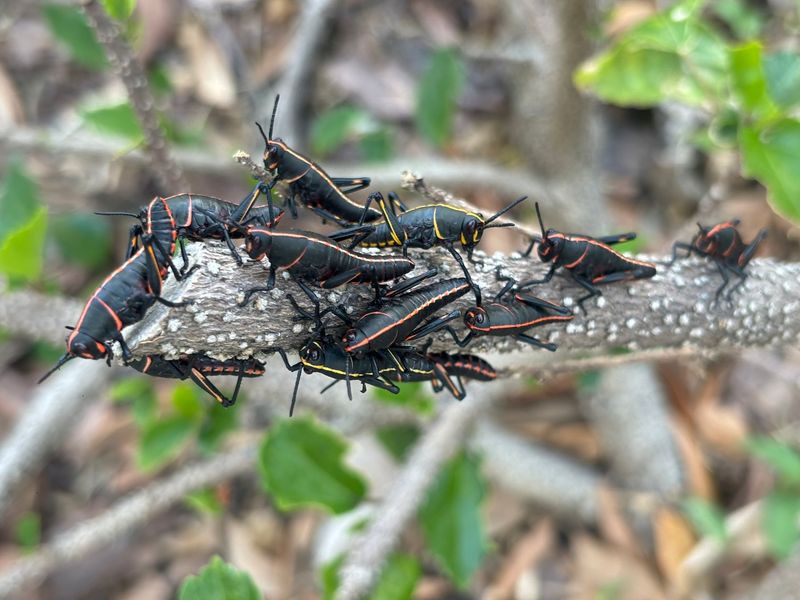
Adult lubbers get all the attention because they are so large and so bold.
But the window where you can actually tip the odds in your favor opens months earlier, when the nymphs are still small, still grouped together, and still genuinely manageable.
Young lubbers pass through five nymphal instars before reaching adulthood, growing from tiny hatchlings to insects about 1.5 inches long.
UF/IFAS Featured Creatures data on lubber development documents this progression, and the key practical detail is that early instars are gregarious.
They gather in clusters, often on strap-leaved plants like amaryllis, crinum, or canna, and they stay low to the ground.
A cluster of 20 black-and-yellow insects on one stem is far easier to collect in one pass than 20 individual adults scattered across the yard weeks later.
Where to look depends on your part of Florida.
In northern Florida and the Panhandle, spring scouting from March onward is worthwhile because nymphs typically hatch earlier there than adults appear.
UF/IFAS Polk County Extension recommends checking the base of plants and low vegetation where newly hatched nymphs congregate.
In South Florida, the calendar is less predictable, so checking your most vulnerable plants year-round is the safer habit.
UF/IFAS Gardening Solutions advises that spraying when grasshoppers are young is more effective because they become more resistant as they mature.
That makes early nymph discovery a genuine advantage, not just a nice idea.
Physical removal of clustered nymphs is still the primary response for manageable situations, but the opportunity is real and worth pursuing.
Dense Borders Can Help Lubbers Reach the Yard
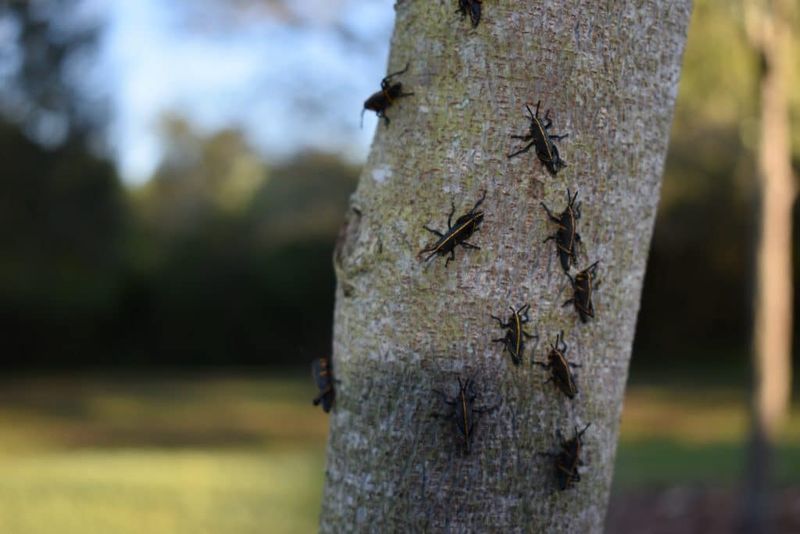
Lubbers do not come from nowhere.
They prefer low, wet areas, drainage ditches, pond edges, pastures, wooded margins, and dense weedy vegetation, and they walk from those places into residential yards.
Knowing that gives you a practical edge that has nothing to do with spraying.
UF/IFAS research on lubber habitat confirms that nymphs disperse from these source areas into surrounding landscapes.
Mowing border vegetation and removing excess weeds where practical reduces the cover lubbers use as a staging area.
A tidier border does not guarantee a lubber-free yard, but it makes insects more visible and your scouting more efficient because you can actually see what is moving.
The connection is especially relevant for Florida homeowners whose properties border pastures, hay fields, fallow land, or weedy swales.
The UF/IFAS Florida Citrus Production Guide on grasshoppers notes that timely weed control and mowing surrounding vegetation can sometimes prevent problems before insects enter a planting.
That advice was developed in a citrus context, but the principle applies to any yard with an unmanaged border nearby.
UF/IFAS Extension Pasco County also recommends removing excess ground-level vegetation near valued plants as part of an integrated management approach.
Think of it as removing the welcome mat rather than building a wall.
Lubbers can still cross open ground, but a less sheltered border slows their approach and keeps your scouting zone manageable.
Along the Gulf Coast and in parts of Central Florida where residential lots back up to natural areas or retention ponds, this habitat step is worth prioritizing before the season peaks.
A mowed strip of 10 to 15 feet along a weedy fence line can meaningfully change what you are dealing with by midsummer.
Keep Chemical Control Targeted and Label-Compliant
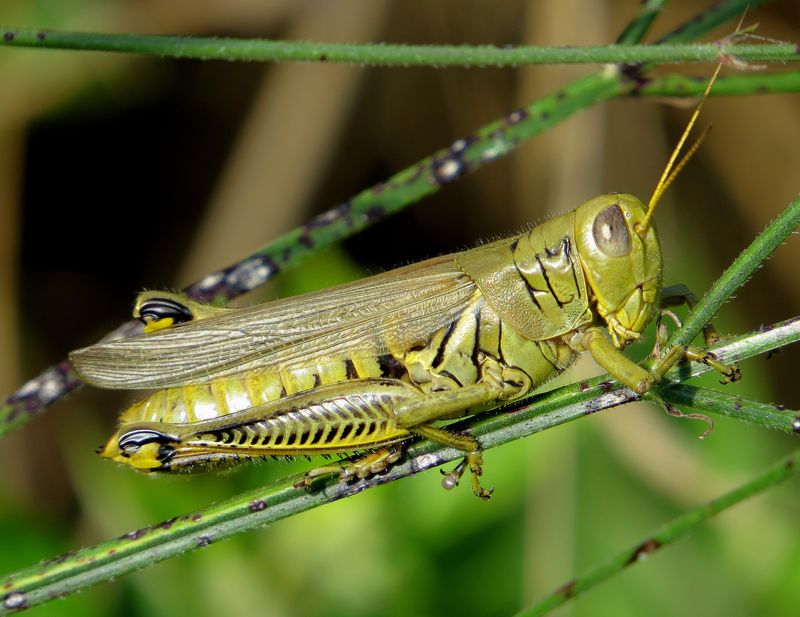
Chemical control has a role in lubber management, but that role is narrow and it works best as a complement to physical removal, not a replacement for it.
When an infestation is large enough or dense enough that hand-picking is not keeping pace, a targeted application can help, provided you choose the right product and use it correctly.
UF/IFAS Featured Creatures lists carbaryl, bifenthrin, cyhalothrin, permethrin, esfenvalerate, and spinosad as active ingredients that can kill lubbers.
That is a list of active ingredients, not a product recommendation or a universal rate.
The product you choose needs to be registered for grasshopper control, and the rate, protective equipment, reentry interval, and any pollinator or aquatic buffer requirements are set by the current label on that specific product.
EPA pesticide labeling guidance is direct: using a pesticide inconsistently with its label violates federal law.
Read the label before mixing, before applying, and before storing.
That is not a formality, it is the difference between a legal, effective application and one that can harm your soil, your pollinators, or your neighbors.
Spinosad deserves a specific caution.
It is relatively lower in toxicity to humans, but UF/IFAS Pasco County guidance notes that spinosad and other insecticides can harm bees and aquatic organisms when used carelessly.
Apply in the early morning or evening when pollinators are less active, and keep applications well away from ponds, ditches, and drainage areas.
A carbaryl bran bait is another option with research support.
UF/IFAS bait research by Barbara and Capinera found that a wheat bran carrier with corn oil attracted lubbers effectively.
The bait works because lubbers eat it, not because it coats leaves, and it performs better near less-preferred plants because lubbers may choose favored hosts over the bait if both are available.
No universal rate applies here either.
Find a currently registered carbaryl bran bait product and follow its Florida label exactly.
Spot-treat visible aggregations rather than broadcasting product across the whole yard.
Use Supporting Measures Without Chasing Miracle Fixes
A few supporting layers can reduce lubber pressure over time, but none of them replace the scouting-and-removal routine that does the actual work.
Knowing what is genuinely useful and what is wishful thinking saves you the frustration of trying a fix that was never going to deliver.
Plant selection is one honest lever.
Lubbers feed on more than 100 plant species across at least 38 plant families, so no plant is truly resistant.
Some vegetables are less preferred, including eggplant, tomato, pepper, okra, and sweet corn, while peas, lettuce, kale, beans, and cabbage are more attractive targets.
UF/IFAS Gardening Solutions uses the framing of less-preferred rather than resistant, which is the accurate way to think about it.
Adjusting what you grow near a lubber-prone border may reduce damage without eliminating it.
Natural enemies exist and do exert real pressure.
Research on parasitism of the eastern lubber by the tachinid fly Anisia serotina documented parasitism rates of 60 to 90 percent of young lubbers in some Florida study sites.
Loggerhead shrikes, sarcophagid flies, and certain pathogens also take lubbers.
That is meaningful biological pressure in the right conditions, but it is not something you can reliably engineer by planting flowers or putting up a bird feeder.
Most birds and lizards avoid lubbers because of their foul chemical defenses, and loggerhead shrikes are the notable exception rather than the rule.
UF/IFAS guidance on natural pest management products is clear that neem oil, horticultural oils, and insecticidal soap work best against small, soft-bodied insects.
Hard-bodied adult lubbers are not good candidates, and oil applications should be avoided when temperatures exceed 90 degrees Fahrenheit, which rules out much of a Florida summer.
Diatomaceous earth requires completely dry conditions to function, which is a poor match for a state that gets sudden afternoon downpours from June through October.
The routine that actually holds up: confirm the identification, scout for nymphs in spring and early summer, hand-remove damaging groups on a regular schedule, reduce shelter along weedy borders, and reach for a labeled spot treatment only when the infestation genuinely justifies it.
That sequence is repeatable, honest about its limits, and more useful than any single product that promises to end the problem in one pass.
The lubber is a slow-moving, hard-shelled, chemically defended insect with a long season, and the homeowners who manage it best are the ones who show up consistently rather than dramatically.