
Spongy Moth: The Invasive Insect Putting Pennsylvania Oaks Under Serious Pressure
Follow us on Google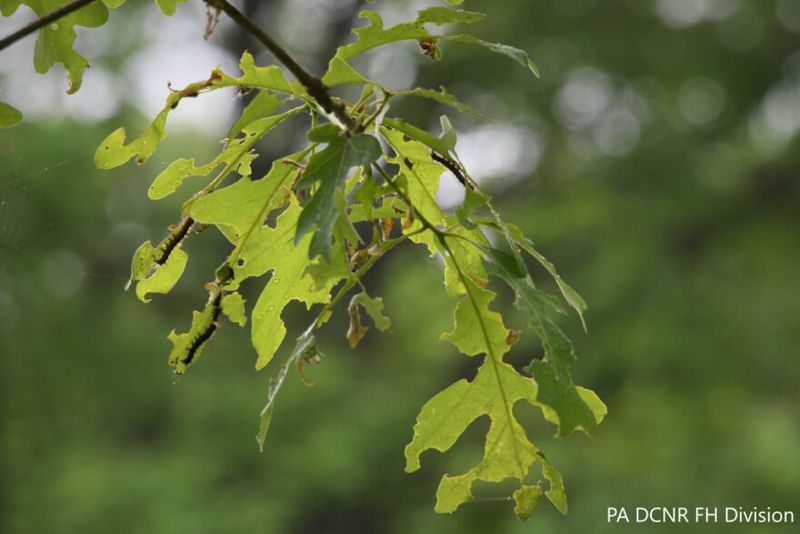
Walk under your oak tree on a June morning and you might notice something unsettling: bare branches where thick green leaves should be, and tiny dark caterpillars dangling from silken threads.
The culprit is the spongy moth, Lymantria dispar dispar, a pest that has chewed through Pennsylvania forests and neighborhoods for decades.
It can strip the leaves off yard trees, street trees, and woodlot oaks just as effectively as it hits remote forest stands.
Knowing what you are dealing with, and what to do about it, makes a real difference for the oaks on your property.
The Pest Behind Pennsylvania’s Oak Defoliation
Spongy moth, known scientifically as Lymantria dispar dispar, is the insect behind some of the most dramatic oak defoliation Pennsylvania homeowners have seen in recent years.
You may still hear it called by its former common name, gypsy moth, but state and federal agencies now use spongy moth as the standard term.
Whatever you call it, the damage it leaves on an oak tree is hard to miss.
Oak is this pest’s preferred meal.
Pennsylvania DCNR identifies spongy moth as a serious forest pest that has killed millions of oak trees across the state and has documented damage in residential areas, smaller woodlots, and municipal landscapes, not just remote timberland.
A yard oak, a street tree planted by your borough, or a cluster of oaks at the edge of your property can all face meaningful defoliation when caterpillar numbers climb.
The insect also feeds on apple, basswood, birch, poplar, sweet gum, willow, hemlock, spruce, and pine, so other trees in your yard are not automatically safe.
But oak draws the heaviest pressure, and that is where Pennsylvania property owners should focus their attention first.
The good news is that spongy moth is manageable when you catch it early.
USDA APHIS confirms that identification, monitoring, and timely action can reduce damage to individual trees.
This article walks through each of those steps so you can respond proportionately rather than in a panic.
Pennsylvania’s Current Risk Varies by Location
Not every Pennsylvania yard is facing the same level of threat right now, and that distinction matters before you decide how urgently to act.
DCNR reported statewide spongy moth population declines during 2025 and 2026, following a stretch of outbreaks that ran from 2021 through 2024.
Statewide numbers are down, but that headline does not mean the pest has disappeared from your neighborhood.
Northeastern Pennsylvania tells a different story.
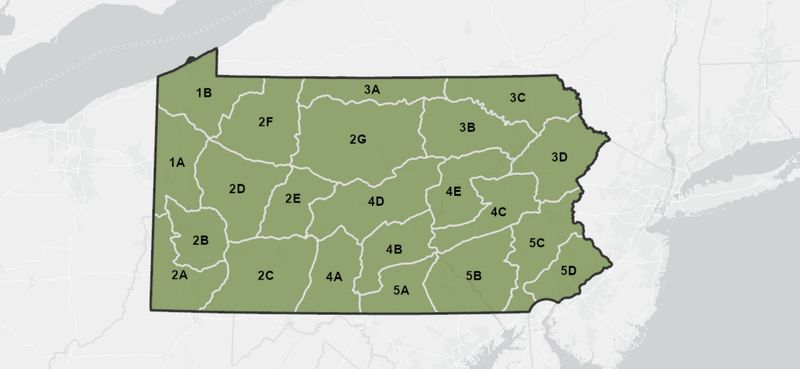
Parts of the Poconos, the northern tier, and surrounding counties continue to show hotspots and lingering populations where defoliation pressure remains real.
DCNR’s targeted aerial treatment program has focused on these areas precisely because the population has not simply evened out across the state.
A homeowner in Monroe County should not assume conditions match someone in Lancaster County or the South Hills of Pittsburgh.
Regional variation in tree stress is also worth keeping in mind.
Individual trees that are already dealing with compacted soil, root damage, drought, disease, or poor site conditions may be more vulnerable to serious damage from defoliation, regardless of where they sit on the map.
Those are potential influences on how a specific tree responds, not a confirmed explanation for why populations are higher in some regions than others.
The practical takeaway is straightforward.
Check your own trees, talk to neighbors, and contact your local Penn State Extension office to get a realistic picture of what spongy moth pressure actually looks like in your corner of Pennsylvania this season.
Regional conditions, not statewide averages, should guide your next move.
Learn the Moth’s Spring-to-Fall Pattern
Spongy moth runs on a tight schedule, and knowing that schedule is your best early warning system.
The insect completes one generation per year in Pennsylvania.
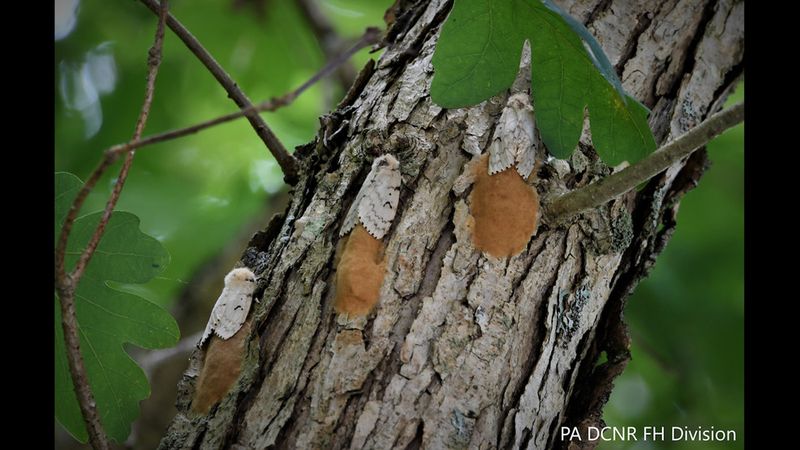
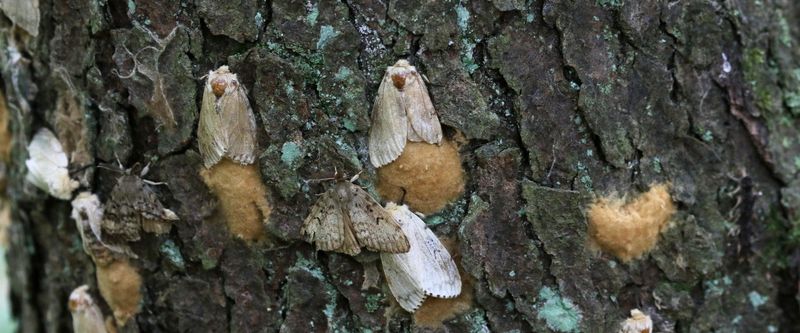
Females lay their egg masses from June through July, depositing pale tan, fuzzy clusters that can contain roughly 100 to 1,500 eggs each.
Those masses sit through late summer, fall, and winter before hatching.
DCNR notes that eggs generally hatch from mid-April through early May, depending on local spring conditions.
In the Poconos or northern tier, where spring arrives later and temperatures stay cooler longer, hatching may run closer to the early May end of that window.
In southeastern Pennsylvania and the Delaware Valley, warmer springs can push hatching earlier.
Caterpillars then feed actively through spring and into early summer, which is when you will see the most dramatic leaf loss.
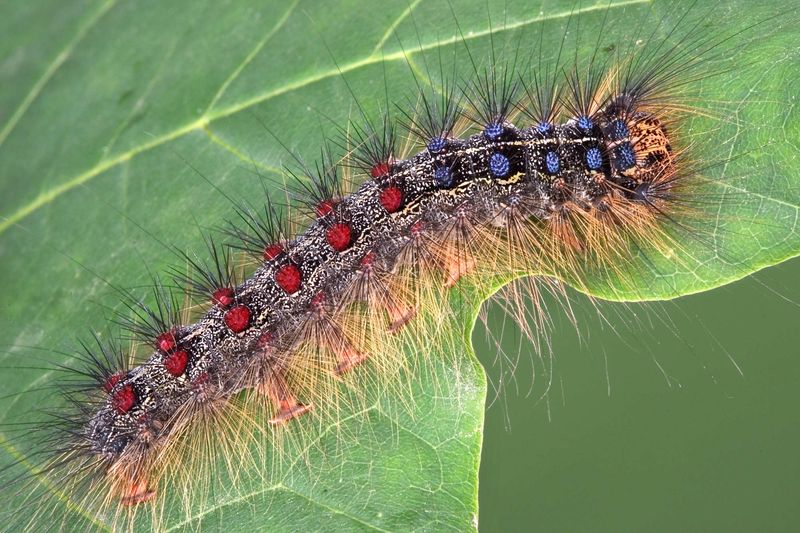
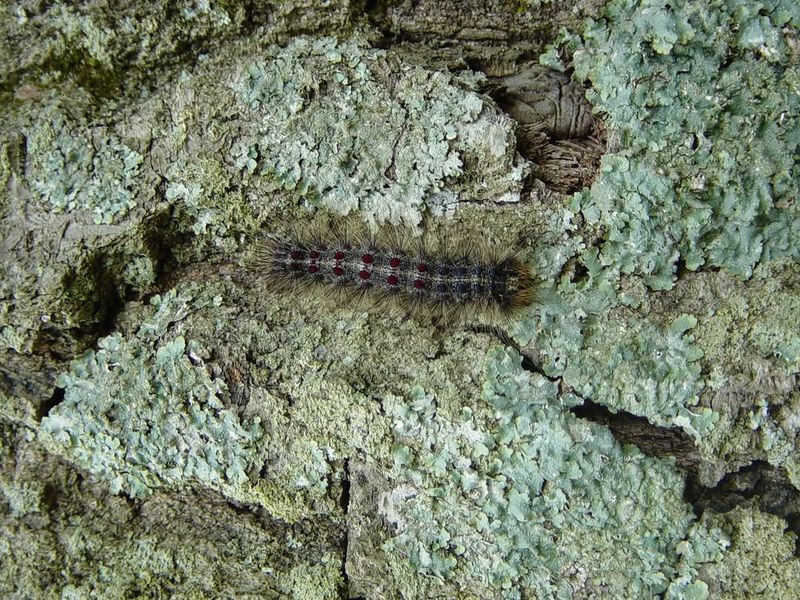
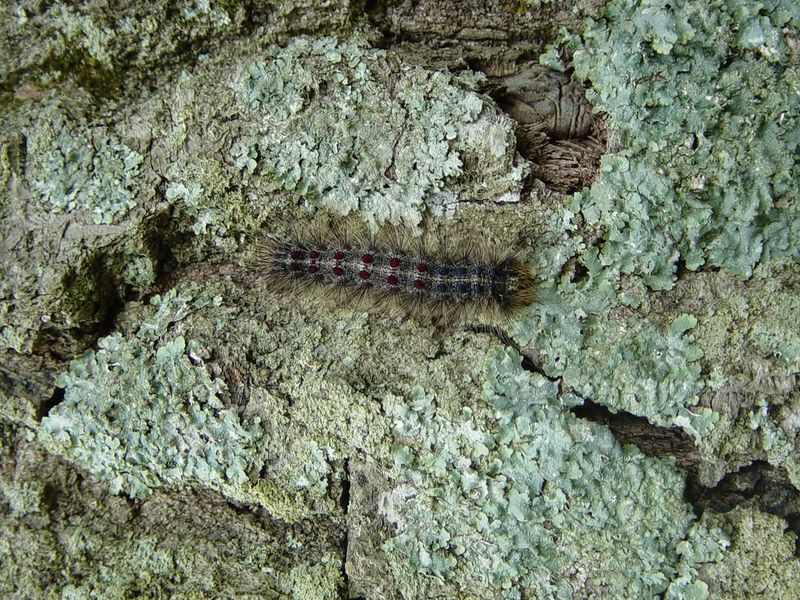
Mature caterpillars reach approximately 1.5 to 2.5 inches in length.
USDA APHIS describes their most recognizable feature: five pairs of blue spots near the head, followed by six pairs of red spots running down the back.
That color pattern is genuinely distinctive once you know to look for it.
Some homeowners confuse spongy moth caterpillars with eastern tent caterpillars, but a few clues separate them quickly.
Penn State Extension explains that eastern tent caterpillars build visible silk tents, usually in branch crotches, and lay smooth, dark egg masses wrapped around small twigs.
Spongy moth caterpillars do not build tents, and their egg masses are fuzzy and attached to bark, walls, or many other hard surfaces.
If you see a silky tent in your tree, that is a different pest entirely.
A Leafless Oak May Still Recover
Stepping outside in June to find your oak completely bare is alarming.
But a stripped tree is not automatically a dead tree, and understanding why matters before you make any decisions about removal or emergency treatment.
Pennsylvania DCNR is clear that spongy moth generally takes more than one year of defoliation before it kills a tree.
One severe season is a stress event, not a death sentence.
Healthy oaks can actually push out a second flush of leaves after early-season defoliation, drawing on stored energy reserves to replace what the caterpillars consumed.
That second flush is smaller and paler than normal spring growth, but it shows the tree is still fighting.
The danger compounds over time.
Repeated heavy defoliation across two or three consecutive seasons reduces the tree’s stored energy year after year, leaving less in reserve for the next spring.
Trees that are already dealing with drought, disease, poor soil, compacted roots, or other stressors have less to draw on from the start, which is why they face a higher mortality risk than a well-established oak growing in good conditions.
Forest Service research on oak growth recovery found that studied oaks took approximately two to three years to fully recover their wood volume growth after two consecutive years of defoliation.
That finding comes from studied oaks in specific conditions and should not be read as a guaranteed recovery schedule for every yard tree in Pennsylvania.
But it does suggest that a single bad season, while genuinely damaging, leaves room for recovery when the tree receives good follow-up care.
Watch for branch dieback, reduced canopy density over multiple seasons, and signs of secondary pest or disease problems as indicators that a tree is struggling beyond a normal recovery arc.
Those are the moments to call a certified arborist for a closer look.
Inspect Egg Masses Before Caterpillars Hatch
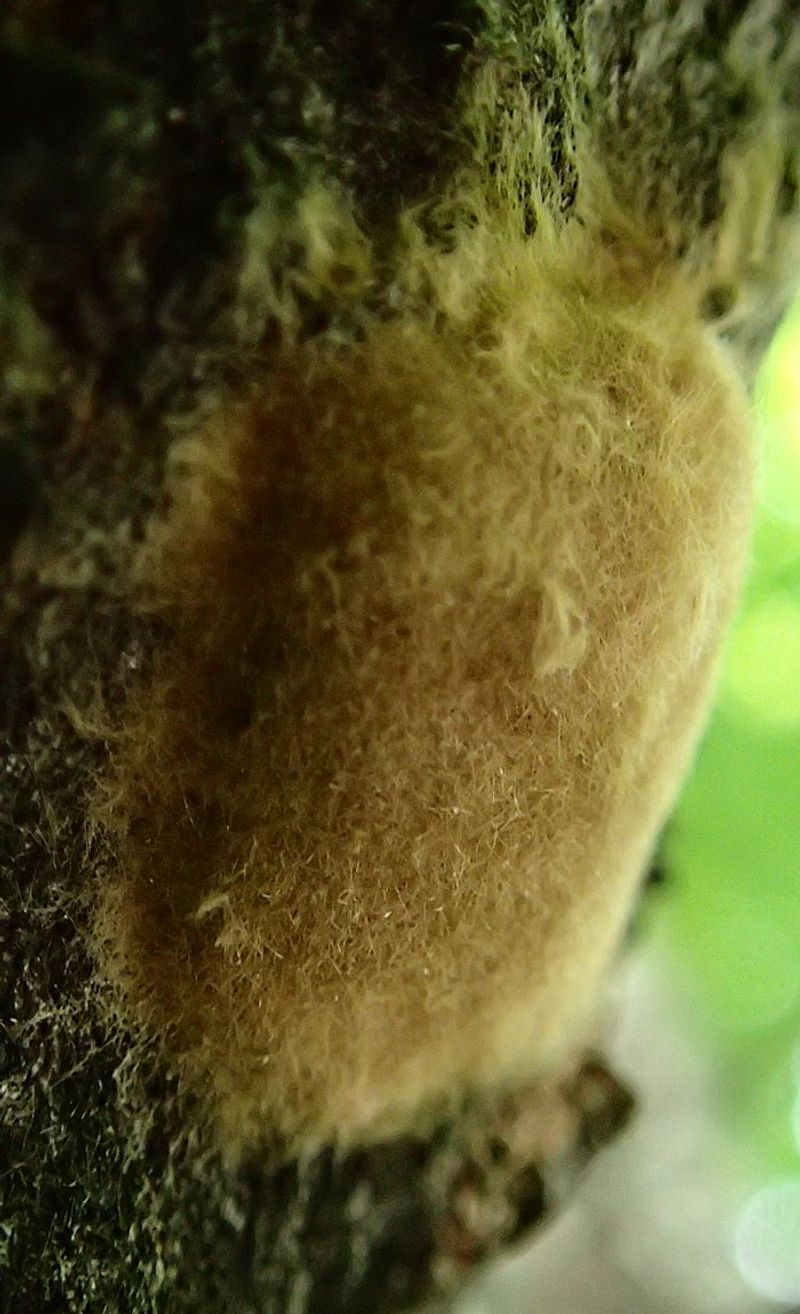
Late summer is actually the best time to get ahead of next year’s spongy moth problem, not spring when the caterpillars are already feeding.
Once you know what egg masses look like, a slow walk around your yard can tell you a lot about what is coming.
Check oak trunks and major branches first, working from the base up as high as you can safely see.
Then expand your search.
DCNR advises inspecting stone walls, fences, firewood stacks, sheds, patio furniture, lawn equipment, and any other outdoor surface where a female moth might have deposited a mass.
Females are not picky about location, and egg masses on a fence post or under a deck chair are just as viable as ones on bark.
For property owners managing woodlots or larger stands of oak, Penn State Extension’s egg mass surveying guidance offers approximate forest-stand thresholds as decision aids.
Roughly 500 to 750 egg masses per acre may signal a risk of noticeable defoliation.
Around 700 to 900 per acre may indicate a risk of growth loss.
At 1,000 to 1,400 per acre, mortality risk for some trees increases.
Penn State is explicit that these are flexible guides, not rigid rules, and recommends using lower thresholds for oak-heavy stands, stressed trees, or situations where the landowner wants to be cautious.
For a single yard oak, a street tree, or a specimen planting, do not try to apply a per-acre forest threshold to one tree.
The math does not translate directly.
Instead, combine your egg mass count with an honest look at canopy condition, tree size, site stress, and local pest pressure.
A certified arborist or your county’s Penn State Extension office can help you weigh those factors and decide whether treatment is actually warranted for your specific situation.
Use Safe Small-Scale Controls
For individual yard trees, a couple of low-cost physical controls can reduce the number of caterpillars that make it to your oak’s canopy each spring.
Neither one is a complete solution, but both are worth doing when egg mass numbers are manageable and your trees are accessible.
Scraping egg masses is the most direct approach.
DCNR recommends scraping masses into a sealed bag or container and destroying them during the late summer, fall, winter, or early spring window before hatching.
A putty knife or stiff brush works well on bark surfaces.
Always wear gloves and long sleeves during this work.
Spongy moth hairs and scales can irritate skin, and you do not want to find that out the hard way while crouched next to a tree trunk in March.
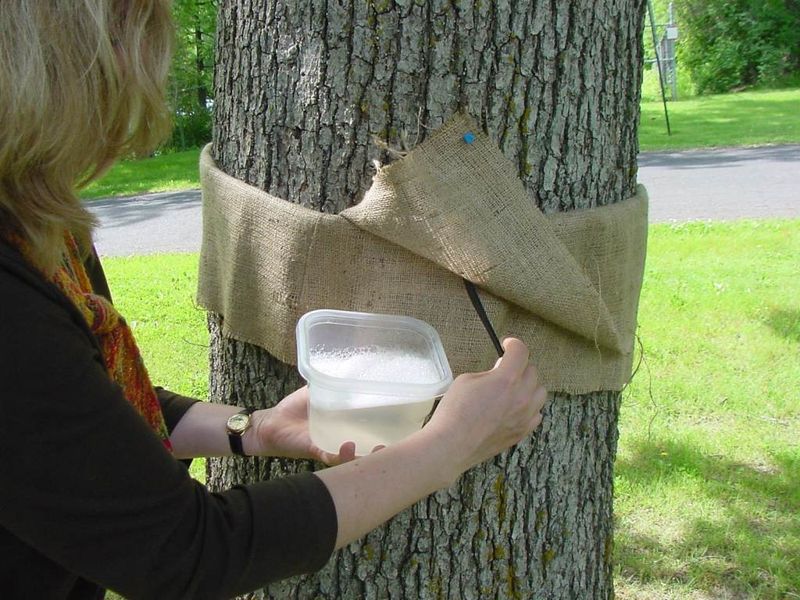
A burlap band wrapped around the trunk at chest height gives caterpillars a shaded hiding spot during the heat of the day.
Lift the band each afternoon and scrape the caterpillars gathered underneath into soapy water.
This daily routine can meaningfully reduce the number of larvae reaching the canopy on a single tree.
Know the limits of these methods before you count on them too heavily.
Scraping and burlap cannot protect a whole neighborhood, cannot reach egg masses high in a mature canopy, and will not stop caterpillars arriving from neighboring properties or nearby woods.
Forest Service research on spongy moth behavior confirms that caterpillars disperse readily, which is why physical controls work best as one layer of a broader management approach rather than a standalone fix.
Moving outdoor items can also spread the pest.
USDA APHIS advises buying local firewood, burning it where obtained, and inspecting trailers, patio furniture, and lawn equipment before moving them from an area with known spongy moth activity.
Egg masses are small and easy to overlook on a folded tarp or the underside of a wheelbarrow.
Treatment Timing Matters
Timing a treatment correctly can mean the difference between effective control and wasted effort.
By the time you notice widespread bare canopies across your neighborhood in late June or July, the caterpillars that caused the damage have already finished feeding and the window for that season’s suppression treatment has likely closed.
Pennsylvania DCNR notes that suppression treatments generally begin in spring, typically in May, when approximately half the caterpillars are in their second instar, a specific developmental stage when they are most susceptible to certain products.
The exact timing depends on the product being used, the site, and local pest development, so monitoring egg hatch in your own yard is more reliable than following a fixed calendar date.
Two products come up most often in Pennsylvania spongy moth management.
Bacillus thuringiensis subspecies kurstaki, commonly called Btk, is a microbial insecticide that targets caterpillars.
EPA considers registered Bt products acceptable when used according to their labels, and Btk is more selective than many broad-spectrum insecticides.
That said, it can affect other susceptible caterpillars, including non-pest moth and butterfly larvae, so it is not risk-free to every insect in your yard.
Tebufenozide is an insect growth regulator that works differently.
Both products have specific labels governing which trees, sites, application methods, and rates are permitted, and the label is legally controlling in every case.
For large trees, dense neighborhoods, or any situation requiring aerial application, a properly certified Pennsylvania pesticide professional is the right call.
Penn State Extension identifies Category 6 or Category 23 certification as relevant for pesticide applications to trees.
And one more thing worth knowing: Pennsylvania does not spray private land through DCNR’s state-forest program.
If your yard trees or woodlot need treatment, that arrangement falls to you, your municipality, or your homeowner association.
DCNR does note that drones are now being used to treat smaller woodlots and residential trees in some situations, which opens options that did not exist a few years ago.
Support the Tree and Check the Diagnosis
After a season of defoliation, your oak needs support more than it needs intervention.
Watering during prolonged dry stretches is the most practical thing you can do.
There is no single statewide rate that fits every Pennsylvania yard because soil type, tree size, recent rainfall, and your region all affect how much moisture the tree actually needs.
The goal is to keep the root zone from drying out completely during drought periods, particularly in summer when Pennsylvania can swing between heavy thunderstorms and stretches of two to three weeks with almost no rain.
Watering helps the tree rebuild energy reserves, but it does not cure an active infestation.
Think of it as keeping the patient strong while the real problem gets addressed through monitoring and, when warranted, treatment.
Call a certified arborist when defoliation repeats for a second season, when branches begin dying back, when the tree is large or particularly valuable, or when you are simply not sure what you are looking at.
Pennsylvania DCNR emphasizes that repeated defoliation over multiple years is what pushes mortality risk higher, so getting an accurate diagnosis early gives you more options.
Two other Pennsylvania oak threats sometimes get confused with spongy moth, and they deserve a clear separation.
Penn State Extension notes that spotted lanternfly has not been documented killing healthy, established ornamental trees and is primarily a nuisance pest in residential landscapes.
It is a real problem, but it is not the caterpillar causing the defoliation described in this article.
Oak wilt is something else entirely: a fungal disease, not an insect, that is a serious concern especially in western Pennsylvania.
Penn State Extension recommends pruning oaks only in winter to avoid attracting the beetles that spread oak wilt through fresh wounds during the growing season.
Keep that threat in its own category.
The sequence that actually works is simple: identify the pest correctly, inspect your trees and outdoor surfaces before caterpillars hatch, support the tree through stress, and act early when local pressure in your corner of Pennsylvania genuinely warrants it.
An oak that has weathered Pennsylvania winters for fifty years has more resilience than it looks like in a bare June canopy.