
Simple Yard Habits That Keep Painted Buntings Coming Back To North Carolina Every Year
Follow us on Google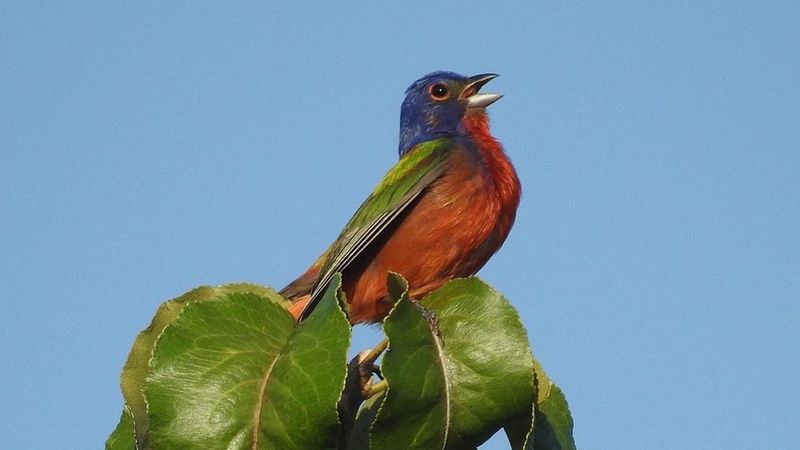
Spotting a male Painted Bunting in your yard is the kind of moment that stops you mid-step, coffee in hand, because nothing in North Carolina looks quite like that bird.
The good news is that the right yard habits can make your property a more useful stop during migration or breeding season, especially if you live along the coast or in eastern North Carolina.
No yard can guarantee a Painted Bunting every spring, but you can genuinely improve the odds by giving the bird what it already looks for.
North Carolina Is Not One Painted Bunting Habitat
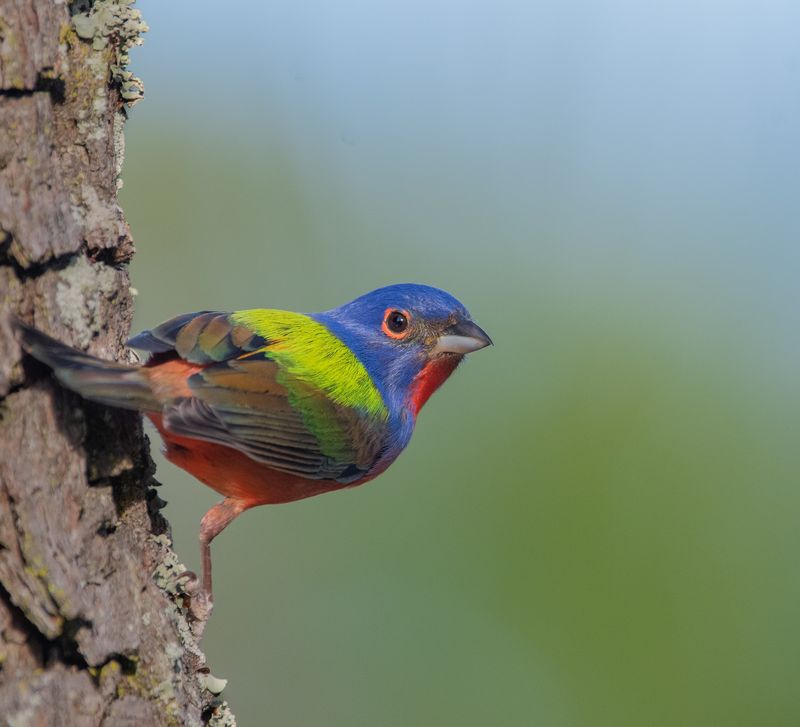
Most of North Carolina is beautiful bird country, but Painted Buntings do not spread themselves evenly across the state.
The eastern coastal population is the one most likely to pass through or nest near your yard, and the North Carolina Wildlife Action Plan places this bird in maritime forests and successional habitats along the eastern part of the state.
If you live near the Outer Banks, the Crystal Coast, or the broad coastal plain stretching inland from Wilmington, the advice in this article fits your landscape.
If you are in Asheville, Charlotte, or the Sandhills, a Painted Bunting is possible but much less likely.
The bird is listed as a special-concern species in North Carolina, meaning state numbers are low and have been declining.
That is not a reason to give up on habitat work.
It is a reason to be realistic about what your yard can accomplish.
USGS range research on the eastern Painted Bunting population confirms that breeding is concentrated along the coastal Southeast, which puts coastal North Carolina at the northern edge of that zone.
A single residential lot cannot create a full Painted Bunting territory.
Cornell Lab of Ornithology reports that males defend territories of roughly 3 acres, so your patch is one piece of a larger neighborhood puzzle.
What you can do is make your piece genuinely useful during migration or the breeding season, and then let the birds decide.
Think of it as contributing to a block-level habitat rather than building a private sanctuary.
Painted Buntings are also migratory, which means your yard is a seasonal address, not a year-round home.
The eastern population winters mainly in Florida and the northern Caribbean, arriving in eastern North Carolina for warm months before heading back south.
Setting that expectation early makes the whole project feel more honest and, honestly, more rewarding when a bird actually shows up.
Familiar Ground Can Bring An Adult Back
Here is where things get genuinely interesting.
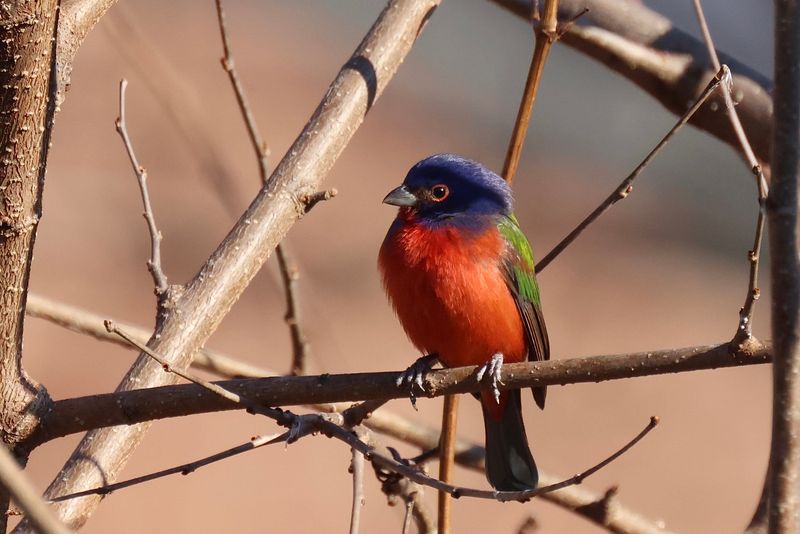
Adult Painted Buntings that survive migration often return to the same general area where they previously fed or nested, a behavior researchers call site fidelity.
A long-term study published in the Wilson Journal of Ornithology tracked banded birds over many seasons and found that 76 percent of 1,463 resighted banded birds were seen only at the same study site where they were first banded.
That is a striking number, and it tells you something real about the species.
What it does not tell you is that your feeder caused a bird to return.
Site fidelity describes where surviving adults tend to reappear, not why any particular yard drew them back.
The bird may have used a half-mile stretch of edge habitat that includes your property, your neighbor’s overgrown fence line, and a vacant lot down the road.
Your yard was part of the picture, not the whole canvas.
There is also an important distinction between an individual bird returning and the species showing up again.
Research on male Painted Bunting settlement found that returning males chose territories based on site familiarity and habitat quality together.
If a bird used your area before, kept its territory, and survived the winter, it may well come back to the same neighborhood.
But if it died, shifted territory, or was displaced by a dominant male, a different bird or no bird at all might appear the next season.
The practical takeaway is straightforward.
Keep the habitat useful every year, and you raise the chance that any bird familiar with your area will find it worth stopping at again.
You cannot control survival or migration, but you can control whether your yard still looks like a place worth visiting when a Painted Bunting comes through eastern North Carolina in spring.
Build A Managed Edge, Not A Wild Thicket

You drag your patio chair into the shade and look out at a yard that is either a flat lawn or a tangle of brush with no middle ground.
Neither one is what a Painted Bunting is looking for.
Cornell describes the species as favoring thickets, hedgerows, brushy edges, yards, fallow fields, and grasses or wildflowers, with open ground nearby for foraging.
The key word there is edge: a seam between low dense cover and open space.
A managed edge looks like a patch of native grasses and low forbs, maybe 6 to 10 feet wide, running along a fence line, the back of a garden bed, or the border of your property.
Keep the area beside it mowed or open so birds can feed on the ground and watch for predators.
Add a few low shrubs, such as a young wax myrtle or a blackberry cane, to give the edge some vertical texture.
A dead branch or a low fence post nearby serves as a perch where a bird can survey the area before dropping down to feed.
NC State Extension recommends layered plantings that move from ground level through herbaceous growth up to shrubs and canopy trees.
You do not need all five layers in a small yard.
Even two or three create the kind of structure that makes an edge feel safe and productive to a small bird.
Leave some seedheads standing through late summer and fall.
Painted Buntings forage on the ground for seeds, and a patch of grass that has gone to seed is a free buffet.
You can still mow a path through the middle or keep the patio side tidy.
NC State Extension notes that matching plants to your local light, soil moisture, and region matters far more than hitting a specific percentage of native species.
Work with what your yard actually supports, and shape the edge around the spaces your family uses every day.
Native Layers Keep Food And Cover Available
Choosing plants for Painted Bunting habitat is less about finding a magic attractor and more about building a pantry that stays stocked through the season.
NC State Extension’s native plants guidance recommends increasing plant diversity and matching species to your local soil, moisture, light, and region rather than chasing a required percentage of native coverage.
That is a forgiving starting point for most eastern North Carolina homeowners.
At the ground level, let some areas of bare or sparsely vegetated soil remain open near your edge patch.
Painted Buntings forage on the ground, so compacted grass-free spots are actually useful.
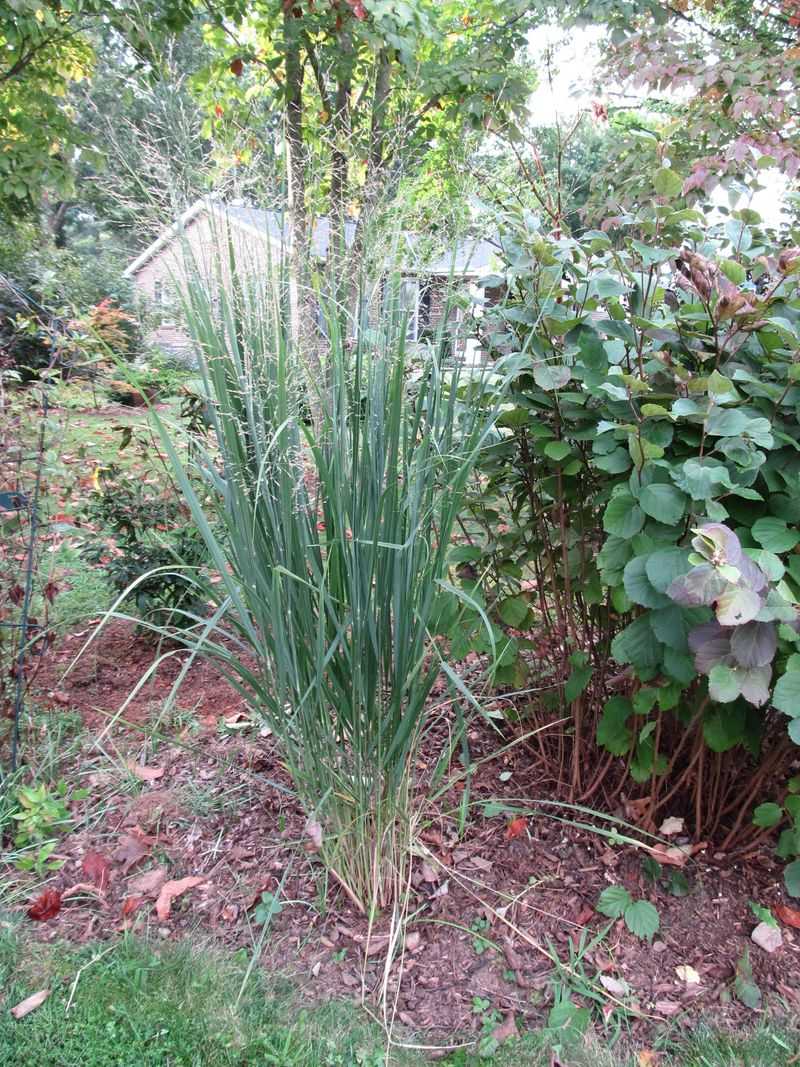
At the herbaceous layer, native grasses like switchgrass (Panicum virgatum) and river oats (Chasmanthium latifolium) produce seeds that support a wide range of birds and hold up through fall and winter.
NC State’s landscaping for wildlife publication identifies panicgrass, smartweed, and native sunflowers as valuable seed sources for North Carolina birds.
At the shrub layer, wax myrtle (Morella cerifera) is a coastal Carolina workhorse: it tolerates salt spray, grows fast, provides dense low cover, and produces berries that songbirds eat.
Elderberry (Sambucus canadensis) and blackberry (Rubus spp.) add fruit and insect habitat.
None of these plants come with a guarantee that a Painted Bunting will appear, but together they create the kind of layered, productive edge that the species uses when it is in the area.
River oats in particular are a solid choice for shaded or partly shaded edges in eastern North Carolina, where full-sun native grasses sometimes struggle under the canopy of live oaks or loblolly pines.
Think of native plants as building a neighborhood grocery store rather than setting a single trap.
The more variety you offer, the more useful your yard becomes across the whole season.
Insects Matter When Buntings Nest
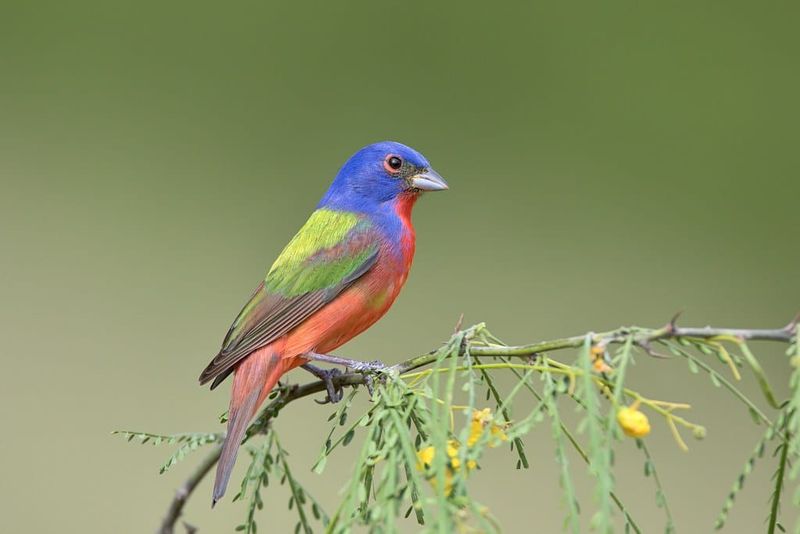
Seeds get most of the attention in Painted Bunting conversations, and that makes sense for migration stopovers and fall feeding.
But during breeding season, the diet shifts in a way that changes what your yard actually needs to offer.
Cornell Lab documents that breeding Painted Buntings eat substantially more insects, including grasshoppers, beetles, caterpillars, wasps, and flies, and feed insects almost exclusively to their nestlings.
A feeder full of millet cannot replace that.
The most practical thing you can do for nesting birds is preserve an insect-rich patch within your habitat edge.
That means resisting the urge to spray broad-spectrum pesticides across your native grass and shrub area.
Insecticides do not distinguish between a Japanese beetle you want gone and the caterpillar a bunting is about to feed its chick.
Targeted, need-based pest management around your patio, porch steps, or play area is reasonable.
Blanket treatment of the habitat patch works against the birds you are trying to attract.
NC State Extension’s wildlife landscaping guidance supports this approach by emphasizing that native plants host more insect species than non-natives, which in turn supports insectivorous birds.
A wax myrtle or a stand of native sunflowers does double duty: it produces seeds and hosts the insects that nesting birds need.
One honest note: this habitat approach does not come with a demonstrated promise of fewer ticks or mosquitoes in your yard.
The evidence here supports bird habitat and food supply, not measurable household pest reduction.
If you want to manage mosquitoes, a separate targeted strategy around standing water and breeding sites is the more direct path.
Keeping the habitat patch for birds and managing pest pressure around family-use spaces separately is a reasonable way to serve both goals at once.
Feed On The Ground Without Creating Trouble
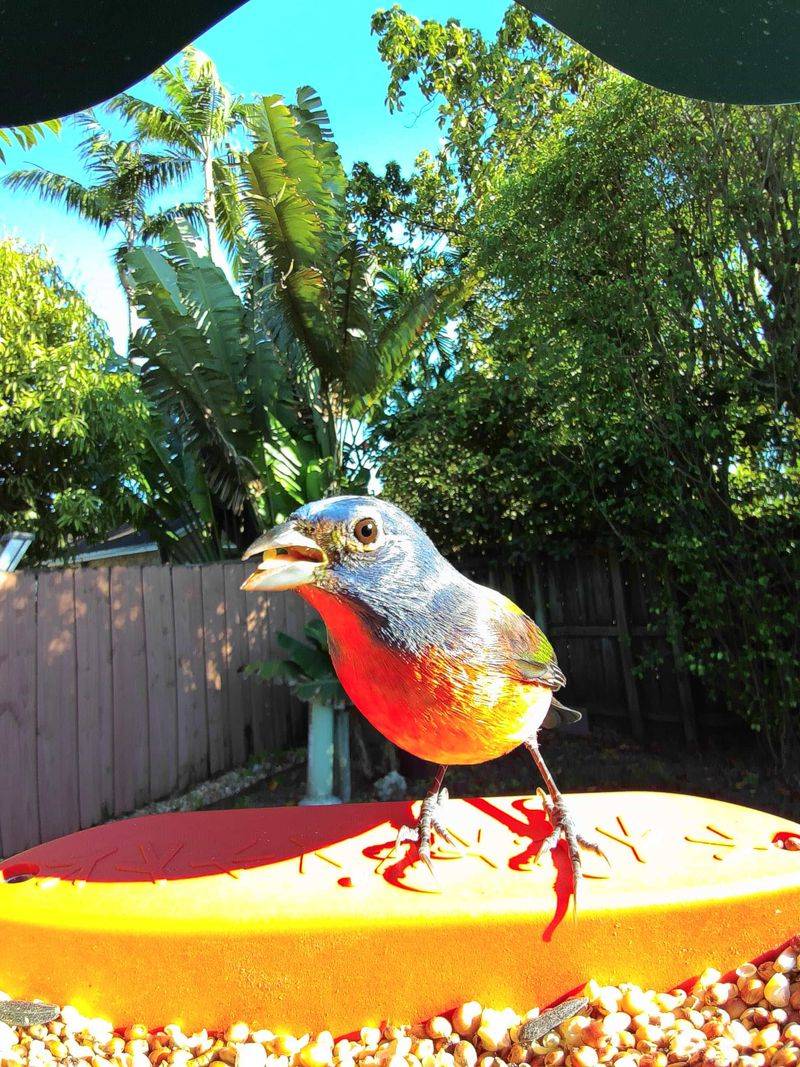
Supplemental feeding works best as one layer added on top of good habitat, not a shortcut around it.
Painted Buntings are ground foragers by nature, and a low platform feeder or a simple ground-feeding station fits that behavior far better than a hanging tube feeder that requires a bird to cling sideways to reach the seed.
NC State Extension recommends white millet as a preferred seed and specifically suggests spreading it on the ground beneath shrubs, in brush piles, or under above-ground feeders, which is exactly the kind of spot a Painted Bunting would choose on its own.
White proso millet is the most defensible seed choice for this species.
A long-term Painted Bunting research program used untreated white proso millet at feeder stations to attract and track birds across multiple seasons.
That tells you the seed can work in a research context.
It does not mean white millet outperforms every other food in every eastern Carolina yard, so treat it as a reasonable starting point rather than a guaranteed draw.
Placement involves a genuine tradeoff.
NC State Extension guidance suggests keeping feeders within about 10 feet of brush or shrubby vegetation so birds can reach escape cover quickly if a hawk appears.
That same shrub, though, can give a stalking cat a concealed approach to the feeder.
Take a look at your specific setup before deciding.
If the nearest cover is a dense evergreen shrub that a cat could crouch behind unseen, move the feeder out a few feet or trim the lower branches to remove the hiding spot.
A platform feeder set low to the ground, maybe 6 to 18 inches high, with a clear sightline in at least two directions, gives feeding birds a chance to spot trouble before it arrives.
Keep portions small enough that seed does not sit out for more than a day or two, especially during North Carolina’s humid summer months when millet can clump and mold quickly.
Safe Feeding Requires Clean Stations And Clear Glass
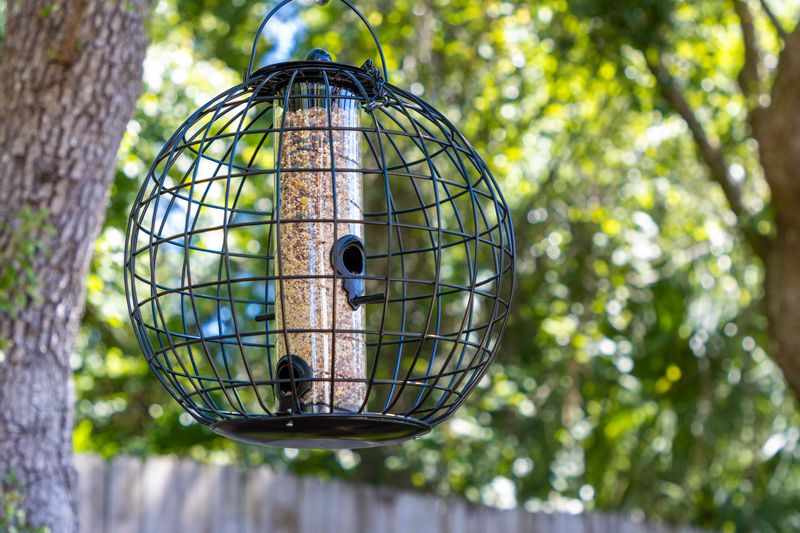
A feeder that attracts birds can also concentrate disease if you let it go.
NC State Extension recommends cleaning and disinfecting feeders at least every 2 weeks, raking up discarded seed and hulls weekly, and never offering seed that is wet, musty, moldy, or visibly contaminated.
In coastal North Carolina, where summer humidity stays high and afternoon thunderstorms are a near-daily event from June through September, that two-week schedule can become a weekly job during the wettest stretches.
If you notice a bird at your feeder that looks puffed up, lethargic, or otherwise unwell, take the feeder down right away.
Project FeederWatch recommends removing the feeder being used for a couple of weeks, then cleaning both the feeder and the surrounding ground area thoroughly before putting it back up.
This gives any concentrated birds a chance to disperse and reduces the risk of spreading whatever illness appeared.
Do not try to handle or treat a sick wild bird on your own.
Window strikes are a separate problem that a clean feeder alone cannot solve.
Cornell recommends placing feeders either within 3 feet of a window or more than 30 feet away.
The dangerous middle zone, roughly 4 to 30 feet from glass, gives a startled bird enough room to build speed before hitting the window.
A single owl decal stuck to the center of a pane does not fix this.
Cornell’s window-strike guidance is clear that markings need to cover the exterior surface with closely spaced patterns, or you can use screens, window films, or other tested deterrents to break up the reflection.
One more guardrail worth knowing: if you spot a nest in the shrubs near your feeder, leave the surrounding vegetation alone.
Active nests, eggs, and dependent young are protected under federal law, and pruning, moving, or removing vegetation around an active nest is not a decision to make on your own.
Wait until the nest is empty and the young have fledged, then reach out to a qualified wildlife resource if you need guidance on what comes next.
Let The Season Set A Realistic Promise
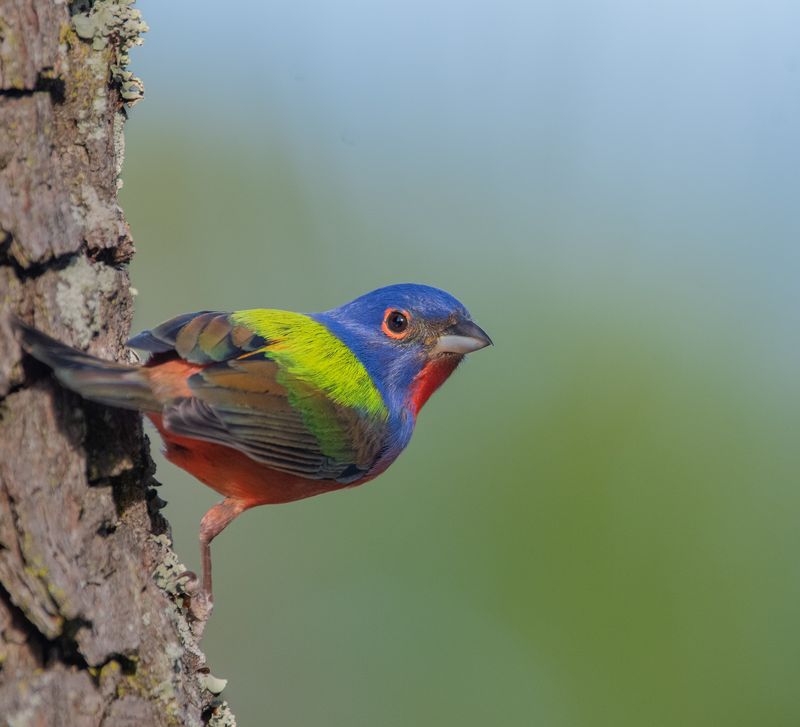
Treat this whole project as a seasonal experiment rather than an annual contract with a particular bird.
Painted Buntings are migratory, arriving in eastern North Carolina for warm months and heading back to Florida and the northern Caribbean each fall.
Your yard is a seasonal address for them, and some seasons it will be used and some it will not.
An individual bird may not return because it died over winter, because another male claimed the territory, because nearby habitat changed, or because the patch simply did not meet its needs as well as somewhere else did.
The long-term site-fidelity research shows strong tendencies among surviving adults, but survival itself is never guaranteed.
That is not a failure of your habitat work.
North Carolina’s Wildlife Action Plan documents that Painted Bunting numbers in the state are low and have declined over time.
That context matters.
Building a managed edge, preserving insect habitat, keeping a clean feeder placed thoughtfully, and leaving seedheads standing through fall are all steps that make your yard more useful to the species whenever one is in range.
You are contributing to a neighborhood-scale habitat, not running a private reserve.
Success, honestly defined, is a yard that could support a Painted Bunting visit during migration or breeding season, year after year, whether or not a particular bird shows up to accept the invitation.
A yard that hums with insects, holds native seed through late summer, and offers clean food beside decent cover is doing its job even on the quiet years.