
One Tomato Plant Can Grow A Second Crop Of Potatoes Under The Soil, And Here Is How Grafting Does It
Follow us on Google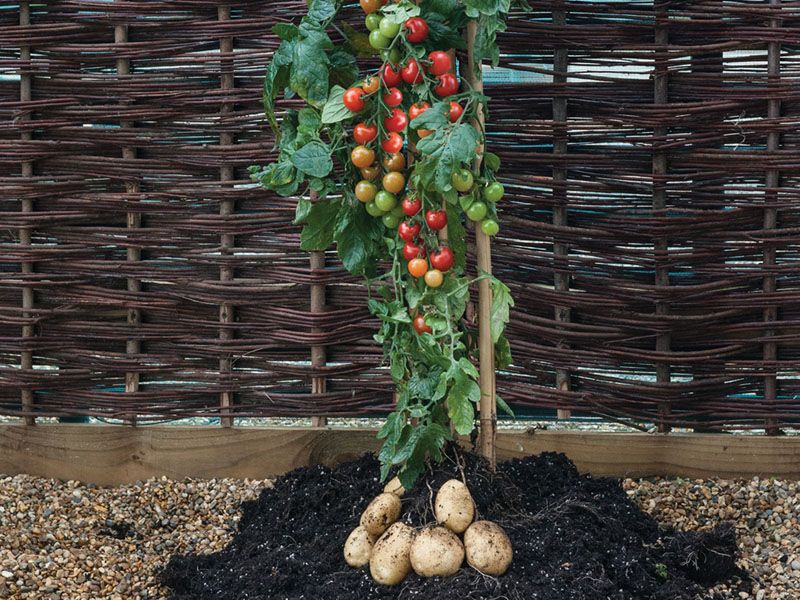
Somewhere between a garden hack and a biology experiment, the idea of harvesting tomatoes above ground and potatoes below from a single plant has been quietly circulating among curious home growers for years.
The headline makes it sound automatic, but the real story requires one extra step that most people skip: you have to graft a tomato onto a separate potato plant to make it work.
That grafted composite, sometimes called a pomato or tomtato, is a genuinely interesting project, though it comes with honest limits worth knowing before you reach for a knife.
Here is what the science actually says and how to try it yourself.
A Grafted Plant Can Produce Both Crops
The headline deserves a quick correction before anything else.
An ordinary tomato plant does not sprout potatoes on its own, no matter how rich the soil or how long you wait.
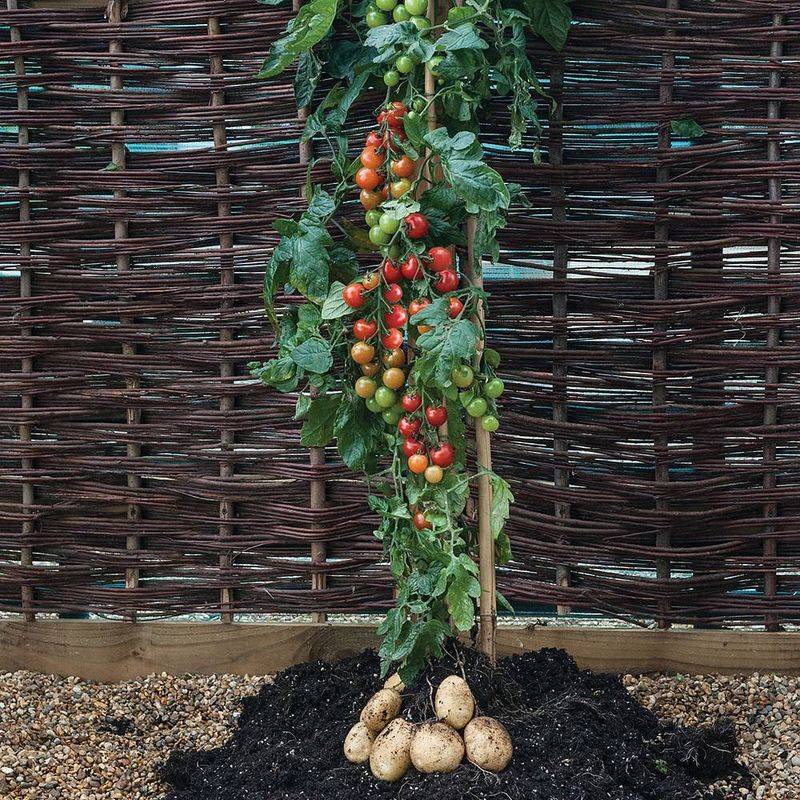
What actually makes this work is grafting a tomato scion, the fruiting upper portion, onto a potato rootstock, the lower stem and roots of a separate potato plant.
If that graft heals correctly, you end up with one composite plant that can produce tomato fruit aboveground while the potato portion forms underground tubers.
Both plants belong to the nightshade family, Solanaceae.
Tomato is Solanum lycopersicum and potato is Solanum tuberosum, and their close relationship is part of why the graft can take at all.
But the result is not a new species or a genetic hybrid.
The tomato fruit remains tomato fruit, and the potato tubers remain potato tubers.
No DNA gets combined.
The University of Minnesota’s horticulture text specifically identifies tomato-on-potato approach grafting as a way to produce tomatoes above and potato tubers below, while making clear that grafting joins two genotypes into one functioning plant without merging their genetics.
Think of it as a living relay race.
The potato team handles the underground leg, building roots and tubers, while the tomato team runs the aboveground leg, climbing toward the sun and setting fruit.
They share the same stem but keep their own identities.
Frame this as an interesting space-saving experiment rather than a dependable double harvest.
A 2024 study published in the Bhutanese Journal of Agriculture confirmed that grafted plants can produce both crops, yet also found that some grafted combinations yielded less of each crop than non-grafted controls grown separately.
Success depends on compatible plant material, graft healing, growing conditions, and how much root and canopy space the plant receives.
A Compatible Union Must Reconnect Its Living Tissues
Grafting is not gluing two sticks together and hoping for the best.
What you are really doing is asking two plants to rebuild their plumbing across a wound.
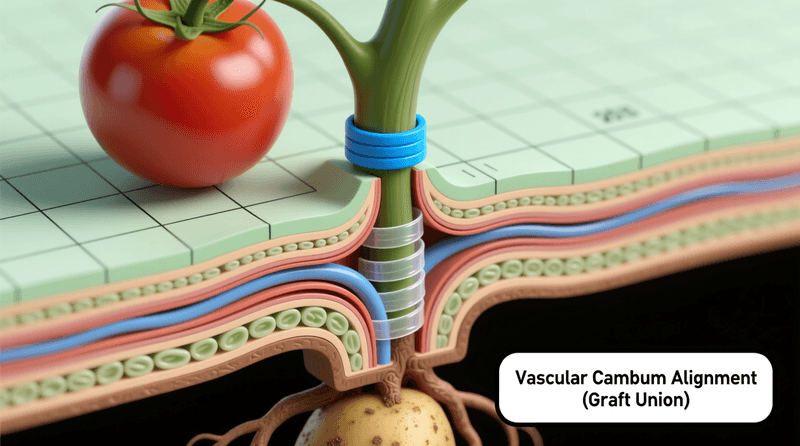
Under the outer bark of each stem runs a thin ring of living tissue called the cambium.
When you cut two stems and press those cambial layers together, the plants can form a callus, a mass of new cells that gradually knits the two sides into a single vascular system.
Once that connection forms, water, minerals, and sugars can move freely from the potato roots up through the union and into the tomato canopy, and carbohydrates made by the tomato leaves can travel back down to feed the developing tubers.
Family membership in Solanaceae gives tomato and potato a head start on compatibility, but it does not guarantee a successful union.
Think of it less like a password and more like a handshake that still has to be firm enough to hold.
Cultivar selection, the cleanliness of the cut, how tightly the surfaces are held together, and the conditions during healing all affect whether the union actually survives and goes on to support useful growth.
Graft compatibility research on interspecific tomato-potato combinations shows that survival and yield differ meaningfully among cultivar pairings and grafting methods.
Some combinations take well, others fail at the union stage, and a few survive but never produce strong growth from both parts.
Checking compatibility before committing to a full season is worth the extra planning, and starting with more than one grafted plant gives you a realistic chance of getting at least one that holds.
Choose Healthy Plants With Matching Stems
Before any cutting begins, the plants themselves need to be in good shape.
A stressed, wilted, or disease-spotted seedling makes a poor candidate for grafting because it is already spending its energy on survival rather than healing.
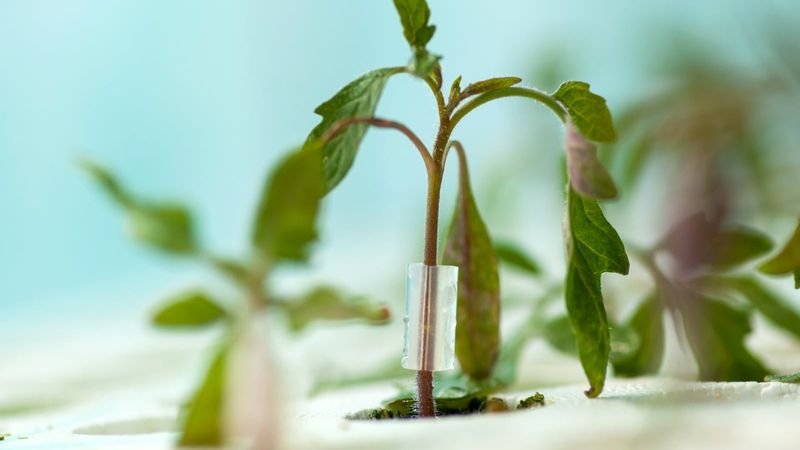
Choose a tomato plant and a potato plant that both look vigorous, with sturdy green stems, healthy leaves, and roots that fill the pot without being severely root-bound.
Stem diameter is where most first-time grafters run into trouble.
Purdue University Extension’s tomato grafting guidance recommends stems at least about 1.5 millimeters thick as a general starting point for clean, workable cuts.
That figure comes from tomato-on-tomato grafting experience, so treat it as useful orientation rather than a hard rule for tomato-on-potato work.
What matters most is that the two stems you plan to join are close to the same diameter, because matching cut surfaces are far easier to align and hold together than mismatched ones.
Your tool list is short but non-negotiable.
Use a fresh single-edge razor blade or a grafting knife that you disinfect between cuts with rubbing alcohol or a dilute bleach solution.
A contaminated blade is one of the fastest ways to spread bacterial or fungal pathogens between two plants that are about to share a vascular system.
Pick up a small pack of silicone grafting clips sized for your stem diameter, they hold the union snugly without the crushing pressure that tape or tight wire can cause.
Set both potted plants side by side on a clean, stable work surface before you make any cuts.
Having everything within arm’s reach matters because the exposed cambial tissue begins to dry out within seconds, and fumbling for a clip while the cut surfaces are open works against you.
Use an Approach Graft While Both Plants Stay Rooted
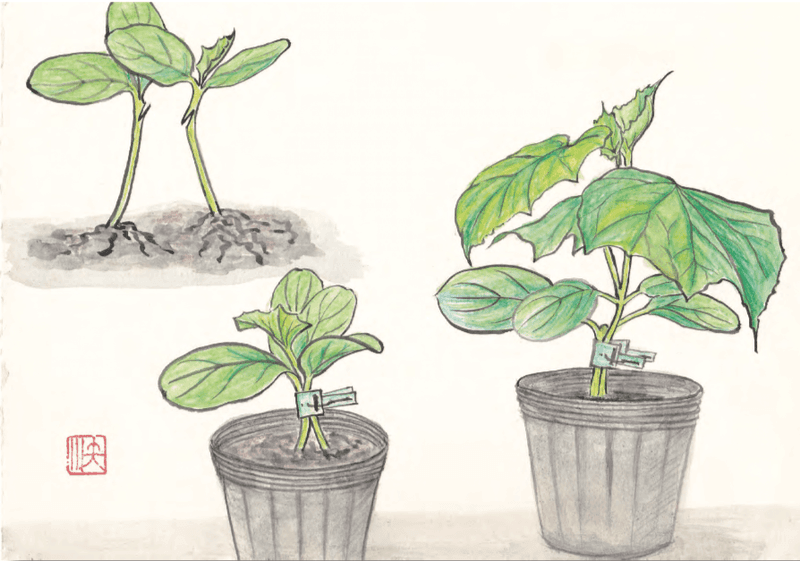
Among the grafting methods available, the approach graft is the most forgiving option for a home experiment.
Both plants stay rooted in their own pots throughout the healing period, so neither one is entirely dependent on the union while it forms.
That independence is a real safety net for beginners.
Position the two pots close enough that the stems can touch at roughly the same height without bending sharply.
Use a clean, disinfected blade to remove a shallow, matching strip of bark and outer tissue from each stem at the contact point.
The exposed area on each stem should be about the same length and shape so the surfaces fit flush against each other.
Press the two exposed areas firmly together so the cambial layers, the thin green rings just under the outer bark, line up as closely as possible.
Slide a grafting clip over the union to hold the contact without crushing the tissue.
The University of Minnesota’s horticulture resource identifies this approach-graft method specifically as the way to produce tomatoes aboveground and potato tubers belowground from one composite plant.
Leave both plants rooted for at least two to three weeks while the union heals.
Watch for the tomato side to remain turgid and continue growing, which is a reasonable sign that the connection is forming.
Once you are confident the union has taken, you can gradually cut away the tomato roots and sever the upper potato shoot over several days rather than all at once.
A gradual transition lets each part adjust to its new role without the shock of a sudden cutoff.
Splice grafting and cleft grafting are two other options, but both are more demanding when the potato stem and tomato stem differ in size.
Purdue’s grafting guide describes matching angled cuts and full surface contact as essential for those methods, along with a clip that holds the union without distorting either stem.
For a first attempt, the approach graft’s built-in backup of two independent root systems is worth the extra pot space.
Treat Healing Conditions As Starting Guidance
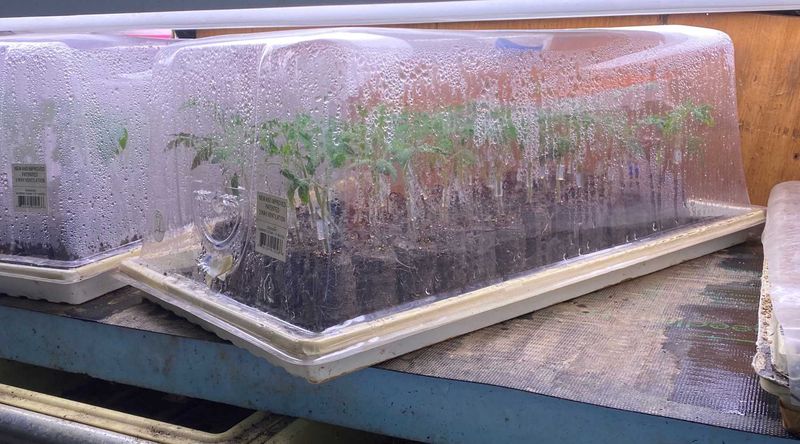
Making the cut is only half the job.
The healing period that follows is where most casual attempts quietly fall apart, and managing it well separates a graft that takes from one that dries out and dies within a day or two.
Purdue University Extension’s tomato grafting guidance recommends keeping newly grafted plants at roughly 72 to 85 degrees Fahrenheit and 85 to 95 percent relative humidity for the first 48 to 72 hours, with reduced light and very little air movement.
Those figures come from standard tomato-on-tomato grafting experience and serve as a useful starting point, not a validated formula for tomato-on-potato combinations.
Use them as orientation and then watch the plant closely for signs of wilting, condensation buildup, or heat stress.
A simple humidity tent made from a clear plastic bag supported by stakes works well for small pots, but keep an eye on the temperature inside.
On a warm day, a sealed bag in a sunny window can climb well above 100 degrees Fahrenheit fast, and that kind of heat will damage the union rather than help it.
Place a small thermometer and a hygrometer inside if you have them, and crack the bag slightly if condensation is pooling on the leaves.
After the first two to three days, begin transitioning slowly.
Lower the humidity a little each day, introduce more light gradually, and allow gentle air movement over approximately four to eight more days.
Sudden exposure to dry air or direct strong sun after a humid, low-light healing period can cause severe wilting even in a graft that was forming well.
Think of it the way you would harden off a seedling: steady, incremental steps rather than a single dramatic change.
A compatible graft may also show signs of struggle even under good conditions, so monitor wilting, leaf color, and stem firmness daily rather than assuming the setup is doing its job unattended.
Keep the Union Above Soil and Give Tubers Room
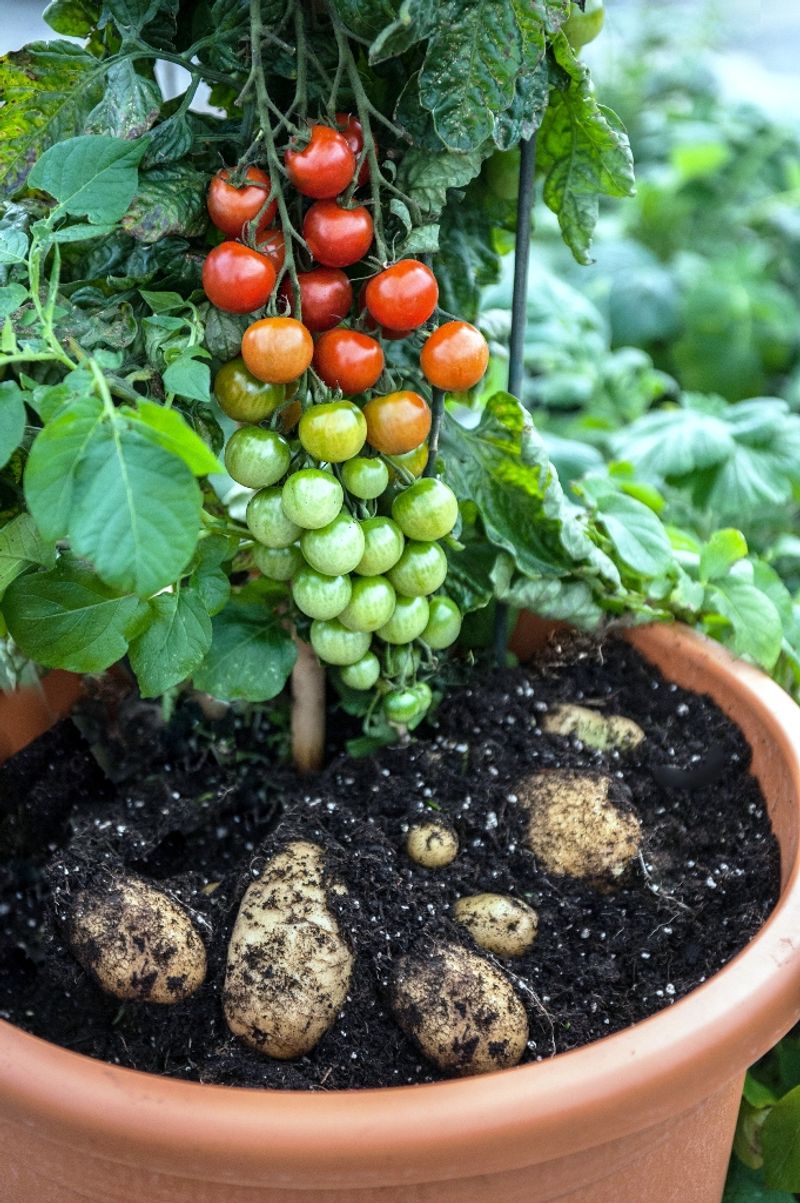
Transplanting a grafted composite plant is not the same as transplanting a regular tomato, and the most common mistake is treating it like one.
Many gardeners know that burying a tomato stem deeply encourages the plant to root along the buried section, giving it a stronger foundation.
With a grafted plant, that advice becomes a problem.
If tomato tissue touches moist soil above the union, it can develop its own roots, effectively bypassing the potato rootstock and turning your carefully built composite back into a plain tomato plant underground.
Keep the graft union several inches above the soil surface at all times.
When you set the plant in its container or bed, position it so the union stays clearly visible and dry.
As the potato side grows, you will need to hill soil up around the base to cover developing tubers and protect them from sunlight, but stop well below the union.
Also watch for shoots emerging from the potato rootstock below the union and remove them promptly.
Those shoots want to become a separate potato plant, and leaving them draws energy away from both the tomato canopy and the tubers you are trying to develop.
The potato root zone needs loose, well-drained soil and enough volume to form tubers comfortably.
University of Minnesota Extension guidance on growing potatoes notes that seed pieces are typically planted about 3 to 5 inches deep with roughly 10 to 12 inches of spacing, and that plants benefit from about 1 inch of water per week during active growth, adjusted for rainfall and soil type.
Those figures describe standard seed-piece planting, not a formula for positioning a grafted transplant, but they give you a sense of the root zone and tuber space the potato side needs to perform.
Above ground, the tomato canopy will need a sturdy cage or stake.
Purdue’s grafting guidance emphasizes that the union and upper stem need support as the plant grows heavier with fruit.
Plan for both vertical support and adequate airflow around the canopy to reduce disease pressure.
Oregon State University Extension advises transplanting tomatoes outdoors only after local frost danger has passed and soil temperatures have warmed.
That timing varies widely across the United States, so check your local conditions rather than relying on a national date.
Two Possible Crops Do Not Equal Two Full Harvests
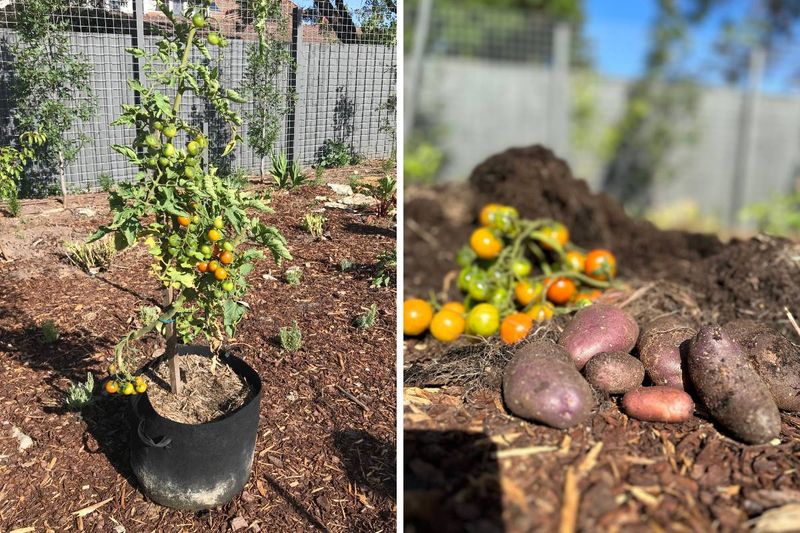
Here is where the headline’s promise needs the most honest handling.
Tomato fruit and potato tubers both draw heavily on the same pool of carbohydrates, water, and nutrients the plant produces.
When one side is pushing hard, the other side often gets less.
That tradeoff is real, and it shapes what you can realistically expect from one grafted plant.
The 2024 Bhutanese Journal of Agriculture study on grafting tomato onto potato found that the best tomato-producing grafted treatment yielded about 4.07 metric tons per hectare, compared with 11.05 metric tons per hectare for non-grafted tomato grown separately.
The best potato-producing grafted treatment yielded about 1.00 metric ton per hectare, compared with 1.44 metric tons per hectare for non-grafted potato.
The study also observed a negative relationship between tomato yield and potato yield within the grafted plants, though it was not statistically significant in that particular experiment.
Those results came from specific cultivars and controlled conditions in Bhutan, so they are not a home-garden yield forecast for every backyard in the United States.
They do tell you, plainly, that both crops can form and that some grafted combinations produce less of each than separate plants do.
Space is the other honest conversation to have.
One grafted plant occupies one planting position, but the potato root zone needs soil volume and tuber room to develop well, the tomato canopy needs vertical support and airflow, and both need practical growing space above and below ground.
Standard potato growing guidance from the University of Minnesota points to spacing and root-zone needs that go well beyond a single square foot of surface area.
A plant can sit in a one-square-foot spot in the bed while still needing a large container, a deep root zone, and a trellis overhead.
The honest summary is this: one grafted composite plant can produce tomatoes aboveground and potatoes belowground, and that is a genuinely cool outcome.
But it is not a reliable replacement for two separate plants, and it will not hand you two full harvests from a tiny corner of the yard every season.
Harvest Tomatoes and Potatoes Safely
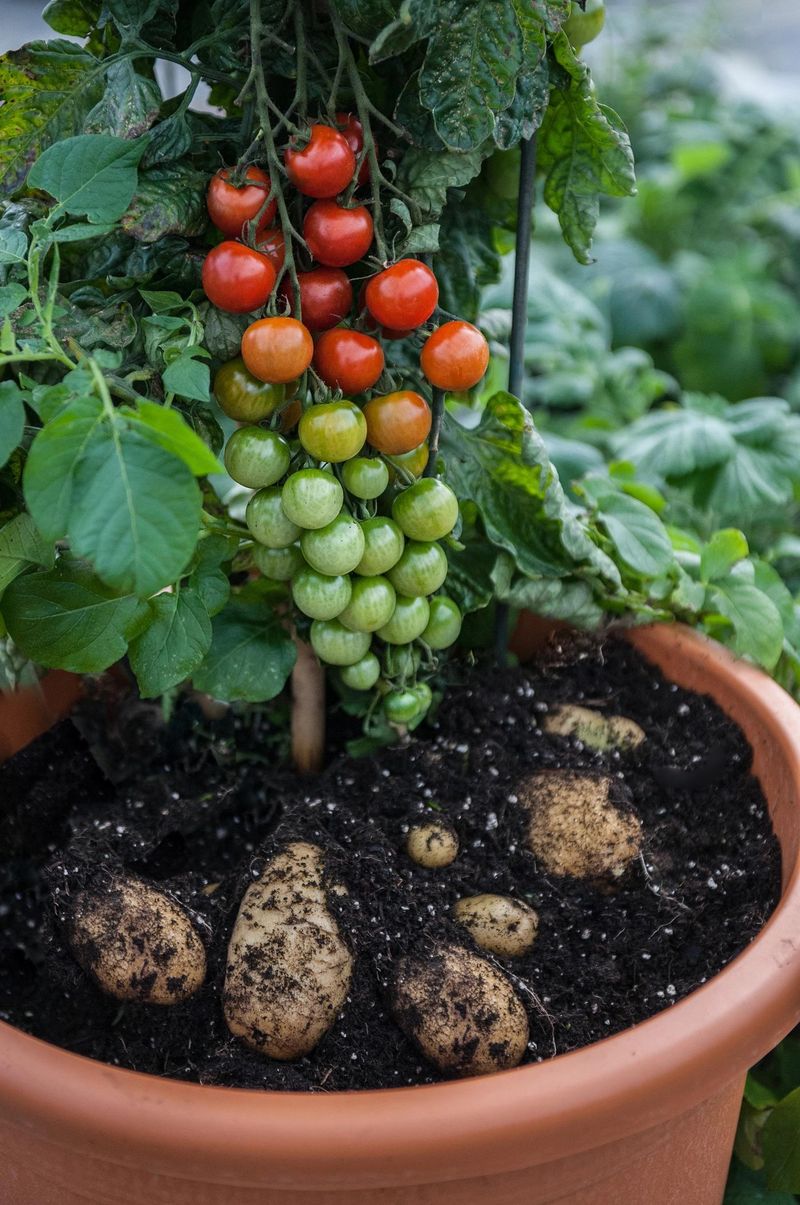
Harvest day on a grafted composite plant comes with one identification task that matters for food safety.
The tomatoes growing on the upper vine are exactly what they look like, edible tomato fruit ready when they ripen to their full color and give slightly to gentle pressure.
The potato tubers form underground on the rootstock side and are ready when the tomato vines begin to yellow and die back, which is the same timing cue you would use for a standalone potato crop.
The part that trips people up is the potato berry.
Potato plants occasionally produce small, round, tomato-like fruits on their stems aboveground.
Iowa State University Extension warns that these berries contain solanine, a poisonous alkaloid, and should never be eaten.
On a grafted plant where a tomato vine is growing right alongside potato stems, that distinction becomes especially important.
If a small round green fruit appears on the potato side of the union rather than the tomato side, leave it alone.
Penn State Extension also cautions that green potato tubers, or tubers that taste strongly bitter, should not be eaten.
Greening happens when tubers are exposed to sunlight and is associated with elevated levels of solanine and chaconine.
Keep developing tubers well covered with soil or mulch, and discard any that have turned noticeably green.
One more practical note: tomatoes and potatoes share several common pests and diseases precisely because they are closely related.
Growing them together on one plant does not create any protection against those shared threats.
University of Minnesota Extension recommends rotating nightshade crops out of the same soil each season to reduce disease buildup, and that advice still applies here.
For most home gardeners after a reliable harvest, Penn State Extension notes that tomato grafting delivers the clearest benefits when a specific stress, like soilborne disease, poor soil, or salinity, is limiting production.
Separate tomato and potato plants usually offer more predictable results in an ordinary backyard.
The grafted composite is best understood as a hands-on curiosity, the kind of experiment that teaches you something real about how plants work, even when the harvest is modest.