
More Praying Mantises In Your North Carolina Garden Means More Pressure On Summer Pest Insects
Follow us on Google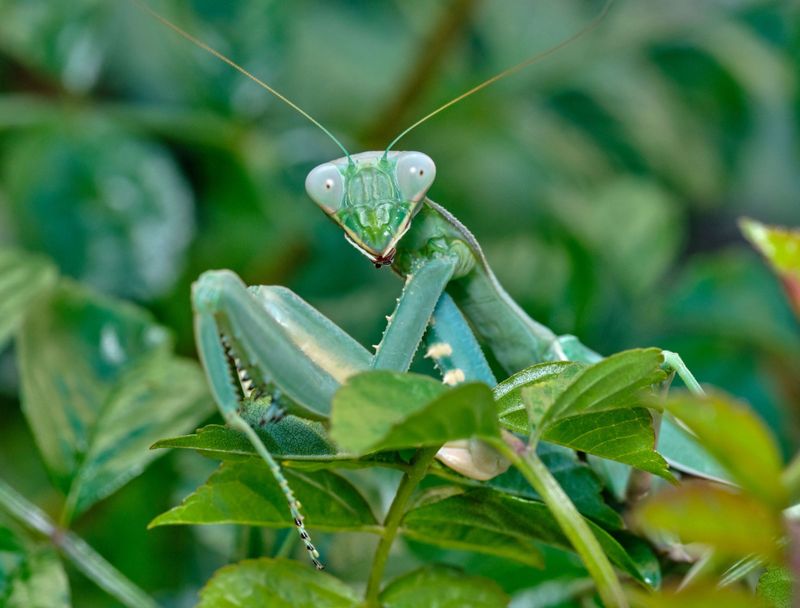
Spot a praying mantis on your tomato cage on a muggy North Carolina evening and it is hard not to feel like the garden just hired its own security guard.
That feeling makes sense, but the story is more complicated than it looks.
Mantises are real predators, but what they actually hunt and how much pressure they put on summer pests might surprise you.
Understanding what a backyard mantis can and cannot do helps you make smarter choices for your yard, your family, and the other wildlife sharing your outdoor space.
What a Mantis Actually Hunts
Picture this: you are watering the pepper bed around dusk, and there it is, a praying mantis locked perfectly still on a tomato stake, front legs folded like it is waiting for something.
It is.
Mantises are ambush hunters.
They do not patrol rows of squash looking for squash bugs the way a gardener might.
They pick a perch, hold position, and strike the moment a suitable insect wanders close enough to grab.
That hunting style is worth understanding before you decide what a mantis is doing for your garden.
NC State Extension’s guidance on biological pest control is direct about this: mantises do not seek out common garden pests such as aphids, caterpillars, and thrips.
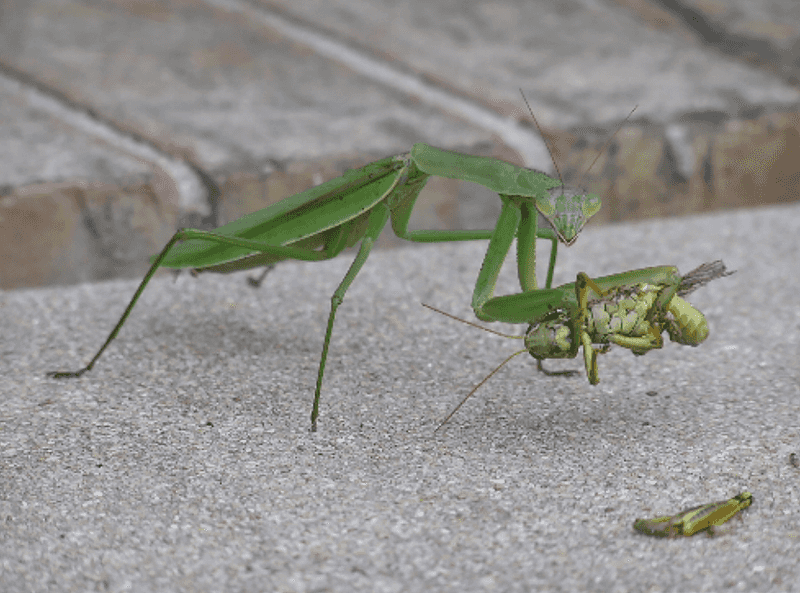
They eat what comes to them, and that list is long.
Flies, grasshoppers, moths, crickets, caterpillars, spiders, bees, butterflies, and wasps are all fair game.
The Chinese mantid factsheet from NC State notes that larger mantises can reach roughly three to four and a third inches in length, which means they are capable of taking down prey that a smaller predator could not handle.
But size does not equal focus.
A mantis that catches a cucumber beetle one afternoon might catch a honeybee the next morning, depending entirely on which insect happens to wander within range.
UC IPM’s overview of mantids describes them as generalist predators, which is the key phrase here.
Generalist means the mantis is not on your side or the pest’s side.
It is simply hunting whatever moves.
That is genuinely fascinating to watch, but it is not the same thing as targeted pest control.
More Mantises Do Not Prove Fewer Pests
Here is where it gets tricky.
If you notice more mantises than usual around your Piedmont garden this summer, the most natural conclusion is that they are eating down your pest population.
The ecology actually suggests the opposite may be closer to the truth.
More mantises most likely means more food.
A yard with abundant insects, good cover, and plenty of stems and shrubs for perching can support a larger mantis population simply because there is enough prey to go around.
The mantises did not cause fewer pests.
The pests, in part, supported more mantises.
That is a meaningful distinction, and NC State Extension’s biological control guidance makes clear that mantises are not suited to providing dependable population control of typical garden pests.
Several factors limit how much any individual mantis can actually accomplish.
Mantises are cannibalistic, so a dense population tends to thin itself out.
Predators such as birds, spiders, and parasitic wasps also take mantises.
Each individual consumes a relatively modest number of insects over its lifetime, and adults live only through a single warm season.
University of New Hampshire Extension concludes that releasing mantises is probably not worthwhile precisely because they do not reliably stay put, they disperse in search of food and mates, and they eat helpful insects along the way.
That same reasoning applies to the idea that a naturally larger mantis population will steadily reduce aphids, thrips, mosquitoes, or any other pest a homeowner might be hoping to see fewer of.
The relationship between mantis numbers and pest numbers is uncertain, and the evidence does not support a direct cause-and-effect claim.
An Existing Outdoor Mantis Can Stay
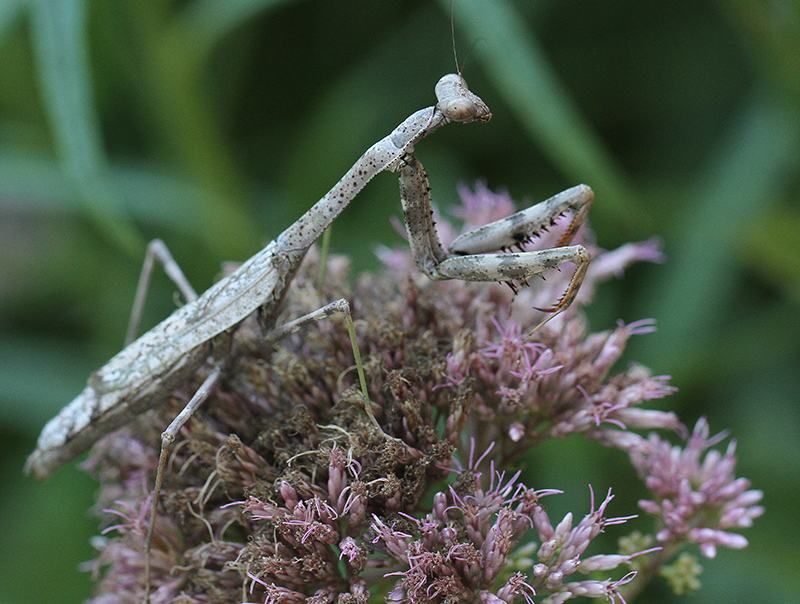
Finding a mantis on your back fence or tucked into a rosebush does not require any action on your part.
An outdoor mantis is not damaging your plants, it is not a threat to your dog or your kids in any ordinary yard situation, and it is not something that needs to be sprayed or relocated.
The sensible response is to observe it and leave it where it is.
Iowa State University Extension’s praying mantis overview and UNH Extension’s mantis release guidance both treat an existing outdoor mantis as something worth watching rather than managing.
That is a low-effort, evidence-aligned position: leave the hunter alone and let it do what it does.
One thing worth knowing before you build any expectations around your backyard mantis: not every mantis in North Carolina is the same species.
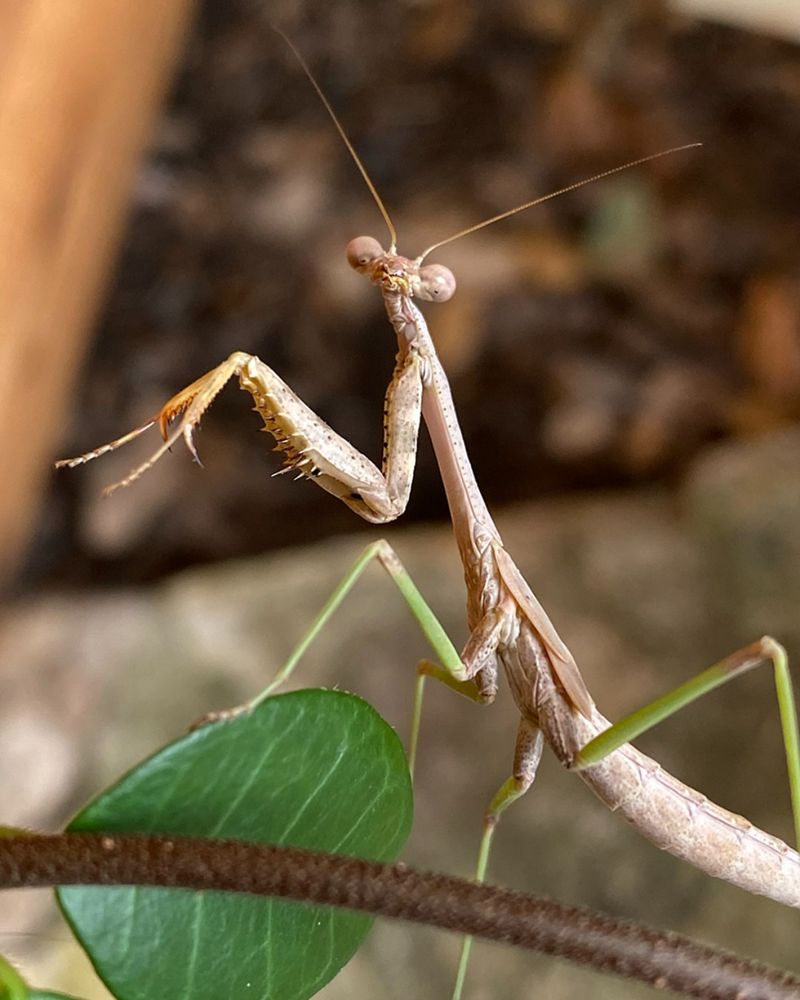
The Carolina mantid, Stagmomantis carolina, is a native North American species.
The Chinese mantid, which is frequently sold through garden catalogs and big-box stores, is an introduced species.
NC State’s Chinese mantid factsheet covers the introduced species in detail, and the NC State Extension factsheet catalog lists resources for native species as well.
Do not try to identify the species by color alone.
Mantis coloring shifts with age, habitat, and individual variation.
If you want a confident ID, iNaturalist’s mantis guide is a practical starting point.
Either way, do not build a pest-control plan around one insect, native or not.
A Purchased Egg Case Is Not a Pest Plan
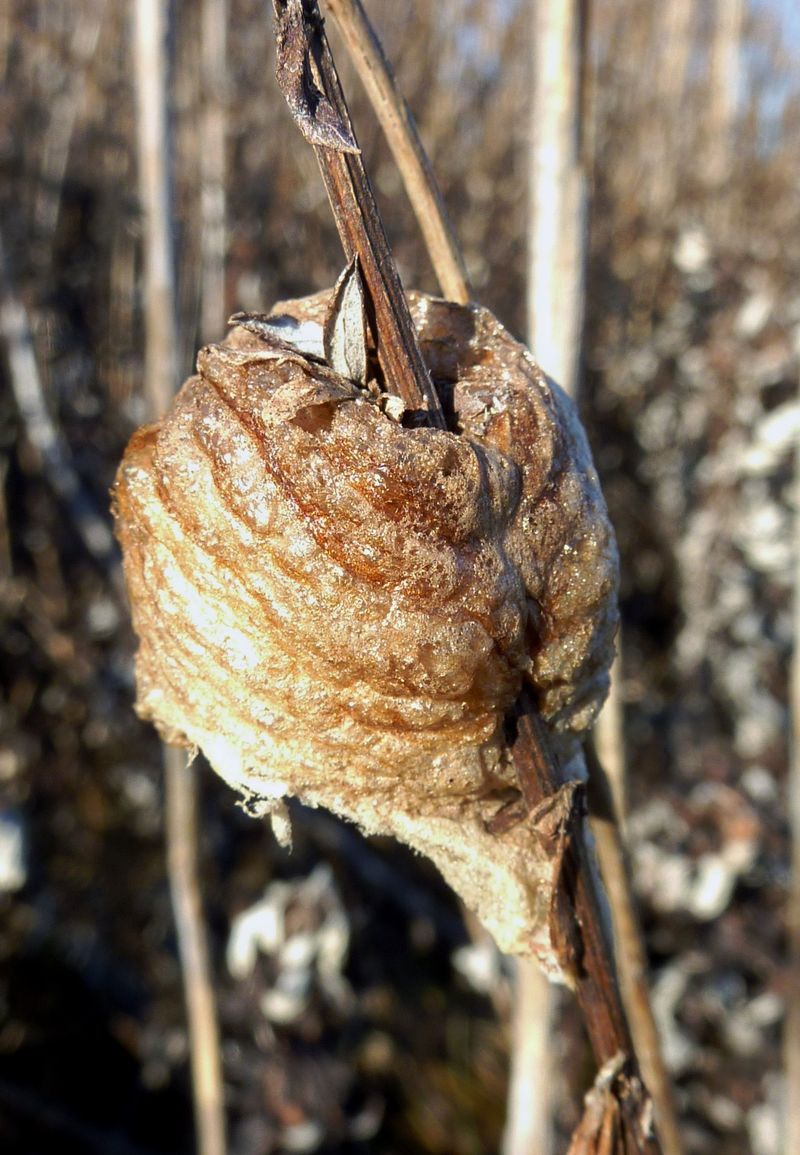
Garden centers and online retailers sell praying mantis egg cases, called oothecae, with the promise that releasing them will bring pest-eating helpers to your vegetable beds.
The appeal is understandable, especially after a summer of stink bugs on the tomatoes or Japanese beetles in the roses.
But the extension guidance on this is pretty consistent: purchased egg cases are not a dependable pest-control tool.
NC State Extension’s biological control Q&A calls for buyer caution and explains that mantises are not well-matched to controlling the pests homeowners most commonly target.
UNH Extension adds that released mantises tend to disperse quickly, may eat helpful insects instead of the problem species, and do not reliably remain in the area where they hatched.
There is also a practical hazard that catches people off guard.
Bringing an egg case into a heated home to watch it hatch seems like a fun project, but warm indoor temperatures can trigger early hatching when there is nothing for the hatchlings to eat.
NC State’s Chinese mantid factsheet specifies that purchased egg cases should be kept outdoors or refrigerated during winter, not stored somewhere warm indoors.
If you find an ootheca already attached to a stem or shrub in your yard, leave it exactly where it is.
That egg case is already in the right environment, already oriented correctly, and does not need your help.
Do not move it to a different part of the yard, and do not transport one from another region.
The mantises that hatch will find their own way.
A Generalist Can Hunt Helpful Insects Too
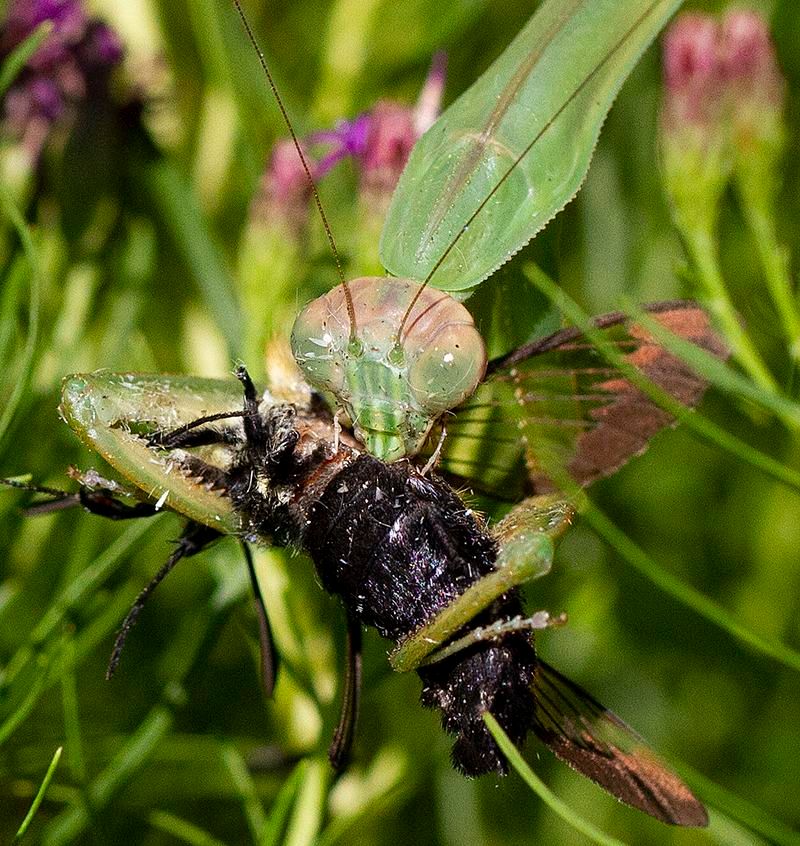
The idea that a mantis is automatically on the gardener’s side is one of the more persistent assumptions about this insect.
A mantis near your goldenrod or Joe Pye weed is not there to protect the pollinators visiting those flowers.
It is there because pollinators visit those flowers, which makes them easy targets.
NC State Extension’s biological control guidance distinguishes between specialist natural enemies, which focus on a narrow range of prey and can provide more predictable control, and broad generalists like mantises, which eat whatever suitable prey arrives.
That generalist diet includes bees, butterflies, syrphid flies, parasitic wasps, spiders, and other predators that North Carolina gardeners might actually want around.
UC IPM’s mantid overview and Iowa State Extension both describe this generalist quality without framing mantises as villains.
Mantises and pollinators can share a yard.
The point is simply that a mantis is not a pollinator protector, and trying to increase mantis numbers as a conservation strategy does not follow from the evidence.
Researchers have also documented mantises capturing small birds, including hummingbirds at feeders.
A peer-reviewed study in The Wilson Journal of Ornithology compiled 147 reported incidents worldwide involving mantises and small birds.
These are real but unusual observations, not a routine North Carolina backyard risk.
If you have hummingbird feeders and notice a large mantis perched nearby, moving the feeder a few feet is a reasonable, low-stakes response.
The bigger takeaway is to tolerate an existing mantis without trying to recruit more of them as a garden strategy.
Use Integrated Pest Management Across the Yard
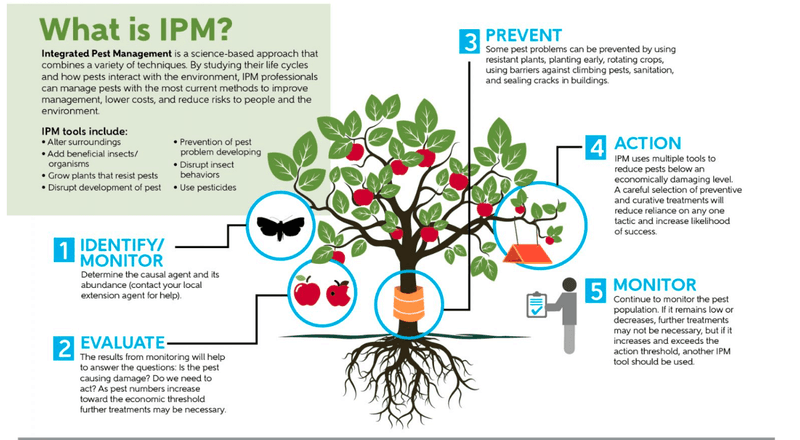
One mantis on one stem is a small piece of a much larger picture.
The yards that tend to have fewer pest problems over time are not necessarily the ones with the most mantises.
They are the ones where the gardener is paying attention and making decisions based on what is actually happening in the soil and on the plants.
That approach has a name: integrated pest management, or IPM.
NC State Extension’s IPM chapter lays out the sequence clearly.
Identify the pest accurately first, because treating the wrong problem wastes time and money.
Monitor the damage and assess whether it has crossed a threshold that actually matters to the plant’s health or your harvest.
Then choose a control, mechanical, cultural, biological, or chemical, that fits the situation.
Evaluate whether it worked.
Diverse plantings, flowering resources that bloom across the season, patches of undisturbed habitat, and tolerance for minor leaf damage all support a broader community of natural enemies.
Penn State Extension’s guide to attracting beneficial insects explains how habitat variety keeps specialist predators and parasitic wasps around, insects that can be more targeted in their pest reduction than a generalist like a mantis.
When a pesticide genuinely becomes necessary, the label is the law.
NC State’s insects chapter notes that broad-spectrum sprays can wipe out natural enemies, and pest populations often rebound faster than predators do, which can make a later outbreak worse.
EPA guidance on pollinator protection and the EPA’s read-the-label-first resource both emphasize checking crop and plant restrictions, timing applications away from bloom periods, and choosing selective products when possible.
These practices support a broader natural-enemy community and are better-supported management choices than trying to engineer a larger mantis population.
Manage Mosquitoes and Ticks Directly

Somewhere between admiring the mantis on your tomato cage and planning your fall garden, the real summer nuisances are circling your ankles.
Mosquitoes and ticks are the pests that actually interrupt a North Carolina porch evening or a walk through the back corner of the yard.
And a mantis, however interesting, is not going to fix either problem.
Mantises occasionally catch flying insects, and a mosquito is technically a flying insect.
But mosquitoes are not the type of prey mantises reliably intercept, and no credible source reviewed here supports mantises as a mosquito management method.
The same is true for ticks, which are not the kind of airborne prey a perched ambush hunter typically captures.
For mosquitoes around a porch or patio, the most effective actions are direct and concrete.
CDC guidance on mosquito control at home recommends emptying and scrubbing water-holding containers at least once a week, covering rain barrels, draining saucers under pots, and flipping over anything that collects water after a storm.
North Carolina summers bring afternoon thunderstorms regularly from June through September, and anything left outside can become a breeding site within a few days.
Where water cannot be drained or covered, a properly labeled larvicide applied according to directions is a targeted and evidence-supported option.
For ticks, CDC prevention guidance points to keeping grass cut, creating a wood-chip or gravel barrier between lawn and wooded edges, wearing long sleeves and repellent when in brushy areas, and doing a full-body tick check after time outdoors.
These steps address the actual exposure risk directly, which is the right place to start.
Welcome the Mantis Without Expecting a Miracle
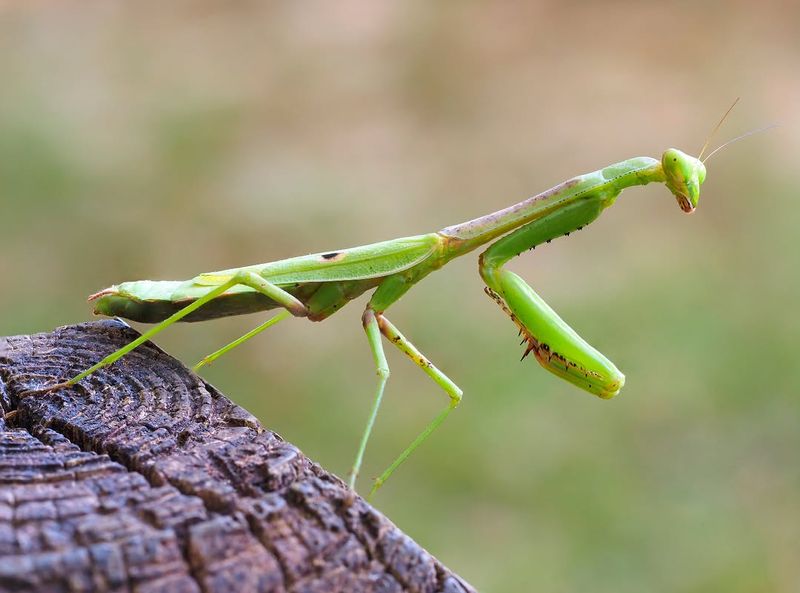
Leaving an existing mantis undisturbed is a genuinely low-effort, reasonable choice, especially when you are already practicing pesticide restraint and working through an IPM plan for the bigger pest concerns.
The mantis did not ask to be your garden’s hero, and you do not need it to be one for the arrangement to make sense.
NC State Extension’s biological control guidance and the IPM handbook both point toward a yard managed with observation, patience, and selective intervention.
A mantis fits into that picture as one small, interesting part of a larger insect community, not as the centerpiece of a pest strategy.
The boundary worth holding onto: welcome the hunter already present in your yard, but do not buy or release one to solve a mosquito problem, a tick concern, or a vegetable-pest outbreak.
Those problems need direct, evidence-backed responses.
Iowa State Extension’s mantis overview puts it well by framing the mantis as a fascinating yard resident rather than a dependable control agent.
A North Carolina backyard in late summer can hold a cookout, a pollinator garden, a tick-check routine, and a mantis on the fence post all at the same time.
None of those things cancels the others out.
The yard gets to be both usable family space and living habitat, and the mantis, quietly holding its perch as the sun drops behind the tree line, is simply part of the deal.