
Keep Your Hummingbird Feeder Up Until October Because The Stragglers Passing Through Now Need It Most
Follow us on Google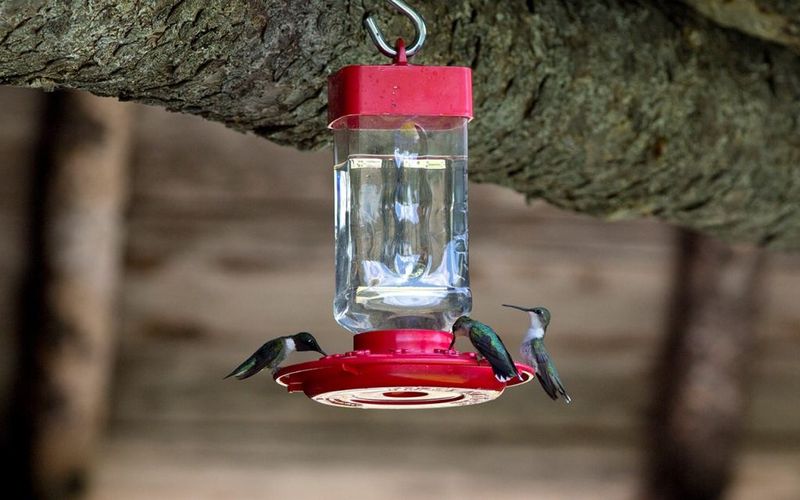
Pulling your hummingbird feeder down too early is one of those small yard decisions that feels responsible but may actually leave a late traveler without a meal.
The headline above is close to right, but October is not a hard stop for everyone, and not every late bird is in crisis mode.
What actually matters is when you last spotted a hummingbird, where you live, what species visit your yard, and whether you can keep the nectar clean and safe.
Get those four things right and your feeder becomes a genuinely useful rest stop, not a trap or a guilt trip.
October Is Not a National Stop Date
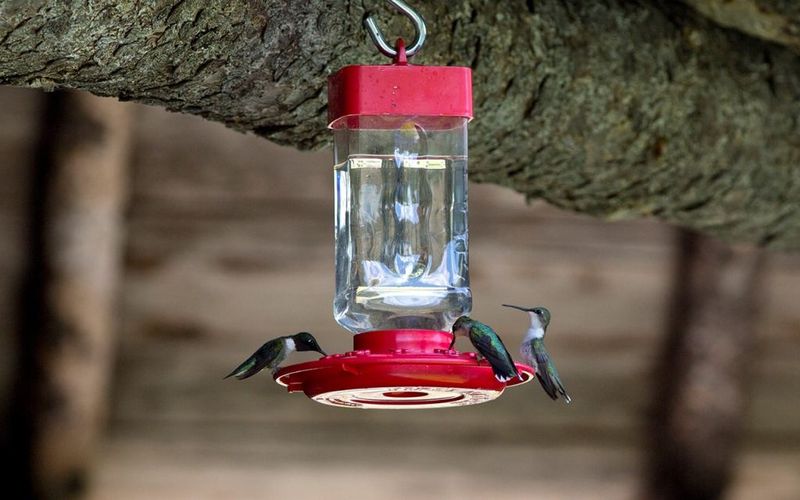
Somewhere along the way, October became the default answer to “when do I take down my hummingbird feeder?” That answer works reasonably well for homeowners in the northern United States and parts of the Midwest, where hummingbird activity genuinely does taper off through September and early October.
But it falls apart fast once you move south or west.
Along the Gulf Coast, in southern Florida, southern Arizona, coastal California, and parts of the Pacific Northwest, hummingbirds may appear later in the season or throughout the year.
Giving those readers a hard October cutoff sends them inside too early.
Meanwhile, a homeowner in Minnesota who waits until November is simply maintaining an empty feeder in the cold.
A more useful rule starts with your last sighting, not the calendar.
Journey North’s annual-cycle guidance puts the practical minimum at two weeks after your last confirmed hummingbird.
Cornell Lab recommends the more cautious choice of several weeks, especially if your local timing is uncertain or late migrants may still be moving through your area.
Two weeks is a solid floor.
Several weeks is the safer ceiling when you are not sure whether the last bird you saw was actually the last one.
The difference in effort is small, and the upside is that any late traveler passing through finds fresh nectar instead of an empty hook.
A few things can override that window entirely.
If freezing temperatures arrive and you cannot manage the feeder safely, bring it in.
If you live in bear country, local wildlife agency guidance takes priority over any general recommendation.
Species, climate, and local wildlife rules all shape the final call, and the sections that follow cover each one.
A Feeder Does Not Delay Migration
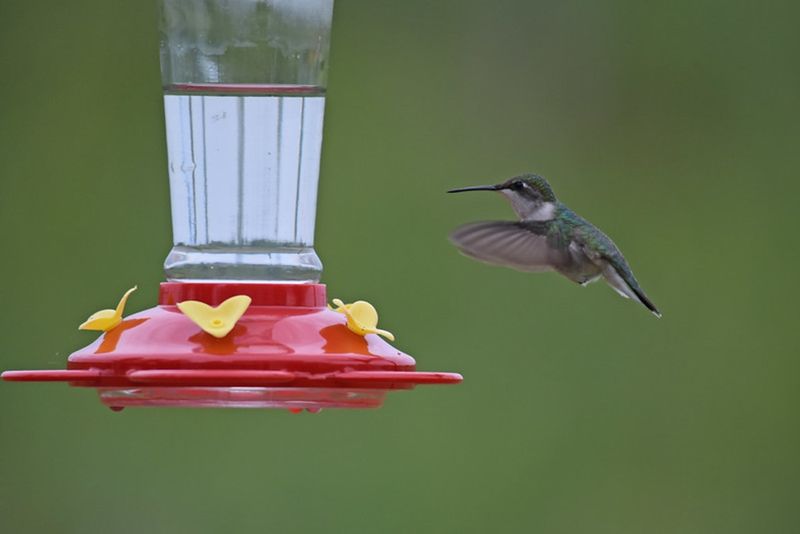
One of the most persistent worries among backyard birders is that leaving a feeder up will convince a hummingbird to stick around when it should be heading south.
That worry has a kind instinct behind it, but the science does not support it.
Cornell Lab of Ornithology explains that hummingbirds respond to seasonal cues, especially the shortening of daylight hours, whether a feeder is present or not.
That internal clock runs on photoperiod, not on how much sugar water is available in your yard.
No amount of nectar overrides it.
Weather, age, body condition, and the availability of food along the broader route also shape when and how a bird moves.
But a backyard feeder is not powerful enough to cancel those signals.
Hummingbirds continue foraging for natural flowers and small insects even when a feeder is nearby, so they are not sitting in one spot waiting for a refill.
Think of the feeder as a gas station on a highway.
Drivers stop when they need fuel, then keep going.
The station does not make them live in the parking lot.
Audubon’s hummingbird feeding FAQ reinforces this point, noting that birds will continue migrating on their natural schedule regardless of feeder availability.
The practical takeaway is straightforward.
Leaving a clean, well-maintained feeder up through the post-sighting window does not create dependence or delay anything.
It simply keeps the option open for birds that pass through while you wait out the recommended period after your last sighting.
Late Birds May Use Supplemental Energy
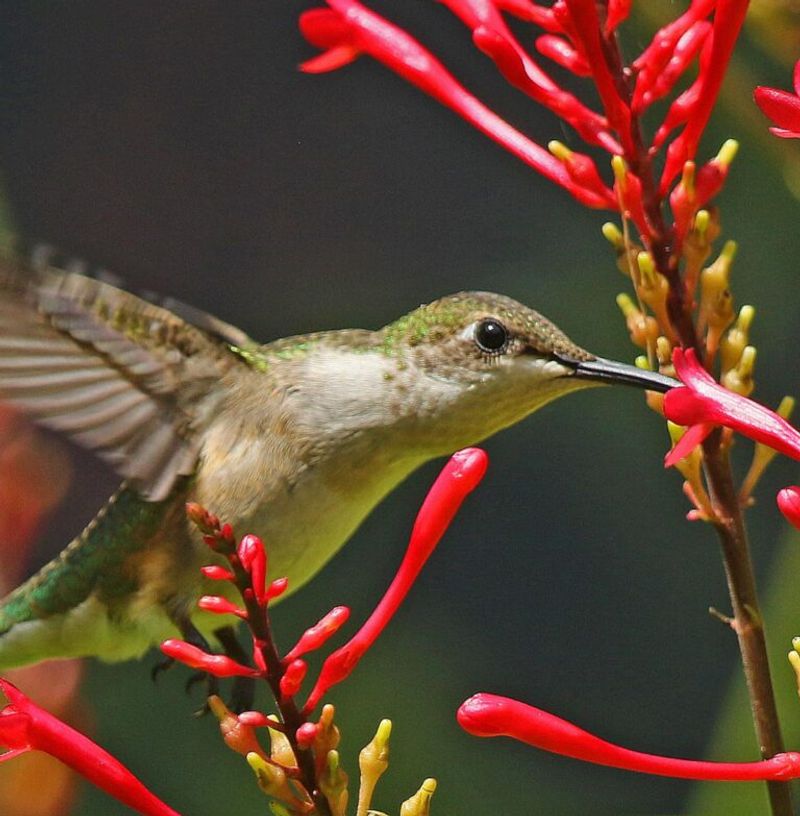
When the last salvia blooms turn brown and a cold front moves through, a hummingbird passing your yard has fewer options than it did in July.
A clean feeder with fresh nectar can fill a gap that natural flowers no longer cover.
That is a real and useful thing, even if it is not the dramatic rescue story the headline implies.
Cornell’s overview of hummingbird migration notes that fall passage through southern Alabama runs from late August through late October, with September as the peak.
A bird moving through your yard in mid-October in the East is often a young Ruby-throated Hummingbird that hatched later in the season and is making its first solo trip south.
Some late October sightings are not Ruby-throated Hummingbirds at all.
Hummingbirds migrate individually, not in groups, so a single bird appearing after the main wave has passed can be a Rufous Hummingbird or another western species that has drifted east.
A few species that appear in fall or winter in the southern United States are not in trouble; they may be exactly where their biology expects them to be.
The honest framing is this: a well-maintained feeder may provide useful supplemental energy to a late migrant when natural nectar is scarce.
That is worth something.
But do not assume every late visitor is struggling, and do not treat your feeder as the only thing standing between a bird and disaster.
It is one resource among many along a very long route.
The Gulf Story Needs More Nuance
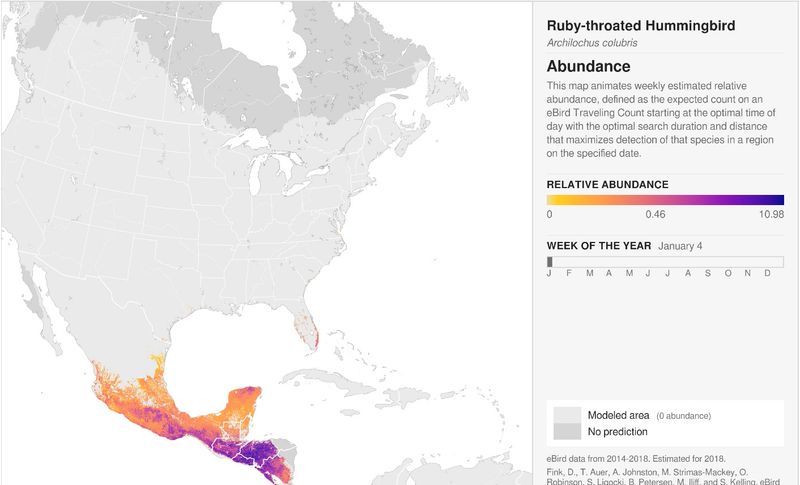
The image of a tiny hummingbird flying nonstop across the Gulf of Mexico is genuinely remarkable, and it is not wrong.
Fish and Wildlife Service confirms that many Ruby-throated Hummingbirds can make that crossing, covering roughly 500 miles over open water in flights lasting up to 18 to 20 hours.
It is one of the more astonishing things a bird the size of a large moth can do.
But not every Ruby-throated Hummingbird takes that route, especially in fall.
Research tracking juvenile birds departing coastal Alabama found that most followed a circum-Gulf route during southbound migration, staying over land and hugging the coast rather than crossing open water.
Spring and fall routes may differ, and individual choices vary by age, condition, weather, and departure point.
Cornell’s range maps for the Ruby-throated Hummingbird show both the direct Gulf crossing and the coastal corridor as documented paths.
Neither route is universal, and the choice a particular bird makes depends on factors that no backyard observer can know from a feeder sighting alone.
Here is the part that matters for your yard: a hummingbird flying nonstop over open water cannot use a backyard feeder during the crossing.
Your feeder’s value is in the days before a long flight, when a bird is fueling up, or after a crossing, when it is recovering.
Framing your feeder as a pre-departure or post-arrival resource is accurate.
Framing it as aid to a bird mid-Gulf is not.
Identify the Bird Before Extending the Date
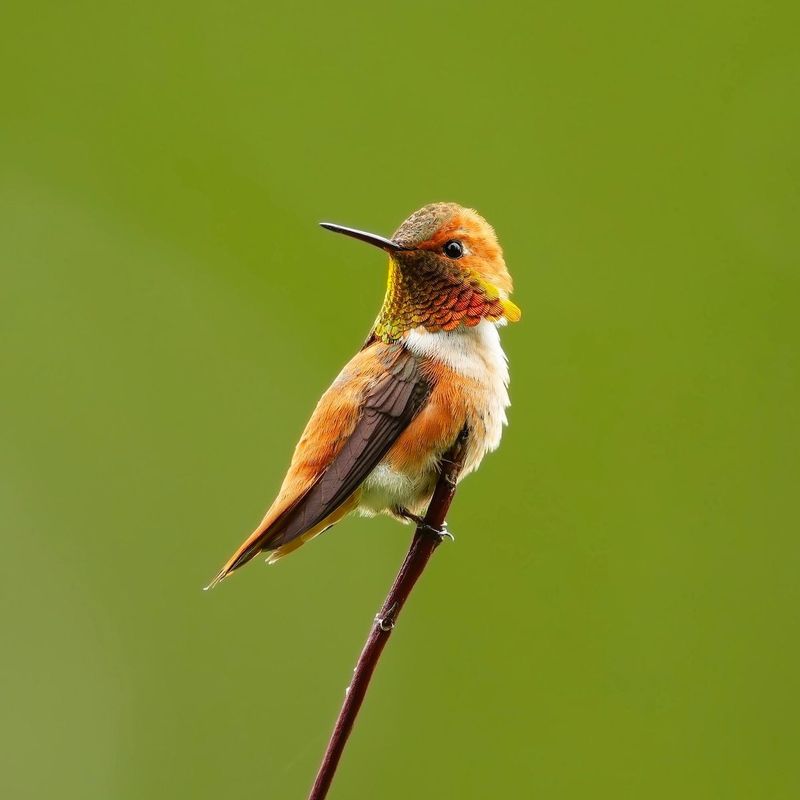
Not every hummingbird you see in October is the same species, and the species matters a lot when you are deciding how long to keep the feeder going.
In eastern North America, the Ruby-throated Hummingbird (Archilochus colubris) is the only species that regularly breeds across the region, and nearly all of them leave the United States and Canada in fall, wintering mainly from Mexico through Central America.
If you are in Ohio, Pennsylvania, or Georgia and you see a hummingbird in late October, it is probably a Ruby-throated, possibly a young bird from farther north making its way through.
But late eastern sightings can also involve Rufous Hummingbirds, which breed in the Pacific Northwest and occasionally drift far east of their normal range in fall and winter.
Because hummingbirds migrate individually rather than in groups, a single bird appearing after the main movement has passed does not signal a problem.
It may simply be an individual on a slightly different schedule.
Western readers are working with a completely different roster.
Anna’s Hummingbirds are year-round residents across much of coastal California and the Pacific Northwest.
Black-chinned, Broad-tailed, Costa’s, and Rufous Hummingbirds all have migration patterns and winter ranges that differ from the Ruby-throated.
Audubon’s hummingbird feeding FAQ notes that some species normally remain in the United States through winter, which means a late bird in Tucson or San Diego is not automatically a straggler in distress.
Take a close look at the bird before you decide the feeder needs to stay up indefinitely.
Region and species together give you a much more reliable guide than the calendar alone.
Use the Standard Nectar and Clean It Often
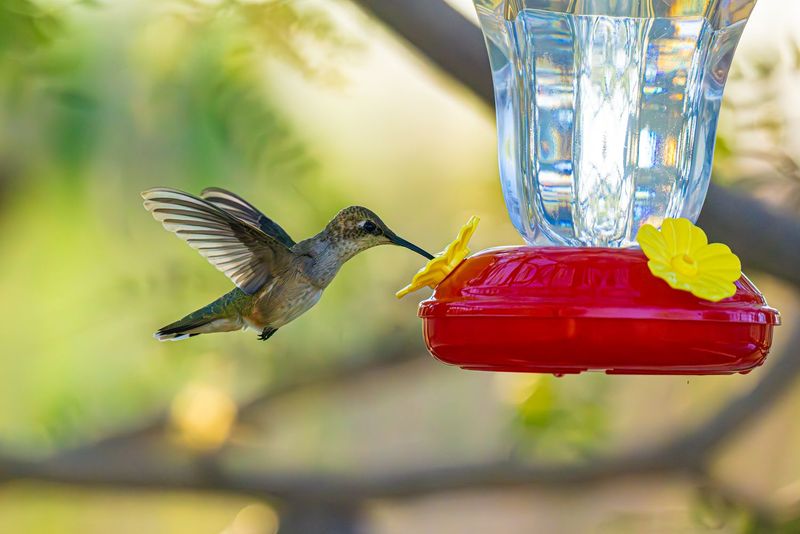
The recipe is simple and it does not need improvement.
Mix 1 part refined white sugar with 4 parts water, which works out to 1/4 cup of sugar per 1 cup of water.
Penn State Extension confirms this ratio as the standard, and it closely matches the sugar concentration in many natural flower nectars.
Let the mixture cool completely before you fill the feeder, because hot nectar can warp some plastic parts and is uncomfortable for birds.
Do not substitute honey, brown sugar, molasses, or artificial sweeteners.
Honey can support dangerous fungal growth inside the feeder.
Artificial sweeteners provide no calories, which means a hummingbird burns energy visiting your feeder and gets nothing back.
Red food coloring is unnecessary because a feeder with red parts or nearby red flowers already does that job, and the dye adds no benefit.
Audubon recommends cleaning the feeder every 2 to 3 days in warm weather, and daily or every other day when temperatures are very high.
In cooler fall weather, spoilage slows, but it does not stop.
Check the nectar before every refill.
If it looks cloudy, smells off, or shows any sign of mold, empty the feeder, scrub it thoroughly, and start fresh.
Do not just top it off.
Make only as much nectar as the birds will use in a few days.
Extra solution can be refrigerated, but bring it back toward room temperature before filling the feeder.
Cold nectar straight from the refrigerator is not dangerous, but room-temperature nectar is more inviting.
Audubon also advises hanging the feeder in partial shade and protecting it from strong wind, both of which slow spoilage and reduce the chance of spilled nectar attracting insects or other wildlife.
Freezing Weather and Bears Can Override the Plan
Cooler fall air is actually your ally for a few weeks.
Lower temperatures slow the growth of mold and bacteria, so nectar stays fresh longer than it does in July.
But “longer” does not mean indefinitely, and once nighttime temperatures drop near or below freezing, a new problem replaces spoilage: the nectar may freeze solid before a bird can use it.
Sugar water freezes at a slightly lower temperature than plain water because dissolved sugar lowers the freezing point, but regularly freezing nights will still leave you with a feeder full of ice by morning.
Audubon notes that drinking cold nectar does not appear to cold-stun hummingbirds, so the cold liquid itself is not the danger.
Frozen nectar that a bird cannot reach, or spoiled nectar from an unattended feeder, is the actual problem.
Do not try to fix this by increasing the sugar concentration.
Penn State Extension states that stronger mixtures may be harmful, so the standard 1-to-4 ratio stays the default regardless of the temperature.
If you want to keep the feeder going through cold snaps, bring it inside overnight and put it back out in the morning when temperatures rise.
If you cannot manage that routine, remove the feeder temporarily rather than leave frozen or neglected nectar out.
Bears are a separate and more urgent issue.
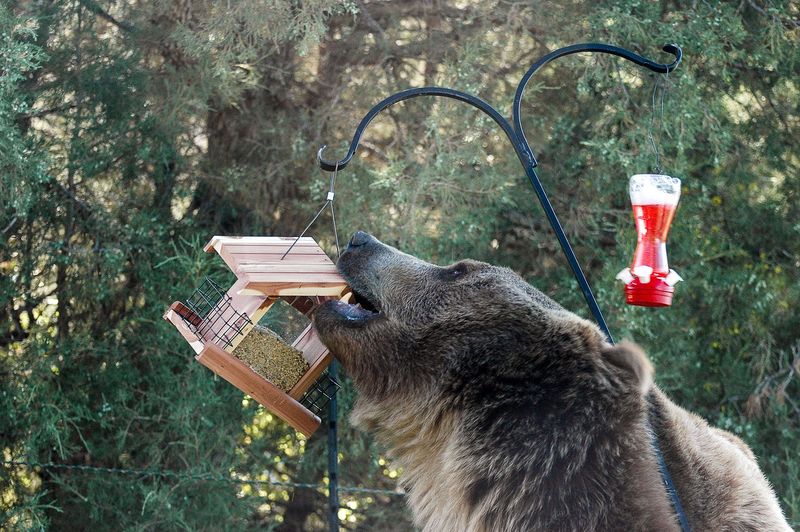
Liquid hummingbird feeders can attract black bears, and once a bear finds one, the problem compounds quickly.
New York State DEC guidance says feeders should come down when bears are active, and DEC’s BearWise reminders make clear that a feeder discovered by a bear must be removed immediately.
If you live in bear country, including parts of New York, Pennsylvania, New Jersey, Michigan, Wisconsin, Minnesota, and much of the West, local wildlife agency rules override any general fall feeder recommendation.
Make the Yard Safer Than a Feeder Alone
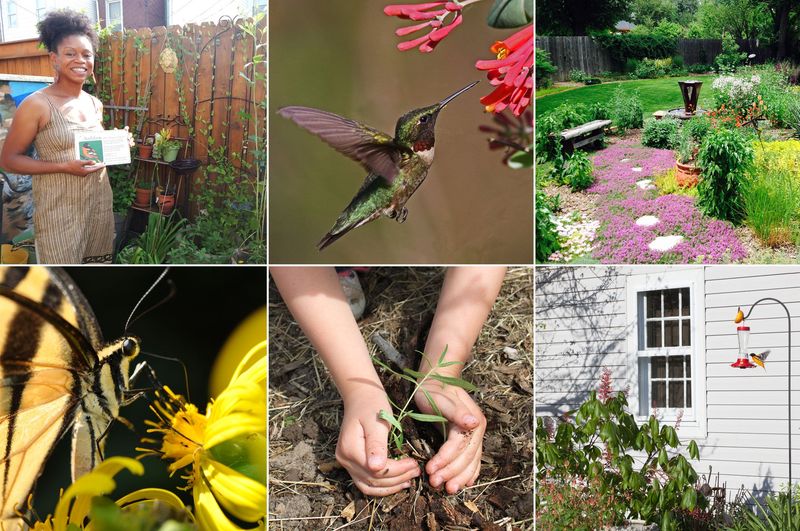
Sugar water is one input.
A yard that genuinely supports hummingbirds is a system, and a feeder is the easiest part of it to maintain.
The harder, more lasting work happens in the ground and around the house.
Native plants that bloom late in the season give hummingbirds actual nectar along with the insects and spiders they need for protein.
Audubon’s hummingbird habitat guide points to native flowers as a stronger long-term resource than sugar water alone, because they also attract the small invertebrates hummingbirds hunt.
Plant choices must be regional, so check with your local Cooperative Extension office or a native plant society for species that bloom into fall in your specific area.
A feeder cannot make up for pesticide exposure, habitat loss, or a yard stripped of natural food sources along the migration corridor.
Fish and Wildlife Service cautions that even well-intentioned feeding setups can create risks if they draw birds into dangerous situations.
Two of the most common are cats and windows.
Keep cats indoors or prevent access near the feeder station, because a hummingbird that visits the same spot repeatedly becomes a predictable target.
For windows, Cornell recommends placing the feeder within 3 feet of glass or more than 30 feet away, avoiding the middle range where birds can build up enough speed to cause serious injury on impact.
Exterior window treatments outperform one or two decorative decals for reducing collisions reliably.
Here is a simple decision checklist for the end of the season.
Keep the feeder available while hummingbirds are present.
After the last sighting, wait at least two weeks as a practical minimum, or several weeks if you are in an area where late migrants may still appear.
Use fresh 1-to-4 nectar, clean the feeder every 2 to 3 days, and manage frozen nectar promptly.
Follow local wildlife rules if bears are active.
The feeder is a good neighbor to a passing bird, and a well-kept yard is the neighborhood it actually wants to live in.