
Curling Tomato Leaves Are Usually A Stress Signal, And Spraying First Makes It Worse
Follow us on Google
You walk out to check your tomato plants on a hot afternoon and notice the leaves curling up like tiny green scrolls. Before you grab a spray bottle or head to the garden center, it’s worth knowing that curled tomato leaves are often a sign of stress, not disease.
Many gardeners waste time and money treating a problem that doesn’t need a chemical fix, and sometimes the spray itself causes new damage. Understanding what your plant is actually telling you can save both the tomatoes and your afternoon.
A Common Stress Response Can Curl Tomato Leaves
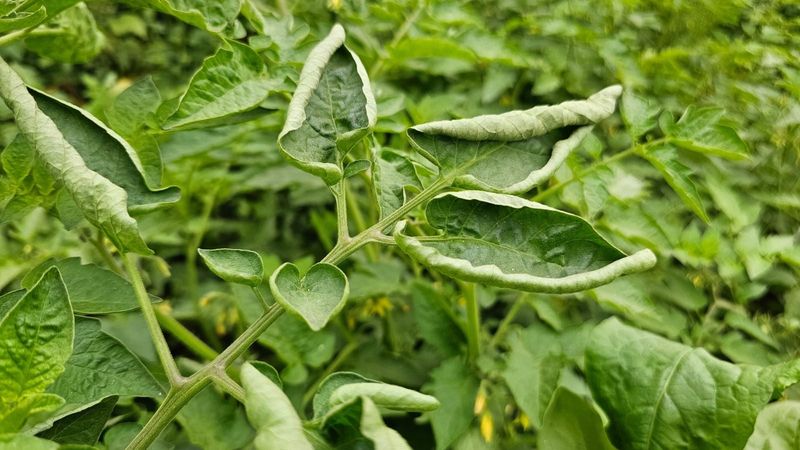
Tomato plants (Solanum lycopersicum) have a built-in coping mechanism that surprises a lot of first-time growers. When conditions get tough, the older, lower leaves begin rolling upward and inward, sometimes forming a loose tube shape.
The leaves stay green, feel firm or leathery to the touch, and show no spots, yellowing, or sticky residue. According to University of Minnesota Extension’s tomato disorder guidance, this pattern is called physiological leaf roll, and it is a noninfectious stress response rather than a sign of disease.
Physiological leaf roll is a common explanation for curled tomato leaves, though it is not the only one. The plant is essentially conserving moisture by reducing the leaf surface exposed to sun and wind.
Growth typically continues, flowers keep forming, and fruit development usually goes on without interruption. That is the good news.
The pattern matters for identification. Rolling starts on the lower, older leaves and works its way upward only when stress continues.
As University of Maryland Extension notes on leaf curling in vegetables, the absence of mottling, spots, or distorted new growth is an important clue that separates physiological rolling from more serious problems. And as Illinois Extension explains in its review of rolling and wilted tomato leaves, the condition by itself does not call for pesticides or disease sprays.
Observation comes first, treatment comes only after you know what you’re dealing with.
Heat, Moisture, And Root Stress Shape The Pattern
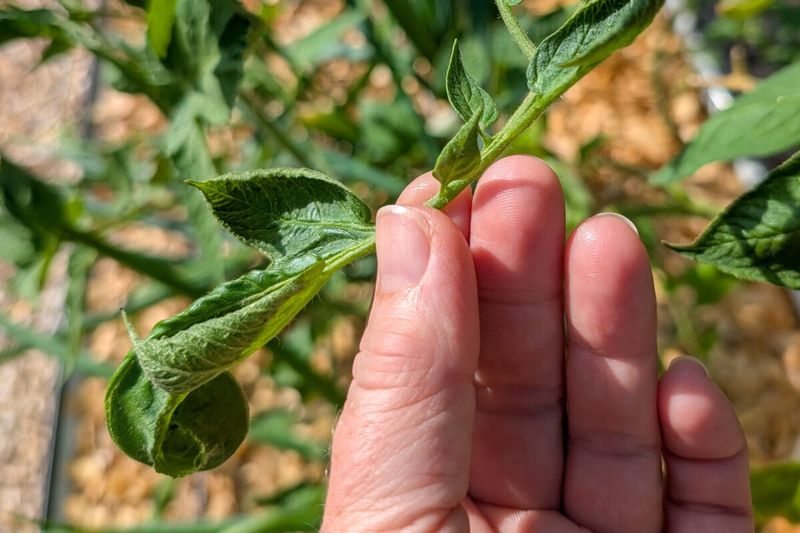
A string of 95-degree afternoons can push a tomato plant past its comfort zone faster than most gardeners expect. When daytime temperatures climb above 90 degrees Fahrenheit and nights stay warmer than 70 degrees Fahrenheit, the plant loses moisture through its leaves faster than the roots can replace it.
University of Minnesota Extension’s hot-weather gardening guide notes that these thresholds can increase daily or every-other-day watering needs, depending on local soil and conditions. The leaves curl partly to protect themselves, the way a person squints in bright sun.
But heat is only one piece of the picture. Uneven watering, where the soil swings between soaking wet and bone dry, stresses roots just as much as steady drought does.
Rapid growth spurts, disturbed roots from nearby cultivation or transplanting, heavy pruning that removes too much leaf area at once, and excess nitrogen that pushes lush, water-hungry new growth can all contribute to the same curling pattern. Illinois Extension’s guide on rolling tomato leaves specifically calls out severe pruning and excess nitrogen as factors that increase heat stress or produce growth the plant struggles to support.
Curled leaves do not automatically mean the plant needs more water. Overwatered roots can be just as stressed as dry ones, and adding water to already saturated soil can make things worse.
Minnesota Extension’s tomato disorders resource reinforces that root disturbance and other non-moisture stressors produce the same outward symptom. Check the actual conditions before reaching for the hose.
Inspect The Soil And Plant Before You Treat

Stick your finger about 2 inches into the soil near the base of the plant. If it feels dry at that depth, moisture stress is a reasonable suspect.
If it feels damp or wet, water is probably not the issue. Check beneath any mulch layer too, because mulch can mask dry soil underneath or, less often, hold so much moisture that the surface feels deceptively cool while the root zone is actually fine.
Containers dry out faster than in-ground beds, and sandy soil loses water more quickly than clay or loam, so adjust your expectations based on what you’re growing in.
A general starting point for garden tomatoes is about 1 inch of rain or irrigation per week, as University of Minnesota Extension’s vegetable garden watering guidance describes, but that number shifts with soil type, container size, local heat, and recent rainfall. Treat it as a flexible guide, not a fixed rule.
Minnesota Extension’s tomato growing resource recommends deep, thorough watering over shallow sprinkling so roots get consistent moisture rather than a surface-level drink.
After checking soil moisture, look at the whole plant. Flip leaves over and examine the undersides.
Check new shoot tips, stems, and a few nearby plants. Look for tiny insects, sticky residue, sooty black film, or distorted young leaves.
The University of Minnesota tomato leaf diagnosis tool walks through how the location and direction of curling, combined with other symptoms, points toward different causes. Think of this inspection as a two-minute investigation that protects you from making a costly mistake.
Why An Unidentified Spray Can Add Injury
Reaching for a spray before knowing what’s wrong is a bit like taking medicine before knowing the diagnosis. Pesticides, horticultural oils, insecticidal soaps, and fungicides are tools designed for specific problems.
When you apply them to a plant that is already under heat or moisture stress, the chemical can cause its own damage on top of the original problem. That added injury is sometimes called phytotoxicity, meaning the product itself harms the plant tissue rather than helping it.
Pesticide labels carry legal weight. The EPA’s introduction to pesticide labels explains that the label is a legally enforceable document, not just a suggestion.
A product must be registered and labeled for use on tomatoes specifically, and you are required to follow its directions on rate, timing, weather conditions, safety precautions, and preharvest intervals. The EPA’s pesticide registration overview and EPA labeling questions and answers both reinforce that using a pesticide inconsistently with its label is a violation of federal law.
Some product labels, such as this EPA-registered label with phytotoxicity precautions and this label addressing heat and moisture stress conditions, specifically instruct users to test a small area first or avoid application during heat or drought stress.
Fertilizer is a separate category from pesticides and does not follow EPA pesticide-label rules. That said, excess nitrogen can worsen physiological leaf roll by pushing rapid, water-demanding growth.
Follow the fertilizer product’s own label, and do not use fertilizer as a response to unexplained curling. When you do not know what is wrong, doing less is usually the safer first move.
Stabilize Likely Stress Without Chasing Perfect Leaves
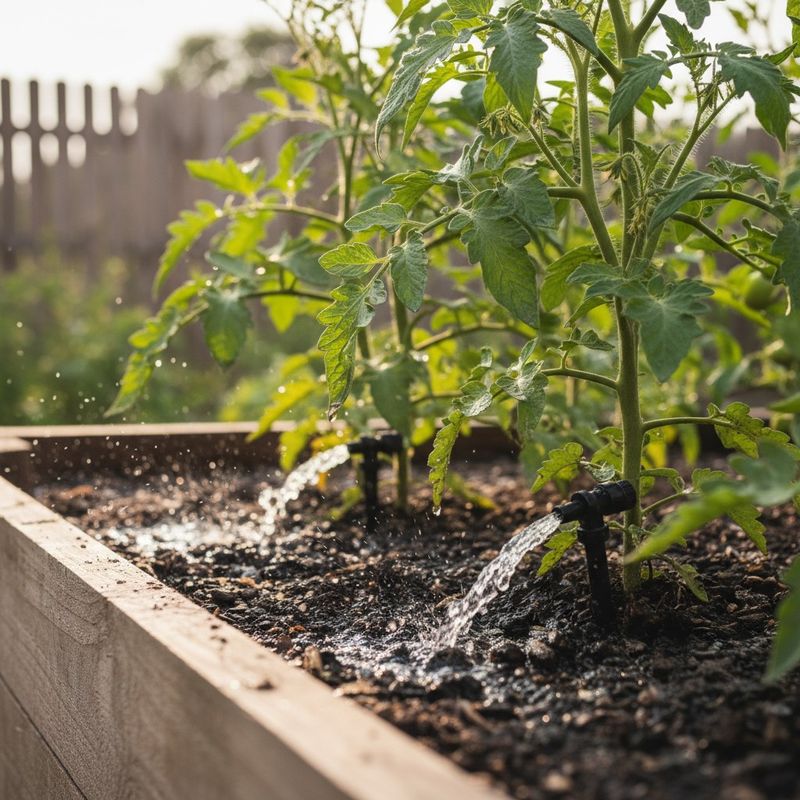
When the symptom pattern matches physiological leaf roll, the right response is to reduce stress steadily rather than try to force the plant to recover overnight. Water thoroughly at the soil line when the soil is dry 2 inches down, giving the root zone a deep drink instead of a quick surface sprinkle.
Drip irrigation or a soaker hose works well because it delivers water directly to the roots without wetting the leaves, which can invite fungal problems. Colorado State University Extension’s tomato growing guide recommends consistent soil moisture as a cornerstone of healthy tomato production.
A 2- to 3-inch layer of mulch around the base of the plant, kept a few inches back from the stem, slows evaporation and moderates soil temperature. Minnesota Extension’s fruit crop watering tips during dry spells supports mulching as a practical way to stretch the benefit of each watering.
Avoid cultivating close to the stem because disturbing shallow roots adds another layer of stress on top of whatever the plant is already managing.
Limit severe pruning during heat waves. Removing too many leaves strips the plant of the shade it uses to protect its own fruit and root zone.
Minnesota Extension’s hot-weather gardening guidance and the tomato disorders resource from the same university both note that steadier conditions matter more than coaxing curled leaves to flatten. Minnesota Extension’s tomato disorder page points out that old leaves may stay curled even after stress eases, and that is okay.
Watch new growth and fruit development instead, those are your real progress indicators.
New Growth Can Point To Herbicide Injury Or Viruses
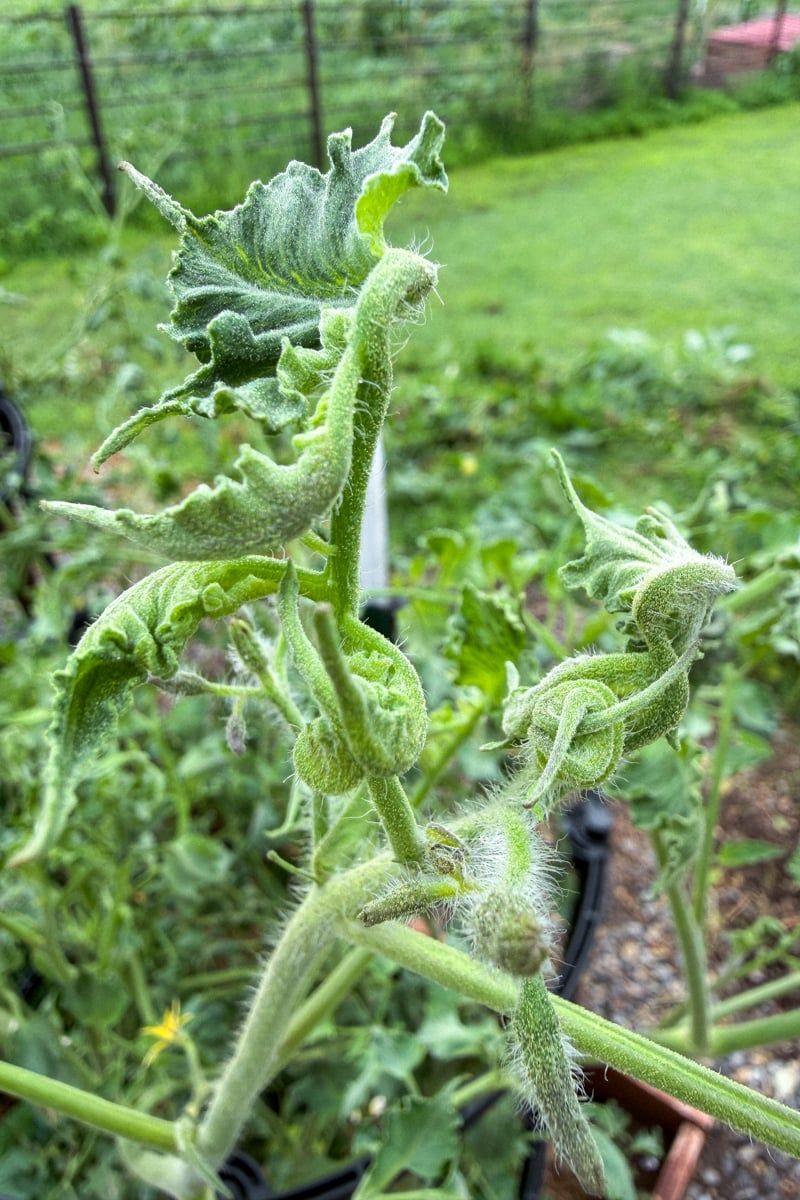
Location and direction of curling are two of the most useful clues a tomato plant can give you. Physiological leaf roll happens on older, lower leaves that roll upward and inward while staying green and firm.
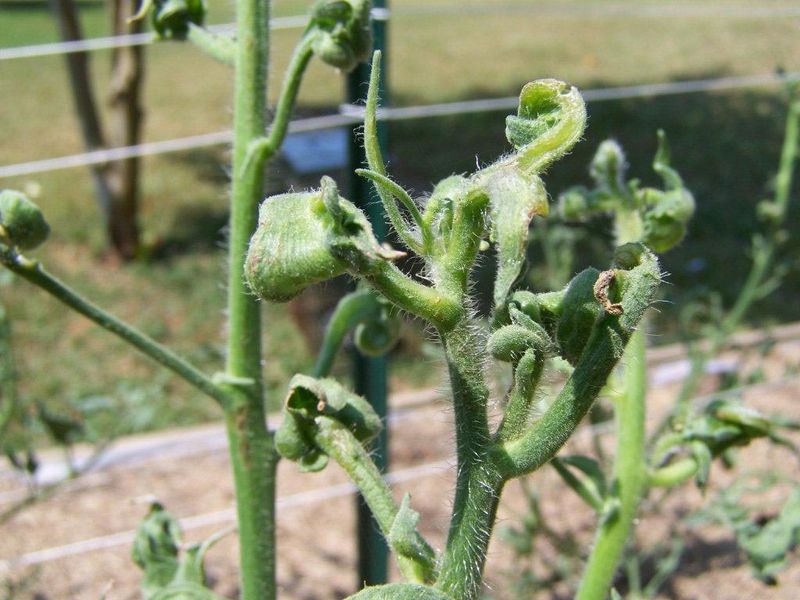
When the curling is happening at the growing tips, on new shoots, or producing narrow, twisted, crinkled, or tightly puckered young leaves, that is a different signal entirely, and it calls for a different response.
Herbicide injury is one possibility that catches gardeners off guard. Products containing 2,4-D, dicamba, and similar plant-growth regulators can reach tomatoes through drift on a windy day, runoff from a treated lawn, or even contaminated compost, mulch, or manure.
The damage tends to show up as downward curling or cupping of leaves, twisted stems, thickened veins, and sometimes distorted fruit. Oklahoma State University Extension’s guide on non-infectious tomato diseases describes these injury patterns in detail, and the University of Maryland Extension’s common tomato problems resource lists herbicide exposure as a cause of distorted growth.
Damage may appear more severe on the side of the plant facing a recently treated yard or field, though the source is not always easy to confirm.
Viruses are a concern when curling appears alongside a cluster of other symptoms, not from curling alone. Minnesota Extension’s tomato leaf diagnosis tool and Minnesota Extension’s tomato disorders page both note that yellow mottling, mosaic or ringspot patterns, stunted growth, shortened internodes, failed flower set, and severe crumpling together suggest a viral problem.
UC IPM’s tomato yellow leaf curl resource describes that virus as producing small, strongly crumpled leaves with upward curling and yellowing along leaf edges and between veins, a symptom cluster clearly different from a simple stress response.
Pests Leave Clues That Stress Alone Does Not
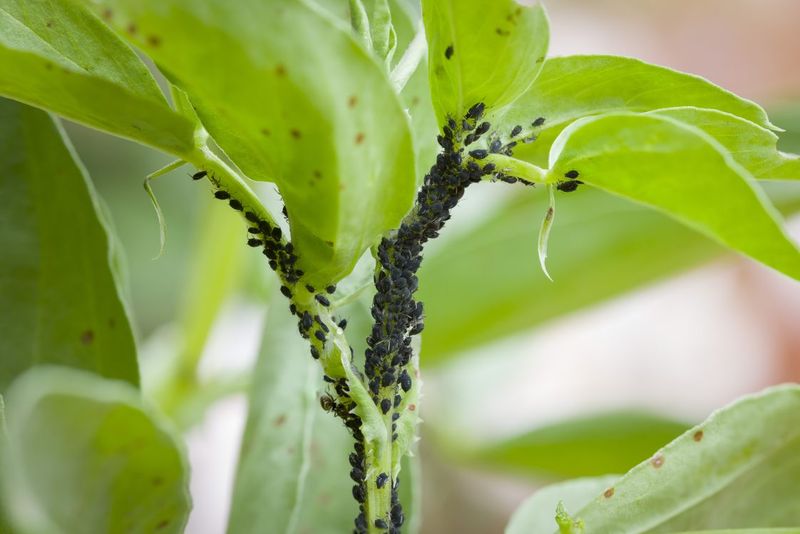
A plant under stress and a plant with a pest problem can look similar from three feet away. Getting close enough to actually look changes everything.
Before reaching for any product, spend two or three minutes examining leaf undersides, stem joints, and new growth tips with your eyes and, if you have one, a hand lens or 10x loupe from a craft store.
Aphids are small, soft-bodied insects that cluster on tender new growth and on the undersides of young leaves. They come in green, yellow, black, or gray, depending on the species.
University of Minnesota Extension’s aphid resource explains that light populations are often kept in check by natural enemies like parasitic wasps and lady beetles, especially when you avoid broad-spectrum pesticides that kill the beneficial insects along with the pests. For a clearly observed, light aphid infestation, a firm stream of water directed at the colonies can dislodge the insects from the plant without adding any chemical to the situation.
Use enough force to knock them loose, but not so much that you erode soil around the roots or bruise tender stems.
Whiteflies are a different story. UC IPM’s whitefly on tomato guide describes how heavy whitefly feeding can cause yellowing, curling, honeydew buildup, and a secondary black sooty mold that grows on the sticky residue.
Tap a branch and watch for a white cloud of tiny insects to flutter up. The Minnesota tomato leaf diagnosis tool lists both aphids and whiteflies as causes of leaf distortion that require a different response from physiological leaf roll.
Identifying the pest first means any treatment you choose actually targets the right problem.
Monitor New Growth, Vigor, And Regional Risk
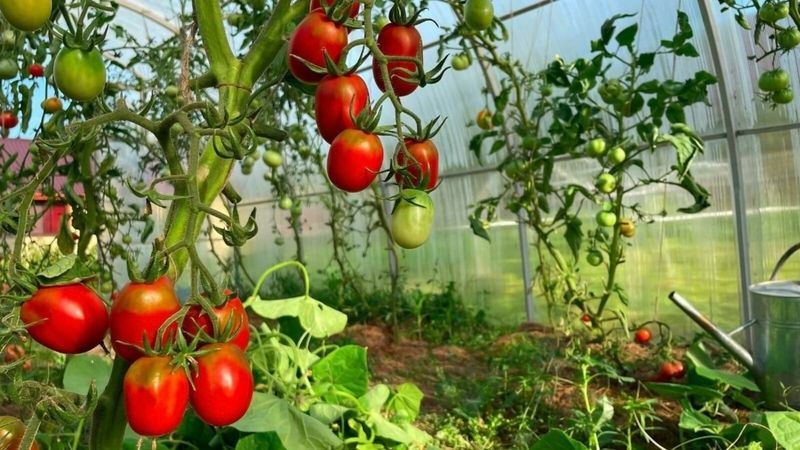
Old leaves that stay curled after stress eases are not necessarily a sign that the plant is still struggling. Tomato plants do not always uncurl leaves that have already rolled.
The better question is whether new leaves are coming in flat and healthy, whether flowers are setting, and whether fruit is sizing up on schedule. University of Minnesota Extension’s tomato disorders guidance and a Utah State University Extension vegetable IPM advisory both point to new growth and overall vigor as more reliable indicators of recovery than the condition of older affected leaves.
Track soil moisture every few days, watch whether curling is spreading to new growth, and note whether any other symptoms are appearing alongside the rolling. If the pattern stays confined to older leaves and new growth looks normal, the plant is most likely managing its stress load.
If new symptoms appear, including yellowing along leaf edges, mosaic patterns, stunted shoots, or insects on the undersides of leaves, revisit the diagnostic steps from earlier sections.
Regional context matters for two specific diseases. UC IPM’s tomato yellow leaf curl page notes that this virus is especially significant in warm regions where its whitefly vector can survive year-round, and infected plants can suffer severe fruit losses.
Beet curly top, spread by the beet leafhopper, recurs mainly in arid and semiarid parts of the western United States, as described by Oklahoma State University Extension’s curly top disease resource. Neither concern applies equally in every American garden, so do not borrow someone else’s regional worry if it does not fit your climate.
The decision rule holds across all regions: stabilize likely stress first, investigate any unusual new symptoms carefully, and spray only when you have identified the problem and confirmed the product label covers the crop and situation.
A tomato plant that’s genuinely recovering will tell you with new leaves and fruit, not by unrolling the old ones.