
That Airy Grass Swaying At Your Border Is The One Most People Cannot Name At First Glance
Follow us on Google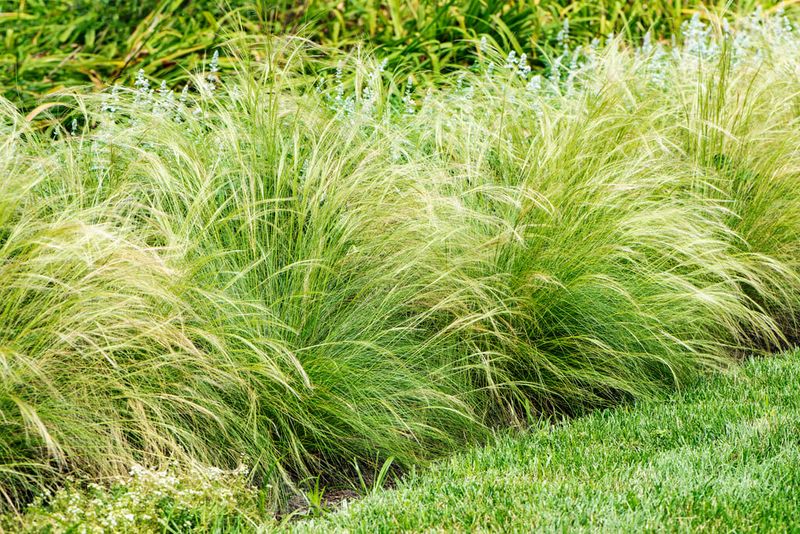
Walk past a sunny border on a breezy afternoon and one plant stops you cold.
It moves differently from everything around it, a soft, threadlike fountain catching light and wind at the same time.
Figuring out its name from appearance alone can be harder than it looks, because several fine ornamental grasses share that same floating quality.
Getting the identification right matters, because this particular grass comes with real regional planting considerations that vary widely across the country.
The Grass May Be Mexican Feather Grass
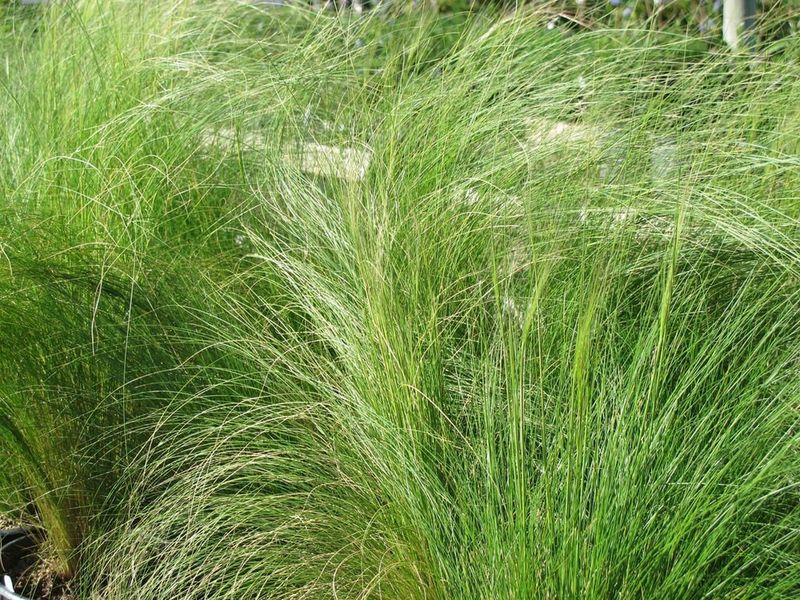
A fine, airy clump swaying at the edge of a sunny border could point to several ornamental grasses, so any identification from appearance alone has to stay provisional.
That said, the description fits one plant especially well: Mexican feather grass, also sold under the names Mexican feathergrass and finestem needlegrass.
Its accepted botanical name is Nassella tenuissima, and gardeners who shopped for it a decade or two ago may still have tags reading Stipa tenuissima, which is a former name for the same plant.
The visual clues that make it a plausible match are specific.
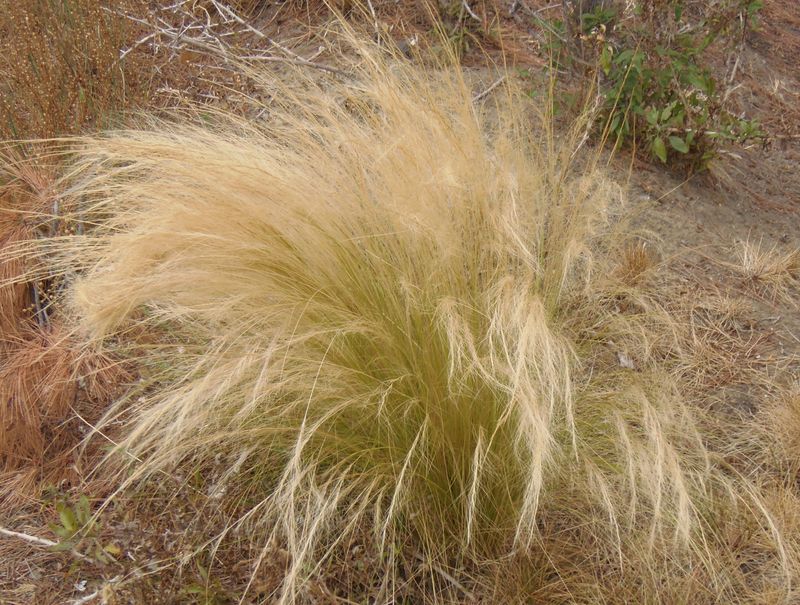
North Carolina Extension describes the plant as forming a fine-textured clump roughly 12 to 24 inches tall and about as wide, with hair-thin leaves that roll slightly inward along their length.
Those narrow leaves are what give the plant its threadlike, almost translucent look from a few feet away.
Above them, delicate flower panicles rise through summer and often persist well into fall, appearing silvery or yellow-green depending on the light and season.
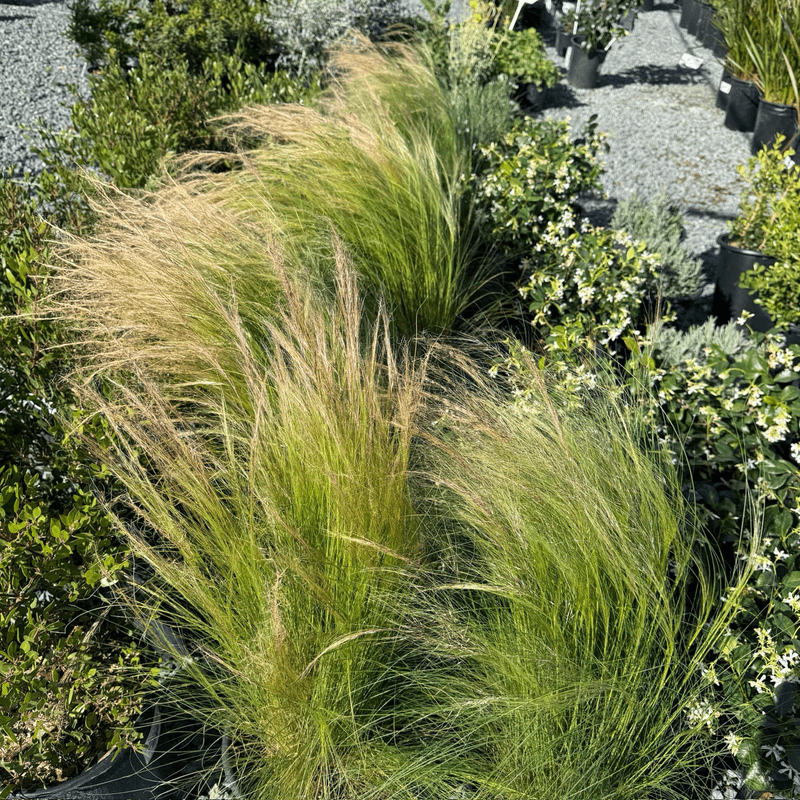
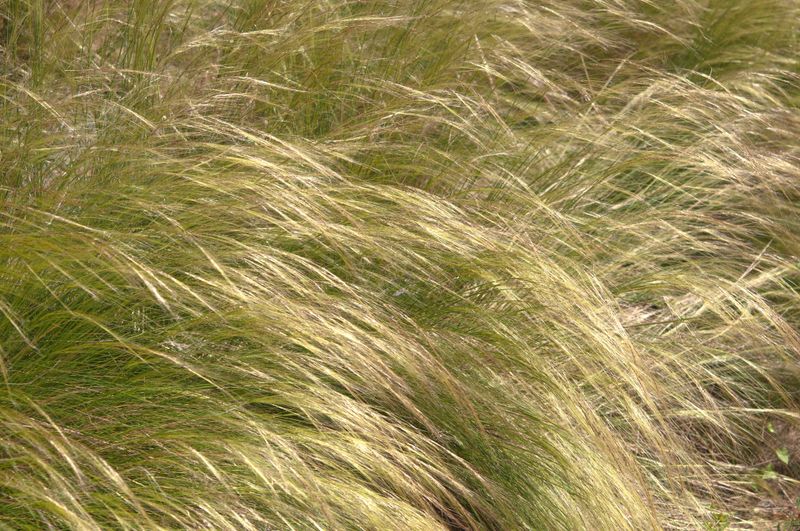
Put all of that together and the picture is a soft, fountain-shaped mound that responds to the lightest breeze with a rippling, floating motion.
That motion is genuinely distinctive, but it is not exclusive to this species.
Blue fescue, prairie dropseed, muhly grasses, and other needlegrasses can produce a similar effect from a distance.
A photograph showing the leaf width, seed structure, and overall scale, or a close look at an actual plant, would be needed before calling the identification certain.
Fine Leaves Create The Airy Motion
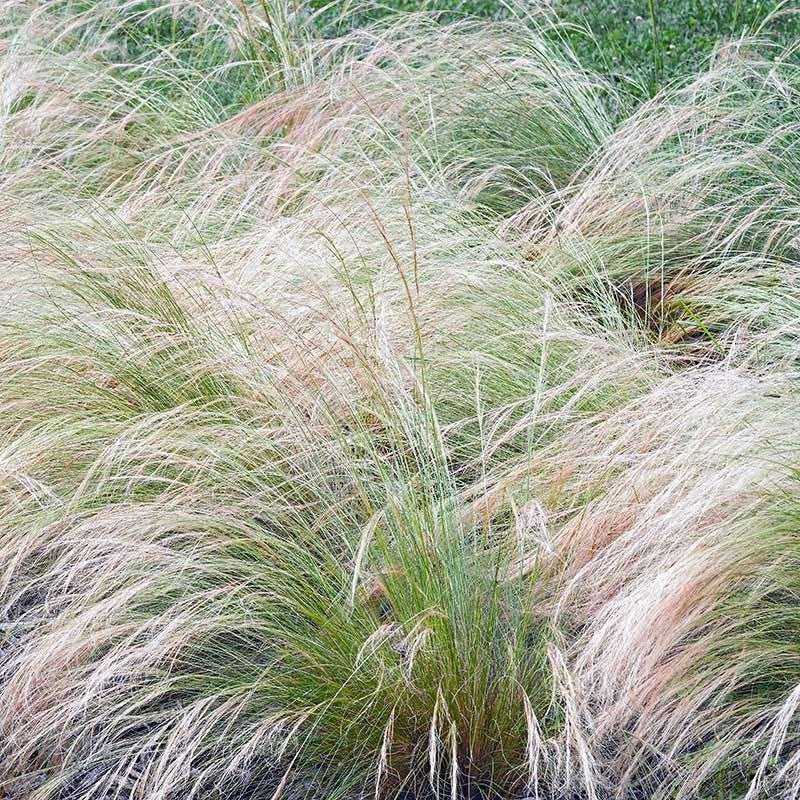
The floating quality that stops people along the border comes directly from the plant’s leaf structure.
Each leaf on Nassella tenuissima is extremely narrow and rolls slightly inward on itself, producing a texture closer to thread than to the flat blade you see on most lawn grasses.
According to North Carolina Extension, those fine leaves create the plant’s soft, almost luminous appearance, especially when backlit by morning or late-afternoon sun.
The flower panicles add a second layer of movement above the foliage.
They emerge through the summer months and can appear silvery or yellow-green depending on age and light conditions, shifting between the two as the season progresses.
Because the panicles are so light, even a slow breeze sets them in motion, and the whole clump seems to breathe rather than simply stand in place.
That persistent movement through summer and into fall is a large part of what draws the eye to this grass along a border edge.
One distinction worth understanding is how this plant spreads.
Nassella tenuissima is clump-forming, meaning it does not send out horizontal runners underground the way some aggressive grasses do.
Missouri Botanical Garden notes the tidy clump habit as part of its ornamental appeal.
But clump formation is a description of how the parent plant grows, not a statement about spread.
The separate and significant concern with this grass is the seed it produces and how far those seeds can travel, which is a different subject entirely and one that shapes the whole planting decision.
A Sunny Dry Border Can Showcase It
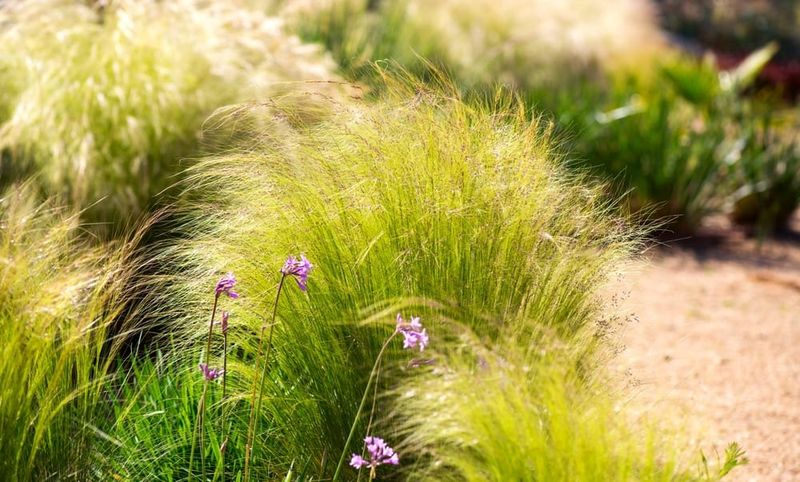
Where local conditions and invasive-plant guidance support it, Mexican feather grass can do real ornamental work in a sunny border.
Its scale, roughly 12 to 24 inches tall and wide, fits the front or middle of a bed without forming a tall screen that blocks the plants behind it.
The soft texture contrasts well against boulders, gravel, flagstone, or the stiff structure of succulents and low-growing perennials, and the constant motion adds something a static plant simply cannot.
Gardeners use it in rock gardens, dry landscapes, edging strips, and mass plantings where a repeated soft texture ties a design together.
North Carolina Extension lists full sun as the preferred exposure, with light partial shade acceptable, and notes that at least six hours of direct sunlight daily keeps the plant performing well.
Drainage matters far more than soil fertility here.
Sandy, rocky, clay, and shallow soils can all work provided water does not sit around the crown after rain.
The lower-water appeal is real but applies to established plants, not new ones.
A freshly planted clump still needs regular irrigation while its roots extend beyond the nursery root ball into surrounding soil.
University of Florida IFAS extension guidance on ornamental grasses notes that establishment watering is a standard requirement even for drought-adapted species.
Think of the lower-water performance as something the plant earns over its first growing season, not a feature that starts on planting day.
A dry border is not a maintenance-free border, and this grass is not an exception to that rule.
Establishment Comes Before Drought Tolerance
Drought tolerance is one of the most misread traits in ornamental grasses.
Gardeners sometimes hear it and picture a plant that can go straight from the nursery cart into a dry spot and never need attention.
That is not how it works.
Established Nassella tenuissima plants can handle dry periods and may even go dormant during severe summer heat and dryness, but a newly planted clump is working entirely from the water stored in its nursery root ball until new roots reach the surrounding soil.
Plan on regular watering for the first growing season, checking soil moisture at the root zone rather than just the surface.
Once the plant shows new growth and seems settled, you can begin stretching the intervals between waterings and let the soil dry more between sessions.
Sandy or rocky soils dry faster than clay, so the timeline varies, but the principle holds everywhere: roots need time to establish before the plant can draw on the surrounding soil for moisture.
Planting technique matters more than most people expect.
Iowa State University Extension recommends digging a hole at least twice as wide as the container so roots can spread into loosened soil rather than hitting a hard wall.
Set the plant at the same depth it grew in the pot.
Keep the crown, the point where stems meet roots, at soil level or very slightly above it, especially in heavier soils where water can pool.
North Carolina Extension emphasizes that wet, low spots are genuinely problematic for this plant.
A raised planting spot or a gently sloped bed gives the crown the drainage it needs to stay healthy through wet seasons.
Spacing And Trimming Preserve The Form
Mature width should drive your spacing plan, not the size of the nursery pot.
Mississippi State University Extension describes the plant reaching about 12 to 24 inches wide at maturity, and some plants push wider in favorable conditions.
Planting at 12 to 18 inches on center creates a fairly connected edging or drift where the clumps touch and weave together as they fill in.
Spacing closer to 24 inches gives each plant more visual room and keeps individual forms readable, which works well when you want the fountain shape of each clump to read as its own accent rather than a continuous mass.
Late-winter maintenance is the one moment each year when you can reset the plant’s appearance before new growth begins.
Oklahoma State University Extension recommends removing only the top third of the plant rather than cutting it hard to the ground, noting that this grass does not respond well to severe cutback.
Other sources, including general ornamental-grass guidance, describe a more substantial late-winter trim.
A conservative approach is to remove the dead and tired upper growth, shape the clump lightly, and leave the crown and its base undisturbed.
Iowa State Extension notes that avoiding crown damage is a consistent principle across ornamental grass care.
Trimming improves appearance and removes old material, but keep it separate in your mind from seed control.
Cutting the plant back in late winter, after seeds have already matured and dropped, does nothing to reduce that season’s seed spread.
Appearance maintenance and seed management are two different tasks with two different timing windows, and conflating them leads to a false sense of containment.
Abundant Seed Changes The Planting Decision
The main spread concern with Nassella tenuissima is not underground creeping.
This grass stays in a clump and does not run by rhizomes or stolons the way some aggressive species do.
The concern is seed.
A peer-reviewed review of invasive Nassella species documents that plants in this genus can produce very large quantities of seed, and that seeds may persist in the soil for several years.
Those seeds travel by wind, water, people, animals, livestock, vehicles, and contaminated soil or equipment.
If you are in a region where local guidance permits planting it, removing flower stems and seed heads before mature seeds disperse is a reasonable step.
Do it while the panicles are still green or just turning, before the seeds harden and detach.
This reduces the number of new seeds entering your garden and the surrounding area.
But removing seed heads does not erase seeds already in the soil, and it does not guarantee that every seed is caught before it moves.
Think of it as reducing pressure, not eliminating risk.
The California Invasive Plant Council lists Nassella tenuissima as a species with documented escape from cultivation, noting that seeds have been found in coastal and disturbed areas and travel by multiple routes.
PlantRight identifies it as a do-not-plant choice across several California climate regions, including the Sierra and Coastal Mountains, Central Valley, Desert, North and Central Coast, and South Coast, and suggests alternatives such as alkali sacaton, blue grama, purple three-awn, and pine muhly.
The University of Florida IFAS assessment rates it as high invasion risk across Florida zones and does not recommend planting it there.
In California and Florida, seed-head removal is not a workaround that makes planting appropriate.
Readers in those states should contact local extension or invasive-plant resources for suggested alternatives suited to their specific region.
Check Climate And Local Guidance Before Buying
Sources commonly place Nassella tenuissima around USDA Zones 7 to 10 for winter hardiness.
North Carolina Extension lists Zones 7a through 10b, and Oklahoma State University Extension places it at Zone 7 as a minimum.
In gardens colder than Zone 7, the plant may fail to overwinter reliably or need to be treated as an annual.
But zone numbers only describe how cold a winter gets.
They say nothing about summer humidity, seasonal rainfall, drainage, or the overall climate conditions that determine whether a plant thrives or creates problems.
Humid southeastern performance is genuinely location-dependent.
North Carolina Extension notes that the plant does not perform well in hot, humid southeastern conditions, while Mississippi State has described successful cultivation in parts of central Mississippi.
Neither verdict applies universally across the Southeast.
If you garden in that region, local conditions and a conversation with your county extension office will tell you more than any zone map.
Before buying, run through a short checklist.
Does local invasive-plant guidance support planting it?
Does the site get at least six hours of direct sun and drain reliably after rain?
Are you prepared to water regularly through the first growing season, remove seed heads before they mature, pull volunteer seedlings that appear nearby, and handle extra dry fuel in the bed if your area has fire risk?
University of Florida IFAS extension guidance on ornamental grasses notes that dry plant material in ornamental grass plantings is a general consideration in fire-prone settings.
If all of those boxes check out, the grass can earn its place.
If local authorities flag it, PlantRight and similar regional resources offer suggested alternatives worth exploring, none of them universally approved for every yard, but each a reasonable starting point for a conversation with a local nursery or extension agent.
The right grass for a dry, sunny border exists in most regions, and finding the one that fits your specific place is the whole point.