
The Pygmy Rattlesnake Hiding In Your Florida Leaf Pile Where You Reach In Blind
Follow us on Google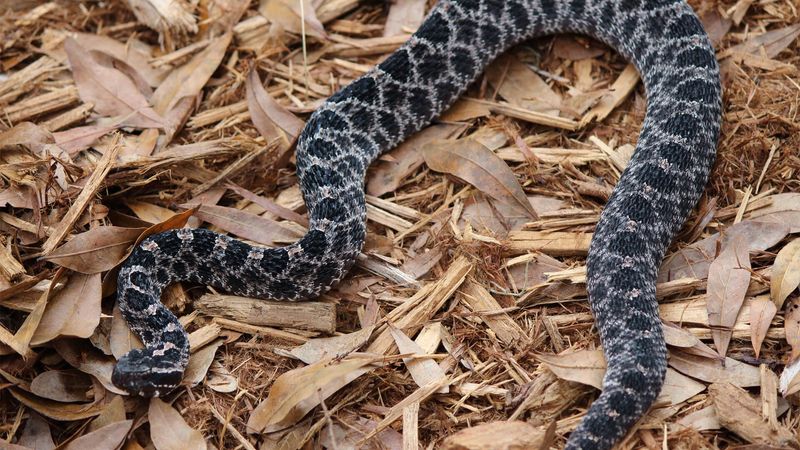
You pull on your work gloves, crouch beside the fence line, and reach into that pile of oak leaves without a second thought.
It is the kind of move every Florida homeowner makes a dozen times a season, and most of the time nothing happens.
But a dusky pygmy rattlesnake could be coiled in that exact spot, completely invisible, and completely silent.
Knowing that one rule, look before you reach, can make every yard-work day a safer one.
A Dusky Pygmy Rattlesnake Could Be Under The Leaves
Reach into enough Florida leaf piles and the odds eventually matter.
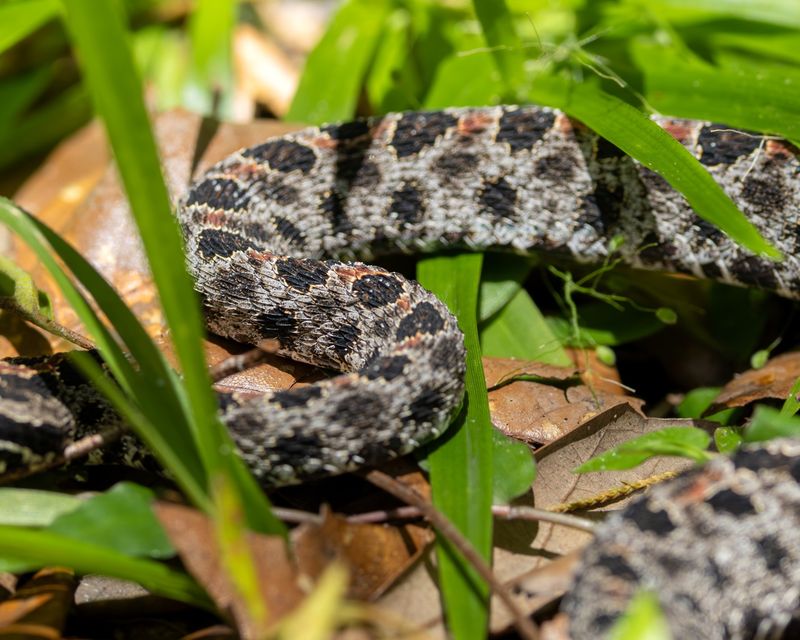
The dusky pygmy rattlesnake, Sistrurus miliarius barbouri, is Florida’s smallest venomous snake, and it is a genuine possibility in concealed yard cover throughout mainland Florida.
According to the Florida Museum of Natural History’s snake identification guide, most adults measure about 12 to 24 inches long, though the Florida Museum records a maximum length of 31 inches.
That is roughly the length of a standard ruler to just under three feet, small enough to disappear completely under a single layer of leaves.
The body is typically gray or brownish gray, decorated with dark blotches and a reddish-brown stripe running down the back.
A dark line passes behind each eye, and the tail ends in a very small rattle.
Against the mottled browns and grays of fallen leaves, pine straw, or old mulch, the coloring is almost perfectly matched.
You could be looking directly at one and miss it.
The species occurs throughout mainland Florida and has been recorded in every county, but is not known from the Florida Keys.
Residential encounters depend heavily on local habitat, nearby natural cover, and the presence of prey.
Lowland pine flatwoods, hydric hammocks, pond edges, marsh borders, and cypress areas are classic territory, but suburban neighborhoods near any of those habitats can host the species too.
No one can tell you that a specific leaf pile near your fence contains a pygmy rattlesnake.
What the biology does tell you is that leaf litter and debris are exactly the kind of concealment the snake uses.
The practical rule that follows from that is simple: inspect before you reach.
Silence Does Not Clear The Leaf Litter
Most people assume a rattlesnake will announce itself.
That assumption is wrong with this species, and acting on it is how bites happen.
UF/IFAS Extension’s guide to Florida’s venomous snakes states that the pygmy rattlesnake’s rattle can be so small it may not be audible even when shaken vigorously.
The rattle is not broken.
It is just tiny, and the sound it produces at close range has been compared to a faint buzzing, closer to a large insect than to the sharp warning people expect from a bigger rattlesnake.
Here is where it gets tricky.
The Florida Museum notes that a pygmy rattlesnake may vibrate its tail in dry leaves even without making a true rattle sound.
That rustling can blend right into the background noise of yard work.
A quiet leaf pile is not a safe leaf pile.
Camouflage adds another layer of difficulty.
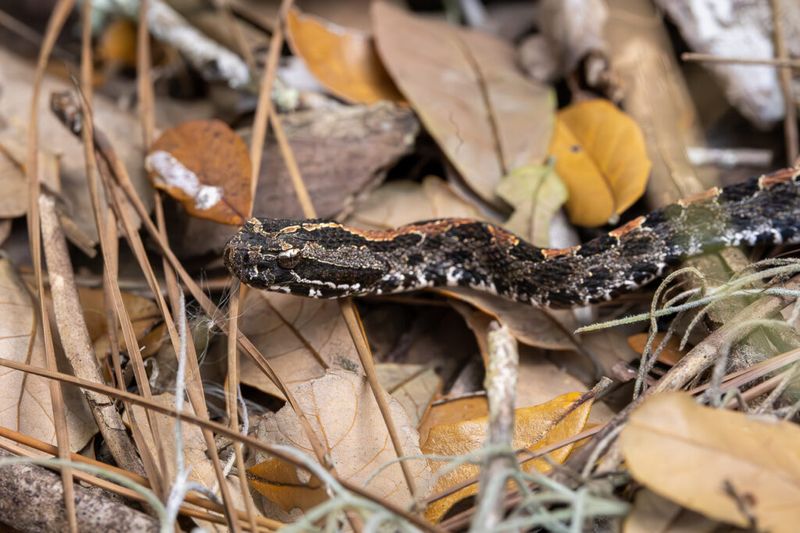
The snake’s gray and blotched pattern matches fallen leaves and sandy Florida soil so closely that the animal can be motionless at your feet and still go unnoticed.
When frightened, the species tends to freeze rather than flee, pressing itself flat and relying on that camouflage instead of bolting.
FWC notes that snakes generally try to avoid people, and the Florida Museum describes the pygmy rattlesnake as defensive rather than aggressive.
Bites most commonly happen when a snake is stepped on, cornered, handled, or otherwise disturbed by someone who never saw it.
Listening for a warning before reaching into leaf cover is not a reliable safety check.
Looking first, from a standing distance, before any hand or foot enters an unseen space, is the habit that actually reduces risk.
Do Not Identify A Small Snake From Size Alone
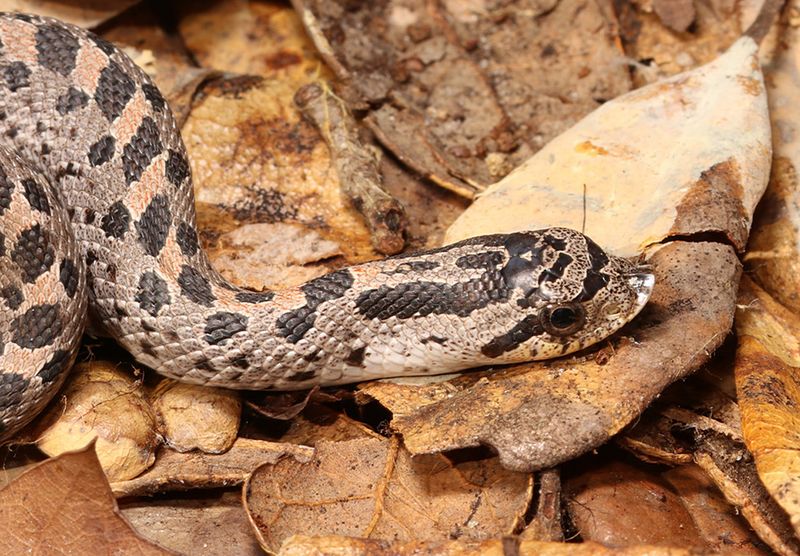
Small, gray, blotchy, and coiled near the flower bed does not automatically mean pygmy rattlesnake.
Florida has several harmless species that share a similar look at a glance.
Juvenile black racers are brown and blotched before they develop the solid dark coloring of adults, and they will actually vibrate their tails in dry leaves when threatened, producing a buzzing sound that mimics a rattle.
Eastern hognose snakes are another common example: stocky, patterned, and prone to dramatic defensive displays that can startle anyone who stumbles across one.
The Florida Museum’s identification guide describes the features that distinguish the dusky pygmy rattlesnake: a visible rattle at the tail tip, a vertical pupil, a heat-sensing facial pit between the eye and nostril, and the characteristic blotched pattern with the reddish-brown dorsal stripe.
Those are real diagnostic clues, but checking them requires getting very close to the animal.
That is exactly the wrong move.
Crouching beside an unidentified snake to examine its pupils puts your face within striking range of a species that could be venomous.
A photograph taken from several feet away, using a phone’s zoom, gives you something to share with a wildlife professional or extension office without putting any part of your body near the animal.
Replace the urge to confirm the ID with a safer default: treat any small, blotched snake in concealed cover as potentially venomous, back away, and let the professionals sort it out.
Safe uncertainty is genuinely better than a risky close look.
Inspect Before You Reach Into Yard Cover
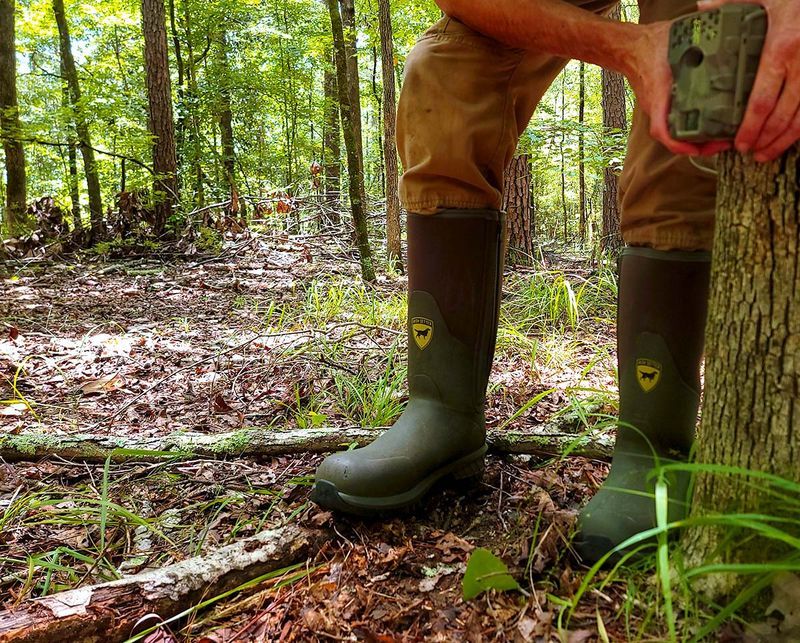
Picture the usual Saturday routine: you grab the rake, drag it across the lawn, and then crouch down to scoop up the pile by hand because it is faster.
That last step, the blind scoop, is the one worth changing.
Before any hand, foot, or knee goes near a pile of leaves, brush, boards, logs, rocks, dense shrubs, or stacked firewood, pause and look at the area from a standing position first.
Then use a long-handled tool to do the moving.
A standard garden rake, a hoe, or even a broom handle gives you 4 to 5 feet of distance between your hands and whatever might be underneath.
Push the debris aside in sections, working from one edge rather than plunging the tool into the center of a pile.
Give anything underneath a moment to move before you step closer.
CDC guidance for outdoor workers around venomous snakes recommends exactly this approach: use tools to move materials rather than bare hands, and wear sturdy footwear any time you work around natural cover.
Sturdy leather or rubber boots and long pants are the right gear for clearing a fence line, pulling debris from under shrubs, or moving anything that has been sitting undisturbed for more than a few days.
Boots protect your ankles and lower legs, which is where a low-to-the-ground snake would most likely make contact.
UF/IFAS Extension’s guide to preventing snake encounters in residential areas recommends gloves for yard work, but with an important clarification: gloves protect against thorns, splinters, and debris.
They do not make it safe to handle a snake or reliably prevent a bite through the material.
Apply the same pause-and-probe habit any time you clear debris from under a deck, move a stack of flower pots, or pull back a tarp that has been sitting on the ground.
Anywhere something has been lying undisturbed is a candidate for concealed cover.
Give A Spotted Snake Room To Leave
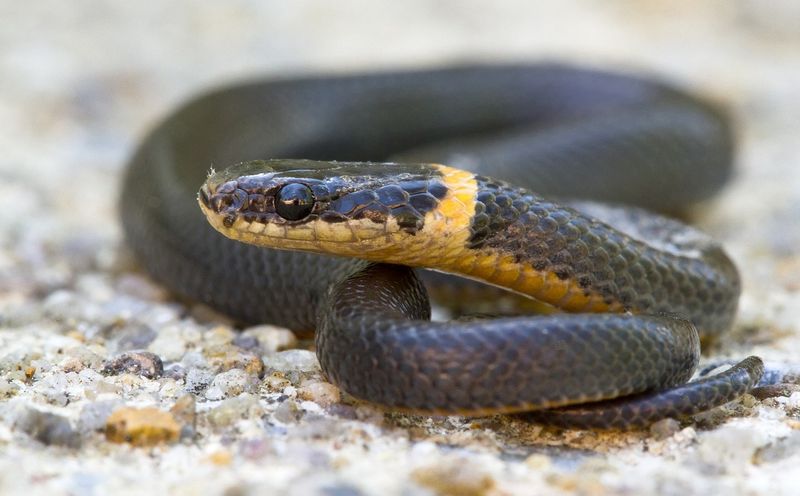
You spot a snake near the back steps and your first instinct is to figure out exactly what it is.
Stop right there.
Back away slowly, keep your eyes on the animal, and put at least 6 feet of distance between you and it before you do anything else.
Most snakes in Florida want nothing to do with people and will move on if given a clear route to cover and a few undisturbed minutes.
Keep children and pets away from the area while the snake is present.
Do not attempt to catch it, kill it, move it with a shovel, pin it down, or photograph it from a crouching distance.
Do not block the snake’s path back toward vegetation or the fence line.
A snake that feels cornered is far more likely to strike than one that has a clear exit.
UF/IFAS notes in its guide to managing conflicts with wildlife that a gentle spray from a garden hose, directed from a safe distance, can sometimes encourage a snake to move along.
That option applies only when you can operate the hose from well away from the animal and when you are not certain the snake is venomous.
It is not a universal fix, and it should not be used as a way to herd or corner an unidentified snake.
When a snake is sitting in a high-use spot, near a doorway, a children’s play area, or a pet run, calling a qualified wildlife professional is the right call.
FWC’s guidance on removing nuisance wildlife recommends professional removal for situations where trapping or handling is genuinely necessary, rather than attempting it yourself.
The snake is not a problem to solve with a shovel.
It is a wild animal that will almost always move on its own if given the chance.
A Small Rattlesnake Bite Still Requires Emergency Care
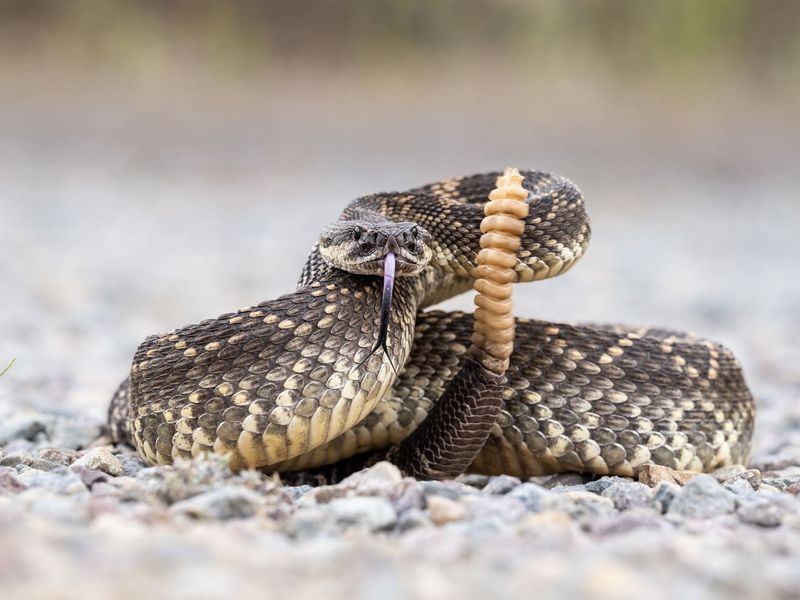
Small rattlesnake does not mean minor bite.
The dusky pygmy rattlesnake is a venomous pit viper, and its bite can cause significant pain, swelling, and tissue injury.
The Florida Museum notes that bites are generally considered less likely to be life-threatening than those from larger rattlesnakes, but the same source is clear that bites can be more serious for children and small pets.
Medical treatment is not optional, and waiting to see how bad it gets is not a plan.
If a bite happens, move away from the snake immediately.
Do not go back to look at it, catch it, or photograph it up close.
Call 911 right away.
Keep as still as possible, because movement increases the rate at which venom spreads through the body.
Remove rings, watches, and anything tight near the bite site before swelling begins.
Wash the wound gently with soap and water, cover it with a clean cloth or bandage, and get to an emergency room as fast as possible.
CDC guidance on venomous snakebites is direct about what not to do: do not cut the wound, do not try to suck out the venom, do not apply ice or a tourniquet, and do not use any kind of electrical shock.
All of those approaches can worsen the injury.
Poison Control’s rattlesnake guidance reinforces the same list.
A photograph taken from a safe distance may help with identification at the hospital, but do not delay treatment to get a picture.
For a pet that may have been bitten, keep the animal quiet and carry it rather than letting it walk.
Contact a veterinarian or emergency veterinary hospital immediately.
VCA Animal Hospitals’ guide to snakebite envenomization lists facial swelling, weakness, stumbling, breathing difficulty, vomiting, and rapid spreading swelling as emergency signs, but any suspected bite should be treated as urgent before those symptoms appear.
Time matters for pets just as it does for people.
Place Yard Cover Away From Daily Traffic
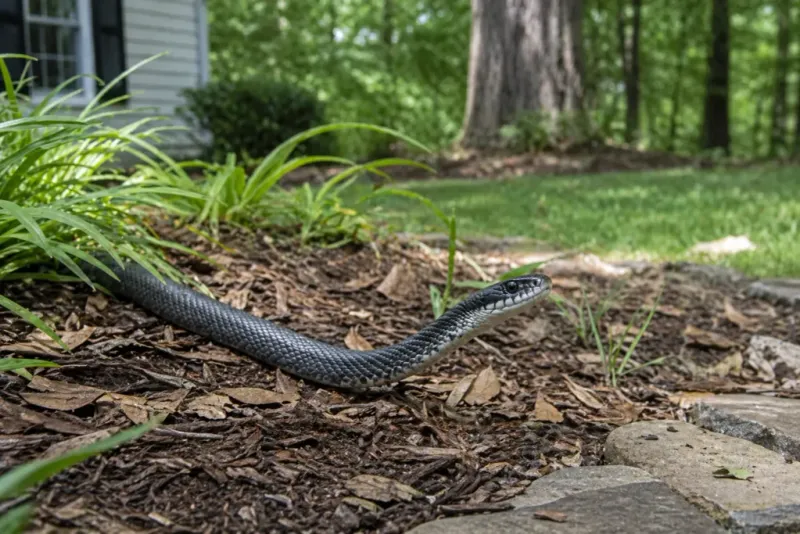
You cannot make a Florida yard snake-proof, and anyone who tells you otherwise is selling something.
What you can do is move the places where a surprise encounter is most likely away from the areas where your family spends the most time.
That one shift in yard organization does more practical good than any product on the market.
Keep brush piles, loose leaf accumulations, and debris away from the house, doorways, walkways, and any children’s play equipment.
When you stack firewood, use a raised rack that keeps the wood at least a foot off the ground, and position the rack away from the back door and the edge of the patio.
UF/IFAS Extension’s residential snake prevention guide recommends exactly this approach: reduce shelter and food opportunities near high-use areas rather than trying to eliminate every piece of natural cover from the entire property.
Keep grass at a manageable height, especially within 10 feet of doors, sidewalks, and play areas.
Trim shrubs and groundcover back from entryways so there are no hidden pockets right beside a door or step.
Seal gaps around the foundation, under doors, and around utility penetrations, because snakes follow rodents, and rodents will use any opening they can find.
Clean up spilled birdseed, fallen fruit, and pet food bowls promptly.
Rodent activity near the house is one of the strongest draws for snakes in residential Florida neighborhoods.
Removing that food source is not just good pest management, it is one of the most genuinely effective steps toward fewer snake encounters near the places you use every day.
A leaf pile at the far edge of the yard near the fence, away from foot traffic, is a very different risk than one piled against the back steps.
Placement is the real lever here.
Wet Weather Calls For Extra Inspection, Not Panic
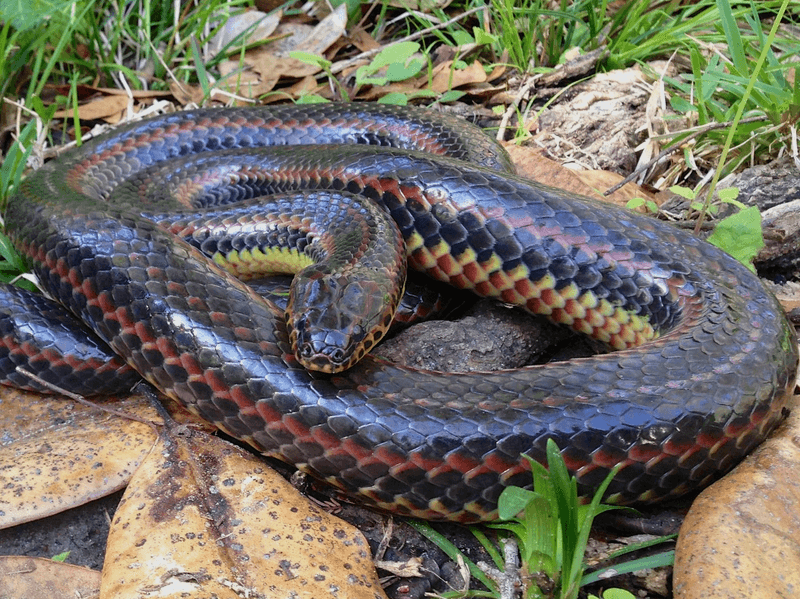
After a tropical storm rolls through Central Florida and leaves the yard soaked for three days, it is worth being a little more deliberate about where you step and reach.
FWC reports that higher water levels are associated with increased snake sightings, as snakes move away from flooded ground cover and into drier areas, which can include yards, porches, and garages.
A peer-reviewed field study of a Central Florida pygmy rattlesnake population, published in the journal Copeia, found that above-ground snake abundance was associated with periodic flooding and that the snakes were active across a wide temperature range, from about 57 to 90 degrees Fahrenheit, with seasonal movement peaks in spring and fall.
That study describes one Central Florida population, not a statewide calendar.
Weather patterns and habitat vary too much across Florida to apply those findings everywhere.
What the research does support is a simple habit shift after wet conditions: slow down, look before you step into debris, and check covered areas before reaching in.
This applies after heavy summer downpours, after flooding from a named storm, and during the gradual wet-season buildup from June through September along the Gulf Coast and Atlantic Coast alike.
Extra caution after wet weather is not about assuming a snake is waiting in every corner.
It is about recognizing that conditions have changed and giving yourself a few extra seconds to look before the hand goes in.
Skip Snake Repellents And Keep The Safe Routine
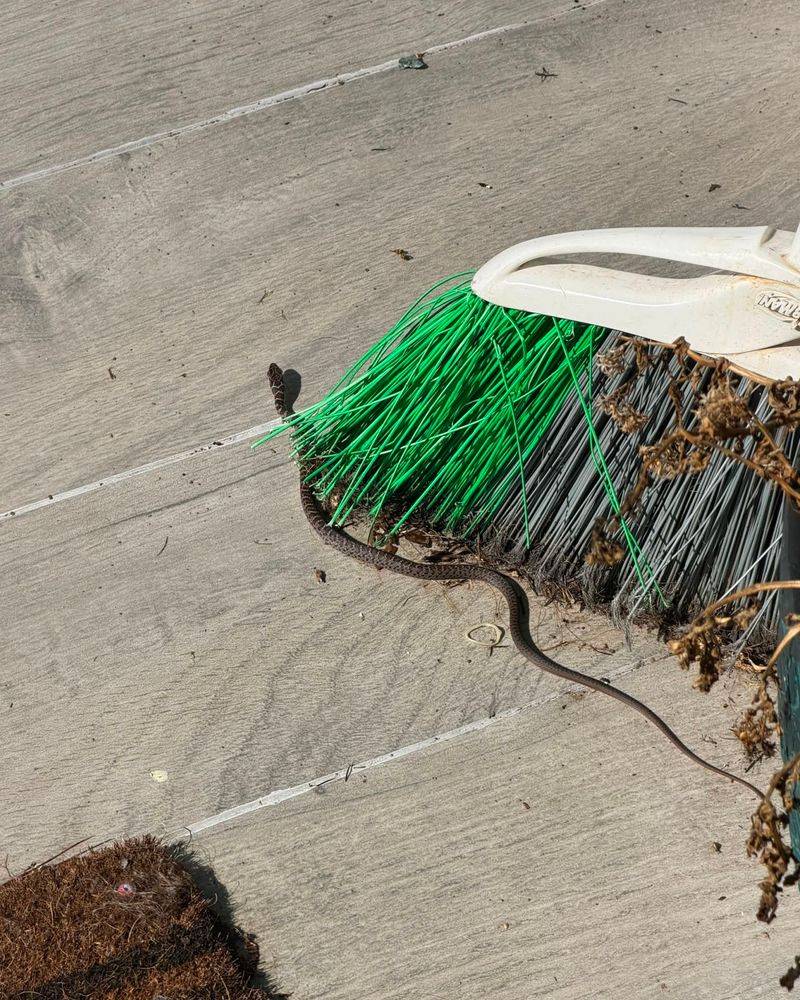
Mothballs scattered along the fence line will not keep snakes away.
Sulfur, garlic powder, cedar chips, and commercial snake repellent sprays will not keep snakes away either.
UF/IFAS Extension is clear that advertised snake repellents do not provide a dependable solution, and mothballs carry their own hazard: they are toxic to children, pets, and wildlife, and using them outdoors in ways not permitted by the product label is actually illegal under federal pesticide law.
The habit that actually works costs nothing and takes about ten seconds per task.
Pause before reaching into any concealed space.
Use a long-handled tool to move debris from a safe distance.
Wear boots and long pants when working around cover that has been sitting undisturbed.
Give any snake you spot plenty of room to leave on its own.
Call a qualified professional when a snake is in a spot where people or pets cannot safely avoid it.
FWC recommends professional removal as the appropriate path when a venomous snake cannot simply be left alone.
Florida yards are genuinely alive in a way that most places are not.
Snakes are part of that, and most of them spend their lives doing nothing more threatening than eating rodents in the brush.
The dusky pygmy rattlesnake is venomous and deserves real respect, but it is not pursuing anyone.
The risk is in the blind grab, the unexamined pile, the hand that goes somewhere the eyes have not been first.
Remove that one habit and the yard stays both natural and safe, which is actually the best outcome available in a state where the wildlife does not clock out for the season.