
The Invasive Texas Tree Quietly Transforming Native Habitat While You Look the Other Way
Follow us on Google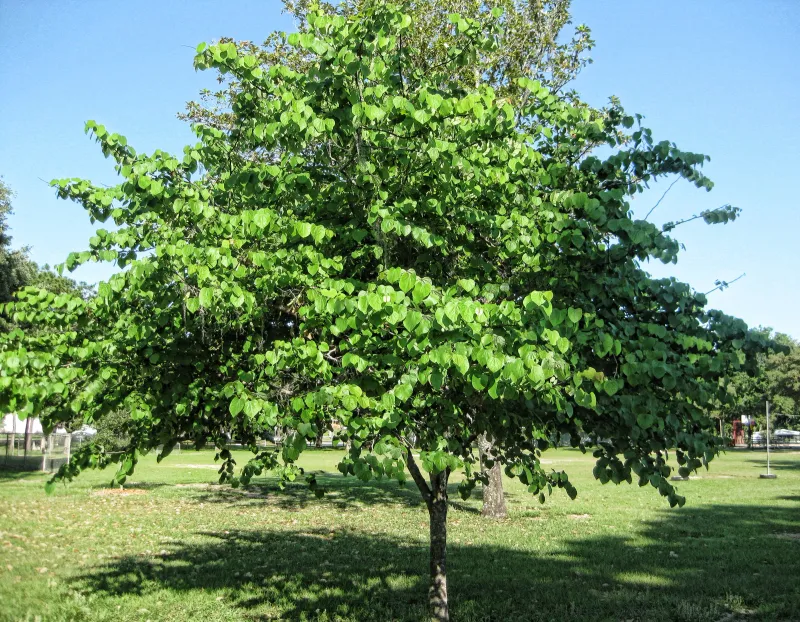
Most Texans have walked right past it a hundred times without knowing what they were looking at.
Chinese tallow, also called the popcorn tree, is spreading across Southeast Texas, Gulf Coast wetlands, and coastal prairies in a way that is changing the land faster than most homeowners realize.
It looks pretty in fall, grows fast, and drops seeds that birds carry everywhere.
But underneath that pleasant appearance, it is quietly replacing native plant communities that took centuries to establish.
The Tree Behind the Revised Headline
Somewhere along a fence line, a drainage ditch, or the edge of a backyard in Southeast Texas, there is probably a Chinese tallow tree growing right now that most homeowners have never noticed.
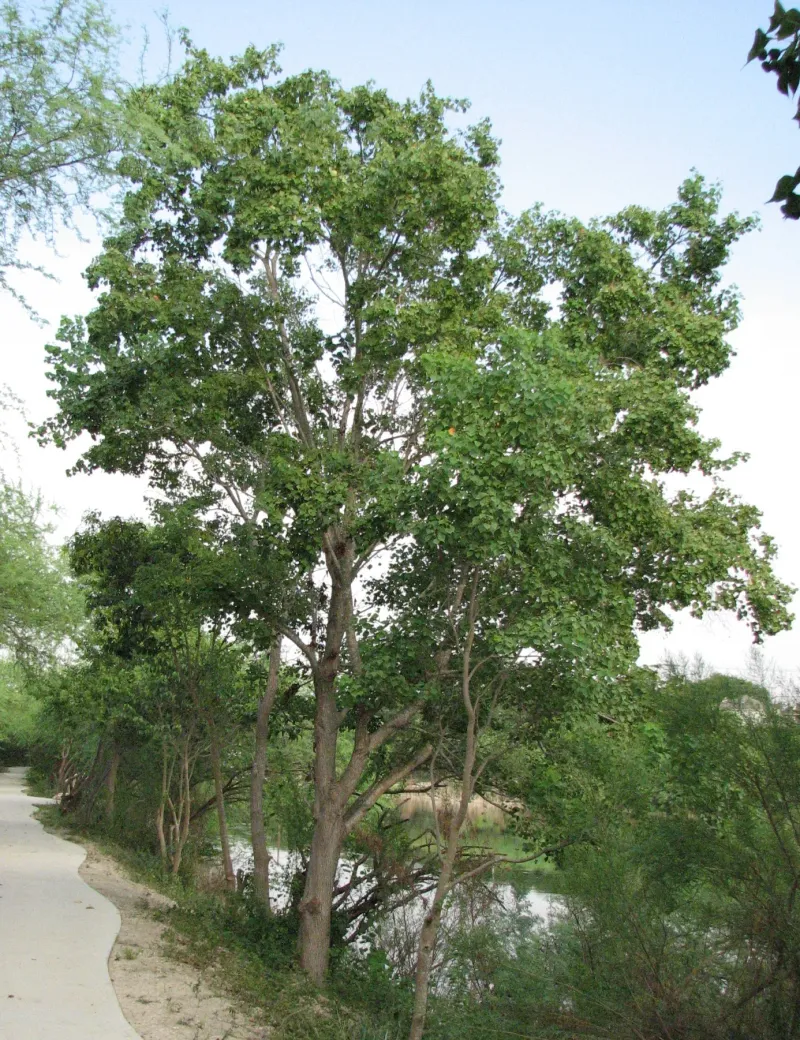
Formally known as Triadica sebifera, and widely called the popcorn tree, this fast-growing deciduous tree can reach roughly 60 feet tall and looks genuinely handsome through most of the year.
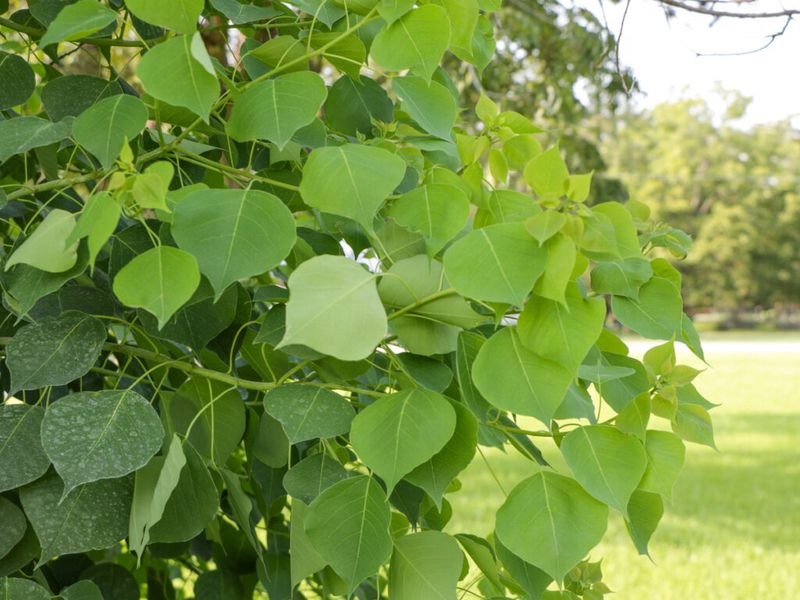
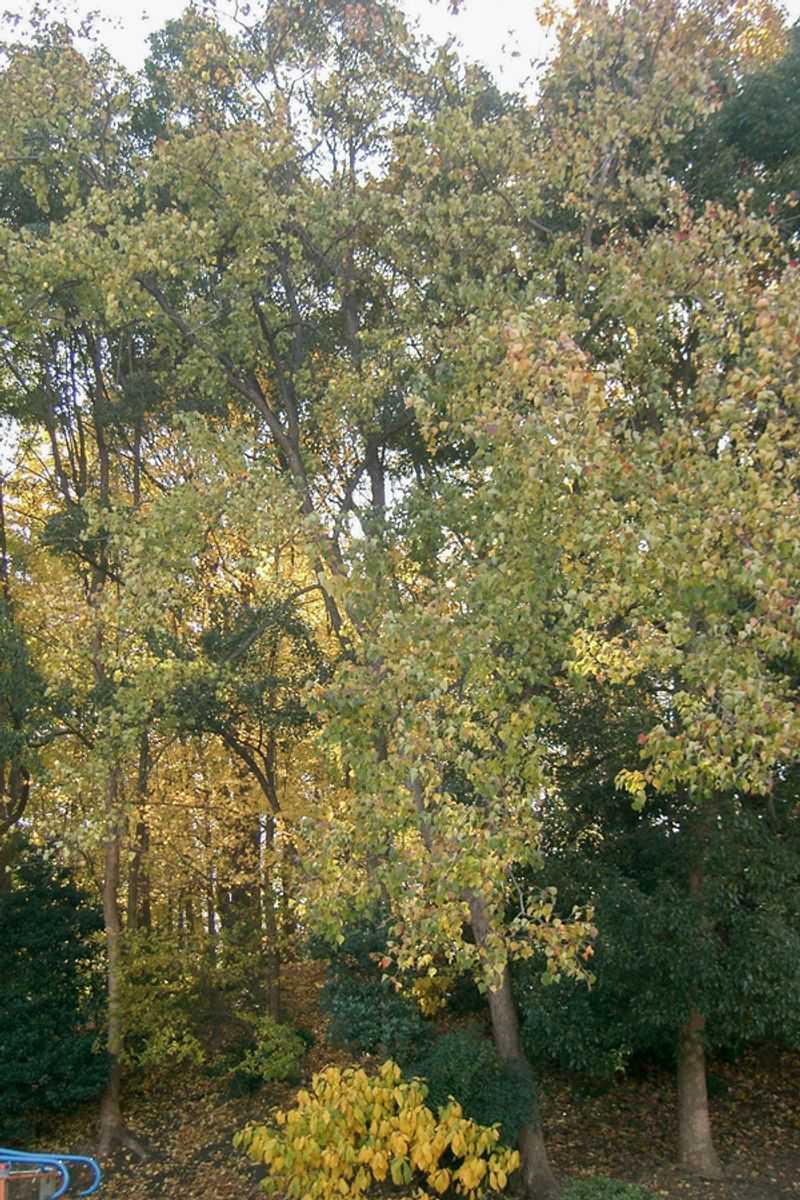
Its leaves are broad and oval, almost heart-shaped, and they turn a vivid red in fall that can stop you mid-step on a cool October morning.
Come late winter, the tree drops its fruit to reveal clusters of small white seeds that look exactly like popcorn spilled across the ground.
That combination of colorful fall foliage and the novelty of those white seeds helped make Chinese tallow a popular landscape choice for decades across the Gulf Coast and beyond.
The problem is that the same qualities that made it look good in a yard also made it extremely effective at spreading far beyond any yard’s edge.
According to Texas A&M Forest Service’s Chinese tallow profile, the tree is a documented invasive species with its strongest presence in Southeast Texas, the Gulf Coast, East Texas bottomlands, freshwater wetlands, and riparian corridors along waterways.
Texas Parks and Wildlife maps dense Chinese tallow forest and shrubland as a non-native invasive vegetation type concentrated in the southeastern portion of the state.
The concern is not equally distributed across every region of Texas, and a homeowner in the Panhandle or the Hill Country faces a very different situation than one living near Houston or Beaumont.
What the evidence does support is a narrower but serious claim: Chinese tallow can quietly change the physical structure of native Texas habitat.
That is different from saying it has eliminated more native life than any other invader.
The comparison with fire ants that circulates in headlines is genuinely difficult to verify, because the two invaders affect ecosystems in completely different ways, and no reliable statewide measurement puts them on the same scale.
What you can say plainly is that this attractive tree is a slow, silent force reshaping native prairies, wetlands, and woodlands across a significant part of Texas.
Why an Ornamental Tree Spreads So Quietly
Chinese tallow did not accidentally end up in Texas.
It was brought to the United States in the 1700s, and later introduced along the Texas Gulf Coast with a specific purpose in mind: its seeds contain a waxy coating that was once used to make soap and candles, and seed oil was another commercial draw.
Planting it seemed like a reasonable idea at the time, and for many years it was promoted as an ornamental tree in Gulf Coast landscapes because it grew fast and looked good doing it.
The reason it spread so far beyond those original planting sites comes down to tolerance.
Texas A&M Forest Service notes that Chinese tallow can handle wet and dry conditions, partial shade, periodic flooding, freshwater soils, and even some saline soils.
That kind of flexibility is rare, and it means the tree can establish itself in places where most other non-native species would struggle, from the saturated edges of a marsh to a dry roadside bank baking under a July sun.
Seeds are the main engine of its spread, and birds do a lot of the hauling.
Songbirds and other species eat the white seeds and deposit them across the landscape, often far from the parent tree.
Water carries seeds too, which is why you find new seedlings popping up along drainage ditches, creek banks, and the low edges of properties after a good rain.
A U.S.
Geological Survey report on Chinese tallow’s spread across the southeastern coastal plain highlights how effectively the tree moves through wetland and waterway corridors.
The timing makes early action genuinely important.
Chinese tallow can begin reproducing in as little as three years, so a seedling you ignore along your back fence today could be dropping its own seeds before your child finishes elementary school.
And because the tree can resprout from both crown and root buds after cutting, simply mowing or trimming a young plant without removing the root system often just delays the problem rather than solving it.
How Tallow Changes Native Habitat
Picture a stretch of open coastal prairie in Southeast Texas, the kind of low, grassy landscape that once covered millions of acres along the Gulf.
Now picture that same stretch 20 years after a few Chinese tallow trees got established at its edge.
The canopy has closed.
The grasses are gone.
The ground underneath is covered in a thick mat of tallow leaf litter that changes the soil chemistry and makes it harder for native prairie plants to germinate or grow.
That shift from open grassland to closed-canopy woodland is exactly the kind of habitat transformation that makes Chinese tallow a serious concern.
It is not that the tree kills every native plant the moment it arrives.
The change is slower and more structural than that.
Dense stands cast heavy shade that sun-loving prairie species cannot survive, and the altered litter layer and soil conditions work against native plant recovery even after the tallow is removed.
The U.S.
Forest Service’s detailed species review of Triadica sebifera describes several of these effects as variable and notes that research into some impacts is still ongoing.
The stakes are especially high on coastal prairie because so little of it remains.
Texas A&M Forest Service identifies Chinese tallow as a contributor to the conversion of open prairie into woodland, removing the habitat that grassland-dependent wildlife needs to survive.
The endangered Attwater’s prairie-chicken is one species that depends on open coastal prairie, and habitat loss from woody encroachment, including tallow invasion, is a documented pressure on that bird’s remaining population.
Some birds and other wildlife do use tallow stands, but studies and agency reports consistently indicate those stands support fewer native species and different wildlife communities than the plant communities they replace.
Forest inventory data collected by Texas A&M Forest Service estimated roughly 343 million Chinese tallow trees in Texas, with a 38 percent increase in East Texas between 2007 and 2017, a 44 percent increase in net volume over that same decade, and approximately 497 million seedlings recorded in East Texas in the same inventory.
These are forest inventory figures from a specific time window, not a current statewide count, but they give a real sense of the scale and direction of change across the region most affected.
Fire Ants Cause a Different Kind of Damage

Fire ants are a genuine menace, and any Texan who has stepped barefoot onto a mound in the backyard does not need convincing.
But the comparison between Chinese tallow and imported fire ants that sometimes circulates in headlines is harder to pin down than it sounds, because the two invaders cause damage in completely different ways and no reliable statewide measurement puts them on the same scale.
According to USDA APHIS data on imported fire ants, the red imported fire ant affects more than 367 million acres across the United States, including large portions of Texas.
Fire ants displace native ant species, reduce the insect and invertebrate food sources that birds and reptiles depend on, injure people and livestock, and can affect vulnerable animal populations directly through predation.
Their damage is biological and behavioral, moving through the food web from the ground up.
Chinese tallow works differently.
Its impact is primarily structural, reshaping the physical environment by replacing native plant communities with dense tallow stands that change shade, litter, soil conditions, and the habitat framework that native wildlife depends on.
A peer-reviewed study on fire ant invasion and arthropod community disruption found major losses in ant diversity after red imported fire ant arrival, while also finding that effects varied with moisture, disturbance, and habitat type, which is a useful reminder that both invaders operate differently depending on where you are.
A study examining fire ant populations near the edge of their range in Central Texas adds more context about how their impact shifts with local conditions.
The honest answer is that Chinese tallow and fire ants are both serious problems for Texas ecosystems, but they are not the same kind of problem and the available evidence cannot determine which one has caused more total habitat loss statewide.
Framing them as competitors in a damage ranking misses the point: each one requires its own response.
How to Recognize Chinese Tallow Before Treating It
Before you reach for a shovel or a herbicide bottle, make sure the tree you are looking at is actually Chinese tallow.
Several native Texas trees have broad leaves or grow quickly in similar settings, and treating the wrong plant is a waste of effort at best and genuinely harmful at worst.
Here is what to look for.
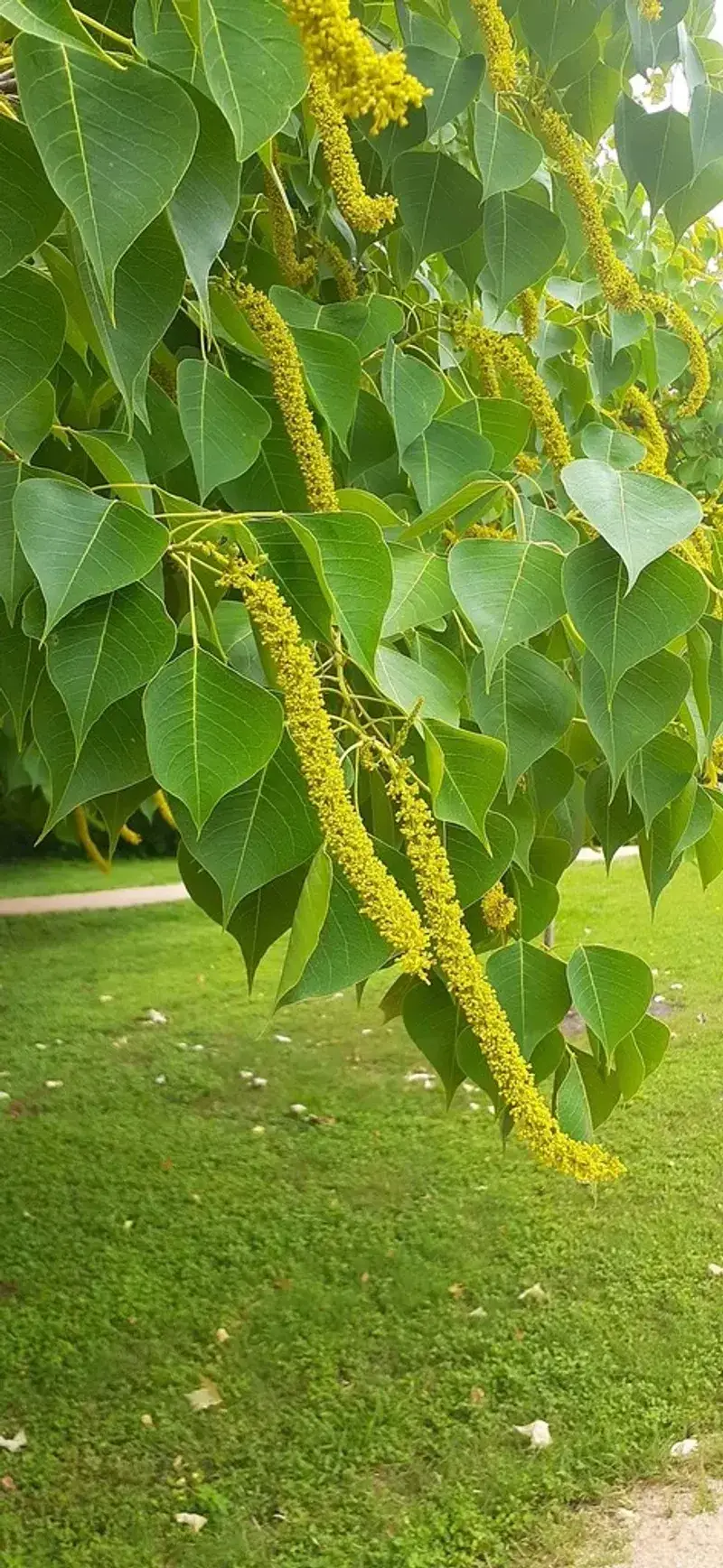
Chinese tallow has leaves that are broadly oval to almost diamond-shaped, with a pointed tip and a slightly waxy surface.
In fall, those leaves turn a bright red or orange that can look almost tropical against a gray November sky.
In spring, the tree produces long, dangling flower clusters, pale yellow-green and about 2 to 4 inches long, that appear before the leaves are fully out.
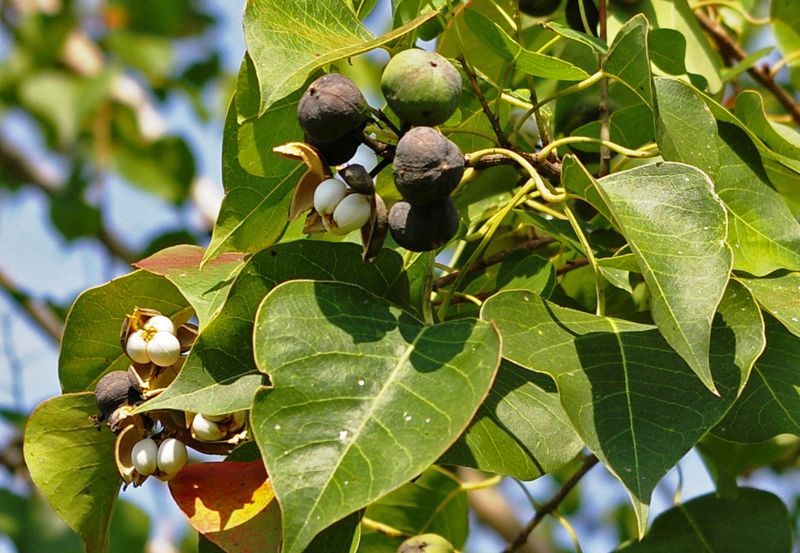
After the flowers drop, small three-lobed fruit forms, and when those open in late fall or winter, they reveal the white waxy seeds that give the tree its popcorn nickname.
Location is another clue.
Chinese tallow almost always shows up first near water, along drainage ditches, creek edges, low spots in the yard, or fence lines where birds perch and drop seeds.
In Southeast Texas and along the Gulf Coast, it can appear in any disturbed or moist soil, including the acidic sandy soils of East Texas bottomlands.
Texas A&M Forest Service’s identification guidance recommends comparing photographs carefully before treating any mature specimen.
If you are uncertain, take a clear photo of the leaves, bark, seeds, and the overall tree shape, then contact your county extension office, a certified arborist, or a local invasive-plant specialist.
Identification and treatment are two separate steps, and keeping them that way protects both the native trees on your property and your time.
Remove Seedlings Before They Become Seed Sources
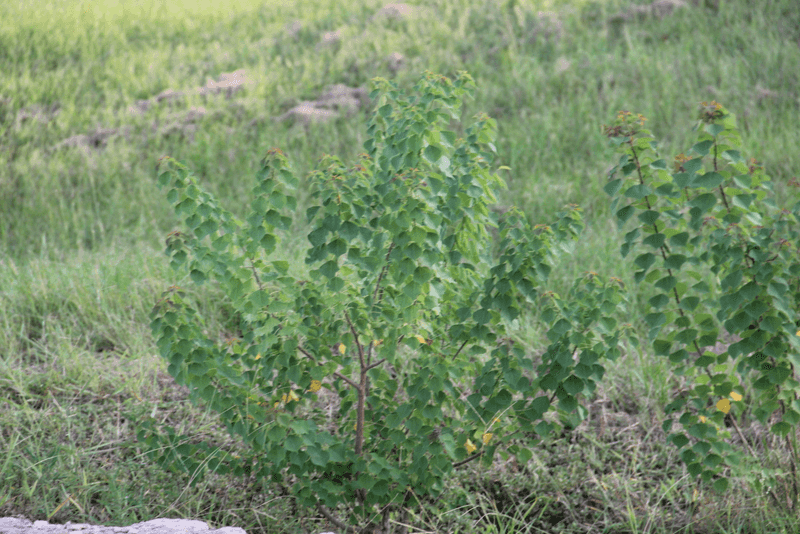
A Chinese tallow seedling in its first or second year is genuinely easy to manage.
Pull it out of moist soil after a rain, get the whole root system, and you have actually solved that particular plant for good.
Wait two or three more years and the same seedling has become a small tree with an established root system, the ability to resprout after cutting, and quite possibly its own crop of seeds already feeding the birds that will carry them to your neighbor’s yard.
That three-year window to reproduction is the reason early removal matters so much.
Texas A&M AgriLife Extension’s tallow removal guidance describes hand-pulling and digging as effective methods for very small plants, with the critical condition being that the entire root system comes out with the plant.
If you break the stem off at ground level and leave the roots behind, the plant will resprout, sometimes sending up multiple new shoots from the crown that are harder to manage than the original seedling.
After you remove seedlings, watch that same spot every spring and fall for the next two to three years.
Texas A&M Forest Service is clear that bird and water dispersal continue regardless of what you do on your own property.
Seeds from tallow trees on neighboring land, along nearby waterways, or further up a drainage ditch will keep arriving.
Early removal works best when it becomes an annual habit rather than a one-time event.
One realistic thing to keep in mind: clearing your own yard does not stop seeds from blowing or washing in from outside your fence line.
The goal of early removal is to prevent the seedlings on your property from becoming seed sources themselves, which breaks one link in the local spread chain even if it cannot stop the regional picture on its own.
Use a Site-Specific Plan for Larger Trees
Cutting a Chinese tallow tree down and walking away is one of the most common mistakes homeowners make.
The stump will resprout, the crown may send up multiple new stems, and within a season or two you can have a multi-stemmed shrub that is harder to treat than the original tree.
Mechanical removal needs to be paired with a follow-up treatment plan, or the work gets repeated.
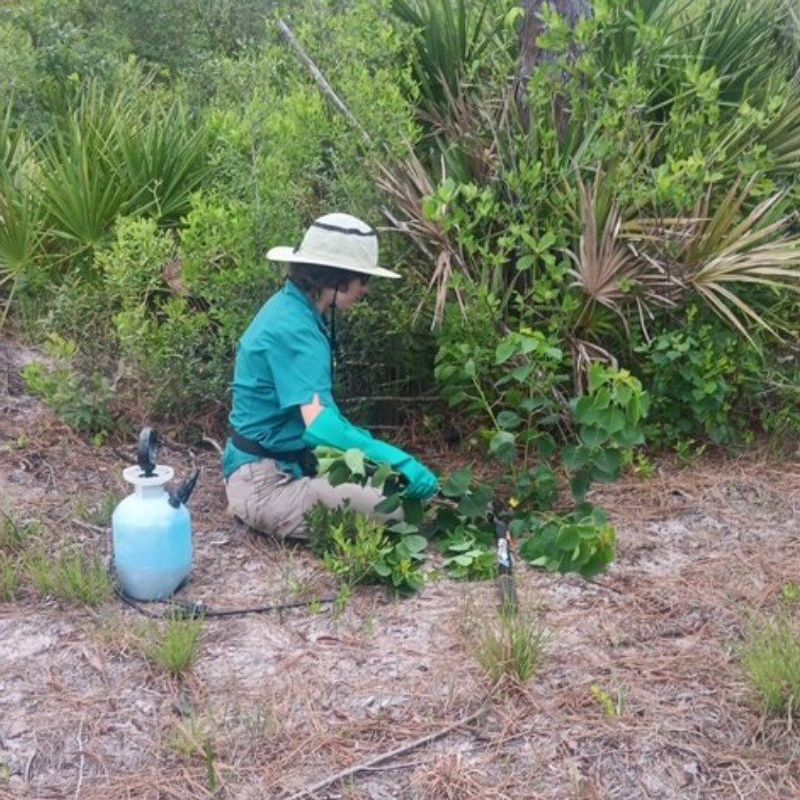
Texas A&M AgriLife Extension’s Brush Busters program outlines two individual-plant herbicide methods suited to different tree sizes.
For well-leafed trees under about 6 feet tall, a leaf spray treatment applied between April or May and September can reach the foliage effectively.
For young trees or older trees with three or fewer basal stems, a stem spray directed at the bark near the base is the recommended approach.
AgriLife Extension’s tallow removal publication reports typical control rates of 76 to 100 percent under good conditions, but those results depend on the right weather, correct application technique, tree condition, and bark characteristics.
That range is a best-case picture, not a guarantee for every situation.
For larger trees with trunks exceeding roughly 5 inches in diameter, cut-surface treatment is the approach Texas A&M Forest Service recommends, applying an appropriate herbicide directly to the freshly cut stump surface immediately after cutting.
AgriLife Extension’s individual-plant treatment guide for leaf and stem applications provides detailed guidance on product selection and timing for those situations.
Any herbicide use requires reading and following the product label completely, including protective equipment, weather restrictions to prevent drift, reentry intervals, and site-specific limitations.
Texas A&M Forest Service specifically warns that some products are soil-active and may harm desirable nearby hardwoods through root uptake, while triclopyr ester formulations should not be used on aquatic sites.
And if a mature tallow tree is growing near your home, a power line, or a structure, please call a qualified arborist before picking up a chainsaw.
A falling limb from a 40-foot tree near a house is not a do-it-yourself problem.
Monitor the Site Instead of Declaring Victory
Removing a Chinese tallow tree, even successfully, is the beginning of a maintenance commitment rather than the end of one.
The site needs to be checked every year, ideally in late spring and again in fall, because resprouts from root tissue and new seedlings from bird-dispersed seeds will keep appearing for several seasons after the original tree is gone.
Fire sometimes comes up in conversations about tallow management, and it is worth understanding what it can and cannot do.
U.S.
Forest Service research on Triadica sebifera describes fire as a context-dependent tool: it can suppress young seedlings when enough fuel is present to carry a hot enough burn, but mature tallow trees can survive fire or resprout from the root crown afterward.
Fire can also increase invasion risk on sites where seed-producing tallow trees are nearby, because opening the canopy or exposing bare soil creates exactly the conditions where tallow seeds germinate readily.
Prescribed fire on coastal prairie is a legitimate management tool in the right hands, but it is not a backyard solution and it is not a guarantee against tallow return.
Herbicide applications near water require extra care.
Texas Parks and Wildlife’s wetland vegetation guidance and label requirements both make clear that not every product is approved for use near ponds, streams, drainage ditches, marshes, or wetlands.
Check the label before treating anywhere near standing or moving water, and when in doubt, consult your county extension office or a licensed applicator.
AgriLife Extension’s tallow removal guidance is a good starting point for understanding which approaches fit which sites.
The native character of a yard, a prairie edge, a wetland border, or a bottomland patch is genuinely worth protecting, and consistent attention over a few years can make a real difference.
The tallow tree is patient, but so are the native grasses and wildflowers waiting for the light to come back.