
What It Really Means When A Gopher Tortoise Digs In On Your Florida Property
Follow us on Google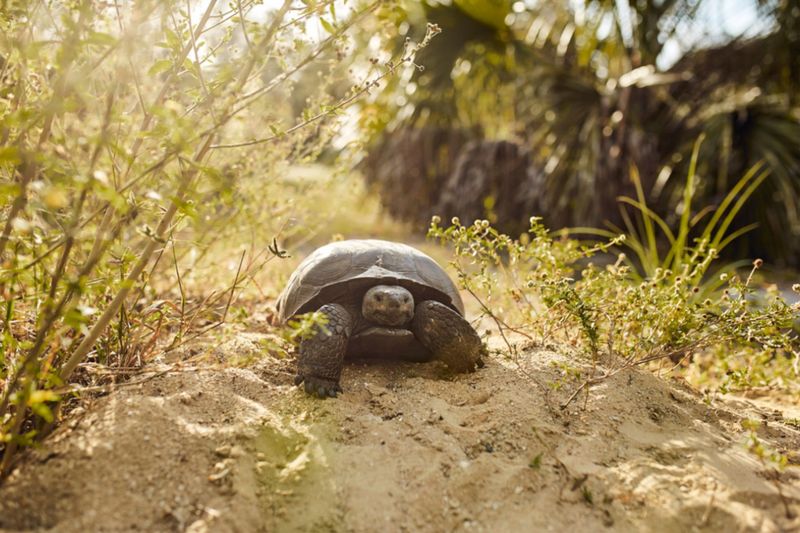
You step onto the back patio one morning, coffee in hand, and there it is: a half-moon-shaped hole in the sandy soil near the fence line, with a small mound of loose dirt fanned out in front like something deliberate happened overnight.
A gopher tortoise picked your property, and that choice tells you something real about your land.
In Florida, that choice also carries legal weight you need to understand before you grab a shovel or call a contractor.
This article walks you through what the sighting actually means, what you can safely do, and exactly when state law requires you to stop and call the Florida Fish and Wildlife Conservation Commission first.
A Tortoise Offers A Limited Report Card
Finding a gopher tortoise digging into your Florida yard feels like an endorsement, and in a narrow sense it is.
The animal chose that spot because something about the site or the connected land nearby still works for it: the soil drains well enough to dig, there is enough open sun to warm up, and low-growing plants are within reach for grazing.
That is a meaningful signal, and you should feel good about it.
But the signal has limits worth understanding right away.
A tortoise on your property does not prove that the entire yard is ecologically healthy, highly biodiverse, or managed correctly. recent research on gopher tortoise burrow communities in modified landscapes found that disturbed and urban sites can support tortoises and even comparable burrow densities while hosting fewer of the associated animal species that depend on those burrows in more intact habitats.
The tortoise may also be using a small sandy pocket near your fence, a roadside edge, or habitat on a neighboring undeveloped lot that connects to your yard.
The sighting tells you that some usable upland conditions remain somewhere in that local network, not that every corner of your property passes a full ecological test.
Three practical priorities follow from that honest read.
First, understand what habitat features the tortoise is actually using so you can protect them.
Second, leave the burrow undisturbed, because Florida law protects both the tortoise and its burrow as a state-threatened species.
Third, contact the Florida Fish and Wildlife Conservation Commission before any construction, grading, clearing, or significant ground disturbance near the site.
The tortoise handed you a useful clue about your land.
The rest of this article helps you read it correctly and respond well.
Read The Habitat, Not The Whole Yard
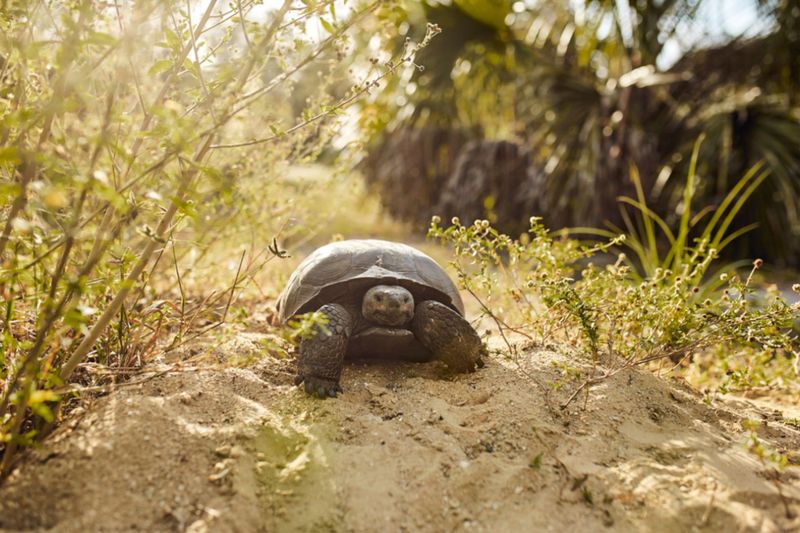
Gopher tortoises are picky about one thing above most others: the ground beneath them.
FWC’s species profile describes suitable habitat as a combination of well-drained sandy soil, abundant low-growing herbaceous plants, and open sunny areas with a sparse tree canopy overhead.
When those three conditions line up, a tortoise can dig, forage, and thermoregulate without much trouble.
When one of them disappears, the site becomes harder to use.
Florida is not one uniform landscape, and tortoise habitat reflects that variety.
In the Panhandle and North Florida, longleaf pine sandhills and flatwoods are classic territory.
Central Florida adds scrub, dry prairie, and xeric oak hammock to the list.
Along both coasts, tortoises use coastal dunes, pastures, and even urban green spaces with enough open ground.
South Florida and the Keys introduce a different setting entirely: shallow limestone-based soils in places like Miami-Dade County can support tortoises in specialized pine rockland and scrubby flatwoods pockets where the standard sandy-soil guidance does not apply in the same way.
A tortoise on your property may be pulling habitat resources from more than one location.
The University of Florida Gopher Tortoise Probability Index illustrates how habitat suitability can shift sharply over very short distances across the state.
Your yard might offer good digging soil while a neighboring lot provides most of the forage, or a roadside edge nearby serves as a travel corridor between the two.
Research on tortoises in urban pine rockland reserves confirms that modified landscapes can still function as part of a usable habitat network, even when they do not tick every ecological box.
Look at the patch of land the tortoise is actually using, not the whole yard at once, and you will get a clearer picture of what is working.
The Burrow Reveals Why The Site Matters
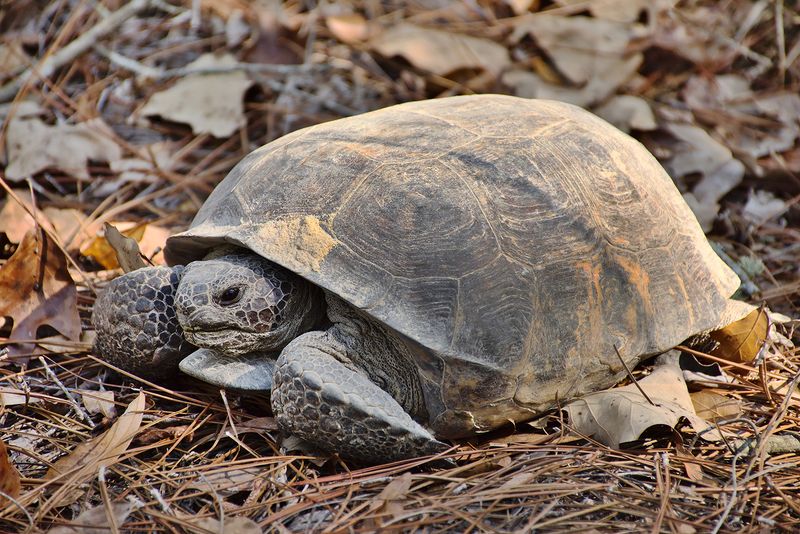
A tortoise you spot crossing the yard is interesting.
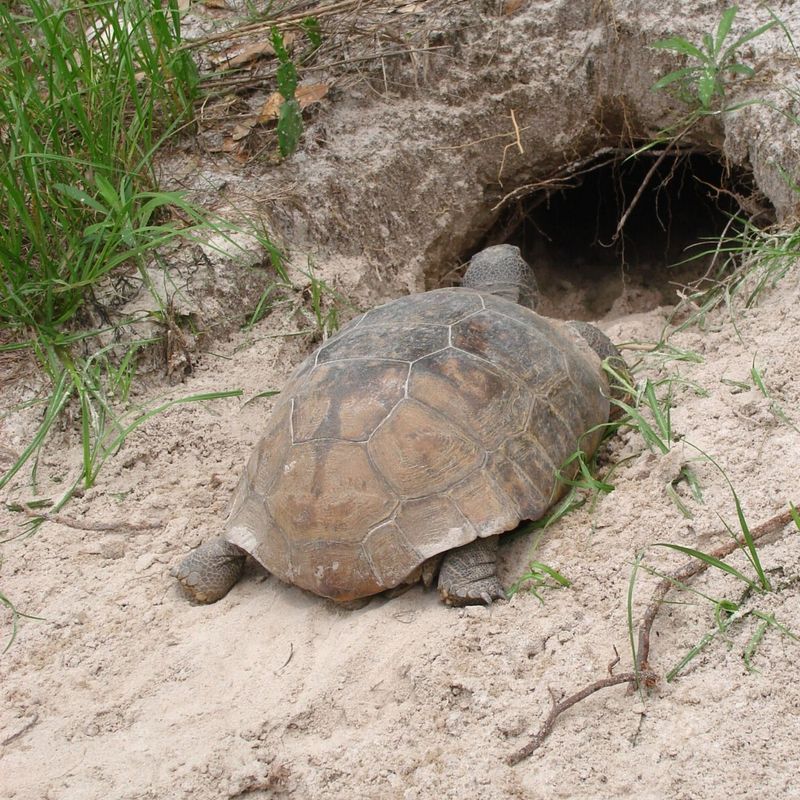
A burrow on your property is something more, because digging a burrow requires a real commitment of time, energy, and soil conditions.
FWC reports that a typical burrow averages about 15 feet long and 6.5 feet deep, though documented burrows can reach approximately 40 feet long and 10 feet deep depending on the animal’s size and the local soil.
The tortoise slopes the tunnel downward at a consistent angle so the chamber at the end stays at a stable temperature and humidity year-round.
That underground chamber does a remarkable amount of work.
It shields the tortoise from Florida’s summer heat, from occasional hard freezes in North Florida, from drought, and from the fast-moving wildfires that historically swept through upland habitats.
FWC notes that tortoises spend up to 80 percent of their time inside burrows, which means the burrow is less a shelter of last resort and more the center of the animal’s daily life.
Other animals use these tunnels too.
Fish and Wildlife Service project documentation and FWC’s gopher tortoise program both reference a broad estimate of more than 350 species that have been documented using tortoise burrows as shelter, including Florida mice, gopher frogs, eastern indigo snakes, and dozens of invertebrates.
That figure is a wide-ranging estimate across habitats, regions, and definitions of “burrow associate,” not a count of what lives in any single burrow.
And as burrow associate research in modified Florida landscapes shows, urban or disturbed sites may retain tortoises while supporting fewer of those associated species than more intact habitats would.
The burrow on your property is genuinely valuable, and keeping it safe is the single most useful thing you can do.
Check The Burrow Without Touching It
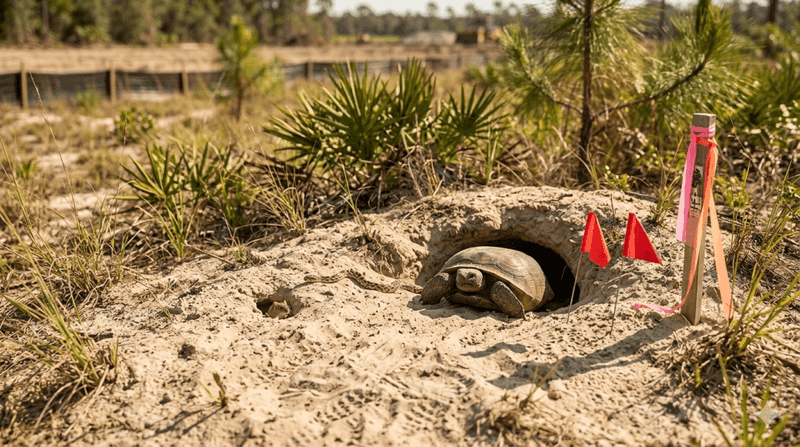
Not every hole in a Florida yard belongs to a gopher tortoise, and making that call correctly matters before you decide how to respond.
The entrance shape is the first thing to check.
A gopher tortoise burrow has a distinctive half-moon or flattened-oval opening, wider than it is tall, because the tortoise’s shell is wider on top and flat on the bottom.
FWC’s burrow identification guidance notes that entrances can range from about 2.5 to 15 inches wide depending on the size of the animal using it, so a small burrow is not automatically something else.
Look at the apron, the fan of loose soil spread out in front of the entrance.
Fresh digging leaves that soil loose and granular.
Tracks pressed into the apron, the paired oval impressions of a tortoise’s front feet and the drag mark from the shell, are a strong sign of recent activity.
Armadillo holes tend to be rounder and more vertical.
Fox and gopher frog burrows have their own shapes and soil signatures.
An occupied tortoise burrow can also look inactive during cooler months when the animal is spending more time underground, so a quiet entrance in January does not necessarily mean the burrow is abandoned.
Observe from a comfortable standing distance of at least several feet and resist the urge to get closer for a better look.
FWC’s guidance for property owners is clear: do not probe the entrance, fill it, block it, cover it, collapse it, landscape over it, or place any objects in the opening.
If you cannot tell whether the hole belongs to a tortoise, a qualified wildlife professional can confirm it.
Federal wildlife guidance reinforces the same caution: when in doubt, treat the burrow as active and protected until you know otherwise.
Florida Protection Starts Before Ground Disturbance
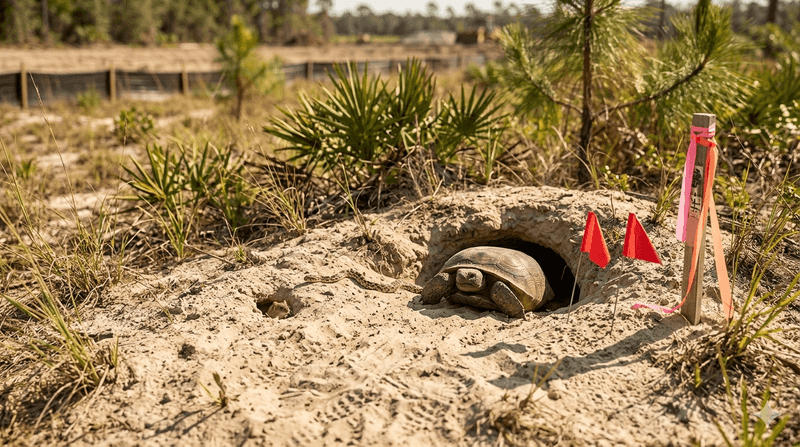
Florida takes its gopher tortoise protections seriously, and the rules apply to your property whether the tortoise showed up last week or has been there for years.
FWC’s rules and regulations page states that capturing, possessing, transporting, harassing, harming, or relocating a gopher tortoise generally requires authorization from the Commission.
That protection extends to the burrow itself.
You cannot fill it, collapse it, or build over it without going through the proper process first.
For ground-disturbing work on your property, the key number to know is 25 feet.
FWC’s permitting FAQ explains that development activities must avoid active burrows by at least 25 feet in all directions or proceed under the appropriate permit and authorized relocation process.
That 25-foot figure is a development and disturbance threshold, not a blanket ban on everything that happens near the burrow.
Ordinary maintenance that does not harm the tortoise or collapse the burrow is a different category from regulated work.
The regulated category is broad and worth taking seriously.
Construction, grading, paving, clearing, pool installation, large tree removal, fence installation, and equipment staging all qualify as ground-disturbing activities that may require authorization.
If your project falls into any of those areas and a burrow is within range, contact FWC before you begin.
FWC’s permit process for sites with 10 or fewer burrows outlines the steps for smaller residential properties, and FWC’s enforcement policy describes what can happen if work proceeds without authorization.
One common misconception is worth clearing up.
Florida’s gopher tortoise is a state-designated threatened species, which is a real and enforceable protection.
The eastern population, which includes all of Florida, was reviewed at the federal level and a 2022 U.S.
Fish and Wildlife Service finding determined that federal listing was not warranted at that time.
Florida’s state protections remain fully in effect regardless of that federal determination, and they are the rules that govern what you can and cannot do on your property.
Keep The Yard Usable And The Entrance Safe
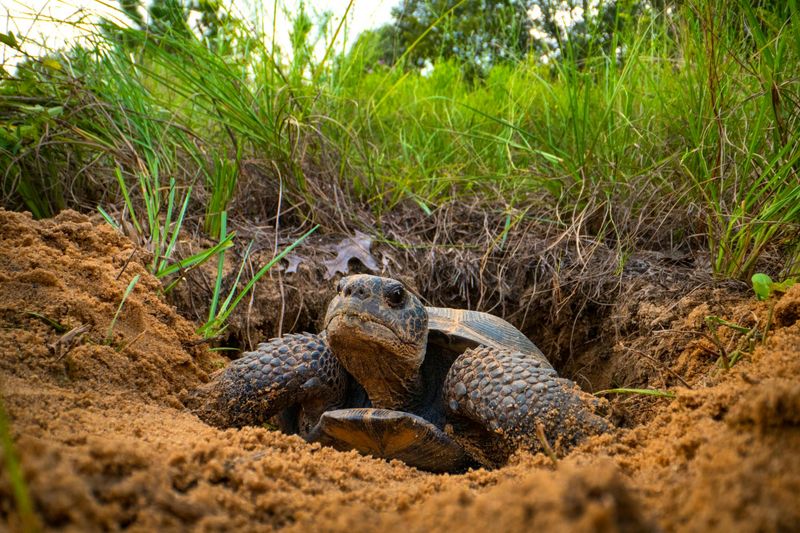
Routine yard care does not automatically put you in conflict with Florida law, but the area immediately around the burrow entrance deserves a different level of attention than the rest of the lawn.
Keep dogs and children away from the burrow.
Mowing, digging, driving, and heavy equipment near the entrance can disturb or collapse the tunnel even when that is not the intent.
FWC’s how-to-help guidance notes that a weed trimmer can be used carefully around grass or weeds immediately near the entrance, as long as the work does not harm the tortoise or damage the burrow structure.
That is the kind of ordinary maintenance that falls outside the permit requirement.
The broader goal for the yard is not a manicured feeding station.
It is open sunlight, safe low-growing forage, and an unobstructed entrance.
Tortoises generally graze within about 160 feet of their burrows, though FWC notes they may travel more than twice that distance when local food is limited.
FWC’s guide to gopher tortoise-friendly plants lists broadleaf grasses, wiregrass (Aristida stricta), prickly pear cactus (Opuntia humifusa), wild grape, blackberry, blueberry, beautyberry (Callicarpa americana), and many other native species as food sources the tortoise will actually use.
Retaining or adding those plants where they fit naturally is a reasonable step.
But planting forage plants alone cannot create suitable habitat or draw a tortoise into a yard that lacks appropriate soil, open light, and burrow conditions.
Think of the vegetation as one layer of a supportive environment, not the whole solution.
FWC’s species profile identifies prescribed fire as a major tool for maintaining many tortoise habitats across Florida because it reduces dense canopy and encourages the herbaceous groundcover tortoises depend on.
On a rural property, thinning woody growth or selective mowing under local expert guidance can serve a similar function.
On a residential lot, keeping the area around the burrow open and uncluttered is genuinely the most practical contribution you can make.
Let The Tortoise Keep Its Route
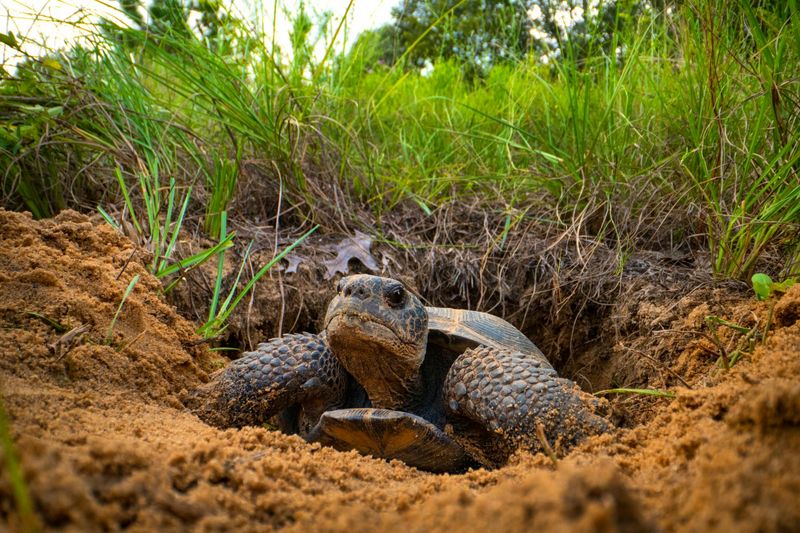
Most of the time, the right response to a healthy gopher tortoise on your property is to watch it from a distance and leave it alone.
Pets create real risk, so keep dogs inside or leashed when the tortoise is active near the burrow.
Children should observe from several feet away without approaching or touching the animal.
Do not offer food, water, or any kind of supplemental care.
FWC’s help page is direct on this point: gopher tortoises are natural grazers adapted to Florida’s conditions, and casual feeding or hand-watering is not recommended.
What works for a captive or desert tortoise does not apply here.
Road crossings are the situation that calls for more active judgment.
A tortoise on pavement faces real danger from vehicles, and it is legal to help in a specific, limited way.
FWC’s tortoise sighting guidance instructs you to move the animal only when it is safe to do so, only out of immediate danger, and only in the direction it was already heading.
That last part matters more than it sounds.
The tortoise has a destination in mind, and reversing its direction puts it back in traffic or cuts it off from the habitat it was moving toward.
Do not carry the tortoise to a park, a pond, a vacant lot, or another neighborhood.
Moving a gopher tortoise away from its home area can separate it from an established burrow and from the landscape connections it relies on.
FWC rules require authorization for relocation, and FWC’s upper respiratory tract disease program notes that moving tortoises between populations without health screening can introduce disease.
The tortoise that picked your property found something useful there.
Protecting that usable connection, the soil, the light, the forage, the safe entrance, does more lasting good than any well-meaning attempt to find it a better spot.