
What It Really Means When A Mourning Dove Starts Lingering Around Your North Carolina Yard
Follow us on Google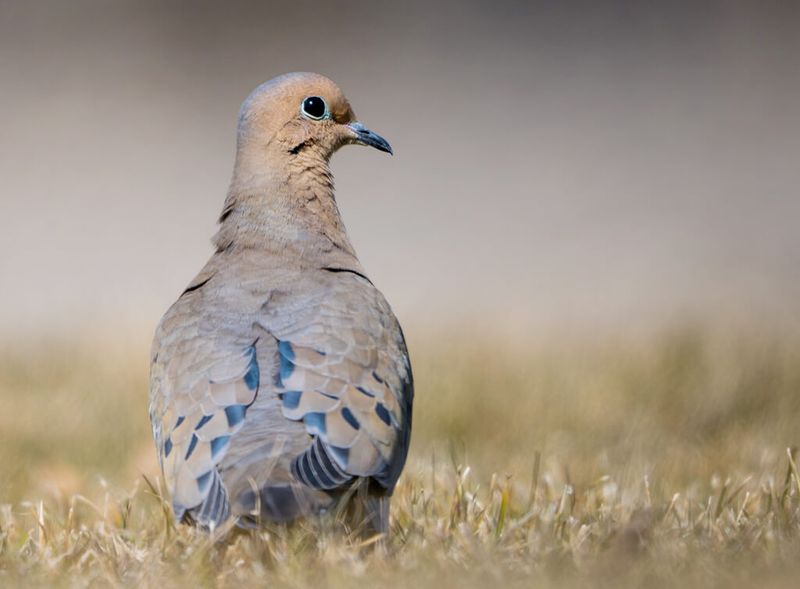
You step out onto the porch with your coffee, and there it is again, that same soft gray bird perched on the fence post or pecking slowly across the lawn.
Most folks in North Carolina have seen a mourning dove up close at least once, but when one keeps showing up day after day, it is hard not to wonder what is going on.
The answer is usually simpler than you might expect, and honestly a little reassuring.
Understanding what draws this bird to your yard can help you watch it more clearly, support it safely, and enjoy one of the most familiar backyard visitors in the state.
Identify the Visitor Before Interpreting It
Before you read too much into a dove’s behavior, it helps to make sure you are actually looking at a mourning dove.
The North Carolina Wildlife Resources Commission classifies mourning doves as common throughout the state, so a repeated visit from one is not unusual.
What you want to confirm is the bird itself.
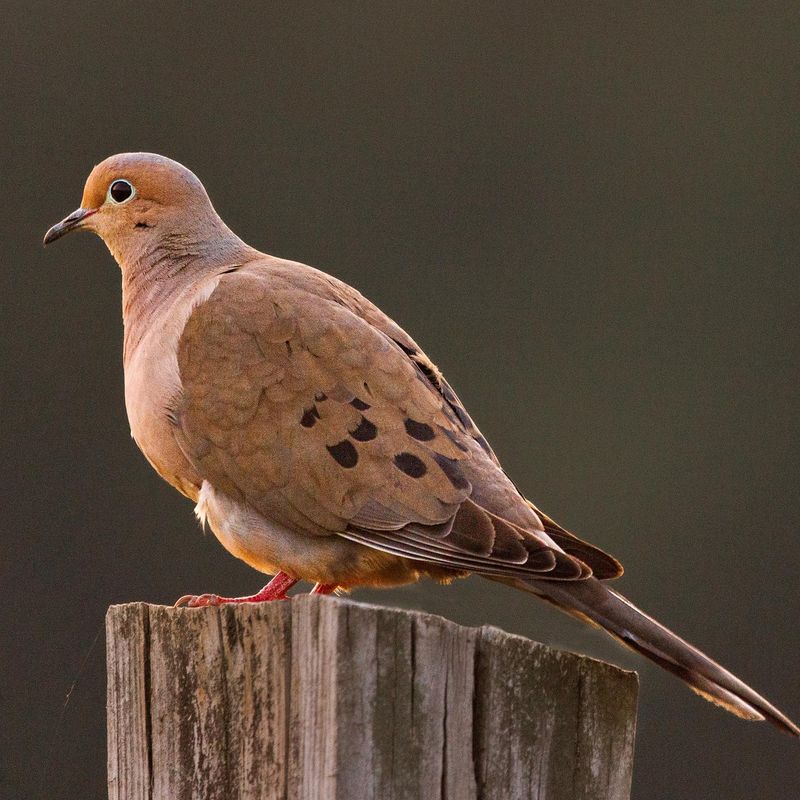
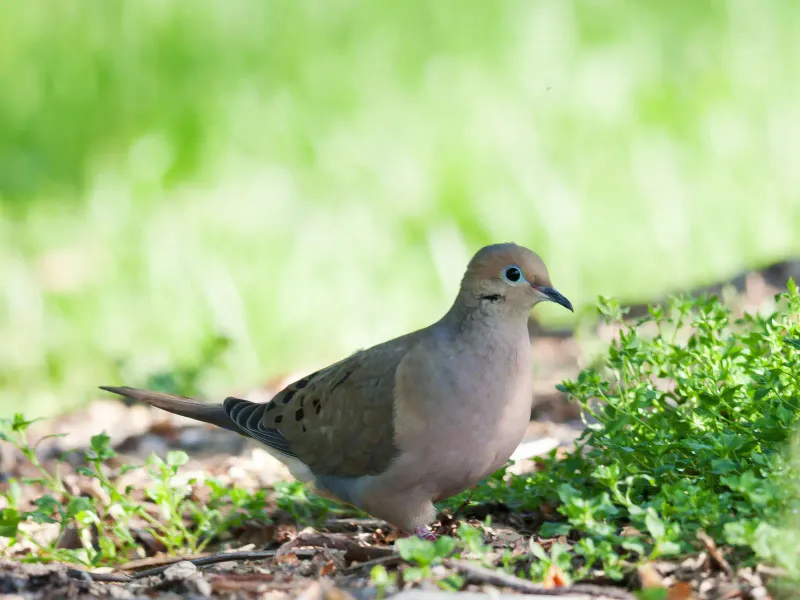
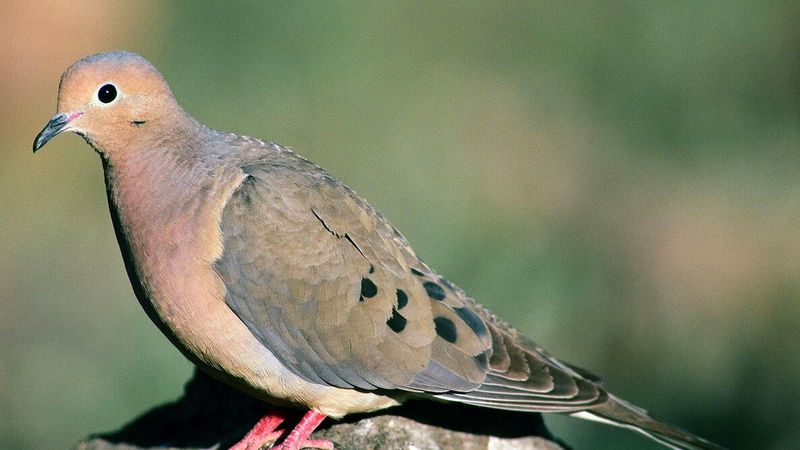
A mourning dove (Zenaida macroura) is slender, about the size of a robin but more elongated.
The body runs brown to gray, the wings carry scattered black spots, and the tail is long and pointed with white edging along the outer feathers.
The head looks almost too small for the body, which gives the bird a slightly delicate look.
Cornell Lab’s identification guide describes the overall impression as a slender, long-tailed dove with a gentle expression.
The call is one of the easiest clues.
That drawn-out, mournful cooing you hear from a tree or rooftop is usually a male, and Cornell’s sound recordings confirm it is softer and more melancholy than most backyard bird calls.
If the bird in your yard has a narrow black collar ringing the back of its neck, pause before assuming it is a mourning dove.
That marking points instead to a Eurasian Collared-Dove, a related but distinct species.
The two species look similar at a glance but behave somewhat differently and are worth telling apart.
Once you are confident about the identification, behavior and location can offer useful clues about what your yard provides.
That said, observation rarely points to a single explanation.
The bird may be doing several things at once, and the same yard feature can serve multiple needs on different visits.
Your Yard May Supply Food, Grit, or Water
Here is where it gets practical.
A mourning dove does not show up in your yard because of fate or a message.
It shows up because something on the ground looks worth eating.
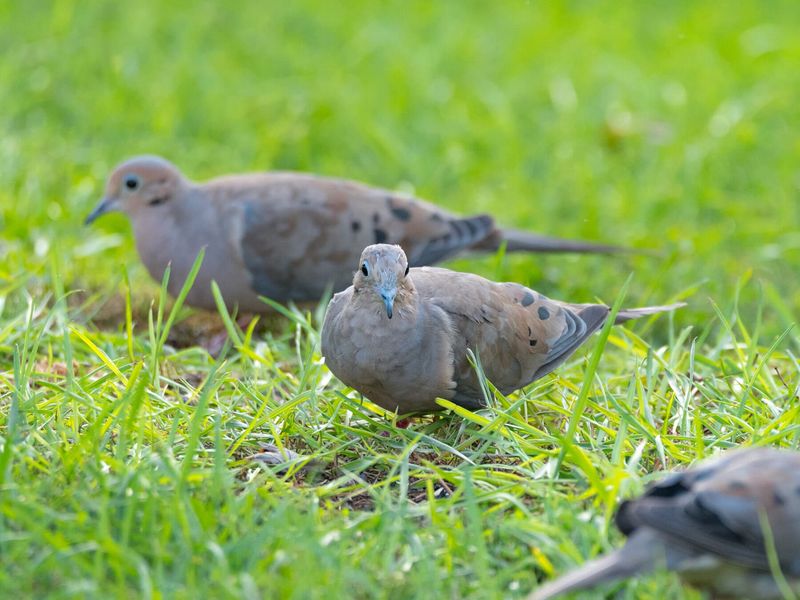
Cornell Lab reports that seeds make up roughly 99 percent of a mourning dove’s diet.
They feed almost entirely on the ground, moving slowly across open or lightly vegetated areas where seeds are easy to spot.
A lawn edge where grass meets a garden bed, a patch of bare soil under a feeder, a strip of weedy ground along a fence, any of these can pull a dove in without any effort on your part.
Spilled birdseed, grass seeds going to head, or weed seeds drying in a sunny patch all count as a meal.
Grit matters too.
Mourning doves swallow small stones and coarse sand to help grind hard seeds in their crop.
Audubon notes this grit-seeking behavior as a regular part of their foraging routine.
A gravel driveway edge, a sandy patch by a downspout, or exposed soil along a path can all serve this purpose.
The bird is not lingering to watch the house.
It is collecting digestive tools.
Water is another draw, especially during North Carolina’s hot, dry stretches in July and August.
NC Wildlife’s dove habitat guidance confirms that dependable water sources can make a yard more consistently attractive to the species.
A birdbath, a slow drip from a hose bib, or even a puddle left after afternoon rain can bring a dove back to the same spot on consecutive days.
None of these features alone proves why any one bird is visiting.
Food, grit, and water often overlap, and a single yard can satisfy all three needs in a short walk.
That combination is probably the most straightforward explanation for a dove that keeps returning.
Behavior Offers Clues About Courtship
A dove that keeps returning to the same high branch and cooing repeatedly is doing something specific.
Males use what ornithologists call a cooing perch, a reliable, visible spot from which they call to attract a mate or signal their presence to rivals.
Cornell Lab describes males defending favorite cooing perches as a regular part of their breeding behavior.
If you notice the same bird returning to the same branch or rooftop at similar times each morning, that pattern is a meaningful clue, though it still does not prove a nest is nearby.
Stronger signs of active courtship look different.
Watch for a male flying up at a steep angle and gliding back down in a wide arc, a display flight used to impress a female.
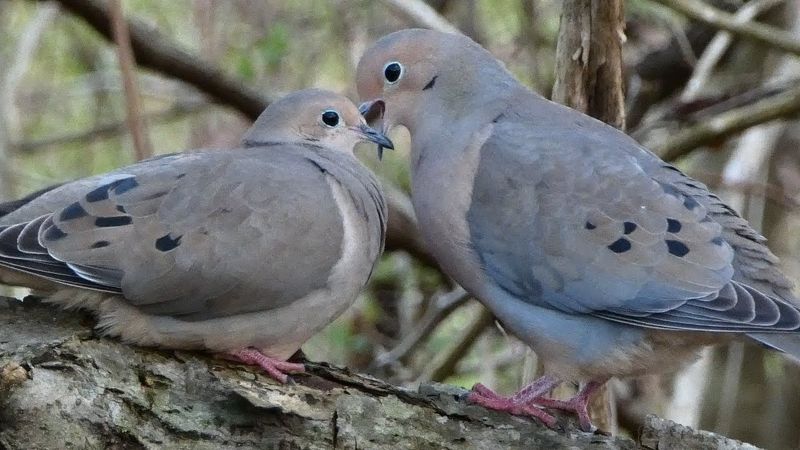
If you see two birds sitting very close together on a branch, touching bills or one bird carefully preening the other’s head feathers, that mutual preening is a reliable sign of pair bonding.
Audubon’s field guide describes these courtship behaviors in detail, and they are genuinely easy to spot once you know what to look for.
Carrying nesting material is another step up.
A dove picking up a thin twig or pine needle and flying off with it suggests nest building is underway somewhere nearby.
Adults feeding young in the open, or a visible nest platform in a tree or shrub, round out the strongest evidence that breeding is actually happening in or near your yard.
One lone dove sitting on a fence or lawn does not mean any of this is occurring.
Courtship in birds involves a recognizable sequence of behaviors, and a single bird foraging quietly is just foraging.
The distinction matters if you want to understand what is actually happening rather than guess at it.
North Carolina Seasons Affect Dove Activity
Timing a dove’s visits to a specific season can feel meaningful, but the pattern is more complicated than most people expect.
Mourning doves can be present in North Carolina yards any month of the year, so a visit in January does not automatically mean courtship, and a visit in October does not automatically mean migration.
NC Wildlife notes that courtship activity, including cooing and display flights, can begin as early as late January and into February across the state.
That is earlier than many people expect, sometimes while there is still a frost risk in the Piedmont or a cold snap rolling through the mountains.
If you hear persistent cooing from a rooftop in February, there is a genuine chance a male is already working to establish himself on a singing perch.
NC State Extension reports that North Carolina’s largest mourning dove concentrations often build in late summer and fall, when young-of-the-year birds join the adults and food sources like weed seeds and agricultural fields are at their most productive.
Some of those birds shift farther south as winter sets in, but others remain through the cold months wherever food and water stay available.
What this means practically is that a dove lingering in your yard in any given season is not, by itself, a signal of anything specific. eBird’s range and abundance data for mourning doves shows consistent presence across North Carolina throughout the year, with variation in numbers rather than presence or absence.
Season adds context, but it does not turn a single dove visit into a diagnosis of what the bird is doing or why it chose your yard.
Offer Modest Support Without Creating Risks
If you want to make a dove feel more at home, the best approach is restrained.
A little goes a long way, and overdoing it can cause more problems than it solves.
Seed is the obvious starting point.
Cornell Lab specifically lists millet as a food mourning doves use well.
Scatter a small amount on a clean platform feeder or directly on the ground in a spot that stays dry and gets some sun.
Avoid letting seed pile up or sit wet, because damp seed grows mold quickly and can make birds sick.
Remove any spoiled or clumped seed promptly, and never wash a feeder in a kitchen sink where food prep happens.
Water helps too, especially during the muggy North Carolina summers when afternoon temperatures push into the 90s.
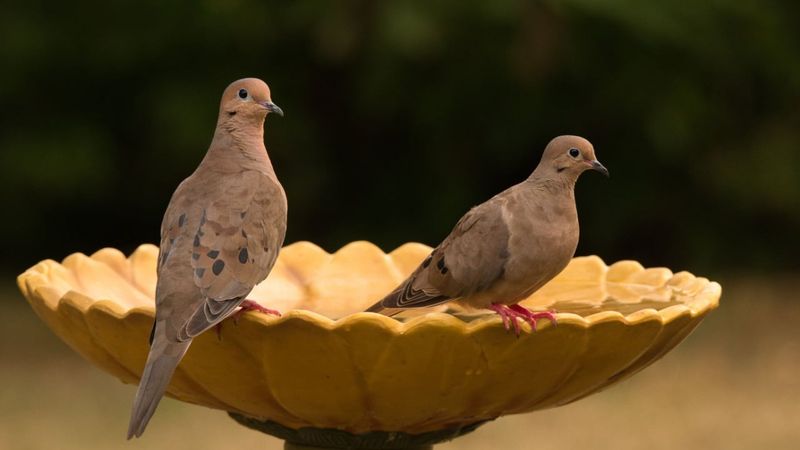
Keep a birdbath shallow, roughly 2 to 3 inches deep, with a textured surface so the bird can grip it.
Change the water every couple of days to prevent mosquito larvae and algae.
NC State Extension recommends cleaning feeders every 2 to 3 weeks under normal conditions, and more often if droppings or wet debris accumulate faster.
CDC Salmonella-prevention guidance advises removing feeders and birdbaths for two full weeks if you find a sick or dead bird nearby, then cleaning them outdoors before putting them back.
That specific two-week window comes from CDC guidance on Salmonella outbreaks linked to bird feeders, and it is worth taking seriously.
Research published in Emerging Infectious Diseases confirms that backyard feeders can serve as transmission points for Salmonella among songbirds.
Cats are the other major risk.
Mourning doves spend most of their time on the ground, which puts them directly in a stalking cat’s range.
Keep feeding areas away from dense shrubs where a cat could hide, and discourage free-roaming cats from the yard if possible.
Ground-feeding birds genuinely cannot afford a crowded, poorly maintained, or predator-accessible feeding station.
Observe a Nearby Nest From a Distance
Mourning doves are not shy about nesting close to people.
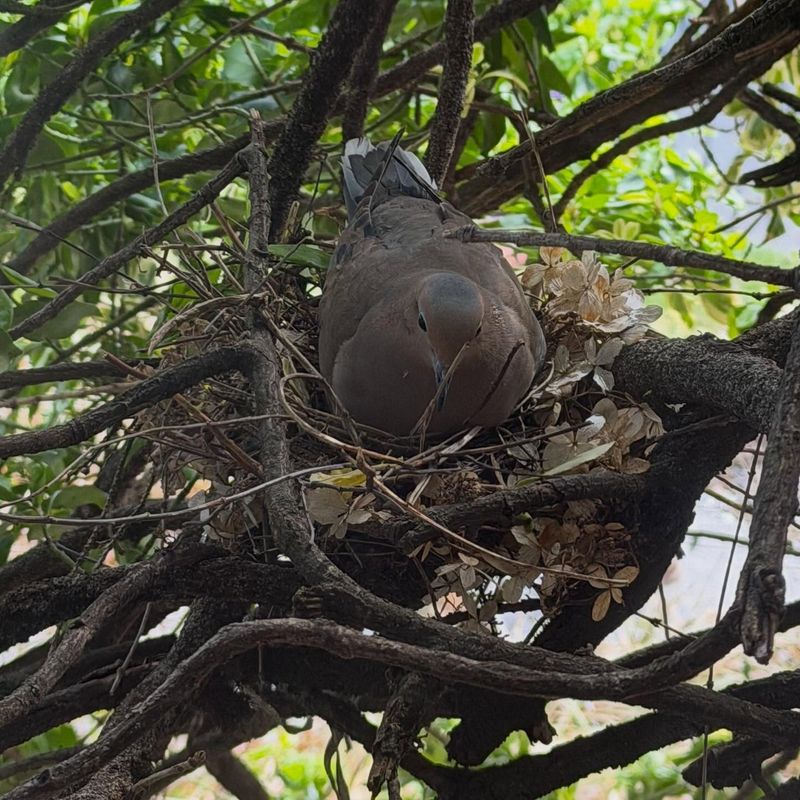
A flimsy platform of thin sticks might appear in a low tree branch, a gutter corner, a porch railing, a window ledge, or the top of an outdoor light fixture.
The nest looks almost unfinished, barely more than a loose collection of twigs, and that fragility surprises a lot of homeowners who find one.
Cornell Lab describes mourning dove nests as shallow platforms where the female typically lays 2 eggs.
Incubation takes about 14 days, with both parents sharing the sitting.
Young birds leave the nest after roughly 12 to 15 days, though adults may continue feeding fledglings on the ground nearby for another week or two.
The whole cycle moves quickly, which means a nest that appears in May could be empty again before June ends.
If you spot an active nest, the best move is to give it space.
Avoid pruning the branch or shrub it sits in, skip pressure-washing nearby surfaces, and resist the urge to check on it repeatedly.
Audubon notes that mourning doves can be easily disturbed during incubation, and repeated human approaches may cause adults to abandon the nest.
FWS guidance on living around birds recommends contacting wildlife officials if a nest creates a genuine health or safety concern rather than handling the situation yourself.
NC State Extension describes supplemental nesting cones that can be placed 6 to 10 feet high in a shaded tree with open flight access, but installing one is entirely optional.
If a dove has already found your yard suitable, it will likely figure out the nesting on its own.
Treat Window Strikes as a Safety Problem
A dove sitting on a windowsill or hovering near a pane of glass is usually investigating a reflection, not sending a message.
Glass that mirrors sky or foliage looks like open space to a bird, and a dove may approach it the same way it would approach any other open flight path.
Occasional perching near a window is not a cause for concern.
Repeated strikes are a different matter entirely.
If you hear a thud against the glass more than once, or if you find a bird on the ground below a window that cannot fly, has an obvious wound, keeps falling over, or has been in contact with a cat, that is a safety problem worth addressing.
Audubon’s guidance on reducing glass collisions is clear that a single hawk silhouette decal does not reliably prevent strikes.
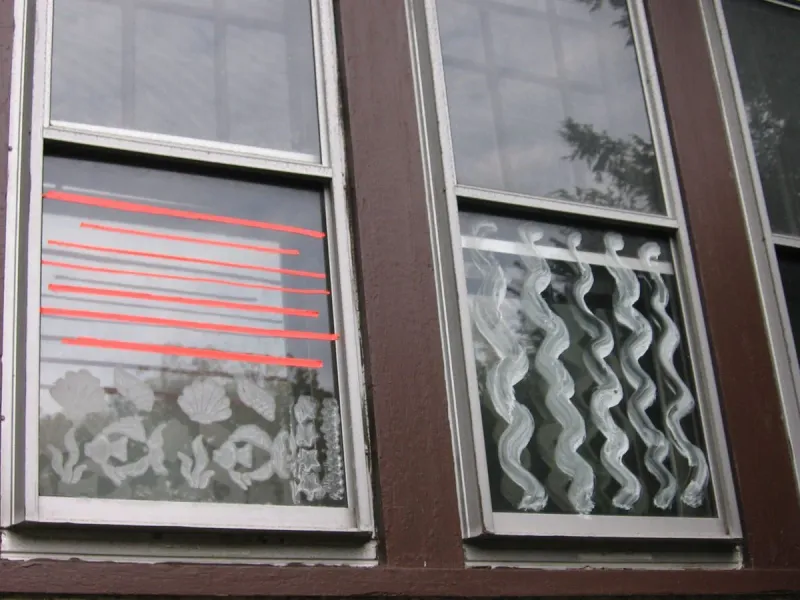
What works is a dense, visible pattern on the exterior surface of the glass, with markings spaced no more than 2 to 4 inches apart so a bird cannot read the gaps as a flyable opening.
Exterior screens, closely spaced tape strips, or temporary window coverings applied to the outside of the glass all work on the same principle.
Feeder placement also matters.
Cornell Lab recommends placing feeders either within 3 feet of a window or more than 30 feet away.
The logic is that a bird flushing from a feeder less than 3 feet from glass does not have enough distance to build dangerous speed, while a feeder more than 30 feet out gives the bird room to redirect before reaching the house.
Audubon’s guidance on what to do after a window strike recommends placing a stunned bird in a covered box in a quiet, dark spot for up to two hours to recover, then releasing it outdoors if it is alert and upright.
Do not handle any bird with bare hands, and contact a wildlife rehabilitator if the bird does not improve.
The Most Likely Meaning Is Practical
Most people who notice a mourning dove returning to their yard are looking for a reason.
That instinct is understandable, and the dove genuinely does offer clues, just not the kind that point to fate or fortune.
Watch where the bird spends its time.
A dove that moves slowly across a lawn edge with its head down is almost certainly foraging.
One that sits on the same rooftop or branch and calls repeatedly is likely a male using a cooing perch.
A pair sitting close together, or a bird carrying a thin twig, suggests courtship or nest building is underway.
NC State Extension notes that local habitat features can concentrate mourning doves without necessarily increasing the regional population, which is a useful reminder that your yard does not have to be anything special to attract a regular visitor.
It just has to offer something the bird needs.
Cornell Lab’s life history overview covers the full range of mourning dove behavior, and what stands out is how ordinary most of it is.
Seeds, water, grit, a perch, a mate, a nest site.
These are the things driving repeated visits, and they are all findable in an ordinary North Carolina yard without any special effort from the homeowner.
NC Wildlife confirms the species is common statewide, which means you are not witnessing something rare when a dove settles into your yard’s routine.
You are watching a bird do exactly what it has always done, in a state where it has always done it.
If the dove is healthy, the yard is safe, and the setup is not creating problems for pets or neighbors, there is genuinely nothing that needs to change.
Personal or spiritual meaning can sit alongside that explanation without replacing it, but the bird itself is simply finding what it needs, one quiet morning at a time.