
This Houseplant Keeps Blooming Even In Rooms With Barely Any Sun
Follow us on Google
Most flowering houseplants give up the moment you move them away from a sunny window. Anthurium, the tropical plant sold as flamingo flower, is one of the few that can keep producing color in a dim room, as long as that room still gets some usable light.
That last part matters, and it changes how you set the plant up for success. Get the light piece right, and anthurium can reward you with showy, long-lasting color in spots where most bloomers just sit and sulk.
Anthurium Can Bloom In A Dim, Illuminated Room
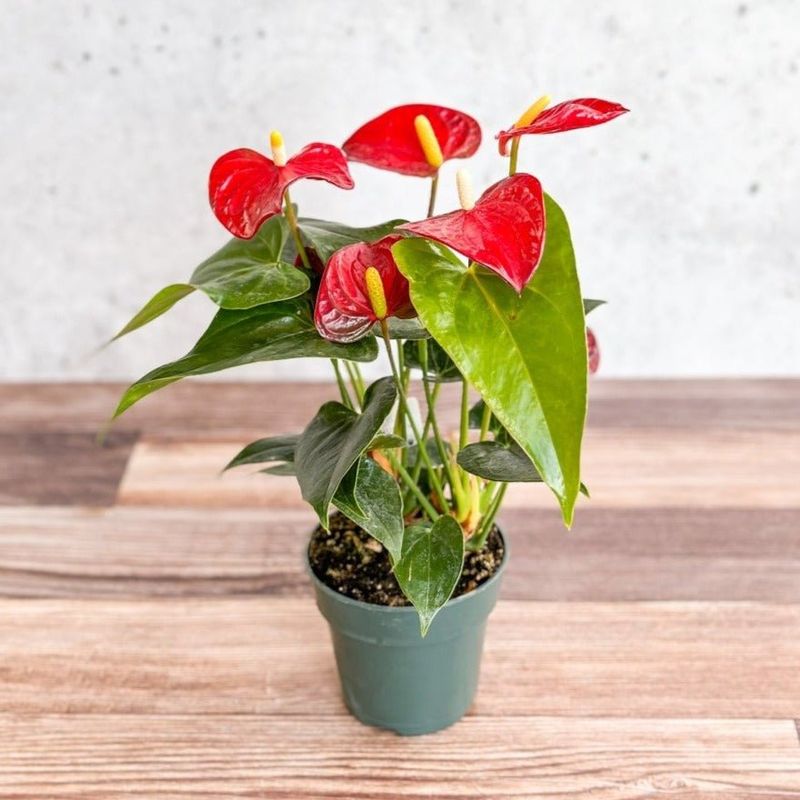
Anthurium, sold in most garden centers as flamingo flower or tailflower, is one of the better-supported choices for repeated color in a room that does not get much direct sun. The species most commonly grown indoors is Anthurium andraeanum, along with a range of related hybrids that share its tolerance for lower interior light levels.
Call it a strong candidate, not a guaranteed performer, because results depend on the cultivar, your actual light levels, and how consistently you care for the plant.
The evidence behind that claim comes from University of Florida research. UF interiorscape production guidelines found that selected anthurium cultivars flowered continuously for more than 18 months under interior light levels of around 100 foot-candles.
That is the kind of dim, ambient light common in a furnished living room or hallway that has windows but no direct sun exposure. No other widely sold flowering houseplant has that kind of documentation for sustained interior performance at those light levels.
The key word in that finding is “selected cultivars.” Not every anthurium on the shelf at a home improvement store has been tested under those conditions. Plant maturity, watering habits, temperature, and the actual foot-candles reaching the leaves all shape what happens.
So the more accurate promise is this: anthurium can bloom in a dim but illuminated room, not in darkness, not in a windowless room without a grow light, but in the kind of low-light interior that defeats most other flowering plants.
UF Gardening Solutions notes that anthuriums grown indoors need bright indirect light to truly thrive, even though they handle lower light better than most tropical bloomers. That distinction matters when you are choosing a spot.
The brighter the indirect light you can offer, the more reliably the plant will perform over time.
Those Colorful Blooms Are Built To Last
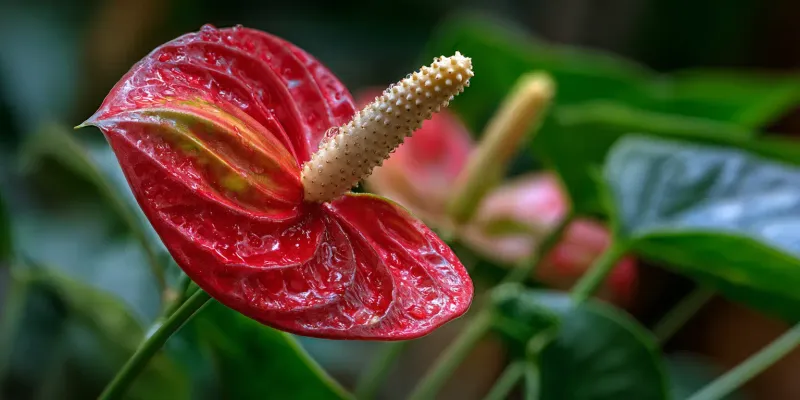
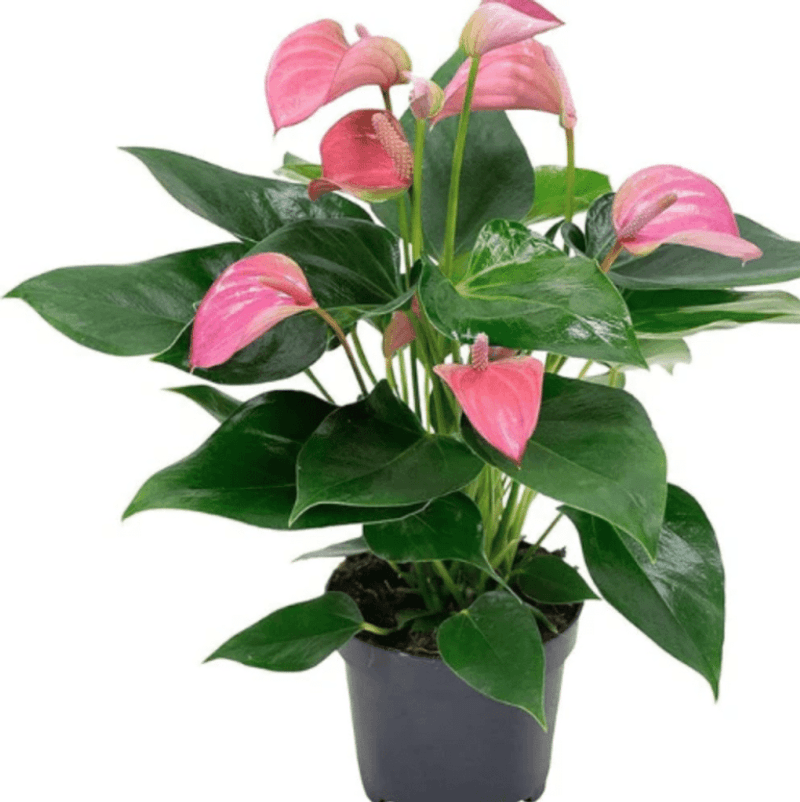
Pick up an anthurium at a nursery and you will almost certainly reach for the glossy red or pink structure that looks like a single sculpted petal. That structure is not a flower petal at all.
UF’s anthurium species profile explains that the showy part is a spathe, a modified leaf that has evolved to attract pollinators. The narrow, finger-like spike rising from its center is the spadix, and the tiny true flowers are clustered along that spike.
Most people never notice the true flowers because the spathe steals all the attention.
That spathe is built to stay. Unlike a rose petal that wilts in a few days, a single anthurium spathe can hold its color and shape for roughly six weeks.
New spathes appear periodically as the plant cycles through its growth, so what you are watching is a succession of long-lasting structures rather than a continuous wall of daily blooms. Some cultivars may produce four to six of these flowering periods in a year under good conditions.
Understanding that rhythm helps set realistic expectations. You may have one or two spathes open at a time, with a gap before the next one emerges.
That is normal, not a sign that something is wrong. The spathes come in red, pink, white, orange, and green depending on the species or cultivar, which means you can match the plant to a room’s color scheme in a way most foliage plants cannot offer.
When a spathe fades and turns green or papery, cut the flower stalk near its base with clean scissors. Removing spent spathes keeps the plant tidy and redirects its energy toward producing the next one rather than forming fruit on the spadix.
Can Your Room Supply Enough Light?
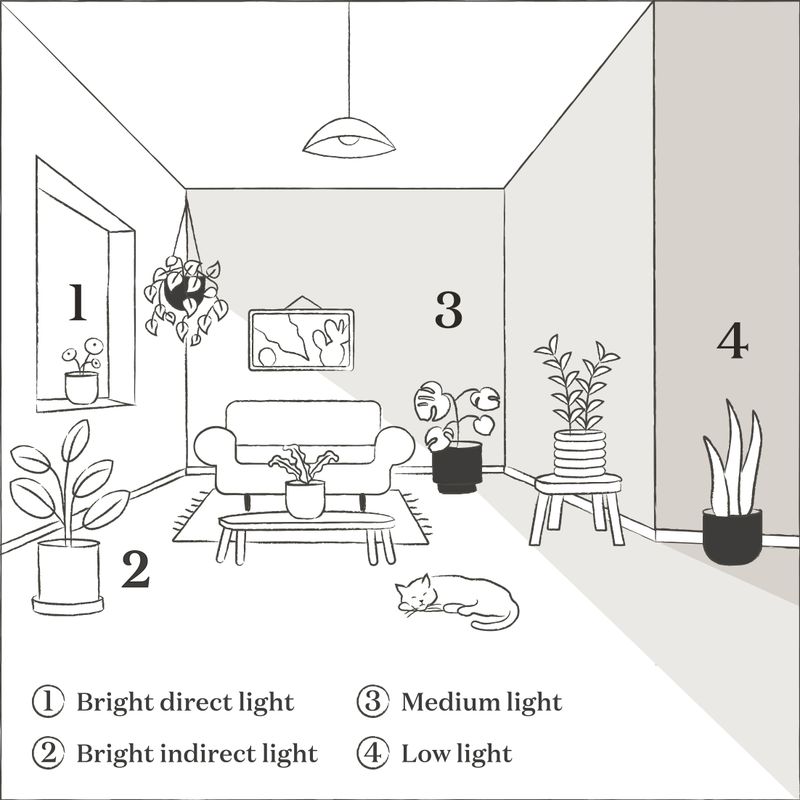
Before you buy an anthurium for a dark corner, take a honest look at what that corner actually offers. Low light is not the same as no light, and the difference matters for whether the plant will flower or just survive.
University of Maryland Extension classifies low indoor light as roughly 25 to 100 foot-candles. Flowering tends to be possible nearer the upper end of that range, especially for anthurium cultivars bred for interior performance.
A quick field test from University of Minnesota Extension works well for a phone-free check: if you can read a newspaper comfortably without turning on a lamp, the room likely clears the low-light threshold. If you need the lamp to read, the room is probably too dim for reliable flowering without supplemental lighting.
Window direction gives you a rough starting point, but it is only a starting point. A north-facing room or a spot a few feet back from an east-facing window can work for anthurium in some homes, while those same positions fall short in others.
Trees outside the glass, neighboring buildings, sheer curtains, window screens, dirty panes, winter’s lower sun angle, and your latitude all chip away at the light reaching the leaves. A window that floods a room in July may barely illuminate it in January.
UF’s anthurium care guidance recommends bright, indirect light as the target for indoor plants. Direct afternoon sun is not necessary and can scorch the foliage.
When you notice the plant stretching toward the window, producing smaller or paler leaves, or simply refusing to push out new spathes, insufficient light is worth checking early, though wet soil, cold air, and other factors can produce similar symptoms.
A Grow Light Helps When Ambient Light Falls Short
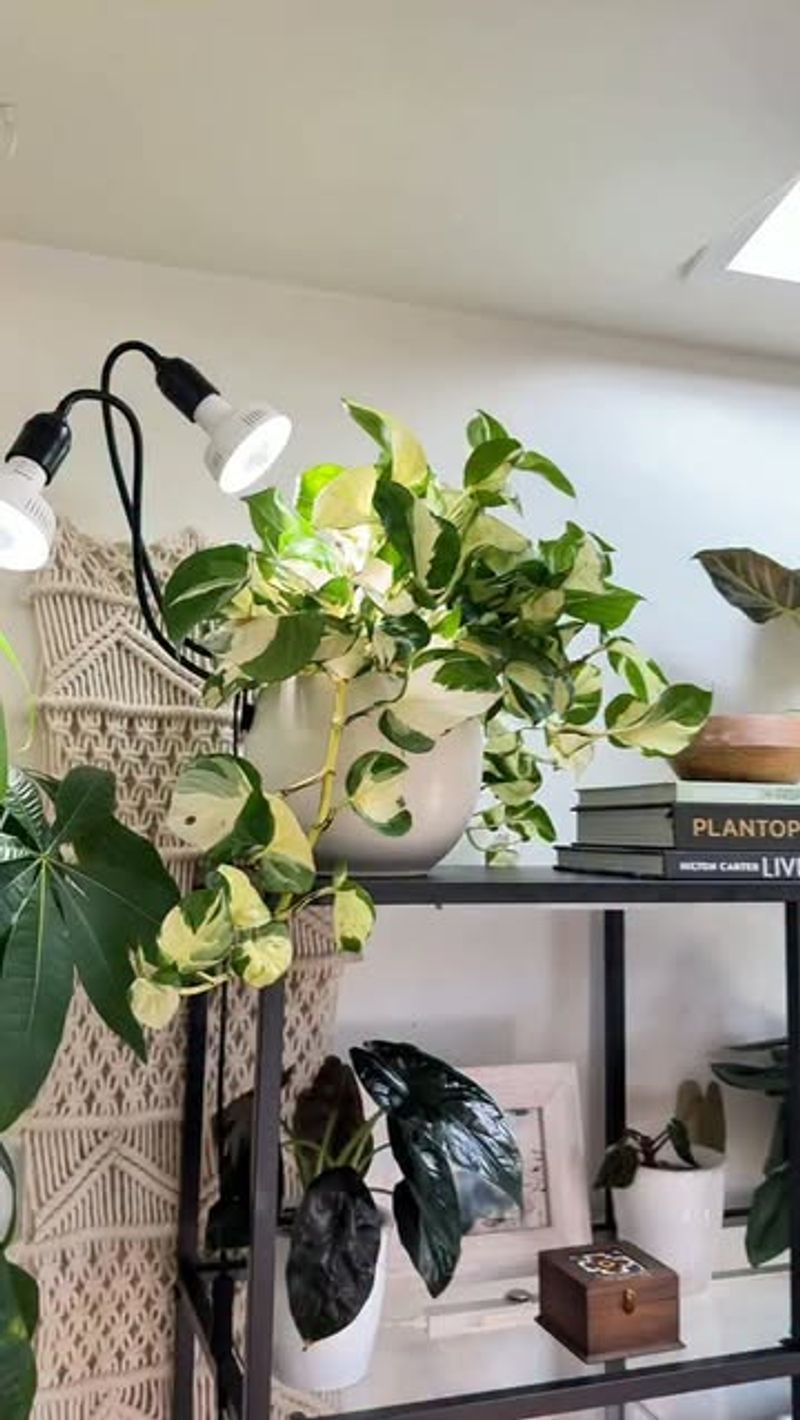
Some rooms just do not have enough natural light, no matter which direction the windows face or how close you push the plant. A full-spectrum or balanced LED grow light is a practical fix for those situations, and it does not require rewiring a room or spending a lot of money.
The goal is to supplement what the room cannot provide, not to replace every aspect of good plant care.
University of Minnesota Extension guidance on lighting for flowering houseplants recommends about 14 to 16 total hours of light each day when using supplemental fixtures. That schedule sounds like a lot, but it mirrors the longer days of a tropical growing season, which is what anthurium’s biology is built around.
Equally important is the dark period. Plants need unlit hours to complete their internal cycles, so running a grow light around the clock is not better than the recommended schedule and may actually interfere with flowering.
Placement depends on the fixture. The commonly cited range of 6 to 12 inches between the bulb and the plant canopy is a starting point, not a fixed rule.
A weaker fixture needs to sit closer, while a high-output panel may need more distance to avoid bleaching the leaves. Read the manufacturer’s guidance for your specific light, then watch the plant for signs of stress such as yellowing or pale patches.
A simple plug-in timer keeps the schedule consistent without any daily effort. Set it, check the plant every week or two, and adjust the light’s height as the anthurium grows.
Supplemental light is one useful layer of a wider approach, not a shortcut that makes watering, temperature, and drainage less important.
Give The Roots A Wet-Dry Rhythm
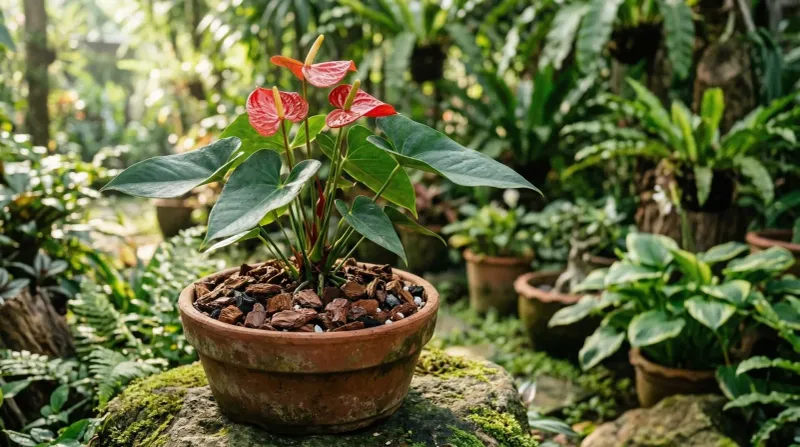
Getting the light right earns you nothing if the roots are sitting in soggy soil. Anthurium wants a clear wet-dry rhythm: water thoroughly until it drains from the holes at the bottom of the pot, then hold off until the top inch or two of the potting medium feels dry to the touch.
That cycle keeps roots oxygenated and healthy, which directly supports the plant’s ability to push out new spathes.
UF’s commercial interiorscape care guidelines describe this as allowing the medium to dry slightly between waterings before watering thoroughly. Constantly wet soil deprives roots of oxygen and creates conditions where root problems can develop quickly.
A pot without drainage holes is not a suitable home for anthurium, regardless of how carefully you try to eyeball the watering amount.
The potting mix matters almost as much as the watering schedule. Anthurium grows naturally as an epiphyte in tropical forests, clinging to trees rather than sitting in dense ground soil.
A loose, well-draining mix that holds some moisture while allowing air movement around the roots mirrors that native environment. A commercial indoor potting mix amended with perlite and a small amount of fine orchid bark is a reasonable homeowner approach, though no single recipe is mandatory.
The goal is a mix that drains freely and does not compact into a dense block after a few waterings.
Temperature plays into root and overall plant health as well. UF research recommends keeping finished anthurium plants in the range of 70 to 85 degrees Fahrenheit and protecting them from air temperatures below about 55 degrees, where cold damage and slowed growth become real risks.
Keep the plant away from cold drafts near winter windows, heating vents that blast dry hot air, and air-conditioning outlets that can chill the foliage during summer months.
Use Humidity And Fertilizer With Restraint
Anthurium comes from humid tropical forests, so it does appreciate some moisture in the air. UF’s anthurium species profile notes that leaves may lose their shine or begin to die back when relative humidity stays below 50 percent for more than a few days.
Most American homes run drier than that during winter heating season, which is worth knowing before you blame poor flowering on something else.
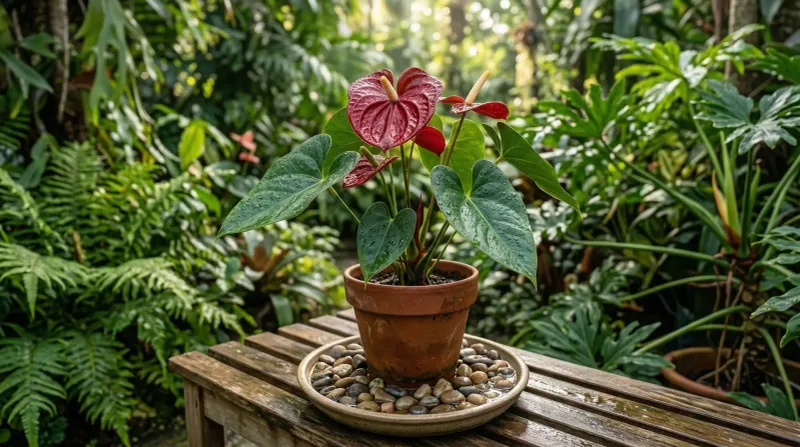
Practical ways to raise humidity include grouping several plants together so their collective transpiration raises the immediate air moisture, setting the pot on a shallow tray filled with pebbles and a small amount of water with the pot itself sitting above the waterline, or running a small humidifier nearby. Misting the leaves with a spray bottle is a common suggestion, but it only raises humidity for a short time and is not a substitute for stable ambient moisture.
Bathrooms sometimes get recommended as naturally humid spots, but light is a separate requirement and many bathrooms are too dim for anthurium to flower reliably.
One caution worth keeping in mind: University of Minnesota Extension notes that indoor relative humidity above 50 percent can contribute to condensation and moisture problems in homes, especially during cold weather. A humidifier is useful when the air is genuinely dry, not something to run continuously in every season.
For feeding, use a balanced houseplant fertilizer at the indoor rate listed on the label, roughly once a month during active growth. UF’s interiorscape guidelines describe dilute fertilizer applications as the standard approach.
Overfertilizing causes salt buildup in the soil and shows up as brown leaf edges, so more is not better here. Remove faded spathes by cutting the flower stalk near its base with clean scissors, which keeps the plant tidy and saves its energy for the next flowering cycle.
Check Several Causes When Flowering Slows
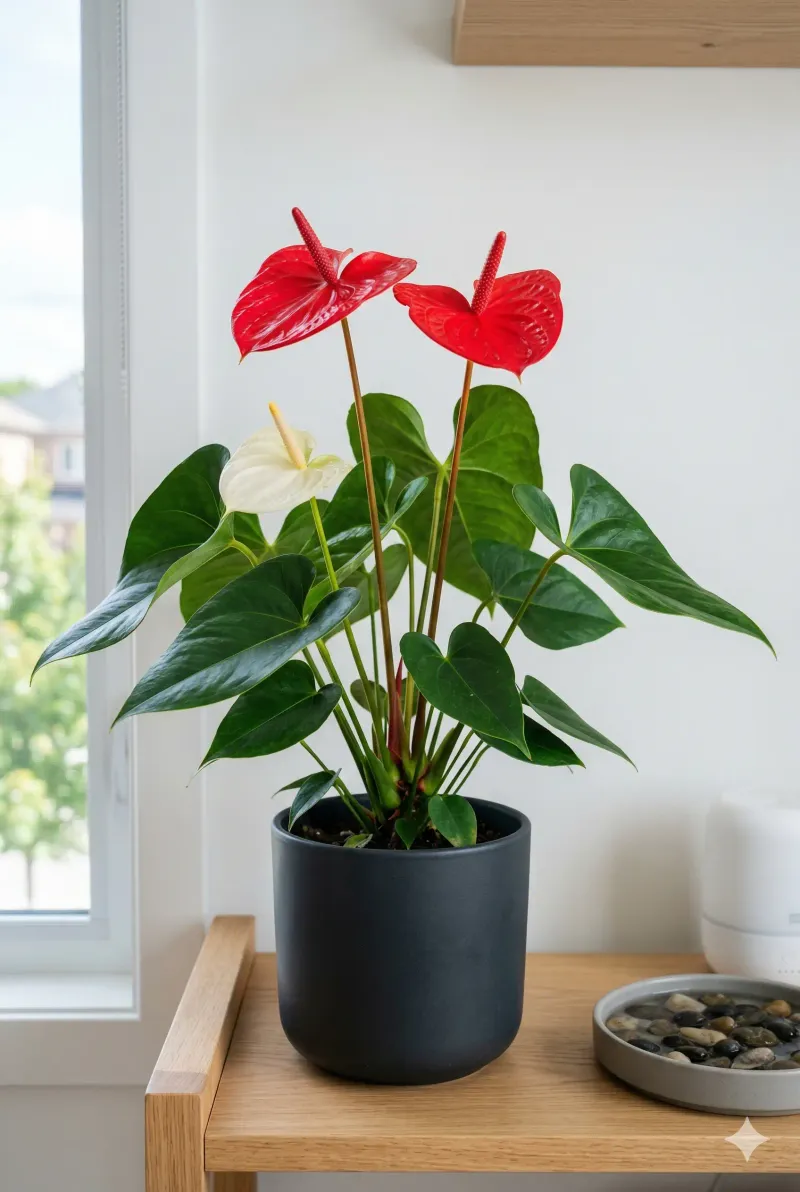
When an anthurium stops producing new spathes, the temptation is to reach for fertilizer. That is usually the wrong first move.
Light is an important early check when a plant stretches toward the window, produces smaller leaves, fades in color, or simply goes quiet on the flowering front. University of Maryland Extension lists diminished flowering, stretching, and fading foliage among the signs of inadequate indoor light.
Moving the plant closer to a brighter indirect-light source, or adding a grow light, is often worth trying before anything else.
That said, light is one factor among several. Wet soil held too long between waterings can stress roots and suppress flowering just as effectively as a dark corner.
Cold air from a drafty window or an air-conditioning vent can slow the plant’s metabolism to a crawl. Dry air below 50 percent humidity over an extended stretch can cause physical damage to the foliage.
Plant maturity matters too, because a young anthurium may simply not be ready to flower yet, and some cultivars are less floriferous than others regardless of care.
University of Minnesota Extension points out that most true low-light houseplants are grown for their foliage rather than their flowers. Peace lilies, snake plants, pothos, and Chinese evergreens can survive in a dim corner, but surviving there is not the same as flowering reliably there.
Anthurium is a stronger candidate for blooming in low light than those plants, but the evidence behind that claim comes from selected cultivars under controlled interiorscape conditions.
Penn State Extension’s guidance on African violets illustrates the same principle from a different angle: even a plant known for indoor flowering will produce few or no blooms when light falls below its threshold. The UF interiorscape study that supports anthurium’s low-light flowering record was conducted under defined conditions with selected cultivars, not in every dim room in every home.
Work through light, watering, temperature, and humidity before concluding the plant or the room is simply not going to cooperate.
Keep The Plant Beyond A Bite
Before you find a spot for your anthurium, factor in who else lives in the house. The ASPCA lists painter’s palette, Anthurium scherzeranum, as toxic to dogs and cats because of insoluble calcium oxalates in the plant tissue.
Chewing any part of the plant can cause oral irritation, drooling, vomiting, and difficulty swallowing. The same calcium oxalate crystals that affect pets can also make plant tissue unsafe for young children to mouth or swallow.
Keep anthurium on a high shelf, inside a closed room, or in another spot that pets and toddlers genuinely cannot reach, and contact a veterinarian promptly if an animal chews any part of the plant.
Once safety is sorted, the practical setup is straightforward. Choose the brightest spot with indirect light that your home offers, whether that is a few feet back from a south or east-facing window, or a shelf under a full-spectrum LED on a 14-to-16-hour timer.
UF’s anthurium profile confirms the plant is tropical and not frost tolerant anywhere in the continental United States outside of South Florida, so it stays indoors year-round in most of the country. If you move it to a shaded porch in summer, bring it back inside before nighttime temperatures drop toward 55 degrees Fahrenheit.
Keep the roots on a wet-dry cycle with a well-draining mix, protect the plant from cold drafts and heating vents, and feed lightly during active growth. The Minnesota Extension lighting framework is a useful reminder that every houseplant, even a tolerant one, needs measurable light to do its job.
Anthurium’s promise is color in a dim but illuminated room, and that promise holds when the light is real.