
The One Thing To Do With Your Florida Desert Rose Now So It Keeps Blooming Through Storm Season
Follow us on Google
You step onto the patio after breakfast and the air already feels heavy, the kind of thick Florida humidity that tells you the afternoon storms are coming back.
Your Desert Rose is sitting right out in the open, and another week of daily downpours is on the way.
Moving that pot to a bright, rain-sheltered spot before the rains take over is the single most useful adjustment you can make right now.
It will not guarantee flowers every single week, but it can remove one of the biggest wet-weather threats to your plant’s roots and overall health.
Move Your Desert Rose Under Bright Cover
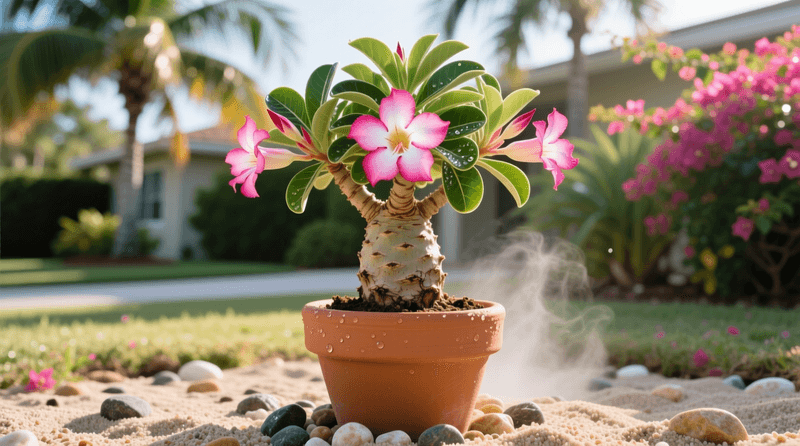
Grab that pot and find the brightest covered spot you own.
A covered patio, a screened lanai, a deep porch with open sides, or any overhead shelter that blocks rain while still letting strong light pour in from the sides will do the job.
The goal is to stop repeated, heavy downpours from soaking the potting mix day after day, not to seal the plant away from every drop of moisture.
Desert Rose, known botanically as Adenium obesum, is built for bright, relatively dry conditions.
UF/IFAS Extension guidance for Adenium obesum recommends bright sunlight, well-drained soil, and regular irrigation that avoids waterlogging.
A covered patio that catches six or more hours of direct or strong reflected light checks every one of those boxes, as long as you manage watering carefully once the plant is out of the rain.
Here is where many Florida gardeners go wrong.
They move the plant under cover and then slide it into the shadiest corner to keep it out of the way.
A dim garage, a deeply shaded overhang, or a back corner blocked by furniture trades one problem for another.
North Carolina Extension’s Adenium profile confirms that the plant needs generous light to perform well.
Low light can slow or reduce flowering just as surely as waterlogged roots can threaten root health.
Think of the move as reducing a major wet-weather stress while keeping the conditions the plant actually needs.
It is a practical adjustment, not a guaranteed bloom switch.
Position the pot at the sunniest edge of your shelter, where morning or afternoon light reaches it freely, and you have given your Desert Rose its best shot through the stormy stretch ahead.
Protect Root Health Before Repeated Downpours
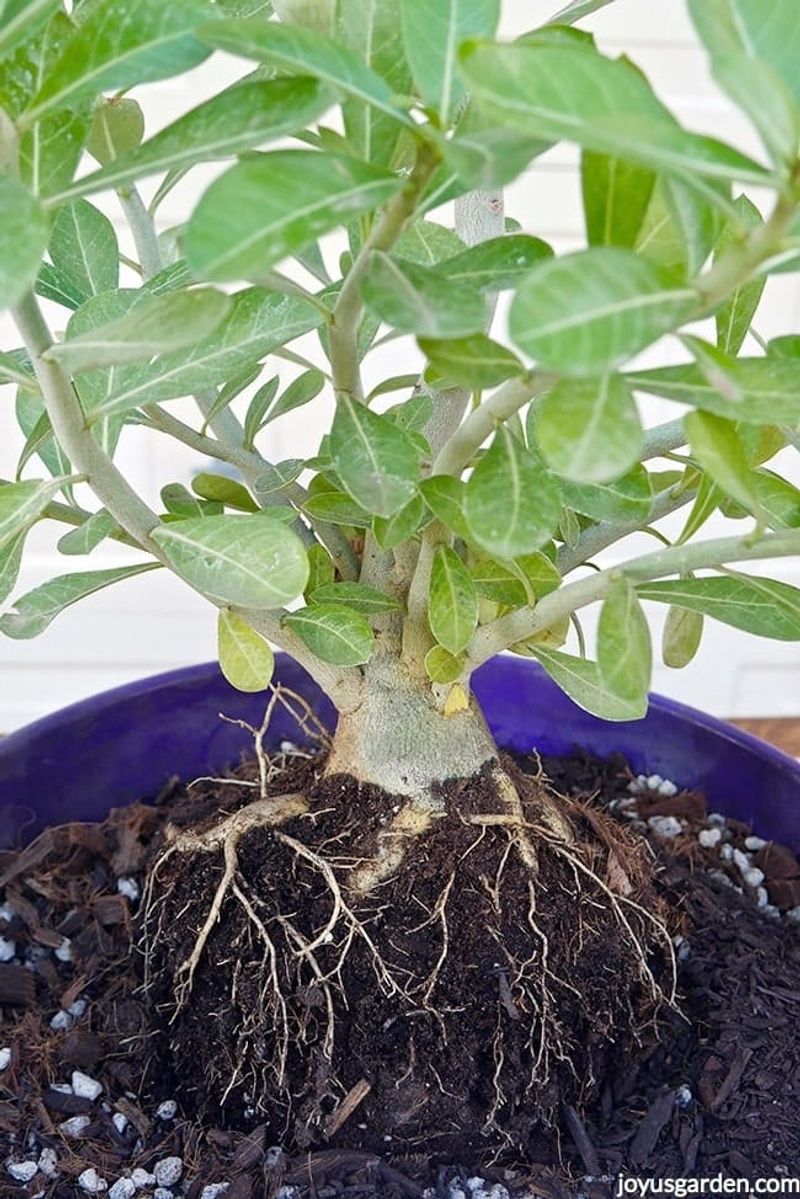
Pull back the surface of the potting mix and look at what you are actually protecting.
Desert Rose grows a swollen, water-storing base called a caudex, an adaptation from its origins in the relatively dry regions of sub-Saharan Africa and the Arabian Peninsula.
That caudex lets the plant shrug off a dry week without drama.
What it cannot shrug off is sitting in wet, oxygen-poor soil for days on end.
Missouri Botanical Garden’s Adenium plant profile warns that excessive moisture and poor drainage can lead to root and stem rot.
Root rot does not just threaten the roots.
It threatens the entire plant’s ability to take up water, move nutrients, and sustain new growth.
A plant fighting root damage has fewer resources to put toward flowering, even if every other condition looks fine.
That said, rain alone is not the enemy.
A single afternoon storm followed by a day of sunshine and a mix that dries out properly is not a crisis.
The concern is repeated saturation, the kind that happens when Florida’s afternoon downpours stack up day after day and the potting mix never fully dries between events.
That is the scenario that pushes roots toward rot and may reduce the plant’s ability to thrive.
Drought tolerance, which Adenium genuinely has, is also not the same as wet-soil tolerance.
The caudex stores water for dry spells, not as a buffer against soggy conditions.
University of Arizona Cooperative Extension guidance on growing adeniums emphasizes that the medium must drain quickly, because even in hot, sunny conditions, a slow-draining mix will cause problems.
Florida’s recurring heavy rains simply make that drainage requirement more urgent.
Six Hours Of Light Still Matter
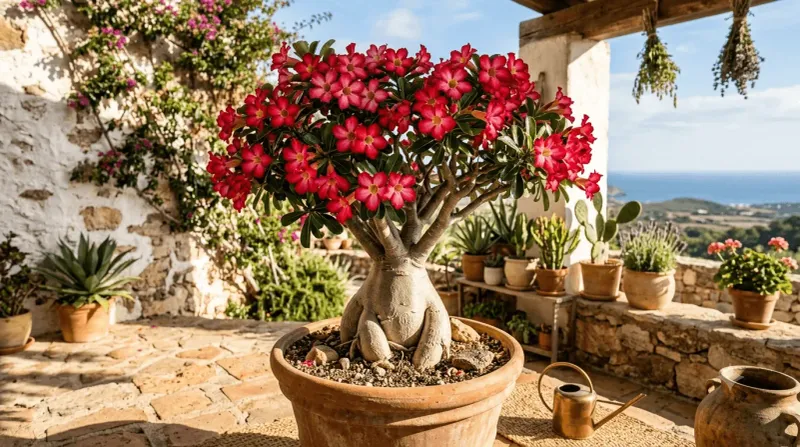
Shelter solves the rain problem and creates a new one if you are not careful.
Moving your Desert Rose under cover is only half the equation.
The other half is making sure the plant still receives enough light to keep flowering, because shade and soggy roots can both slow a Desert Rose down, just through different mechanisms.
UF/IFAS recommends at least 6 hours of bright sunlight daily for maximum flowering in Adenium obesum.
That number is not a rough estimate you can quietly ignore.
Drop the plant into a spot that gets three hours of filtered light and you may protect the roots while quietly shutting down the conditions that produce blooms.
The plant can stay alive and even look healthy for a while, but flowering often slows or stops when light falls well below that threshold.
Choosing the right spot under a covered area takes a little observation.
Walk your patio or porch at different times of day and notice where direct light actually reaches the floor.
The outer edge of a covered patio, a corner that catches strong morning sun from the east, or a spot near an open side where afternoon light streams in can all work.
A spot pushed against the house wall, tucked behind furniture, or shaded by a heavy roof overhang may not.
Many Central Florida gardeners find that the south or west-facing edge of a covered lanai gives a Desert Rose enough direct afternoon sun to stay productive through a stormy stretch.
The goal is to preserve the conditions that support flowering, not to guarantee flowers on a schedule.
Light, drainage, and a potting mix that dries between waterings work together, and shelter only helps when all three stay in place.
Let Dry Soil Set The Watering Rhythm
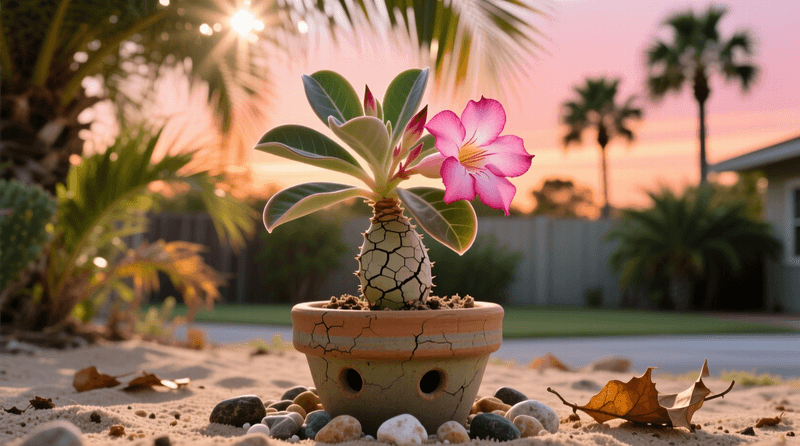
Once the pot is under cover and out of the rain, your watering instincts need a reset.
The plant is no longer getting free water from afternoon storms, but that does not mean it needs daily irrigation to compensate.
The potting mix should be your guide, not the calendar.
Press a finger about an inch or two into the mix.
When the soil feels dry through much of the pot, water thoroughly until water runs freely from the drainage holes, then empty the saucer completely.
Missouri Botanical Garden’s guidance on indoor plant problems notes that a pot with no drainage hole and a saucer left full of water creates conditions ripe for root rot.
The same principle applies outdoors under a covered patio.
Do not water on a fixed daily schedule during a stormy week.
If the mix is still damp from your last watering, leave it alone.
But do not swing to the opposite extreme and withhold water for the entire rainy period either.
Active Desert Roses in hot Florida conditions still need moisture, and a plant that goes too long without water can drop leaves and stall growth.
Drought stress is a real problem, just a different one from root rot.
University of Arizona Cooperative Extension reports watering smaller adenium pots as often as 3 to 4 times weekly during peak summer growth in southern Arizona, but that is a desert climate with different heat, wind, and humidity than Florida.
Treat it as a regional comparison, not a prescription.
In Florida, pot size, shade level, airflow, and how quickly your particular mix drains all affect how fast it dries.
Let the soil tell you when it is ready, and water accordingly.
Make The Pot And Shelter Work
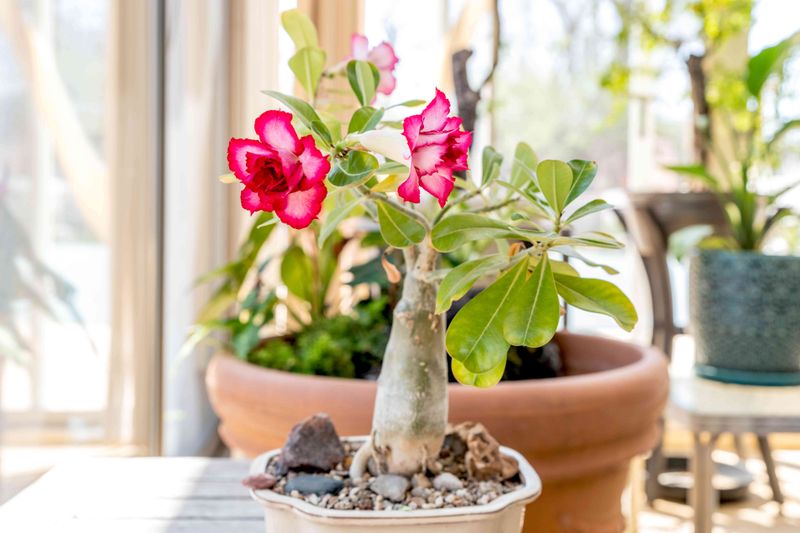
The shelter does its best work when the pot underneath it is set up correctly.
Start with the basics: your container needs clear, unobstructed drainage holes.
If debris, a flat saucer sitting flush against the bottom, or patio grime is blocking those holes, rain or irrigation water has nowhere to go and the mix stays wet longer than it should.
Raise the pot slightly on pot feet or a small stand so water can escape freely after each watering.
UF/IFAS guidance for Adenium specifies well-drained soil for outdoor cultivation, and that requirement only holds up when the drainage holes are actually doing their job.
While you are at it, check that the potting mix itself is loose and sandy or gravelly, designed to drain quickly rather than hold moisture.
A dense, peat-heavy mix will stay wet far too long even in a sheltered spot.
One shortcut that does not actually help: placing a layer of gravel in the bottom of the pot to improve drainage.
Research on container drainage has shown this creates a perched water table that can actually keep the lower mix wetter, not drier.
Use a fast-draining mix throughout the entire container instead.
Airflow matters more than most gardeners expect.
A covered patio with open sides lets moving air dry wet leaves and flowers after a storm blows through.
University of Minnesota Extension guidance on gray mold recommends spacing and airflow so plant surfaces dry after rain or watering, because prolonged leaf and flower wetness can encourage fungal problems.
A cramped, humid corner under a solid roof can create exactly those conditions, so keep your Desert Rose where air moves around it freely.
Storm Winds And Cold Change The Plan
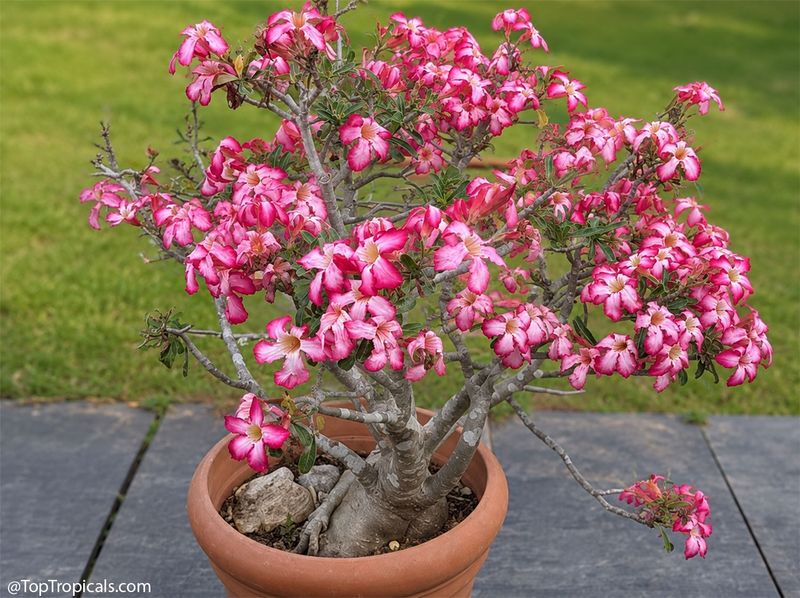
A covered patio handles ordinary Florida afternoon storms well.
A tropical storm or hurricane is a different situation entirely, and your plan needs to change when one approaches.
Even a solid overhead cover may not stop a tall or top-heavy container from tipping over in wind gusts that accompany a tropical system.
A tipped pot can crack, spill the mix, and expose roots to whatever comes next.
UF/IFAS hurricane preparation guidance for container nurseries specifically recommends moving valuable potted plants to protected areas and removing plants from exposed benches before severe weather arrives.
For a homeowner, that means bringing the Desert Rose inside, into a garage, or into an interior room with a window before a named storm gets close.
Get it settled before conditions deteriorate, not during the outer bands.
Where you garden in Florida also changes how much cold caution you need.
South Florida and the Keys can support year-round outdoor growing for Desert Rose when light is strong and drainage is excellent, since those areas rarely see temperatures that threaten the plant.
Central Florida can experience brief cold snaps that catch gardeners off guard, and North Florida needs real freeze planning.
UF/IFAS states that Desert Rose is not freeze tolerant and should not be exposed to temperatures below 32 degrees Fahrenheit.
North Carolina Extension and Missouri Botanical Garden both recommend bringing container plants indoors when nighttime temperatures start dropping below 55 degrees Fahrenheit in autumn, a more cautious threshold worth noting for gardeners in Central and North Florida.
Coastal gardeners along the Gulf Coast and Atlantic Coast face one more consideration after a storm passes.
If salt spray has coated the leaves or the pot, a gentle rinse with fresh water once conditions are safe can help remove residue.
Keep the rinse light so you do not saturate a mix that may already be damp from storm moisture.
North Carolina Extension notes that Desert Rose has some salt tolerance, but repeated heavy salt exposure is still worth addressing when it is safe and practical to do so.
Know What Shelter Can And Cannot Do
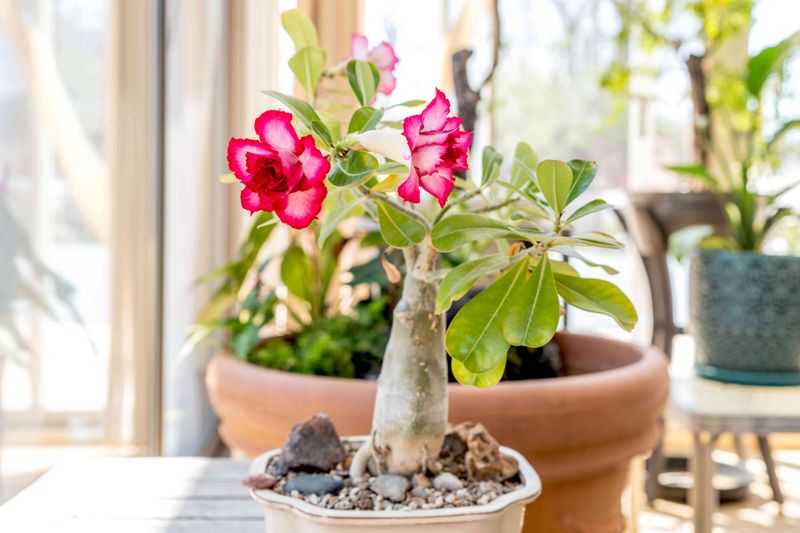
After the storms roll through and your Desert Rose is still sitting in bright light with dry-ish soil and clear drainage holes, you have done what you can.
Shelter, good drainage, careful watering, and airflow all work together.
No single one of them is a magic solution, and they cannot replace each other.
Fertilizer cannot fix waterlogged roots.
Pruning cannot compensate for a plant parked in a dim corner for two months.
And a well-lit, well-drained pot still cannot guarantee flowers on your preferred schedule.
Flowering in Adenium depends on more than wet-weather management.
Light intensity, temperature, the plant’s age and maturity, cultivar, root health, and normal pauses in growth all play a role.
University of Arizona Cooperative Extension guidance on adeniums reflects how many variables interact in this plant’s growth cycle.
A Desert Rose may take a natural rest from blooming regardless of how well you manage the rainy stretch, and that is not a failure on your part.
After each storm, take a few minutes to check the plant.
Look at the potting mix, confirm the drainage holes are clear, and glance at the leaves and stems for any signs of fungal spotting or soft tissue near the base.
Catching a problem early gives you options.
One more thing before you handle the plant: ASPCA lists Adenium obesum as toxic to dogs, cats, and horses.
North Carolina Extension also notes that the milky sap can irritate skin.
Wear gloves when pruning or moving damaged stems, wash your hands after handling the plant, and keep it out of reach of pets and young children.
The plant is worth protecting, and so is everyone sharing your porch with it.
Shelter it well, let it dry between waterings, and it will bloom again on its own time.