
The Dragonflies Swarming Your Yard Right Now Are Migrating Farther Than Monarchs
Follow us on Google
Step outside on a late-summer evening in many parts of the United States and you might find dozens of dragonflies wheeling above your lawn, circling the porch, or hunting low over a nearby pond.
Some dragonfly species are linked to migration routes that dwarf the eastern monarch’s famous fall journey, but that swirling cloud above your yard may not be a long-haul migration at all.
Knowing what you are actually watching, and what you can do to protect it, turns a puzzling spectacle into one of the most interesting wildlife moments a backyard can offer.
Some Dragonflies Beat The Comparison—With A Major Qualification
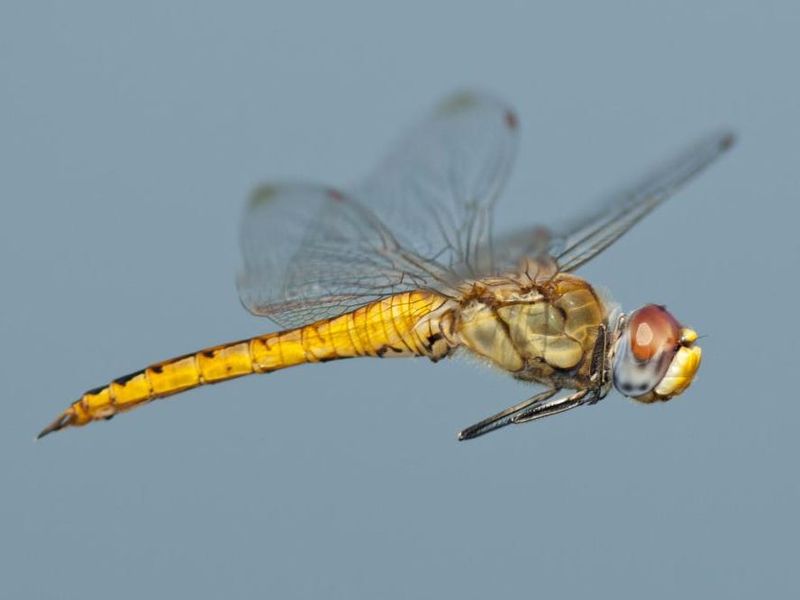
Somewhere over the Indian Ocean, a dragonfly the size of your thumbnail is riding a monsoon wind toward East Africa.
That insect is a globe skimmer, Pantala flavescens, and research on globe-skimmer migration describes a multigenerational Afro-Asian route that may exceed 14,000 kilometers, or about 8,700 miles.
That is a genuinely staggering number compared with the eastern monarch butterfly’s typical maximum fall journey of about 3,000 miles.
Here is the qualification that matters.
Those two figures do not describe the same biological event.
The globe-skimmer number covers a route completed across successive generations, meaning no single dragonfly flies the whole distance.
One monarch, by contrast, can complete its individual fall migration from Canada to central Mexico on its own wings.
So the comparison is real, but it is a multigenerational relay versus a solo journey, and treating them as identical overstates the case.
Parts of the full globe-skimmer route also remain inferred or modeled rather than completely observed.
Researchers have used stable hydrogen isotopes in wing tissue and wind-trajectory modeling to piece together the probable path, and recent isotopic analysis of globe-skimmer migration supports the broad outline while acknowledging gaps in direct observation.
Some sources place the full round-trip route between 14,000 and 18,000 kilometers, but the higher end of that range relies on portions that have not been tracked in real time.
The most important point for anyone watching a late-summer swarm from a porch chair is this: you cannot identify the species from behavior alone, and you cannot confirm migration status from a backyard sighting.
Monarch migration distance data and globe-skimmer estimates both describe well-studied species under specific conditions.
An unidentified cloud over a US yard may or may not contain migrants, and it may or may not include globe skimmers at all.
The wonder is real, the comparison is partly defensible, and the uncertainty is also real.
Dragonflies Carry An Ancient Lineage Into A Three-Stage Life
Long before the first dinosaur set foot on land, dragonfly-like insects were already patrolling ancient swamps.
Odonata, the order that includes dragonflies and damselflies, has a fossil record reaching roughly 300 million years, and Natural History Museum research on ancient dragonflies describes griffinflies with wingspans approaching 70 centimeters hunting Carboniferous skies.
Modern dragonflies are not those creatures, though.
Evolution kept working, and systematic analysis of Odonata evolution makes clear that today’s species represent a lineage with deep roots, not a frozen snapshot of prehistory.
What makes the life cycle so surprising is how much of it stays completely hidden.
A dragonfly begins as an egg laid in or near water, hatches into an aquatic nymph, and spends most of its life underwater before emerging as the winged adult you see above your lawn.
Depending on the species, that nymphal stage can last anywhere from a few months to several years.
NC State Extension’s dragonfly predator profile notes that nymphs are themselves active predators, feeding on mosquito larvae, small invertebrates, and even tiny fish.
The contrast between the two stages is striking.
A dragonfly nymph is a squat, camouflaged, gill-breathing hunter that looks almost nothing like the jewel-winged adult it will become.
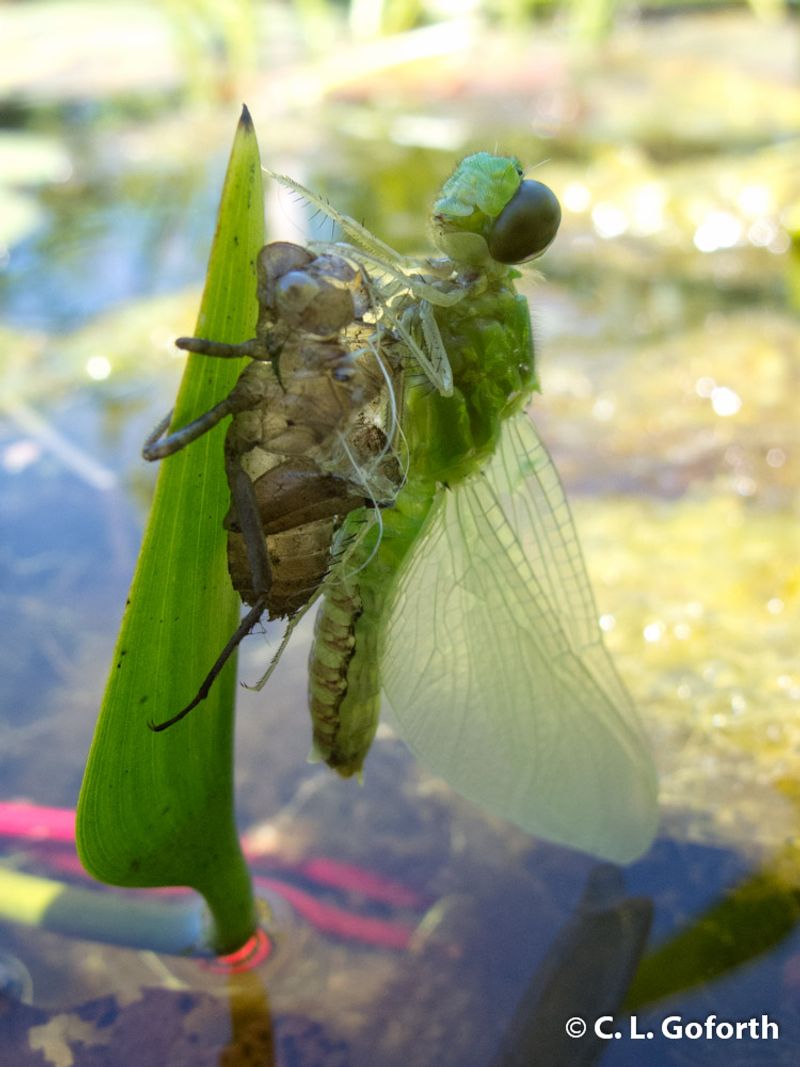
When conditions are right, the nymph climbs out of the water, splits its skin along the back, and the adult pulls free.
That shed skin, called an exuvia, is often left clinging to a reed or rock at the water’s edge.
Finding a cluster of exuviae near a pond tells you that a local emergence happened recently, which is useful context when you are trying to figure out what that cloud of dragonflies over your yard actually represents.
Common Green Darners Follow A More Familiar North American Pattern
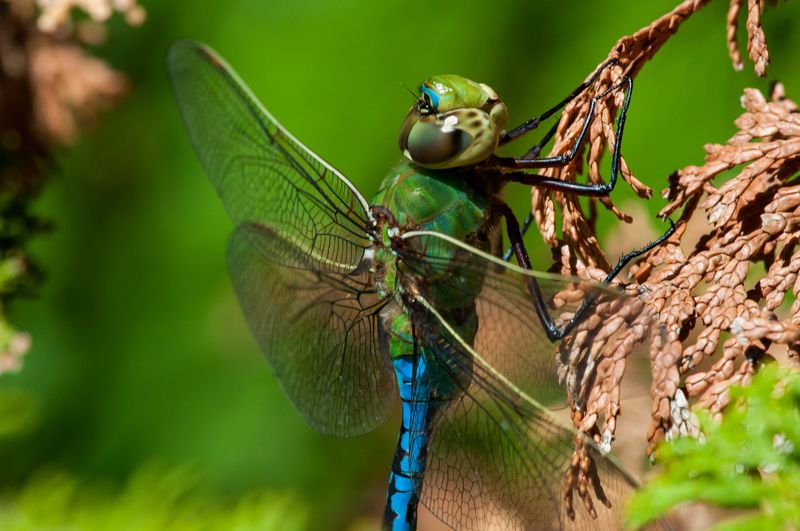
Pull the lens back from the Indian Ocean and focus on North America, and a more familiar migrant comes into view.
The common green darner, Anax junius, is one of the largest and most recognizable dragonflies on the continent, and it is a documented migrant.
Smithsonian research on green darner migration used stable isotope analysis to confirm that individuals born in the northern part of the range travel south in late summer and fall, completing a multi-generational annual cycle.
That cycle works across three generations.
One generation moves north in spring to breed.
A second generation develops through summer and then moves south in late summer and fall.
A third generation overwinters in the southern part of the range and starts the northward push again the following spring.
Peer-reviewed green darner migration research found that southbound movement can begin as early as July and continue into October, with northern-origin darners appearing in southern areas during August and September.
The distance figures deserve careful handling.
Some individual green darners travel more than 2,500 kilometers, or about 1,553 miles, but the species’ average documented migration exceeds 600 kilometers, or about 373 miles.
Neither number exceeds the monarch’s maximum fall journey.
The Monarch Joint Venture’s migration distance overview places the monarch’s individual fall journey at up to roughly 3,000 miles.
Green darners are impressive migrants, but they are not the basis for the “farther than monarchs” comparison.
Timing also varies considerably by latitude, weather, wind, rainfall, and local habitat.
Xerces Society citizen-science dragonfly tracking has helped researchers understand how variable the timing really is across different parts of the country.
A late-summer darner cloud in Minnesota may appear weeks earlier or later than one in Virginia, and local conditions can shift the whole picture from one year to the next.
Read The Cloud’s Movement Before You Call It Migration
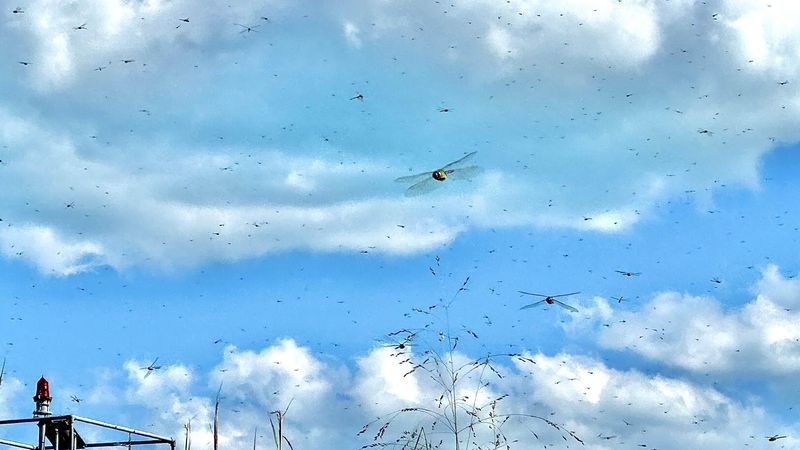
Not every dragonfly cloud is a migration, and the difference matters if you want to understand what you are actually seeing.
The most useful thing you can do in the first few minutes is watch the direction of travel.
A group of insects that keeps moving in one general direction, continuing past your yard rather than circling back, is behaving more like migrants.
That pattern does not prove migration, but it is the closest behavioral clue available to a backyard observer.
Repeated loops over the same patch of lawn, the same beach, or the same field tell a different story.
That kind of circling is more consistent with a feeding swarm, where dragonflies are hunting a concentration of smaller flying insects.
Iowa DNR dragonfly guidance describes feeding swarms as a common late-summer sight that can involve hundreds of individuals hunting together without any directional movement.
Dense activity near a pond or wetland edge, especially if you can spot newly emerged adults with soft, crumpled wings or find shed skins on nearby vegetation, points toward local emergence rather than long-distance travel.
Mating activity adds another layer of complexity.
Males patrol territories near water, sometimes in large numbers, and mixed-species gatherings are common enough that Xerces Society dragonfly migration research notes that a single swarm may contain several species with different behaviors happening simultaneously.
Academic research on dragonfly movement ecology also points out that feeding and migration are not mutually exclusive.
A migrating dragonfly still needs to eat, so a cloud that pauses over your yard to hunt may still be moving through on a longer journey.
The practical takeaway is that these clues are suggestive, not definitive.
You cannot identify a species from behavior, and you cannot confirm the cause of a swarm from a single observation.
What you can do is watch, note the direction and duration, and appreciate that the answer may be genuinely uncertain even to researchers who study this full time.
A Sudden Porch Cloud May Be Hunting Prey
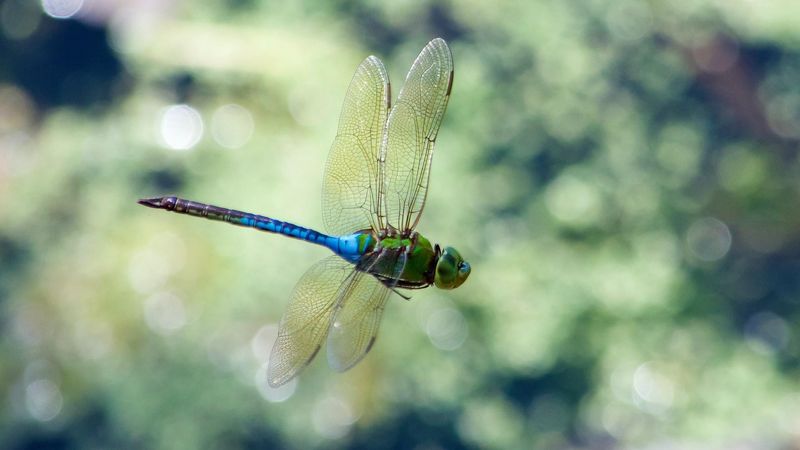
Adult dragonflies are among the most effective aerial predators on the planet.
They catch prey on the wing with a success rate that most raptors would envy, targeting flies, midges, gnats, mosquitoes, and other small flying insects.
When a large group appears suddenly over a yard, lawn, or open field, prey concentration is a reasonable first guess, but it is not the only explanation and it is not always confirmed by what researchers find on the ground.
A study of dragonfly swarm sites found no consistent difference in insect abundance between locations where swarms occurred and nearby control sites that attracted no swarm, according to Dartmouth research on dragonfly swarming behavior.
That result suggests that prey availability alone cannot explain every cloud.
Weather fronts, temperature changes, and nearby insect emergences may all play a role, but the causal picture for any given swarm is rarely settled.
Treat the explanations as possibilities, not certainties.
What dragonflies do offer is genuine ecological value as predators.
NC State Extension’s beneficial predator profile notes that adults consume a wide range of flying insects and that aquatic nymphs prey on mosquito larvae and other invertebrates.
But framing them as a household mosquito-control service overstates the case.
National Park Service dragonfly coverage notes that a large dragonfly’s stomach may hold around 12 mosquitoes, and the actual daily intake is likely toward the lower end of the figures that circulate online.
Mosquito abundance also depends on standing water, weather, sanitation, and a whole food web of other predators.
The more useful way to think about a porch cloud is as a sign that the local food web is functioning.
Something is feeding something else, and you are close enough to watch it happen.
That is worth a few minutes of your evening regardless of whether the dragonflies are migrating, hunting, or doing both at once.
Protect The Aquatic Habitat Behind The Aerial Show
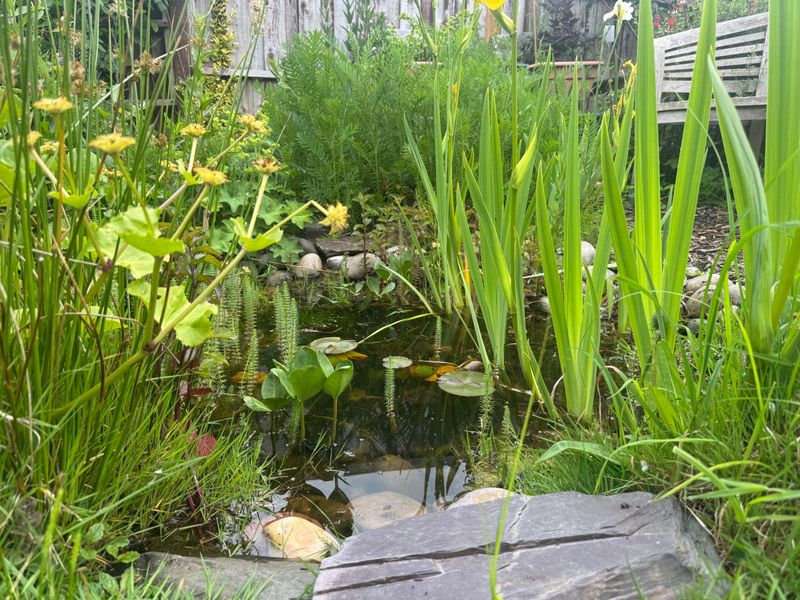
Every dragonfly you see above your lawn spent most of its life underwater.
That aquatic chapter of the life cycle is where habitat protection actually matters, and it is where homeowners have the most practical influence.
Nymphs develop in ponds, streams, wetlands, marshes, and in some species, temporary or seasonal pools that hold water for only part of the year.
USGS dragonfly habitat research makes clear that habitat requirements vary considerably by species: some need water that persists for one or more years to complete a nymphal stage that can last several years, while others can use shallower or more temporary water bodies.
That species-level variation matters when you are thinking about your own yard.
A backyard birdbath or a small decorative container is not a substitute for a functioning pond, stream, or wetland.
NC State Extension’s dragonfly guidance notes that dragonflies generally need suitable permanent or semi-permanent freshwater to complete their life cycle.
Small standing containers without circulation or depth can also become productive mosquito-breeding sites, which works against the goal of supporting beneficial insects.
A container is not the same as a habitat.
The most effective thing a homeowner can do is protect what already exists nearby.
If your property borders or includes a pond, stream, wetland edge, or even a seasonal wet area, keeping that water clean and its edges intact is genuinely useful.
Avoid draining low spots that hold seasonal water, minimize lawn chemicals that can run off into water, and leave some native vegetation along water edges rather than mowing to the shoreline.
EPA integrated pest management guidance reinforces that clean, well-vegetated water edges support the whole aquatic food web, not just dragonflies.
None of this guarantees a resident dragonfly population or a reliable swarm over your yard each summer.
Habitat protection improves conditions, but dragonfly presence also depends on regional populations, species distribution, weather, and factors well beyond any single homeowner’s control.
The goal is to leave the door open, not to promise a particular outcome.
Watch The Swarm And Skip The Unnecessary Spray
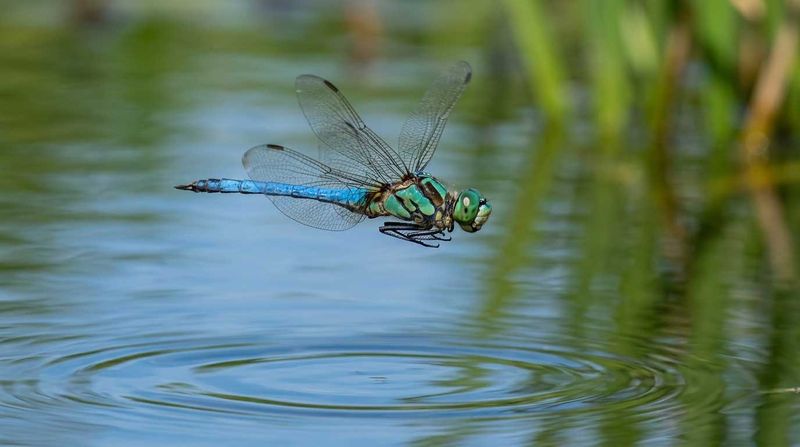
When dozens of dragonflies appear over your yard, the instinct to do something is understandable.
The most useful action is also the simplest: watch them.
Dragonflies are not aggressive toward people and will not seek out a confrontation.
The National Park Service notes across multiple sites, including Everglades insect guidance and Mississippi River dragonfly profiles, that dragonflies can bite or pinch when handled, and larger individuals can break skin.
The practical advice is to observe rather than catch them.
They will give you a better show from a respectful distance anyway.
Reaching for a broad-spectrum insecticide when a swarm appears is one of the least helpful responses possible.
EPA guidance on reducing pesticide impacts to wildlife recommends treating only the areas that genuinely need treatment, following the product label precisely, keeping pesticides out of water, and avoiding applications before heavy rain that can carry chemicals into nearby streams or ponds.
Broad applications near ponds, wetlands, flowering plants, or other wildlife habitat can harm the aquatic invertebrates, beneficial insects, and food-web species that make a yard function well.
EPA aquatic life benchmarks for pesticide risk show how quickly common insecticides can reach harmful concentrations in water, even from small runoff events.
Do not spray in or near a dragonfly swarm to thin it, redirect it, or attract more dragonflies by reducing competing insects.
University of Minnesota Extension research on pesticide risks to beneficial insects documents how insecticide drift and soil residue affect non-target species well beyond the intended application zone.
Manipulating a swarm with chemicals risks harming the very insects you are hoping to encourage.
A late-summer cloud of dragonflies over your yard may be migrating, feeding, emerging from nearby water, or doing some combination of all three.
Leaving it undisturbed protects the habitat and food web regardless of which explanation fits.
The swarm does not need your help to do its job, it just needs you to stay out of the way long enough to watch something genuinely ancient work.