
What Smart Texas Homeowners Do With All Those Acorns Piling Up On The Lawn
Follow us on Google
Smart Texas homeowners sort the acorns into two piles: the ones that get in the way, and the ones that don’t. Clear them from walkways and the mowing path, keep the grass at its normal height, and skip the panic.
You don’t need a bare yard to have a healthy one. Here is how to handle the late-fall drop without wasting your weekend.
Acorns On The Ground Aren’t A Lawn Emergency
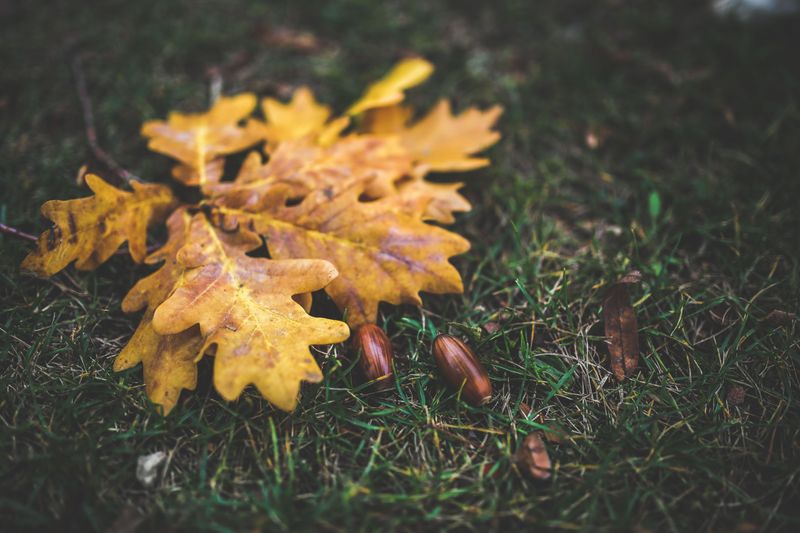
You walk out for the paper and the grass crunches. Acorns are everywhere, and it looks like the lawn is losing a fight.
Take a breath. It is mostly a mess, not a disaster.
Illinois Extension guidance says acorns do not damage grass or other plants simply by lying on the ground. That advice comes from an Illinois forestry specialist, not a Texas turf trial.
Still, it matches what the problem really is. Acorns on established grass do not by themselves show the lawn is being harmed.
So the useful question is simple. Are the acorns getting in the way of mowing, walking, or daily life?
If so, deal with those spots. If not, they can wait.
Timing varies by oak. For one example, USDA Forest Service information on post oak reports mature acorns dropping from September through November.
Do not assume every Texas oak follows that same schedule, because your neighbor’s tree may drop on its own calendar.
A heavy year can feel like a sign of something. It is not that simple.
A 2012 Texas A&M AgriLife report said oak crops vary and the causes are more complicated than drought alone. A 2023 study of Southern Appalachian oaks found big differences among species, years, and trees.
A heavy drop in your yard does not prove a statewide mast year or a single cause.
Think of the acorns as clutter, not a threat.
Clear Walkways And Mowing Areas First
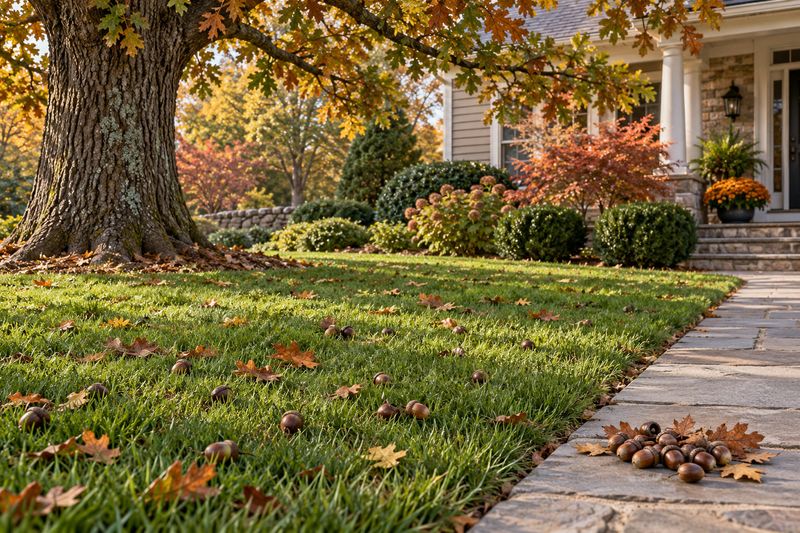
Blunt truth: the first place to clear is wherever feet and wheels go. Walkways, patios, and driveways come before any patch of grass.
Acorns underfoot roll like tiny marbles, and nobody wants to test that with a basket of laundry.
Pick or rake those hard surfaces first. Add the spots where kids and pets play, and the path to the mailbox.
A broom works well on pavement, and a few minutes usually does it.
Next, walk the mowing area before you pull the cord. The U.S.
Consumer Product Safety Commission advises checking the lawn for debris before mowing, because mower blades can throw objects and cause severe injuries.
That warning is general, not an acorn-specific injury finding. Acorns are simply hard objects, so they belong in the same category as sticks and stones.
Clear them from the mowing path and you remove a needless risk.
There is no need to claim acorns wreck blades. That is not what the safety guidance says.
The point is the thrown debris.
Do not try to mow a thick layer into oblivion just to make it vanish. That shortcut tends to make a bigger mess and a louder mower.
A quick walk-through first saves you the headache.
Ten minutes of clearing now means a calmer mow later.
Choose A Cleanup That Fits Your Yard
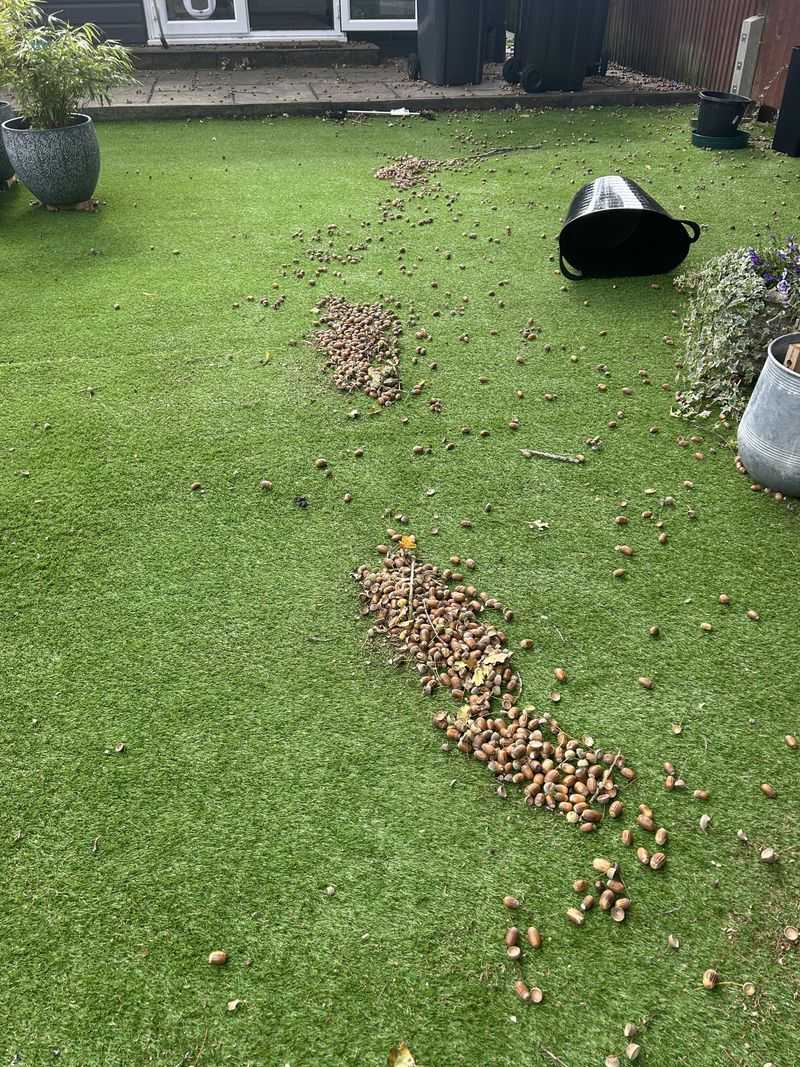
Many homeowners picture a perfectly bare yard, then quit after twenty minutes. A better goal is clearing the troublesome areas, not every last nut.
Since acorns lying on grass are not a lawn emergency, as Illinois Extension explains, you get to be selective. Collect them from turf when their numbers interfere with mowing or household use.
Hand collection is the simplest option. Grab a bucket and work in sections, especially under the tree where the drop is heaviest.
It is slow, but it is quiet and it works.
A leaf rake is another straightforward choice. Pull the acorns into rows, scoop them up, and move on.
A flexible rake with wide tines tends to glide over the grass without tearing it.
A lawn sweeper is something to try, not a sure fix. Some people like rolling one across the yard, and others find it clogs or skips nuts.
If a neighbor owns one, borrow it before you buy.
Start with the zone nearest the house and the mowing lanes. Then decide if the rest bothers you.
If it does not, leave it for another weekend.
You are managing a yard, not winning a war.
Keep Grass At Its Recommended Height
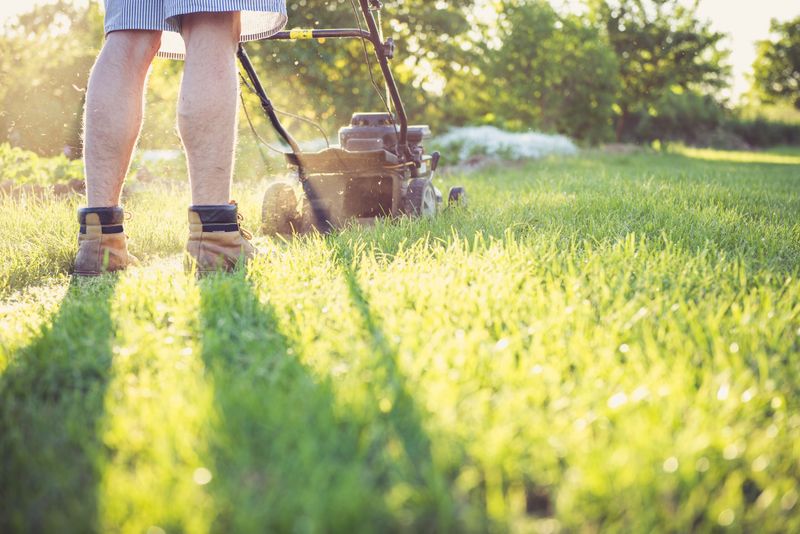
Here is the myth: cut the grass short and the acorns will not matter. It sounds logical.
It is not a good plan.
Cutting unusually short stresses turf, and scalping is not a cleanup method. Clear the troublesome acorns first, then mow at the height your grass prefers.
Texas A&M AgriLife’s mowing height guide gives an optimal height of 1.5 inches for common bermudagrass and 2.5 inches for St. Augustinegrass. Those are the numbers to aim for.
St. Augustine is a little different. AgriLife’s St. Augustinegrass guidance gives a general range of 2 to 4 inches.
The 2.5 inch figure is the optimal height, and the 2 to 4 inch range is the wider window.
Check what grass you really have. Bermudagrass and St. Augustinegrass look different in the blades and the way they spread.
If you are unsure, take a small clump to a local nursery or your county Extension office.
Set the mower deck before you start, and mow only after the path is clear. Acorns in your way are a reason to pick up, not a reason to chop low.
Healthy grass at the right height is the best neighbor your oak tree could have.
Keep Dogs From Eating Acorn Piles

Picture your dog nosing through the pile like it found treasure. Before you worry, know the facts.
Not every nibble is an emergency.
According to Texas A&M’s veterinary school, a dog swallowing one or two acorns is not generally expected to cause toxicity. Larger or repeated ingestion can cause problems, though.
Size and hardness are separate concerns. A big, hard acorn can be a problem on its own, even apart from toxicity.
That is why it makes sense to keep your dog from making a habit of it.
The Merck Veterinary Manual discusses poisoning mainly in the context of animals eating large quantities of young oak leaves or green acorns. So the worst concern involves heavy eating, not a stray bite.
Keep that advice about dogs separate from livestock and other animals. Different animals face different risks, and acorns are not harmless to all of them.
Practical steps are easy. Rake piles where your dog plays, and redirect a dog that keeps munching.
If you see vomiting, belly pain, or other symptoms, call your veterinarian.
A calm eye beats a panic every time.
Some Acorns Can Stay In A Quiet Corner

Here is a surprise: you do not have to clear every acorn. Leaving some in a low-traffic spot is a perfectly fine choice.
It is optional. Nobody needs to keep acorns to be a good neighbor to nature, and your yard is not required to feed anything.
If you like the idea, wildlife is one reason. Texas Parks and Wildlife says acorns are a staple food for fox squirrels in Northcentral Texas and part of the diet of Rio Grande turkeys there.
Those are examples from one region. They do not tell us which animals will eat acorns in every Texas yard, from the Gulf Coast to the Panhandle.
So treat them as a local note, not a rule.
A quiet corner works best. Pick a back fence line, a bed under the tree, or a spot nobody walks.
Keep it away from pet areas, patios, and the mowing lanes.
If the corner bugs you after a few weeks, rake it up. You are in charge of the yard.
A small patch left alone can be a nice bonus, not a duty.
Crush Acorns Before Composting
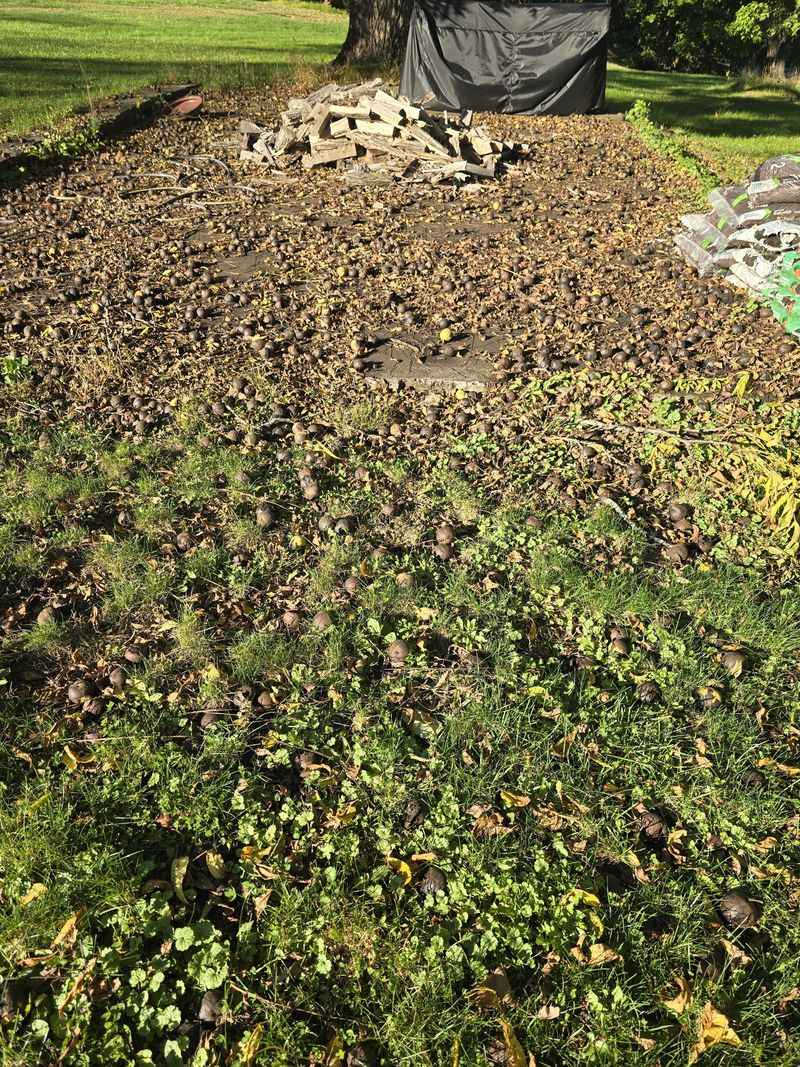
Composting is a choice, not a quick way to get rid of a mountain of acorns. Whole acorns break down slowly.
An Extension volunteer response recommends crushing the shells before adding them to compost. Otherwise, it warns, they may take years to break down.
It is a general Extension Q&A, not Texas compost research, so treat it as a practical tip.
That also means whole acorns are not good quick mulch. Spreading them across beds is not a shortcut.
Some can germinate too, as Illinois Extension notes, so you may find baby oaks where you least expect them.
If you want to try it, set aside a bucket. Crack the shells with a hammer on a sturdy surface, then mix the pieces into your pile in small amounts.
Expect it to be slow.
If that sounds like too much work, no problem. You can bag the acorns, drop them off where your city allows, or leave some in that quiet corner.
The plan stays simple: clear what is in the way, then leave the rest to your own taste.
A tidy path and a mowed lawn beat perfection every fall.
