
Before You Mow That Quiet Patch of Lawn, Look for This Yellowjacket Entrance First
Follow us on Google
You are halfway through a muggy Saturday mow in North Carolina, and the engine drone fills your ears. Then you notice small yellow-and-black wasps slipping in and out of one spot in the grass.
That steady traffic is worth a pause, because a ground nest is easy to miss until a mower rolls over it. Here is how to read the clues, stay calm, and pick a safe next step.
Repeated Traffic Can Signal a Colony
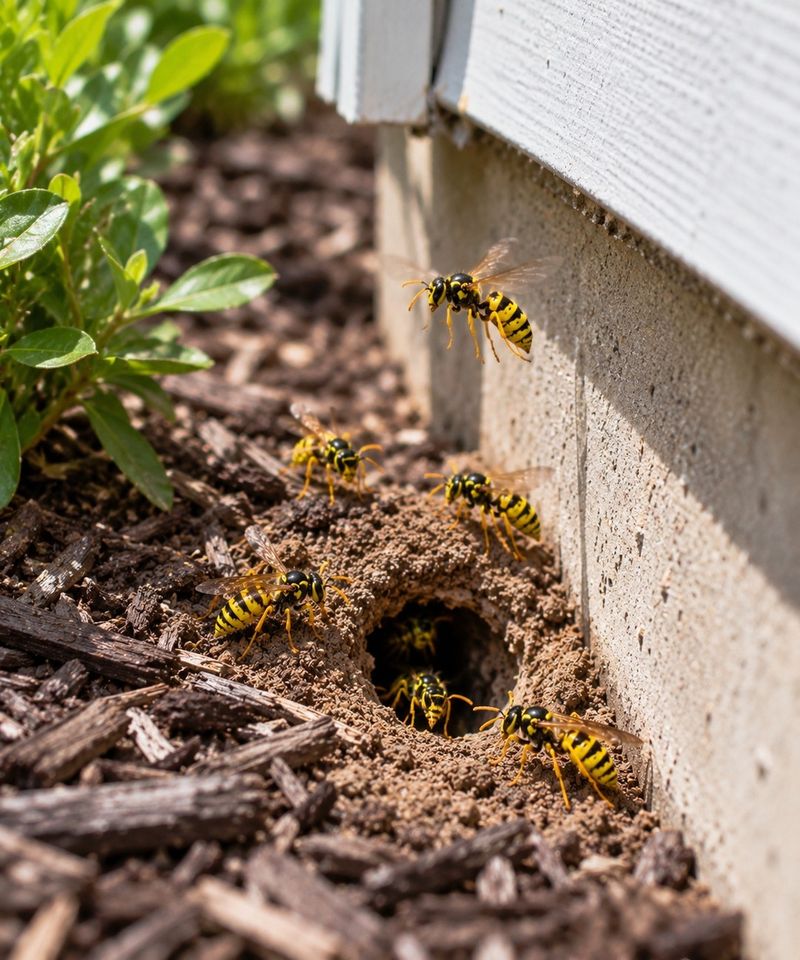
Picture the edge of your lawn on a hot July afternoon. You glance over and see small yellow-and-black wasps coming and going from the same spot in the ground, again and again.
That repeated traffic is the clue worth remembering.
Watch from where you are standing. Do not walk closer for a better look.
A steady stream of wasps using one opening can suggest a social colony, the kind that may defend its home if something shakes it. In North Carolina, the eastern yellowjacket is the most common yellowjacket, and NC State Extension notes that people often find nests by accident while working or mowing nearby.
Now the honest limit. Traffic is a hint, not a verdict.
One wasp near a hole does not make a nest. A quiet patch of grass tells you nothing at all, because a nest can be hidden under a lawn that looks perfectly peaceful.
Plenty of other wasps also use soil, and some of them are solitary and behave very differently, which University of Maryland Extension explains in its guide to predatory wasps.
So the useful habit is simple. Notice repeated traffic at one opening, treat it as a reason to keep the mower away, and let the pattern guide your next move instead of guessing from a hole alone.
A Bare Hole Is Not Enough
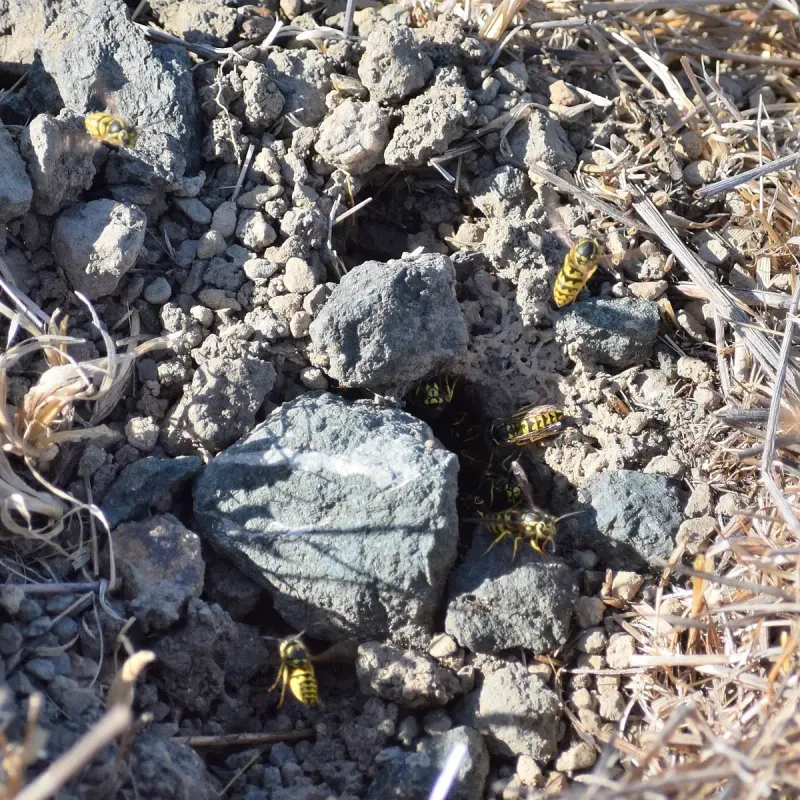
Here is a myth worth retiring. A hole in the lawn does not prove yellowjackets live there.
Chipmunks, voles, and several kinds of wasps and bees all leave openings in the soil.
Size will not settle it either. NC State shows a yard nest entrance about 1 inch across, but that is one example, not a ruler you can hold up to your yard.
Some entrances are bigger, some smaller, and some are tucked under grass so you barely see them.
The better question is what the traffic looks like. Many wasps funneling through one opening suggests a social colony.
Several separate holes, with only one or two insects hanging around each, can point to solitary wasps instead.
Cicada killers are the famous look-alike. They are big, about 2 inches long, and they may nest in groups in sunny, bare soil, which is why they alarm people.
University of Maryland Extension describes them as solitary wasps, and they generally do not defend a communal nest the way yellowjackets do.
Even so, do not crouch down to sort it out. Identification from a distance is a guess, and a guess is a fine reason to be careful, not a reason to poke around.
The Nest Can Hide Beneath Your Mowing Route
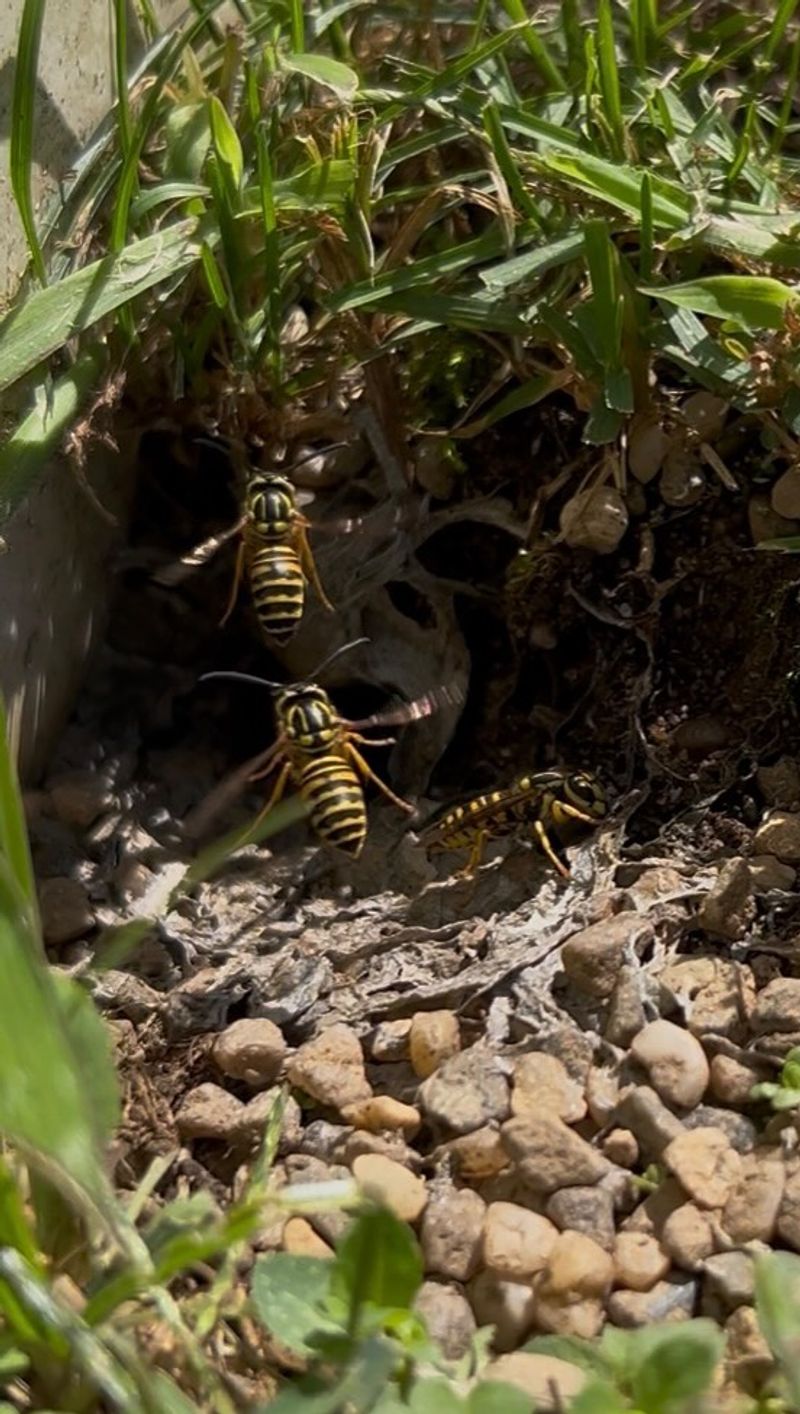
Yellowjackets are not big on building in plain sight when the ground offers a ready-made room. They often use an underground cavity or an old rodent burrow.
All you may ever see is a small opening, while the nest sits out of view below.
That is why so many encounters feel like a surprise. People tend to find these nests while working or mowing nearby, as NC State Extension reports.
The nest did not appear overnight in your path. It was simply invisible until you came close.
Then there is the mower. Its vibrations can set off a defensive response, because to a colony underground, a rumbling machine can feel like a threat to the whole home.
University of Maryland Extension also notes that social wasps defend their nests when disturbed.
How many wasps might respond is not something anyone can predict. It could be a few, it could be many, and you cannot know ahead of time.
That uncertainty is the whole point.
So when you spot traffic near your mowing route, think of the opening as the tip of something larger. Let the unseen part of the nest guide how much room you give it.
Stop Mowing and Retreat Calmly
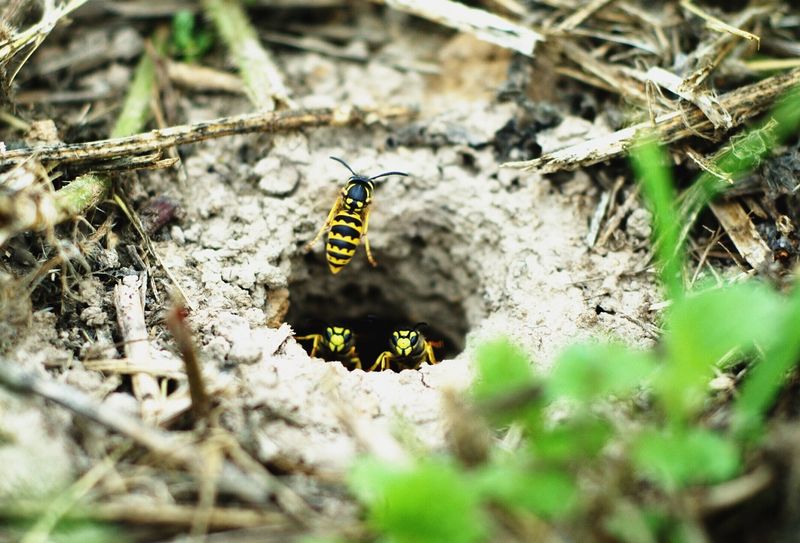
Say you are mid-pass and you notice wasps streaming from one spot. Your first job is not to be a hero.
Do not mow over that opening, and do not walk over to investigate.
If you can shut off the mower without stepping closer to the spot, do it. If reaching the controls means moving toward the opening, skip that and focus on getting yourself away.
Once you are moving, walk off calmly. Swatting and flailing tend to make things worse.
Why the care? Yellowjackets can sting more than once.
Their alarm pheromones, which are chemical signals, can also bring nestmates into the defense, as NC State Extension describes. One upset wasp can turn into several.
No one can hand you a magic number of feet that guarantees safety. Think of it as putting steady, unhurried distance between you and the spot, and keeping kids and pets away too.
University of Maryland Extension notes that social wasps can respond together when a nest is disturbed.
Once everyone is clear, you can take a breath. The mower can wait an hour, a day, or a week.
The lawn will forgive you.
A Nest in the Mowing Route Needs Attention
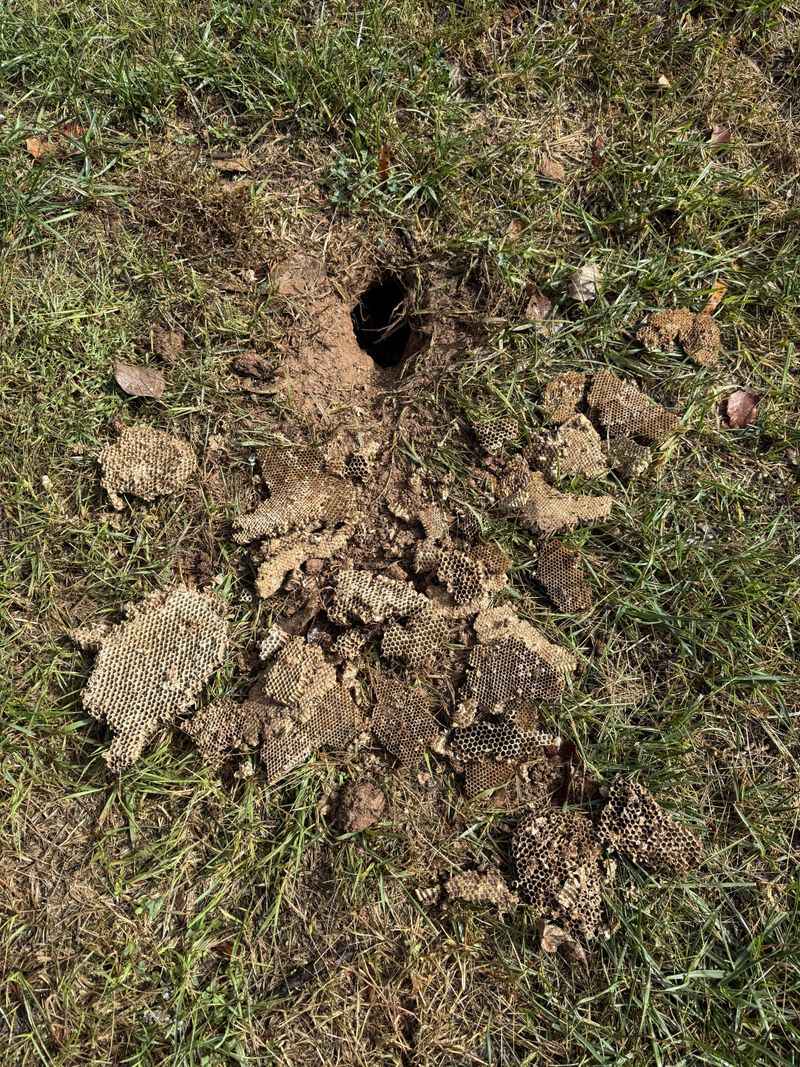
Not every nest is the same problem. What matters most is where it sits and who walks past it.
A nest at the back of a wooded lot is a very different story from one beside the path you mow every week.
If the nest is in a mowed lawn or another place people regularly use, treat it as a real hazard. NC State Extension points to nests in mowed areas and spots people encounter as situations where control may be appropriate.
A turf-focused guide from NC State on yellowjackets in turf covers the same lawn setting.
While the situation is unresolved, reroute your mowing so the mower stays away from the spot. Keep family members and pets away from that corner as well.
A leash on the dog and a quick word with the kids go a long way.
Compare that with a nest tucked in a far corner that nobody visits. There, the risk to your household is small.
Ask yourself a simple question about each nest. Does it put someone in its path?
If the answer is yes, give it attention. If it is no, you have more options, which the next section covers.
Some Nests Can Be Left Undisturbed
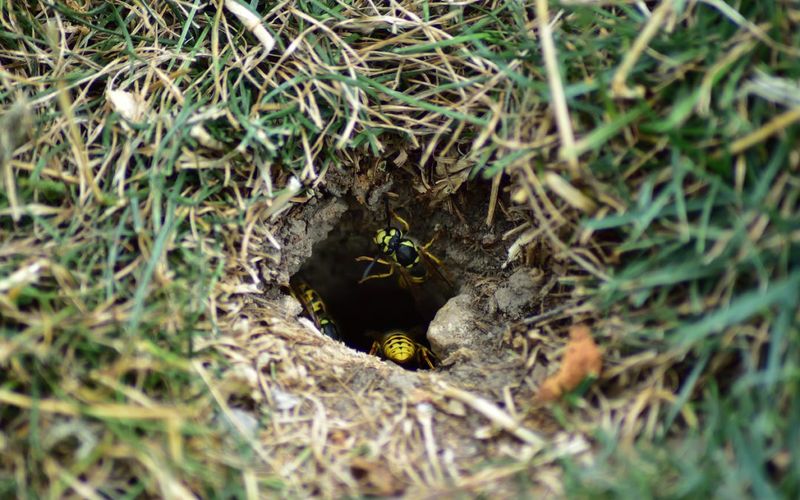
Here is a calmer truth. You do not have to treat every yellowjacket nest like an enemy.
These wasps eat other insects, so they do some quiet pest control in the yard.
Their time is also limited. NC State Extension explains that colonies die out each year, and that yellowjackets do not reuse old nests.
A nest you leave alone this summer will not become a permanent fixture.
So if a nest is truly out of the way, far from walkways, play areas, and mowing paths, leaving it undisturbed can be a reasonable choice. Just keep people and pets from wandering over, and do not poke at it to see what happens.
Now the catch. These facts are not a free pass.
A nest in your mower path is not made safe by the good that yellowjackets do for the garden. Benefit in the yard does not cancel risk on the route.
Think of it as a sorting question. Out of the way and harmless to the household, you can let it be.
In your path, it needs a plan, and that is where the last section comes in.
Choose Professional Help When Risk Rises
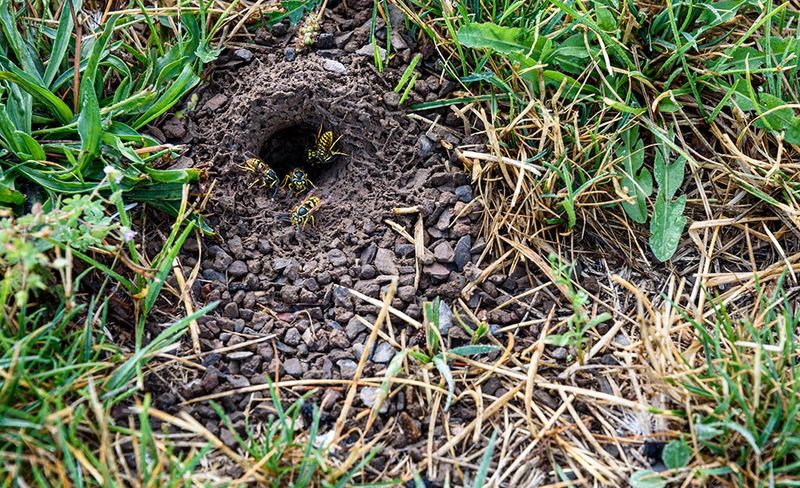
Some situations call for a pro, and knowing which ones saves worry. Think about hiring one if anyone in the household has a history of serious sting reactions, if the nest is hard to reach, or if you simply are not sure how to handle it.
Severe allergic reactions can develop fast. For anyone with a known severe sting allergy, follow the clinician’s emergency plan.
If anaphylaxis starts, use prescribed epinephrine and call 911. The American College of Allergy, Asthma and Immunology offers more on insect sting allergies, and University of Maryland Extension also covers when stinging pests call for extra caution.
If you still consider treating the nest yourself, the product label rules. NC State’s 2026 Agricultural Chemicals Manual describes treating soil-nesting wasp openings after dark, but the label decides whether, where, and how a product may be used.
The EPA says using a pesticide against its label is a violation of federal law.
Never pour gasoline or any other accelerant into a hole. It is hazardous and harms the soil.
And do not expect one treatment to wipe out a colony, since repeat treatment may be needed.
A quiet call to a professional is not giving up. Sometimes the smart mower move is to hand the job to someone with the gear.
