
That Weed You Just Yanked May Have Been Worth More Than Anything Else In The Bed
Follow us on Google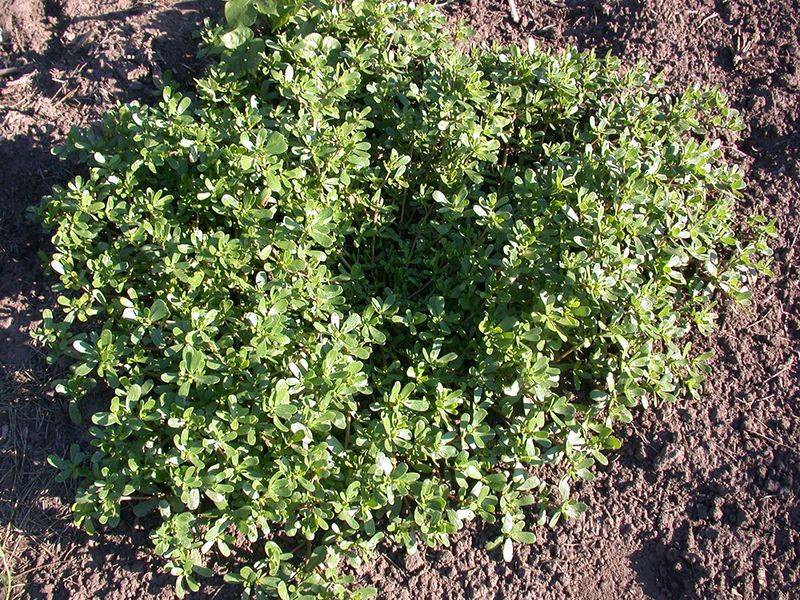
Most gardeners have pulled it dozens of times without a second thought, tossing it into the compost bin like any other nuisance.
But that low, fleshy, mat-forming plant spreading across your vegetable bed might actually be common purslane, an edible green that shows up uninvited and costs you nothing to grow.
Before you reach for the next one, it’s worth pausing long enough to take a closer look.
The Weed Is Common Purslane
Reach down and look at what you just pulled.
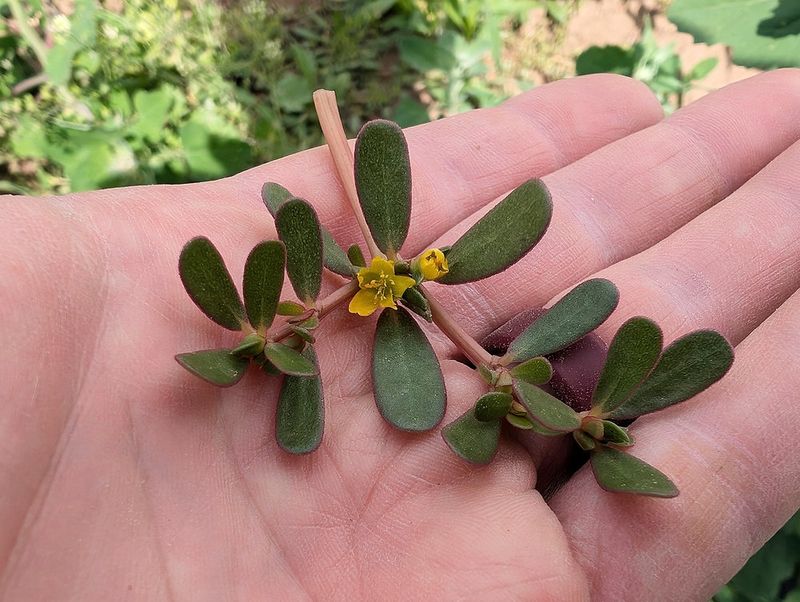
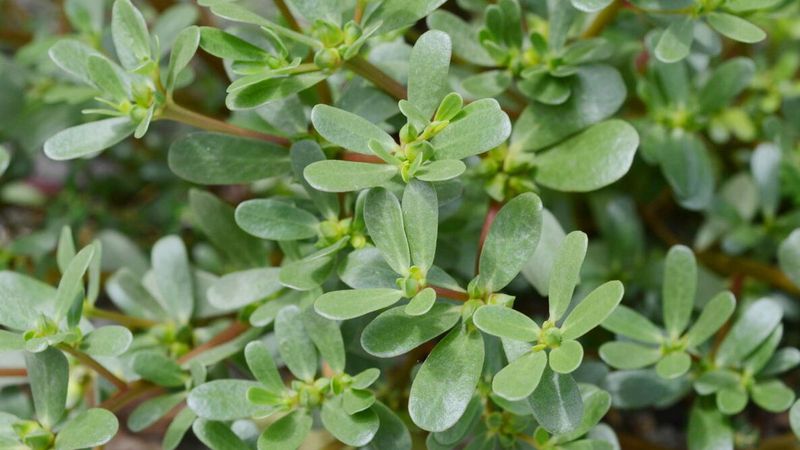
If the plant has smooth, fleshy, oval to wedge-shaped leaves arranged in opposite pairs along spreading stems that range from green to pink or reddish, you are most likely looking at common purslane, Portulaca oleracea.
Its stems fan outward from a central point and press close to the ground, forming a low mat that blends into the soil so well that most people pull it without registering what it is.
Purslane shows up in summer garden beds, thin turf, disturbed soil along fence lines, and even the cracks of sidewalks and driveways.
It is a warm-season annual, meaning it germinates in warm soil and dies with the first frost.
Penn State Extension confirms its widespread presence in Pennsylvania gardens, and similar Extension programs across the country report the same pattern from the Mid-Atlantic to the Southwest.
One identification clue is not enough to act on.
Fleshy leaves alone do not confirm purslane, because other plants share that trait.
Look for the combination: smooth leaves in opposite pairs, stems that are clearly succulent rather than papery, and small yellow flowers with five petals that tend to open only in full sun.
UC IPM’s identification gallery illustrates these features clearly and is worth bookmarking on your phone before you head back outside.
That mat-forming habit, the same quality that makes purslane easy to overlook, is also what makes it a surprisingly low-effort edible volunteer.
It grows without being planted, without being watered on schedule, and without any help from you at all.
Its Practical Value Starts In The Kitchen
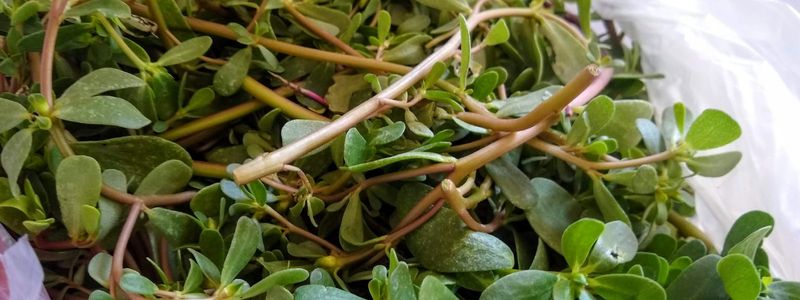
Young purslane leaves have a mild, slightly sour flavor that holds up well in a simple salad or wilts down neatly in a hot pan.
Cornell Extension describes it as both a salad vegetable and a pot herb, meaning you can use the tender leaves raw or cook them the same way you would spinach or any other quick-wilting green.
Many cuisines around the world have used it this way for centuries, which puts it in well-tested company.
On the nutritional side, University of Florida IFAS Extension identifies several distinct components worth noting: vitamins A, C, and E; the mineral potassium; and alpha-linolenic acid, or ALA, a plant-based omega-3 fatty acid.
These are separate categories and should be understood as such.
ALA is not the same as the EPA and DHA found in fish oil and algae, and eating purslane does not replicate the effects of a fish-oil supplement.
It is a source of ALA, not a replacement for other omega-3 sources.
Nutritional levels also vary depending on plant age, which part of the plant you eat, growing conditions, and how the sample was tested, so treat published figures as a general range rather than a guarantee.
One meaningful caveat comes from a published oxalate review, which reports roughly 671 to 869 milligrams of oxalate per 100 grams of fresh purslane leaves.
That is a substantial amount.
People with kidney disease, a history of calcium-oxalate kidney stones, or any medical dietary restriction should talk to a doctor before eating purslane regularly.
Treated as one useful green among many in a varied diet, purslane earns its place.
Treated as a miracle food to eat in large quantities every day, it does not.
A Useful Volunteer Still Needs A Boundary
A few purslane plants growing between widely spaced, established tomato cages are a different situation than a dense mat pressing up against a row of carrot seedlings.
Location and crop size determine whether purslane earns a temporary spot or needs to come out immediately.
Deciding that every purslane plant is either always worth keeping or always worth removing misses the point.
Purslane’s fleshy leaves help it tolerate dry stretches better than many weeds, but that does not mean it leaves extra moisture behind for its neighbors.
UC IPM notes that purslane competes directly with crops for water, nutrients, and light, especially during hot summer weather when both the weed and your vegetables are under the most stress.
A mat of purslane around young lettuce, beans, or fresh transplants can shade the soil surface and pull from the same limited moisture those seedlings depend on.
The math changes when crops are established and well-spaced.
A single purslane plant tucked between two healthy pepper plants is not staging a takeover.
It is sitting in otherwise open soil, and if you plan to harvest it before it sets seed, its presence costs you very little.
Think of it as a squatter with a short lease.
You can let it stay if it is not crowding anyone and you are paying attention.
But the moment it starts competing with slow-growing crops or spreading toward seedlings, removing it is the right call.
University of Florida IFAS frames this practical balance well: the plant has genuine value, but that value depends entirely on whether the gardener is managing it deliberately rather than letting it run.
Harvest Only What You Can Verify And Trust
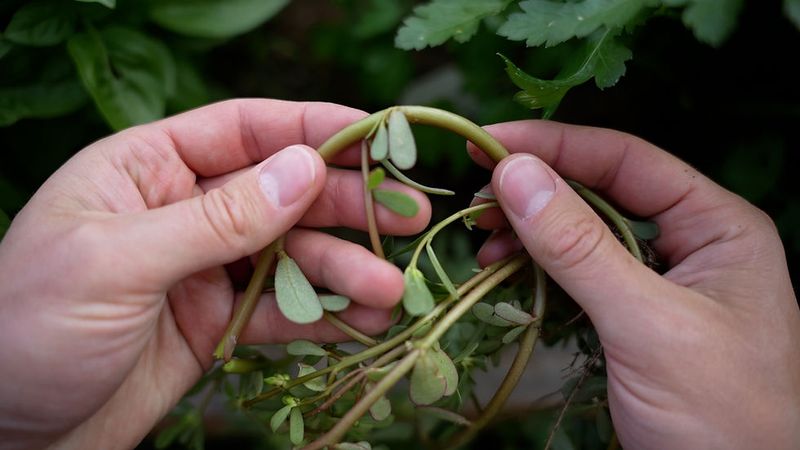
Food safety comes before harvest technique, and the first question is not how to pick purslane but whether you should pick this particular plant at all.
Eat it only after you have positively identified it and only when it grew in soil and water you can trust.
That means no plants from beds that received herbicide, insecticide, weed-and-feed products, unknown fertilizers, or irrigation water from a questionable source.
Utah State Extension’s urban edibles research reinforces that growing location and treatment history matter as much as the plant’s identity.
Washing under running water removes soil, surface debris, and most insects, but it does not reverse chemical exposure.
A plant treated with herbicide last week is not made safe by a thorough rinse.
If there is any doubt about what has been applied to the bed or the surrounding lawn, skip the harvest and pull the plant out instead.
Before picking anything, break a stem.
Purslane will not release milky sap.
If a white, latex-like fluid appears, stop immediately.
That is a sign you may be holding spotted spurge, a lookalike that Poison Control warns can irritate skin, eyes, and the mouth on contact.
Do not eat it.
Once you have confirmed identity and location, the harvest itself is straightforward.
University of Florida IFAS Extension identifies roughly 5 to 6 inches as a useful harvest stage for young shoots, before the stems become fibrous and tough.
Pick in the morning when the leaves are plump, rinse thoroughly under cool running water, and remove any damaged tissue, insects, or soil clinging to the stems.
Ask Extension guidance on garden food safety and University of Minnesota Extension’s food safety recommendations both support using clean tools and containers to avoid cross-contamination during harvest.
Keep A Small Patch Or Let It Go
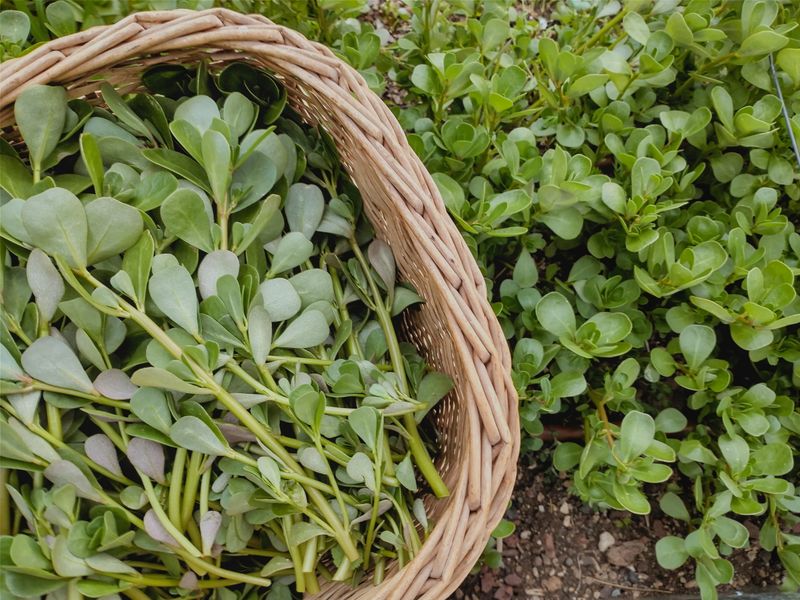
Keeping purslane as a controlled crop is a reasonable choice, but it requires actual management, not just a decision to leave it alone.
A clearly marked patch at the edge of a bed, or a handful of plants in a spot away from slow-growing seedlings, is about as much as most home gardens can handle without things getting out of hand.
Harvest from it regularly and treat it like any other cut-and-come-again green rather than a plant you check on once a month.
The critical step is removing plants before the seed capsules mature.
UC Agriculture and Natural Resources explains that purslane can produce a very large number of seeds, and those seeds can remain viable in the soil for years, with some sources reporting germination after many seasons.
Exact longevity figures vary across studies and growing conditions, but the practical message is consistent: one plant that goes to seed today can cause a much bigger problem next summer.
Careless hoeing makes things worse.
UC IPM notes that fleshy stem fragments left on damp soil can reroot and keep growing as if nothing happened.
Cutting purslane at the soil line and walking away is not removal, it is redistribution.
Pull larger plants by hand, carry them out of the bed, and let them dry completely on a hard surface before composting.
If the plants have already begun to flower or form capsules, use a disposal method that will not spread viable seed or plant material back into the garden.
Utah State Extension’s IPM guide on purslane offers the same practical framing: this plant rewards attentive management and punishes neglect.
When You Want It Gone, Act Young
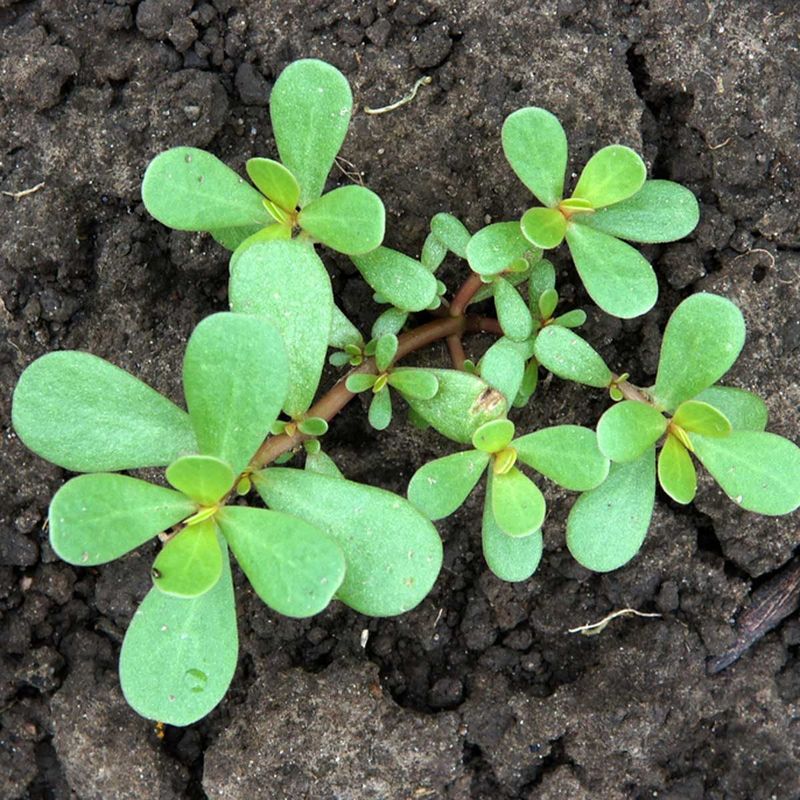
Purslane seedlings pulled when they are small and still pale green come out cleanly and leave almost nothing behind.
Wait until they are flowering and sprawling, and the job gets considerably harder.
UC Agriculture and Natural Resources research summarized by UC ANR found that plants older than about four weeks become more difficult to control and that uprooted mature plants can still produce viable seed even after you have pulled them.
That four-week marker is a useful guide, not a fixed calendar date, because warmer temperatures and consistent moisture speed growth considerably.
Walk the bed every week or two during the summer and pull any purslane you spot before it reaches flowering stage.
Young plants come out easily after a light rain or watering when the soil is loose.
Drop them into a bucket rather than leaving them on the soil surface, where a damp day could give the stems enough moisture to reroot.
A 3-inch layer of light-blocking organic mulch over planting beds can reduce how many purslane seeds germinate in the first place.
UC IPM recommends this as one control layer, not a permanent solution.
Mulch that contains weed seed introduces new problems, and any time you disturb the soil to plant or transplant, you bring buried purslane seed closer to the surface where it can sprout again.
For beds with a heavy, persistent infestation, Utah State Extension and UC IPM both describe clear-plastic soil solarization as an option worth considering.
Laying clear plastic over moist soil for 4 to 6 weeks during the hottest part of summer, before you plant, can reduce the seedbank in the top few inches of soil.
This is a climate-dependent method that works best in regions with reliably hot summers and works poorly in cooler or cloudier climates, so check whether your conditions match before committing the time.
Make The Plant Earn Its Place
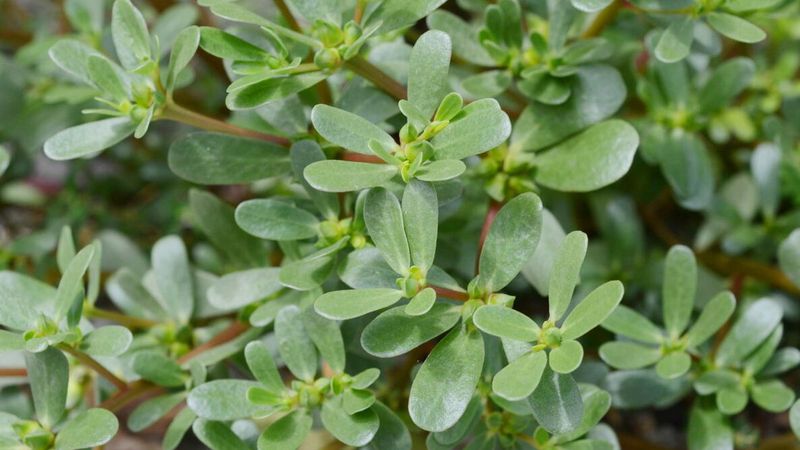
Pause before you pull the next one.
Look at where it is growing, what is growing nearby, and whether you can say with confidence what plant you are holding.
Those three questions answer most of what you need to know.
If purslane is confirmed, the soil has not been treated with anything you would not want on your food, and the plant is sitting in open space rather than pressing against young vegetables, a small marked patch and a regular harvest schedule is a reasonable choice.
University of Florida IFAS Extension treats it as a legitimate home-garden crop under those conditions, and that framing holds up when the gardener stays attentive.
If the plant is tangled through seedlings, growing in a bed that received chemicals this season, not clearly identified, or already forming seed capsules, remove it.
UC IPM and Penn State Extension both make clear that purslane’s ability to spread, reroot, and persist in the seedbank means a hands-off approach usually creates more work, not less.
Purslane is not a superfood that belongs in every garden, and it is not a throwaway weed that belongs in every compost pile.
Its value is specific, and it depends on whether you can positively identify it, trust its growing location, keep it from crowding your crops, and harvest it before it sets seed.
Meet those conditions and you have a free, low-effort edible green.
Miss any one of them and removal is the smarter move.
A plant that earns its place is worth keeping; one that does not is just a weed with good press.