
This Common Garden Plant Keeps Fooling People Because The Leaves Tell A Different Story
Follow us on Google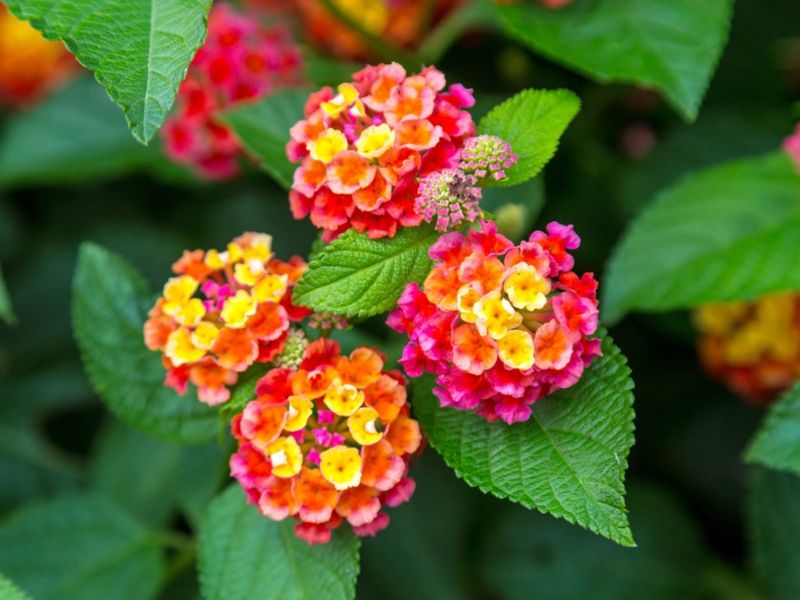
Walk past a certain shrubby plant in your neighbor’s yard and you might count three or four different flower colors on a single cluster, then wonder if you’re looking at one plant or several.
That color-shifting display is one of the most reliable ways to spot a plant that millions of American gardeners grow without fully understanding it.
The flowers are doing something genuinely interesting, but they’re also throwing you off.
The leaves, it turns out, are the part that actually tell you what you’re dealing with.
The Mystery Plant Is Most Likely Common Lantana
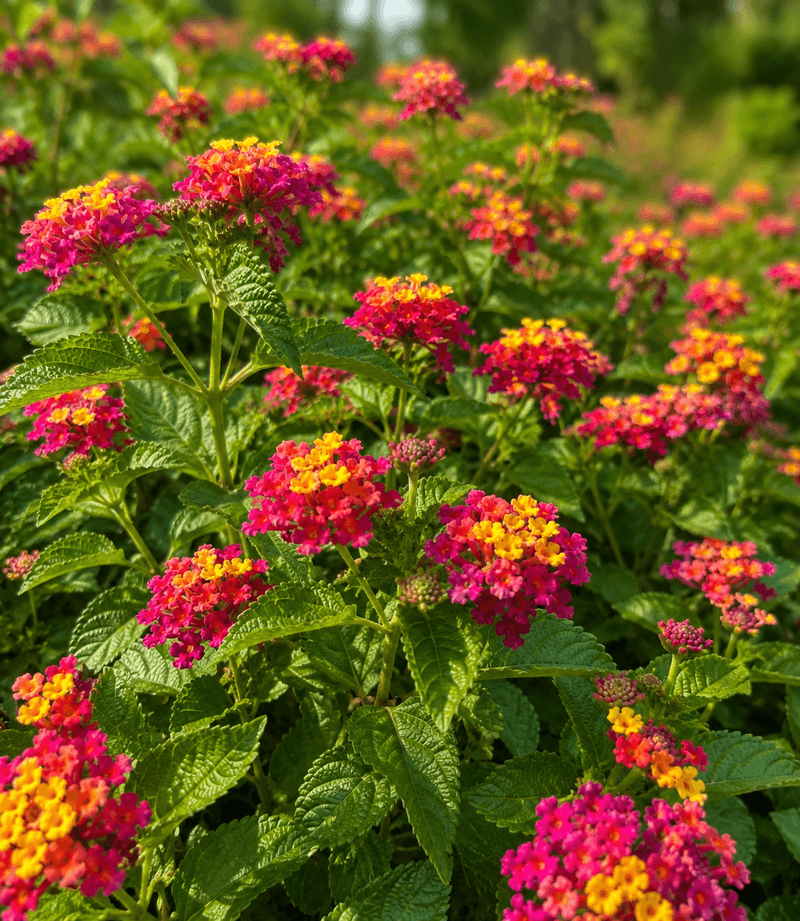
Picture a rounded flower head packed with dozens of tiny blooms, some yellow, some orange, a few edging toward pink or red, all sitting on the same stalk at the same time.
That display is the first strong clue pointing toward common lantana, known botanically as Lantana camara.
The multicolored look is not a sign of several plants tangled together or a quirk of the soil.
It is how this one species works, and it can appear in gardens from Florida to California to Minnesota.
But here is where the mystery earns its name.
Bloom color alone cannot confirm the identification.
NC State Extension’s lantana profile notes that common lantana flower heads can display yellow, orange, pink, red, purple, or white florets, sometimes all at once, depending on the cultivar and the age of individual flowers within the cluster.
A yellow-and-orange plant in one yard and a pink-and-purple plant three doors down may both be common lantana, or they may not be.
Color gets you curious, not certain.
That is the practical promise of this article.
The flowers create the puzzle, but the foliage gives you the fastest, most reliable path toward an answer.
Oregon State University’s plant identification guidance makes clear that leaves, taken together with stems, fruit, and growth habit, are where confident identification begins.
So before you name the plant, buy more of it, or decide where it fits in your yard, spend sixty seconds looking below the flowers.
The Flower Cluster Changes Its Story
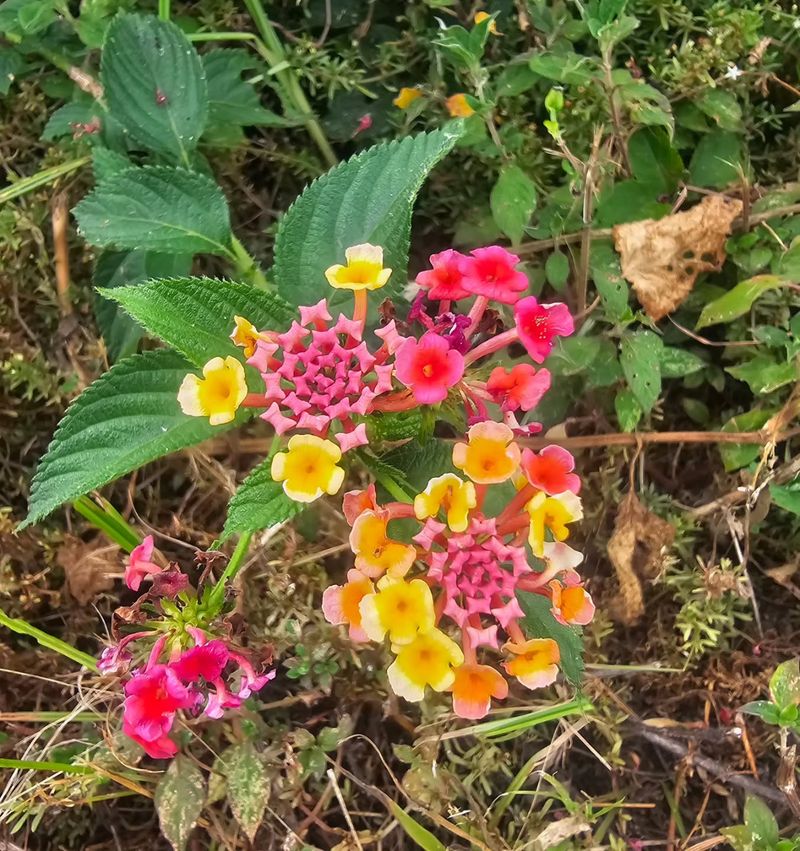
Each rounded lantana flower head is not one flower.
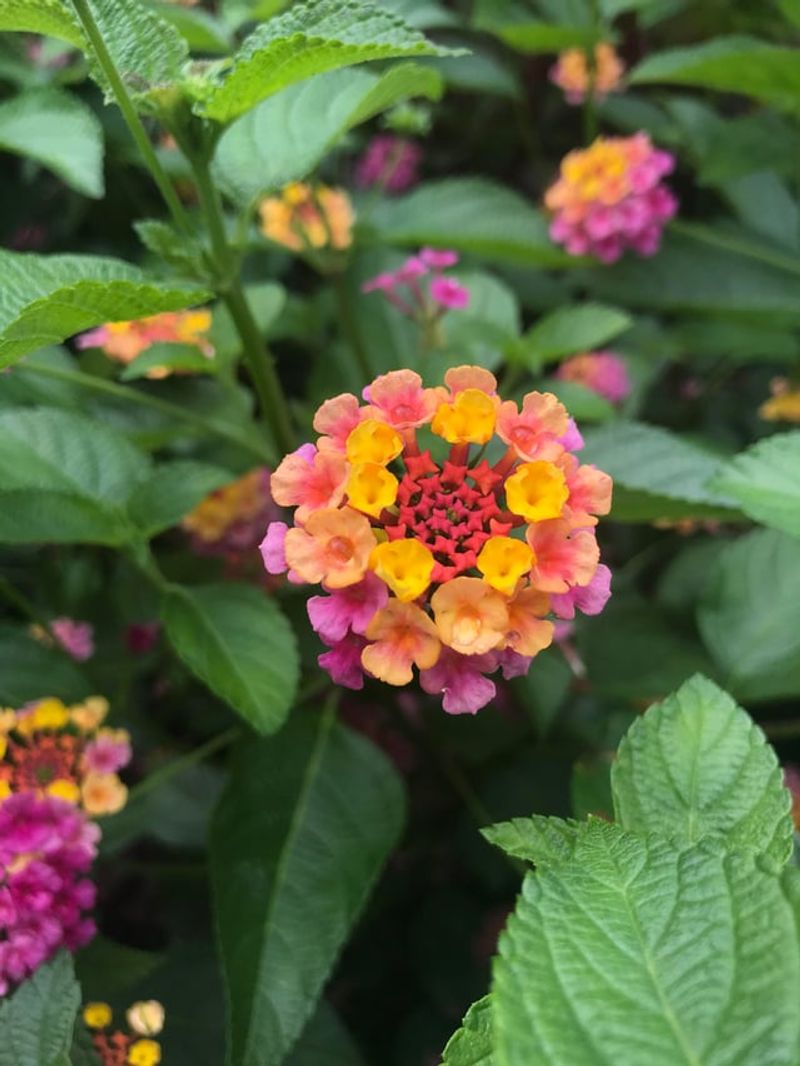
It is a tight collection of many small tubular florets, and they do not all open at the same moment.
The newest florets tend to sit near the center of the cluster and often open pale yellow or light-colored.
As those florets age, their pigment shifts, moving through orange, then deeper shades of pink, red, or purple depending on the cultivar.
The result is a single cluster that looks like a painter tested several colors on the same canvas.
Age-related pigment change is the well-supported explanation for most of what you see.
A Journal of Experimental Botany study on Lantana camara flower color changes documented pink buds, yellow newly opened flowers, and older florets shifting through orange, scarlet, and magenta within the same inflorescence.
That same study found evidence that pollination could also trigger pigment change in the specific cultivar examined.
Those two mechanisms are not interchangeable, and they do not apply equally to every lantana species or garden variety.
Research on a related species adds another layer.
A study on Lantana undulata color change and pollinator behavior found that retaining color-changed flowers on the inflorescence increased attraction for pollinators.
Whether that dynamic holds for every lantana cultivar in your yard is not settled.
What is settled is this: the multicolored display is the plant doing its own work, not a sign that something has gone wrong.
The Leaves Give You the Faster Clue
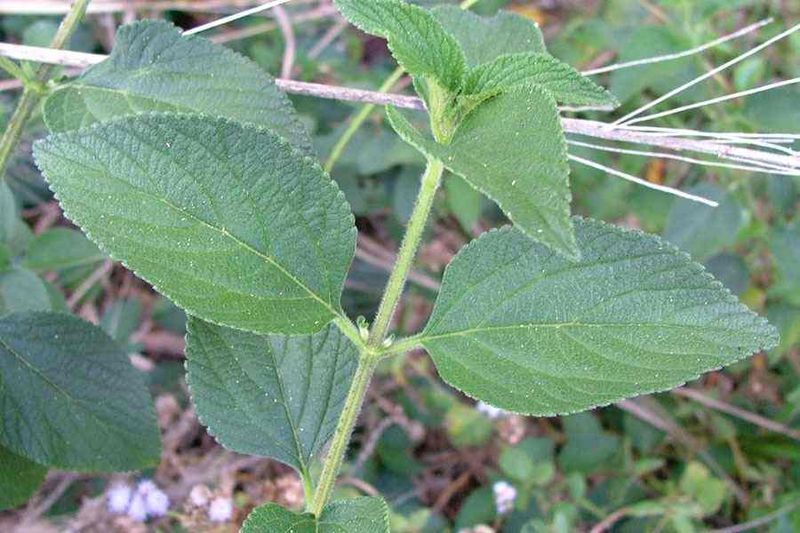
Forget the flowers for a moment and crouch down to the foliage.
Common lantana typically carries simple leaves arranged in opposite pairs along the stem, meaning two leaves grow directly across from each other at each node.
Those pairs often rotate at roughly a right angle to the pair below, so the leaves spiral up the stem rather than stacking flat.
That arrangement is one of the fastest things to check because it is consistent even on plants grown in different conditions.
The blade itself is generally oval, somewhere between 1 and 4 inches long on a mature garden plant, with clearly toothed edges running most of the margin.
Run a finger across the top surface and it feels noticeably rough, almost sandpapery.
Pinch or crush a leaf lightly and a strong, somewhat medicinal or sage-like scent comes off it.
NC State Extension describes common lantana leaves as simple, opposite or whorled, ovate, toothed, and rough-textured, with a pronounced aroma when crushed.
That scent is a clue you can use even in low light.
One leaf is not enough.
Oregon State University’s leaf identification resource points out that leaf size and shape can shift on the same plant depending on how much sun a branch receives.
A shaded inner leaf may look narrower or smoother than a leaf in full sun at the tip of the same stem.
Check several mature leaves from different parts of the plant, look for the toothed edge, feel for roughness on multiple blades, and crush one to confirm the scent before you draw any conclusions.
A Whole-Plant Check Prevents Mistakes
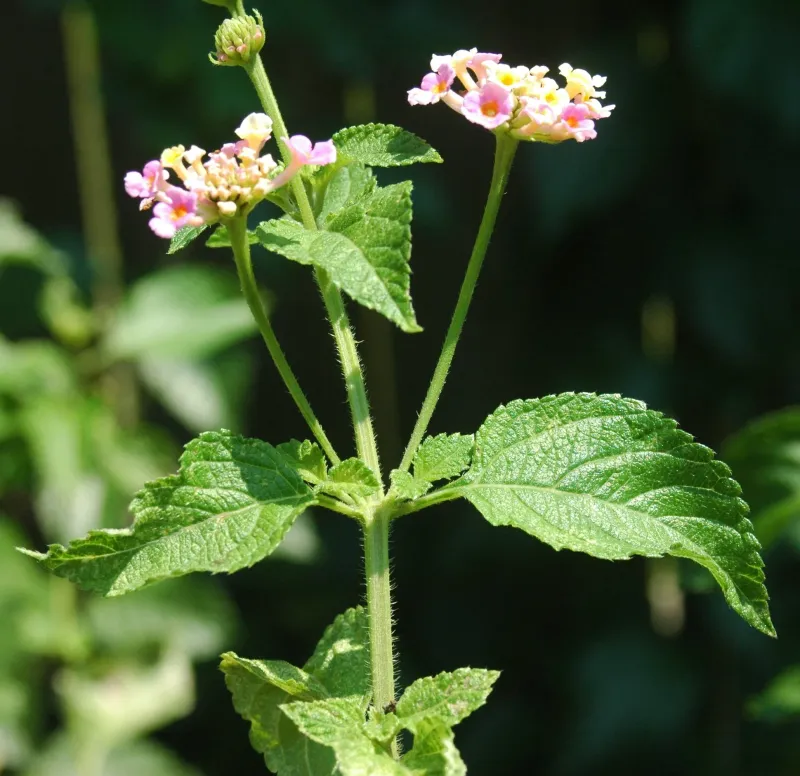
Leaf shape narrows the field, but it does not close the case.
Once you have checked several leaves and found the opposite arrangement, toothed edges, rough texture, and that distinctive crushed-leaf scent, move on to the stem.
Common lantana stems are often square in cross-section rather than round, and many plants carry small, fine prickles along the angles.
That squared stem is a useful secondary clue because it shows up even on plants that have been cut back or are not currently flowering.
Next, look at where the flower clusters sit.
On common lantana, rounded flower heads typically appear on stalks that rise from the leaf axils or near branch tips, not buried deep inside the foliage.
Check the growth habit too.
In warm climates, common lantana can become a sprawling shrub several feet wide.
In cooler gardens, it stays more compact.
If the plant has fruited, the berries are small, round, and turn from green to dark purple or black when ripe.
Do not eat them, and keep children and pets away from them.
Lookalikes deserve a mention here.
Verbena is the most common mix-up, but verbena leaves tend to be more deeply cut and the stems are usually round, not square.
University of Texas material on Texas lantana, Lantana urticoides, describes a plant with broadly ovate, coarsely toothed, aromatic leaves and mixed yellow-orange flowers, features that overlap with common lantana.
In Florida, pineland lantana, Lantana depressa, is specifically reported to hybridize with nonnative common lantana, making visual separation even harder in that region.
Oregon State’s identification guidance and NC State’s lantana profile both reinforce that combining multiple features, rather than relying on any single one, is the responsible approach.
The Right Spot Keeps Lantana Flowering
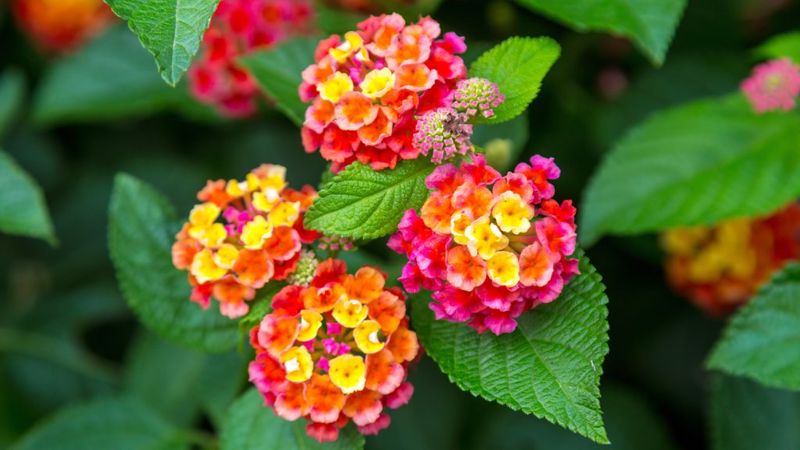
Sun is non-negotiable.
Lantana earns its reputation as a heat-loving, low-fuss plant only when it gets at least 6 hours of direct sun per day, and closer to 8 hours for the strongest flowering.
Put it in partial shade and the bloom count drops noticeably.
Most gardeners who complain that their lantana stopped flowering moved it or planted it somewhere that looked sunny in spring but filled in with shade by July.
University of Minnesota Extension’s lantana guidance recommends waiting until soil temperatures climb above 60 degrees Fahrenheit before setting plants outdoors, and spacing them about 12 inches apart.
That timing is specific to northern gardens where late cold snaps are a real risk.
In the Southeast or Southwest, soil warms earlier and planting windows open sooner, so follow your local extension office rather than treating any single date as universal.
Watering matters most in the first few weeks.
Lantana is drought-tolerant once its roots have settled in, but overwatering during that establishment window, or consistently wet soil afterward, can reduce flowering and set up root disease.
Well-drained soil is the baseline requirement.
After establishment, many gardeners in warm, dry climates can rely mostly on rainfall, though a long dry stretch still calls for supplemental water.
In colder parts of the country, lantana is typically grown as an annual and replaced each spring.
In frost-free or mild-winter areas, it overwinters in the ground.
Clemson Extension’s lantana culture guide notes that hardy types can be cut back in spring to roughly 6 to 12 inches to encourage fresh growth, while plants in warmer climates may be cut nearly to the ground at the end of the season.
Pruning timing depends on your winters, so check what applies to your zone before cutting.
Its Beauty Comes With Regional Cautions
Common lantana looks friendly.
The flower clusters bring in butterflies and hummingbirds, and the plant handles heat and neglect better than most annuals.
But a few facts about this species deserve plain attention before you order a flat of it or let it go to seed.
In Florida and other warm regions with mild winters, common lantana is nonnative and invasive.
The UF/IFAS Center for Aquatic and Invasive Plants lists Lantana camara as a serious invasive concern in Florida, where it can escape cultivation and crowd out native vegetation.
Cold winters in the northern United States naturally limit how far the plant can spread, but that does not make it safe to plant carelessly in warm-climate states.
UF/IFAS Gardening Solutions recommends replacing invasive common lantana with native Florida species or sterile cultivars from reputable sources when you are gardening in that region.
Deadheading spent flower clusters can limit fruit development on fertile plants and is worth doing regularly.
But removing flowers is not a complete invasive-control method on its own.
If you are in a warm-climate state and unsure whether your plant is a fertile or sterile cultivar, your county extension office can help you sort that out.
The toxicity picture is equally direct.
The ASPCA lists Lantana camara as toxic to dogs, cats, and horses.
UF/IFAS guidance on common poisonous landscape plants identifies the leaves and unripe berries as hazards for livestock and people.
NC State Extension also notes the risk of contact dermatitis in sensitive individuals.
If a pet or child ingests any part of the plant, contact a veterinarian or poison control immediately.
Do not wait for symptoms.
Use the Whole Plant Before You Name It
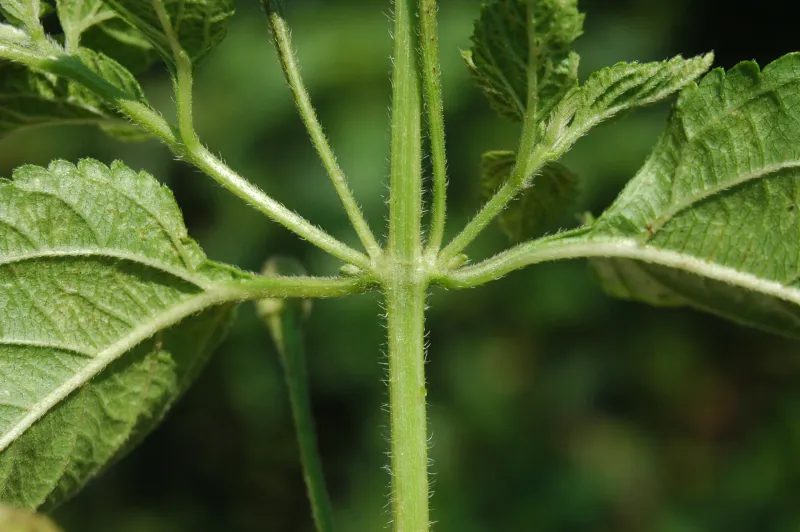
A quick field checklist pulls the article together without pretending the identification is settled.
Start with several mature leaves from different parts of the plant.
Check that the blades are simple and roughly oval, with toothed margins and a sandpapery surface.
Crush one leaf and smell it.
Then look at how the leaves attach: opposite pairs, often rotating at right angles up the stem.
From there, run a finger along the stem to feel whether it is square and whether small prickles are present.
Look at where the flower clusters sit and how the florets are arranged within each rounded head.
If the plant has fruited, note the small round berries and their color.
Consider the growth habit and the region where the plant is growing, because Oregon State University’s plant identification guidance and NC State’s lantana profile both emphasize that combining features, not isolating one, is how reliable identification works.
Multicolored blooms are a useful signal to investigate, not a final answer.
If your checklist points consistently toward common lantana but something still does not fit, your local cooperative extension office can review a photo or a sample and give you a confident regional answer.
The plant that keeps fooling people is actually quite readable once you know where to look, and the leaves have been telling the story all along.