
Texas Oak Trees Are Declining: The Twolined Chestnut Borer, Oak Wilt, And What To Do Now
Follow us on Google
Something is wrong with your oak tree, and you want to know if a beetle is to blame.
A lot of Texas homeowners are asking that same question right now, especially in the Hill Country and Central Texas, where live oaks are as much a part of the landscape as limestone and cedar.
The short answer is that a native wood-boring beetle called the twolined chestnut borer does show up in declining oaks, but the bigger, well-documented threat to your trees is oak wilt.
Knowing the difference between those two problems, and acting on the right one, is what will actually protect your trees.
The Evidence Does Not Show A New Texas Oak-Borer Invasion
You may have seen a social-media post warning that an invasive insect is spreading through Texas oak trees at an alarming rate.
That claim does not hold up against what state and federal researchers actually know.
No current Texas A&M Forest Service or USDA alert identifies a new, rapidly spreading invasive beetle attacking Texas live oaks statewide.
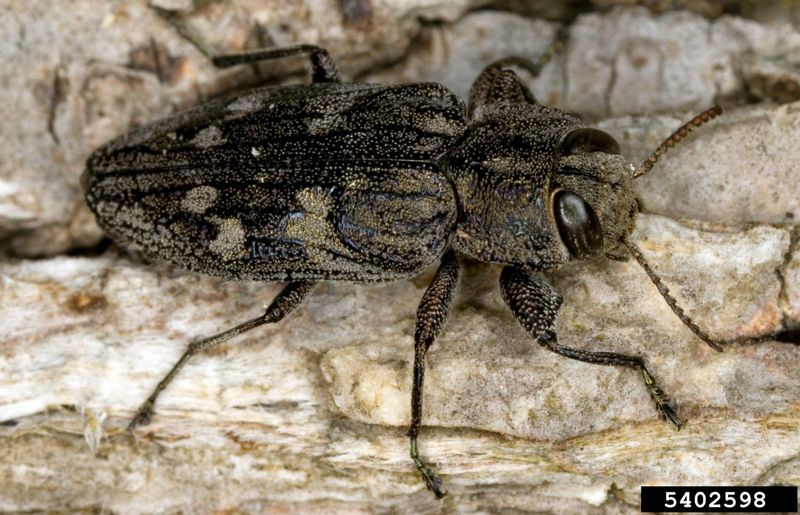
The beetle most likely behind the concern is the twolined chestnut borer, Agrilus bilineatus.
It is a real insect, it is genuinely present in Texas, and it does damage oaks.
But Morton Arboretum guidance on the twolined chestnut borer is clear that this species is native to North America, not a newly introduced invader.
Its known range has included Texas for a long time.
Research describes the twolined chestnut borer primarily as a secondary pest, meaning it tends to colonize oaks that are already weakened by drought, disease, defoliation, freeze damage, or construction injury.
A USDA Forest Service study on borers in Texas oak-wilt settings found the beetle in stressed and declining trees, not as a primary attacker of healthy live oaks.
Some online coverage confuses the twolined chestnut borer with the goldspotted oak borer, Agrilus auroguttatus.
Those are two different insects.
USDA research on the goldspotted oak borer associates that species with severe oak mortality in Southern California, not an established outbreak in Texas neighborhoods.
So the more useful question is not whether a new beetle invasion is sweeping Texas.
The better question is what is weakening your specific tree, and what can you do about it safely.
That starts with understanding the threat that Texas foresters actually do document as a major concern.
Oak Wilt Is A Major Documented Threat In Parts Of Texas
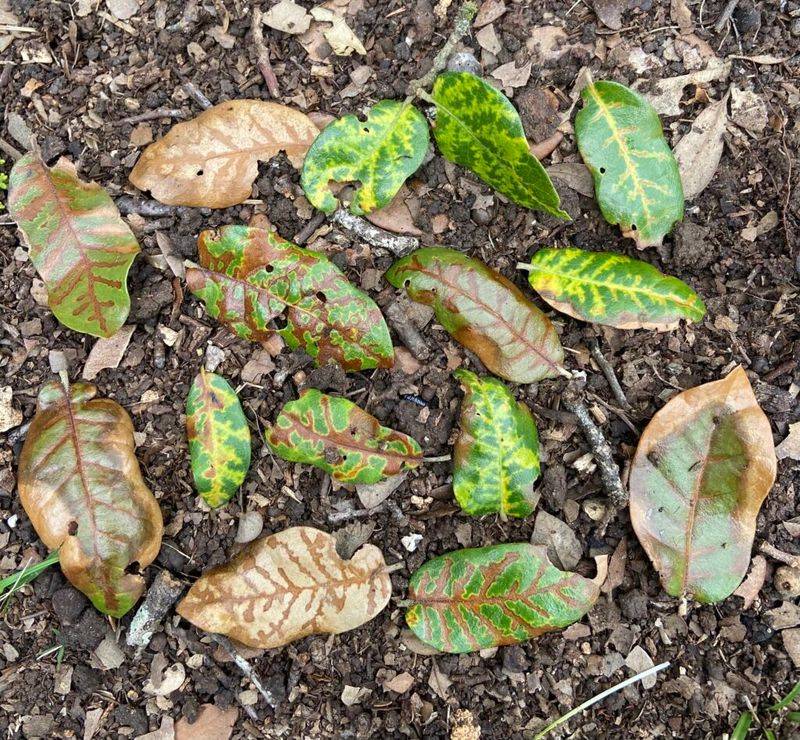
Walk through the Hill Country in late spring and you will sometimes see a cluster of live oaks gone brown in the middle of an otherwise green grove.
That pattern is often oak wilt, and it is the threat that Texas forestry professionals spend the most time tracking.
Oak wilt is caused by the fungus Bretziella fagacearum.
Texas A&M Forest Service guidance on oak wilt prevention explains two main ways the disease moves: sap-feeding beetles can pick up fungal spores from infected wood and carry them to fresh wounds on healthy trees, and connected root systems can pass the fungus directly between neighboring oaks underground.
Live oaks in Central Texas and the Hill Country are especially vulnerable because they frequently grow in dense groves with roots that graft together.
The disease is documented in dozens of Texas counties, with its heaviest impact concentrated in Central Texas and the Hill Country.
Risk, host species, and severity do vary across the state.
Conditions in the Panhandle, East Texas, and the Gulf Coast are not identical to conditions in Travis or Gillespie counties, so the picture is genuinely regional rather than a uniform statewide emergency.
What does apply broadly is the importance of wound prevention.
Sap-feeding beetles are most active and the fungus spreads most efficiently during warm months.
The Texas Oak Wilt Partnership’s integrated management guidance and Texas A&M Forest Service both identify February 1 through June 30 as the period when avoiding nonessential pruning and other oak wounds matters most.
That window is the single most important piece of timing information a Texas oak owner can carry into the growing season.
The Twolined Chestnut Borer Often Follows Tree Stress
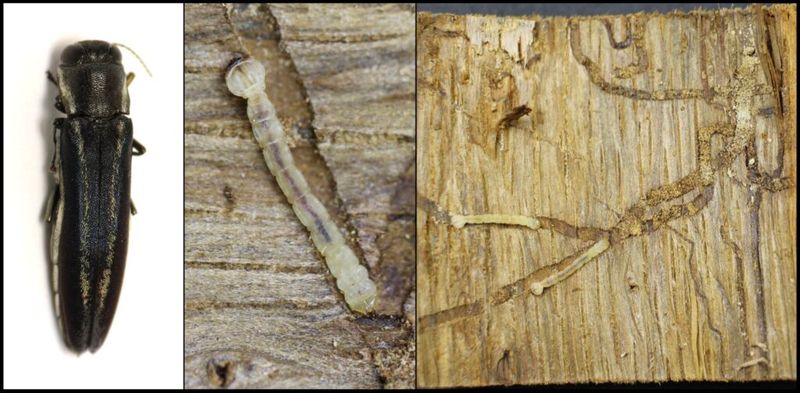
Picture a small, narrow beetle with a metallic dark body and two pale yellowish lines running along its back.
That is the adult twolined chestnut borer, and it is easy to miss because it is only about half an inch long.
Michigan State University Extension’s profile of the twolined chestnut borer describes how the larvae feed beneath the bark in winding galleries, cutting off the flow of water and nutrients through the cambium and outer wood.
That feeding is what does the real damage.
Here is where the biology gets interesting.
The beetle does not typically target a vigorous, well-watered oak.
It looks for trees that are already in trouble, oaks stressed by drought, defoliated by insects, damaged by a hard freeze, disturbed by construction grading, or already sick with another disease.
A tree sending out distress signals through its chemistry is genuinely more attractive to this insect than a healthy neighbor.
One Texas study examined oaks infected with oak wilt and found the twolined chestnut borer in more than 95 percent of the trees sampled.
That USDA Forest Service study reported adult emergence beginning in early March, with peak trap captures occurring in June.
Those figures came from one specific research setting and should not be read as a statewide forecast for every oak in every year.
What the study did conclude is that the beetle was attacking trees already weakened by oak wilt or other stressors, not driving the initial decline on its own.
Treating the twolined chestnut borer as the root cause of your tree’s problem, when drought or oak wilt may have set the stage, leads to responses that miss the actual threat.
Finding the beetle is a sign that your oak is under serious stress, and the next step is figuring out why.
Symptoms Can Suggest Decline But Cannot Confirm Its Cause
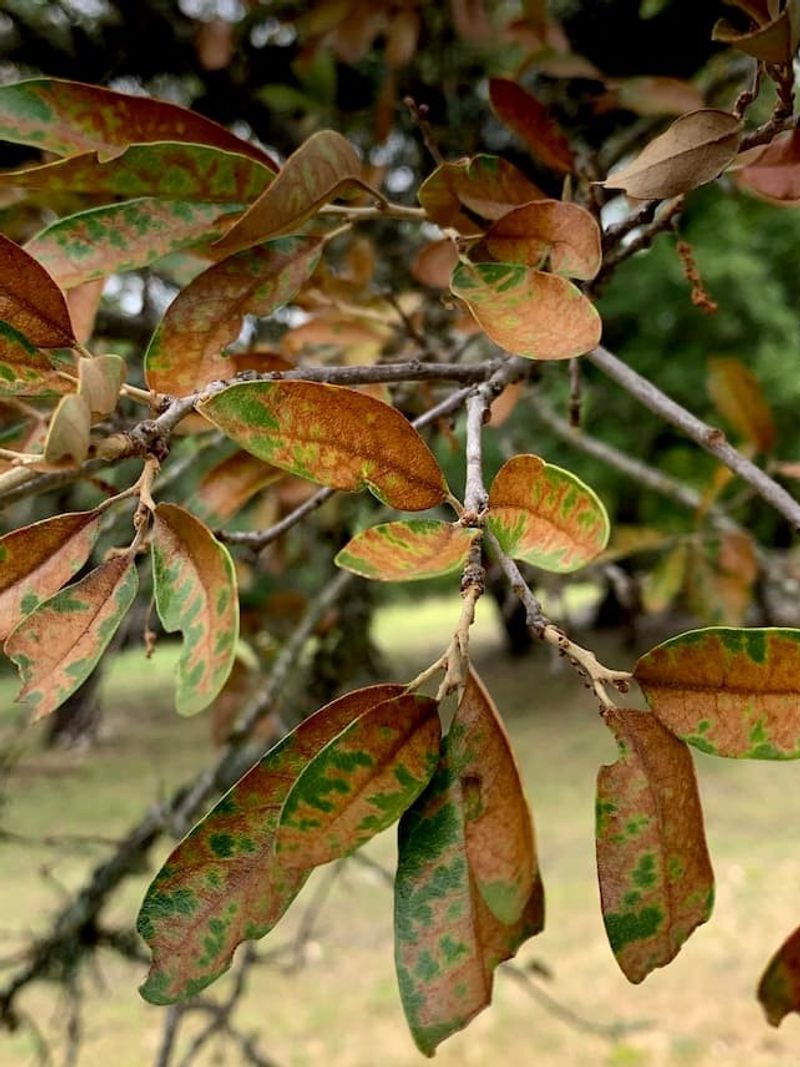
Rapid browning in the upper crown.
Leaves dropping weeks ahead of schedule.
A yellowing or bronzing that traces along the veins of the leaf itself, a pattern called veinal necrosis.
Those are the signs that send most Texas homeowners to their phones looking for answers.
Oak wilt educational materials from the Texas Oak Wilt Partnership describe how the disease can kill highly susceptible red oaks within just a few weeks of infection.
Texas live oaks tend to decline more slowly, sometimes over several months, which can make the progression harder to recognize early.
Both patterns are worth taking seriously.
The tricky part is that drought, a hard freeze, root disturbance from nearby construction, soil compaction, and other diseases can produce symptoms that look nearly identical.
Texas A&M AgriLife Extension’s oak wilt identification and management guide is consistent on this point: visual diagnosis alone is not reliable enough to act on.
You need a professional assessment.
Exit holes in the bark add another layer of confusion.
D-shaped holes are associated with several different flatheaded borers, not just the twolined chestnut borer.
The emerald ash borer, Agrilus planipennis, also produces D-shaped exits, but Texas Department of Agriculture alerts on emerald ash borer make clear that insect attacks ash trees, not oaks.
Similarly, the goldspotted oak borer produces its own exit pattern, and UC IPM guidance on the goldspotted oak borer connects it to California outbreaks, not a documented Texas residential problem.
A hole in the bark tells you something fed there.
It does not tell you what, or whether that insect caused the tree’s original decline.
When you see troubling symptoms, contact Texas A&M Forest Service, your local AgriLife Extension office, a certified arborist, or a plant diagnostic laboratory.
Getting a confirmed diagnosis before you spend money on treatment, or before you pick up a chainsaw, is the step that actually protects your investment.
Protect Oaks From Wounds During The High-Risk Season
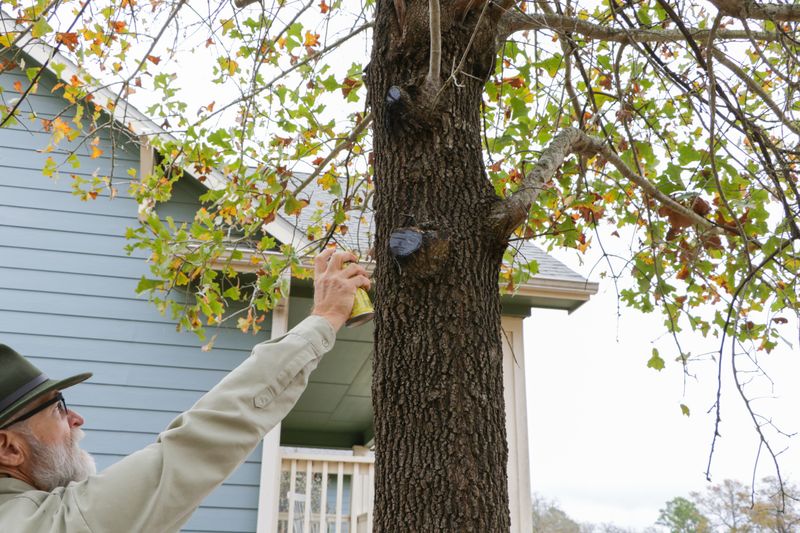
Most oak wilt infections that start at a wound are preventable.
That is not an overstatement, it is the core message behind every piece of official Texas oak guidance, and it comes down to two habits: timing and paint.
From February 1 through June 30, postpone any pruning that is not genuinely necessary.
Texas Oak Wilt Partnership pruning guidance explains that sap-feeding beetles capable of carrying the oak wilt fungus are most active during this window, so a fresh cut on an oak is a real invitation during those months.
If a storm breaks a large limb or a mower clips a root during that period, you do not get to wait.
Paint the wound immediately.
Latex paint or pruning paint applied right away, within minutes if possible, is the standard recommendation from Texas A&M Forest Service oak wilt prevention guidance.
Cover every fresh wound: pruning cuts, storm damage, construction scrapes, mower injuries, and fresh stumps.
This applies year-round, not just during the high-risk season, because wounds outside that window can still attract beetles or allow other pathogens entry.
Routine pruning for shape, clearance, or dead-wood removal is best saved for July through January, when beetle activity is lower and the risk of fungal transfer drops significantly.
Texas A&M Forest Service guidance on pruning mature trees and Texas Oak Wilt Partnership FAQ materials both support that seasonal approach.
For any work involving large limbs, a chainsaw, climbing, trees near power lines, or a tree you suspect is structurally compromised, hire a qualified arborist.
A licensed professional carries the right equipment and the liability coverage to do that work safely.
Protecting your oak with good timing costs almost nothing, and it is genuinely one of the most effective things a Texas homeowner can do.
Avoid Unconfirmed Treatments And Firewood Movement

Seeing a beetle or a D-shaped hole in your oak bark can make you want to do something fast.
That urgency is understandable, but the wrong response can cost you money, harm the tree, and in some cases make the problem worse for your neighbors.
Do not apply insecticide just because you found a beetle or an exit hole.
Wood-boring larvae feed beneath the bark, where sprays cannot reach them effectively.
More importantly, you may be treating the wrong problem entirely.
A declining tree that actually has oak wilt will not recover from a beetle spray, and you will have added chemical stress to an already struggling root system.
Texas Oak Wilt Partnership FAQ guidance is consistent on this: get a confirmed diagnosis before any treatment decision.
Do not cut down a declining oak before you know what is killing it.
Oak wilt, drought damage, freeze injury, and borer activity each call for different responses.
Removing a tree infected with oak wilt without proper handling can actually spread the problem if the wood is moved or the stump is left unsealed.
Leave the tree standing until a professional has assessed it.
Do not move suspicious oak firewood to another property.
Firewood from a tree that died of oak wilt can carry the fungus and introduce it to a new location.
Keep it where it is, or have it assessed before any transport.
When oak wilt is confirmed, professionals may recommend a combination of site-specific interventions.
The Texas Oak Wilt Partnership’s integrated management approach describes options that can include prompt removal of recently killed red oaks to eliminate spore mats, trenching to sever root connections between infected and healthy trees, and propiconazole fungicide injections into selected high-value trees near confirmed infection centers.
Trenching, for example, may go at least 4 feet deep and extend 100 feet beyond the outer symptomatic tree in some management situations.
These are not do-it-yourself fixes.
They are site-specific decisions made by qualified professionals after Texas A&M Forest Service or an equivalent authority has confirmed the diagnosis.
Use A Calm Inspection And Confirmation Plan
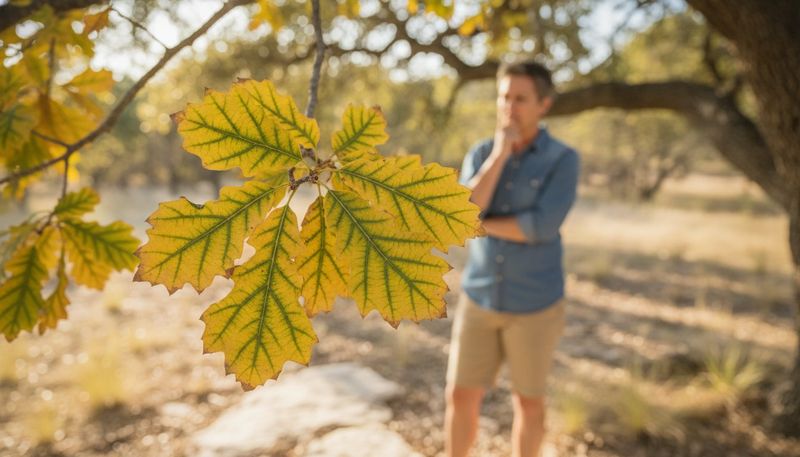
Panic is not a tree-care plan.
A calm, methodical look at your oak after a documented stress event will tell you far more than a social-media post about a beetle outbreak ever could.
Start by thinking about what your tree has been through recently.
Has Central Texas been in a prolonged dry stretch?
Did a late freeze hit your area hard?
Has any construction, grading, or trenching happened within 100 feet of the trunk in the past year or two?
Those are the conditions that genuinely weaken oaks and open the door to secondary problems like the twolined chestnut borer.
Walk around the tree and look for crown changes, premature leaf drop, discoloration that follows the leaf veins, bark wounds, and any signs of recent root disturbance.
Keep in mind that Texas conditions vary widely.
USDA Forest Service Texas forest health documentation reflects how differently oak threats play out across the state.
The oak wilt risk in the Hill Country is not the same as conditions in East Texas or along the Gulf Coast, so region-specific guidance matters.
The actions that apply broadly are straightforward.
Avoid seasonal wounds from February 1 through June 30.
Paint every unavoidable injury immediately with latex paint.
Keep suspicious oak firewood on your own property.
And before you spend money on any treatment or pick up a chainsaw, contact the Texas Oak Wilt Partnership, your county’s AgriLife Extension office, Texas A&M Forest Service, or a certified arborist for a proper diagnosis.
Your oak has survived Texas summers, hard freezes, and long dry spells.
Giving it a careful look and the right diagnosis is the best thing you can do for it now.
Careful timing and a confirmed diagnosis protect trees more reliably than any reaction to an unverified alarm.