
What It Really Means When A Pileated Woodpecker Starts Visiting Your Pennsylvania Yard
Follow us on Google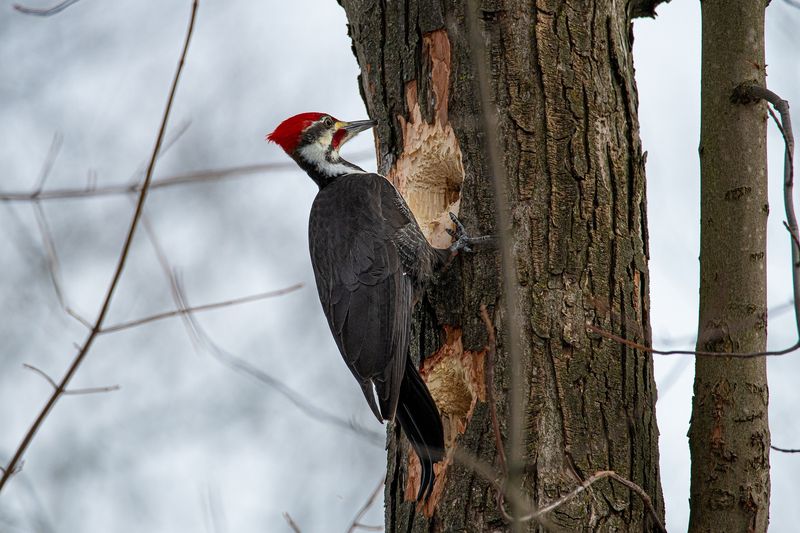
You’re out back on a quiet morning when something the size of a crow drops onto an old oak, and the hammering that follows is loud enough to make you stop mid-step.
That’s a Pileated Woodpecker, and it didn’t land in your yard by accident.
Pennsylvania’s largest woodpecker is genuinely picky about where it spends its energy, and the fact that yours showed up tells you something specific and useful about your property.
The Visitor Is Reading Your Yard
Most people who spot a Pileated Woodpecker for the first time assume something is wrong.
The bird is big, loud, and it leaves marks that look serious.
But the more accurate read is that your yard passed a test, because Cornell Lab’s Pileated Woodpecker life history makes clear that this species gravitates toward mature woodland, large trees, standing dead wood, fallen logs, stumps, and insect-rich decay.
If your property connects to any of that, even through a hedgerow or a neighboring woodlot, it qualifies as worth a stop.
The bird itself is hard to miss once you know what to look for.
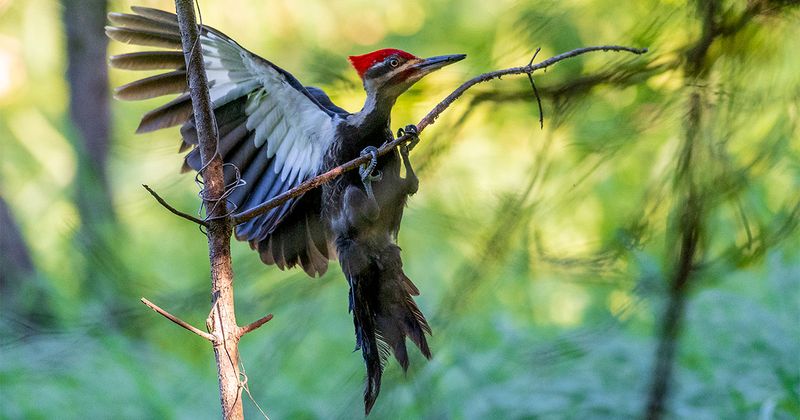
Pileated Woodpeckers run about 16 to 19 inches long, roughly the footprint of an American crow, with wingspans reaching close to 29 inches.
The red crest is the giveaway, set against a mostly black body with white markings that flash when the wings open.
The call carries a long way, a loud, laughing series of notes that sounds almost prehistoric.
One visit does not mean the bird lives in your yard.
Pennsylvania Game Commission records describe the species as a year-round resident that holds large territories and may cross open ground to reach a distant food source.
A single sighting may represent nothing more than a brief stop within a much wider range.
What the visit does confirm is that something in or near your yard made the trip worthwhile, and figuring out what that something is gives you a practical lens for everything the bird does next.
Watch Where the Beak Lands
Here is where it gets genuinely interesting.
The exact surface the bird chooses tells you more than the visit itself does.
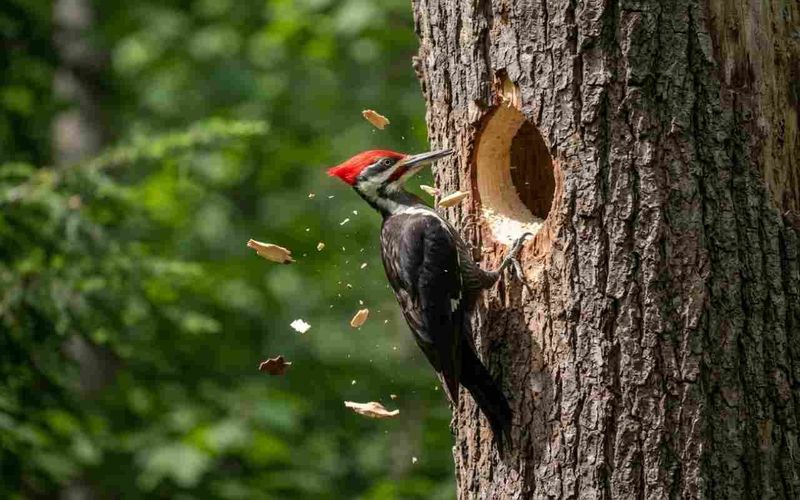
A Pileated Woodpecker working a stump, a fallen log, a dead limb, or a standing dead tree is almost certainly hunting food or sizing up a cavity site.
Those large rectangular excavations, sometimes 3 to 4 inches wide and several inches deep, expose the galleries where carpenter ants and beetle larvae hide inside decaying wood.
Drumming on a metal chimney cap, a downspout, aluminum siding, or a utility pole is a different story.
Penn State Extension’s woodpecker guidance explains that hard, resonant surfaces amplify sound, and that woodpeckers use drumming to communicate territory and attract mates, not just to find food.
Spring is when this behavior peaks, though fall can bring a second round.
If the bird is hammering your downspout at 6 a.m., it is probably broadcasting, not feeding.
Identification clues work best in combination.
Pennsylvania Game Commission notes that large rectangular holes are suggestive but not absolute proof of Pileated activity.
Other woodpeckers, decay, insects, and preexisting cavities can complicate the picture.
Use the bird’s size, red crest, black body, white wing flash, loud call, and excavation pattern together before drawing conclusions.
A hole alone, without the bird, leaves room for other explanations.
Watch for a few minutes before reacting.
The working surface, the behavior, and the pattern of return visits together give you a much clearer picture than any single detail on its own.
Dead Wood Usually Explains the Meal
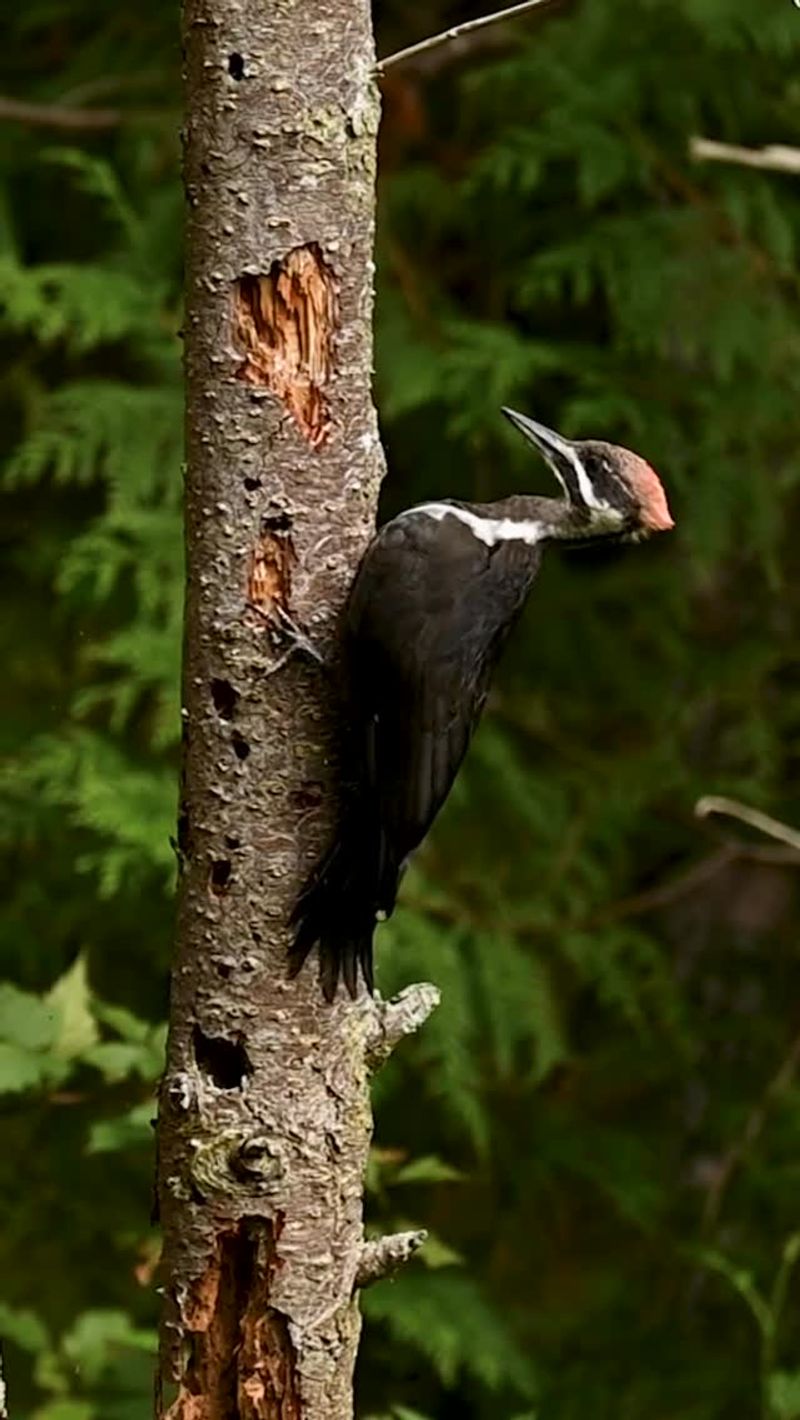
Carpenter ants are the headline item on the Pileated Woodpecker’s menu.
Cornell Lab research found that ants made up roughly 40 percent of the diet in some studies and as much as 97 percent in certain individuals, though those figures reflect specific study conditions rather than a fixed daily rule.
Add wood-boring beetle larvae, termites, and other insects found inside rotting wood, and you have a bird that is essentially a specialist in finding food that most other animals cannot reach.
Wild fruits and nuts round out the diet when insects are less available.
Dogwood, sassafras, sumac, blackberries, elderberries, and acorns all show up in records of what this species eats across Pennsylvania’s varied landscapes, from wooded lots in the northern tier to hedgerows in the Susquehanna Valley to suburban woodlots in southeastern Pennsylvania.
Carpenter ants deserve a plain-language clarification here.
Penn State Extension’s carpenter ant guidance explains that these ants do not eat sound wood.
They excavate galleries inside wood that is already soft, moisture-damaged, or decaying.
Finding them in a tree usually means the decay came first, not that the ants caused the problem.
Their presence may be a signal worth noting, but it is not automatically an emergency.
The Pennsylvania Game Commission notes that Pileated Woodpeckers use mature woodland edges, hedgerows, and suburban woodlots, which means a bird feeding in your neighbor’s old stump may simply be working its territory and passing through your yard as part of the same foraging loop.
The food source is often closer than you think, and quieter than the hammering suggests.
A Tree Check Is Sensible, Not Automatic
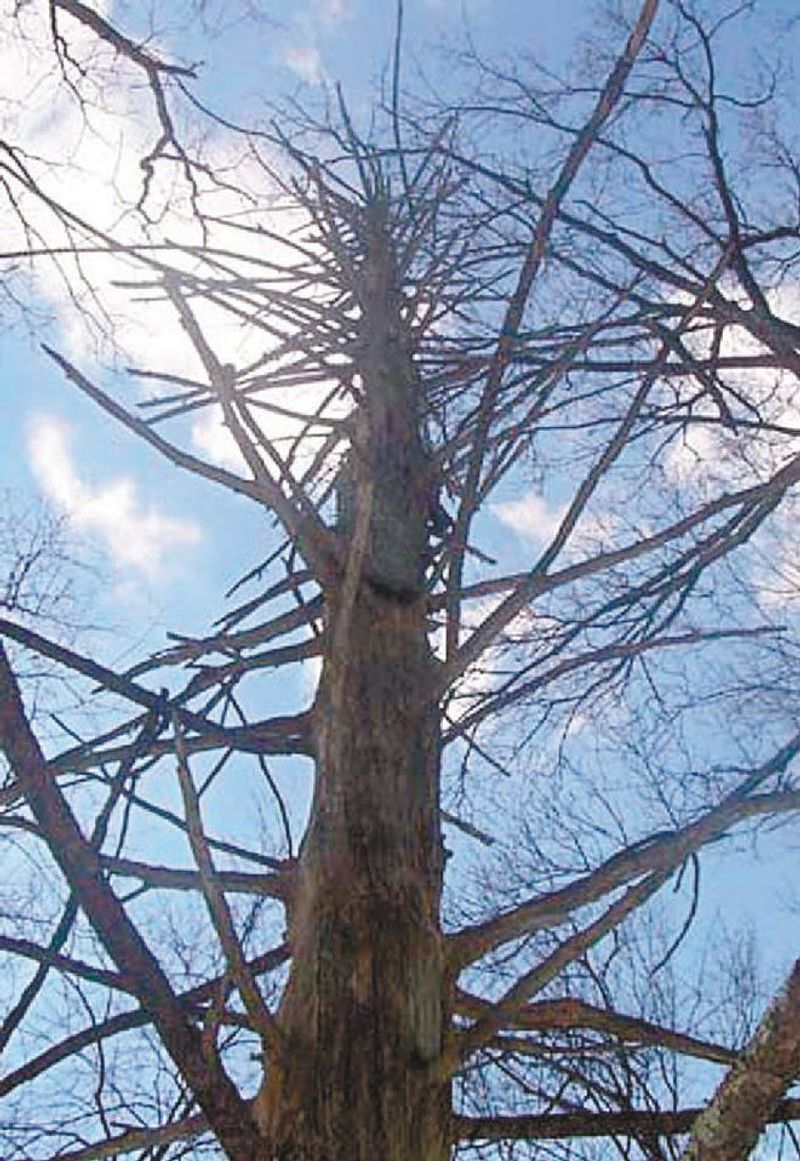
Seeing the bird work a specific tree does not mean that tree is doomed.
Pileated Woodpeckers can excavate into a dead section, a weak limb, or a preexisting cavity on an otherwise living tree.
They also work genuinely dead trees and standing snags.
The bird’s presence is a prompt to look more carefully, not a verdict on the tree’s health.
Start with location.
Penn State Extension’s dead wood for wildlife resource points out that fallen logs, stumps, and standing dead trees support a wide range of species beyond woodpeckers, and that leaving safe dead wood in place is one of the lower-effort ways to support local wildlife.
If a dead limb or standing snag sits well away from your house, driveway, deck, play area, vehicle, and power lines, leaving it is a reasonable choice.
Penn State notes that Pileated cavities are typically excavated higher than 15 feet up, so a dead tree with room to fall freely may serve the yard better than a stump would.
Penn State Extension and U.S.
Forest Service hazard tree guidance both treat proximity to people and structures as the deciding factor.
A dead tree near a path, a play area, a parking spot, neighboring property, or utility lines needs a professional assessment, because decay makes structural stability unpredictable over time.
A certified arborist can tell you whether a tree is worth preserving as habitat or needs to come down for safety.
One caution worth stating plainly: do not intentionally kill or damage a tree to create a snag and attract the bird.
The safety math does not work in your favor, and a hazardous snag is a liability problem, not a wildlife feature.
Work with what you already have, assess it honestly, and let a professional weigh in when the stakes are real.
Your House Needs a Separate Diagnosis
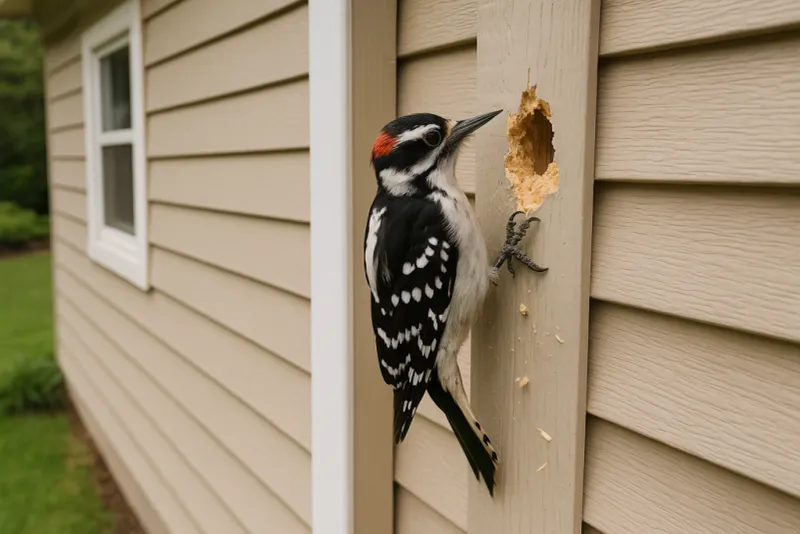
A Pileated Woodpecker visiting your yard is not the same thing as a woodpecker attacking your house, and a yard visit is not proof that carpenter ants are inside your walls.
The bird may be feeding in a stump 40 feet away and have no interest in your siding at all.
Keep those two situations separate before deciding what to do.
If the bird is actually excavating siding, trim, eaves, or another part of the structure, that pattern deserves attention.
Penn State Extension’s woodpecker page recommends inspecting for the underlying cause rather than treating the bird as the original problem.
Look for moisture damage, soft wood, or signs of insect activity near the excavation sites.
Woodpeckers working a building usually respond to something inside, not to the paint color or the siding material itself.
Physical exclusion is the recommended approach when the bird is genuinely damaging a structure.
Lightweight mesh or plastic sheeting, held at least 3 inches away from the wall surface so the bird cannot grip through it, can protect vulnerable areas while you address the underlying moisture or insect problem.
Repair damaged wood promptly.
Correct any moisture intrusion that is softening the material.
Penn State Extension notes that carpenter ants found outdoors in a tree or log do not automatically mean there is a colony inside the house.
Outdoor and indoor infestations are separate situations.
Inspect the structure if you see frass, soft wood, ant trails entering the foundation or siding, or repeated excavation on the building itself.
Otherwise, the yard visit alone is not a trigger for structural treatment.
And no toxicants are registered for woodpecker control in Pennsylvania, so that path leads nowhere useful.
Feeding Helps Only If Habitat Allows
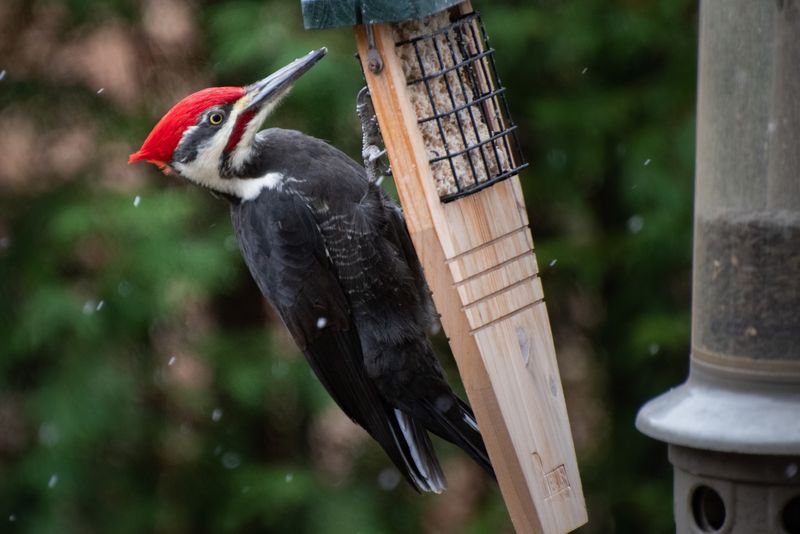
Suet can attract a Pileated Woodpecker, but putting out a feeder is not what explains the visit, and it is not a reliable way to pull the bird into a yard that lacks the habitat it actually needs.
Cornell Lab’s Pileated Woodpecker overview describes suet as a food the species may use at feeders, with the key word being “may.” Territory size, natural food availability, nearby woodland, and individual bird behavior all shape whether any particular bird ever visits a feeder at all.
If you want to try it, use a sturdy feeder designed for large birds and put out only a small amount of suet at a time.
Penn State Extension’s feeder disease-risk guidance recommends scrubbing feeders with soap and disinfectant about once a week, removing spilled food and droppings promptly, and discarding any suet that has gone moldy.
A dirty feeder can spread disease among the birds that use it, which is the opposite of what most people have in mind when they set one up.
Cavity and nest protection is a separate matter worth knowing.
Fish and Wildlife Service guidance on bird nests explains that many migratory bird nests, especially active nests containing eggs or dependent young, may be protected under the Migratory Bird Treaty Act.
If you find a Pileated cavity that appears to be in active use, do not disturb it without first getting species-specific professional guidance.
Penn State Extension can point you toward the right contacts for Pennsylvania-specific questions about nest situations and legal responsibilities.
Notice the Pattern, Then Let It Be
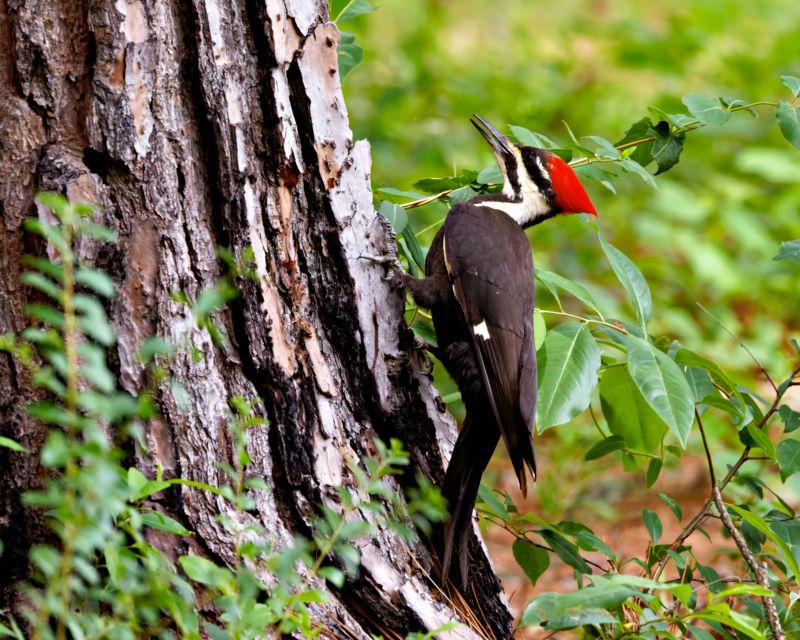
The most useful thing you can do after spotting this bird is slow down and pay attention for a few minutes.
Note the date, the working surface, whether the bird is excavating or drumming, what dead wood is nearby, and whether it returns.
A single visit within a large year-round territory is common.
Repeat visits to the same spot suggest something genuinely worth the bird’s effort, whether that is a food-rich stump, a cavity in progress, or a resonant surface it has decided to use for communication.
Pennsylvania Game Commission records make clear that this species holds large territories and may cross open landscapes to forage in a hedgerow or woodlot far from where it roosts.
Your yard may be one stop among dozens in a weekly circuit.
That context makes a single sighting less alarming and more interesting.
Pennsylvania yards vary enough that no single prescription fits all of them.
A wooded Poconos lot, a Susquehanna Valley property with a field edge, and a suburban Delaware Valley yard with one old oak all offer different combinations of food, dead wood, and nearby forest.
Penn State Extension’s dead wood resource is a practical starting point for thinking about what to preserve, what to assess, and what to remove safely.
The practical takeaway fits in a sentence: protect people and structures, preserve dead wood that poses no safety risk, correct genuine moisture or insect problems if the bird is working on the building, and enjoy the fact that your yard earned a visit from one of Pennsylvania’s most capable and genuinely striking birds.
The woodpecker read your yard as worthwhile.
That is actually good news.