
Why Rosemary Earns A Spot By A North Carolina Porch Right Now
Follow us on Google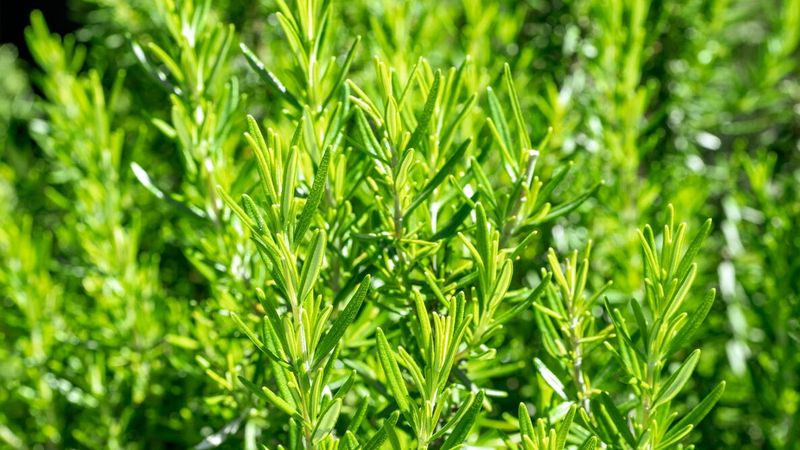
Brush past a pot of rosemary on your way up the porch steps and the whole evening changes.
That sharp, resinous scent hits you before you even sit down, and suddenly the porch feels less like a transition space and more like somewhere worth staying.
For North Carolina homeowners who spend real time outside, one well-placed herb can add fragrance, fresh cooking sprigs, evergreen structure, and flowers that pull in bees and butterflies, all from a single container.
That is a lot of return for one pot by the door.
Rosemary Changes the Porch at Arm’s Reach
Salvia rosmarinus, the plant most people still call by its former name Rosmarinus officinalis, does something quietly remarkable when you put it close to where you actually sit.
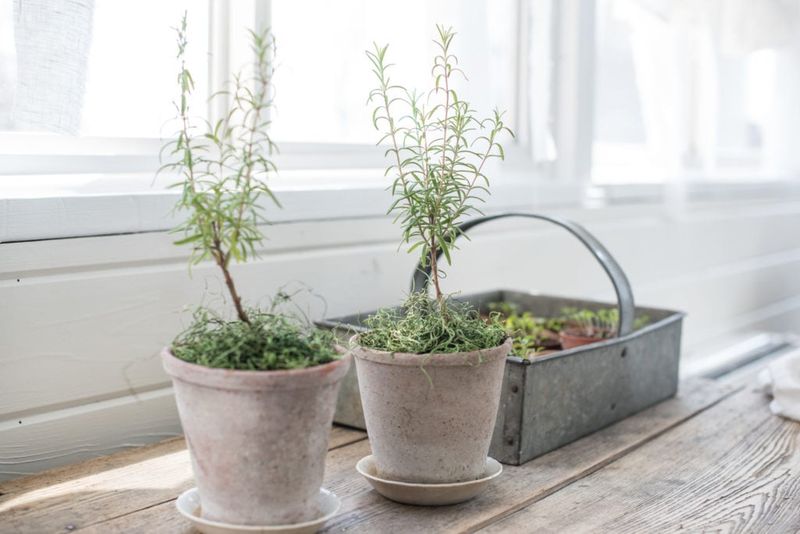
The foliage releases its strongest scent when you brush or handle it, so a pot beside porch steps, next to a patio chair, or along a walkway pays off every single time you pass.
That is not an accident of placement, it is the whole point.
Most herb gardens sit ten or fifteen feet away from the action, which means you admire them from a distance and never quite interact with them.
Rosemary earns its spot by the porch precisely because contact is built into the design.
NC State’s Plant Toolbox specifically lists rosemary for patios and recreational areas, describes its foliage as intensely fragrant, and confirms it as drought-tolerant, pollinator-friendly, edible, and container-suitable, which is a rare combination for one plant.
Beyond the scent, rosemary is an aromatic, evergreen, woody perennial shrub that holds its form and color through most of the year.
Mature plants can reach roughly 4 to 5 feet tall and 3 to 4 feet wide in the ground, though container plants tend to stay more compact.
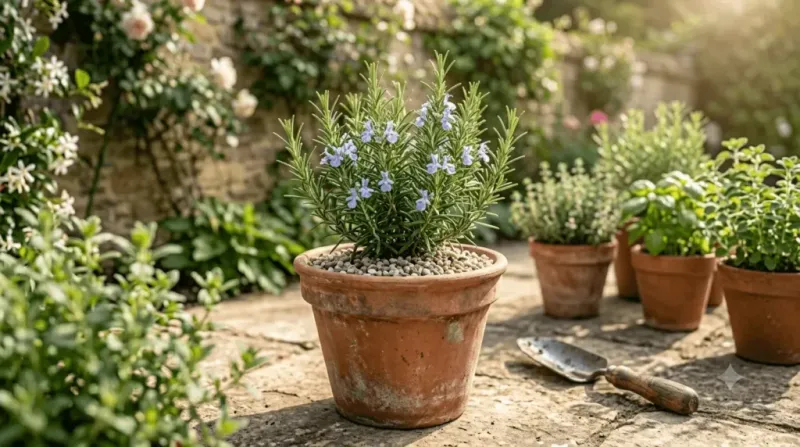
The small flowers, which come in blue, lavender, pink, or white depending on the variety, can attract bees, butterflies, and hummingbirds close enough to watch from your chair.
Fresh cooking sprigs stay within arm’s reach for as long as the plant is out there.
That combination of fragrance, structure, pollinators, and kitchen use is what makes rosemary feel like a companion rather than a chore.
Think of it as a quiet, useful presence, not a miracle solution to anything.
Full Sun Matters More Than a Fancy Pot
Here is where a lot of porch herb gardens quietly fail.
The pot is beautiful, the plant looks healthy at the nursery, and then it slowly declines because the porch only delivers 3 or 4 hours of direct light.
Rosemary needs at least 6 hours of full sun daily, and that requirement does not bend much for North Carolina’s muggy summers or the partial shade of a deep covered porch.
Afternoon thunderstorms roll through the Piedmont and the coast from June through September, and those storms keep the air humid even when the temperature climbs past 90 degrees.
Rosemary tolerates heat well, but it does not tolerate wet, poorly ventilated conditions.
NC State’s rosemary profile warns that wet, humid conditions and overwatering can cause root rot or plant death.
A covered porch can actually help by shielding the pot from excessive rain, but only if the spot still gets enough direct light and air movement.
Container choice matters too, but not in the way most people assume.
The pot style is far less important than the drainage holes at the bottom.
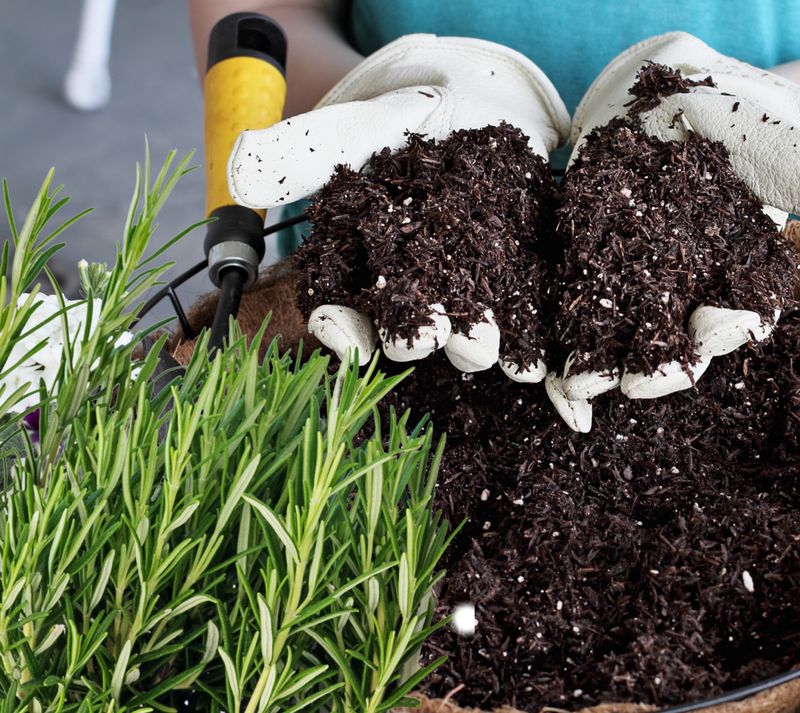
Use a commercial potting mix rather than yard soil, because Piedmont red clay drains poorly once it is packed into a container.
NC State’s Piedmont container guidance recommends an airy mix with perlite for dry-soil herbs like rosemary, and NC State’s container gardening handbook reinforces that garden soil compacts in pots and cuts off the drainage rosemary depends on.
A 14- to 16-inch container gives the roots enough room to establish without holding more moisture than the plant can use.
Get the light and the drainage right first, and the rest of rosemary’s care gets a lot simpler.
August Rewards Careful Watering
Adding rosemary to a porch container in August is genuinely doable in North Carolina, but the heat changes the math on watering fast.
A newly planted container sitting on a concrete or wood porch surface in direct sun can dry out in less than 24 hours when temperatures push into the upper 80s and 90s, especially if there is any breeze moving across the porch.
Drought tolerance is a long-term trait that kicks in once the plant is established, not a free pass during the first weeks in a new pot.
The right approach is to check the potting mix 2 to 3 inches deep every day and water when it feels dry at that depth.
When you do water, go slowly and thoroughly until water runs out of the drainage holes at the bottom.
Then empty the saucer.
NC State’s container gardening handbook notes that mature containers may need watering at least daily during hot conditions, but the actual frequency depends on pot size, wind, light exposure, and the potting mix itself.
There is no single schedule that fits every porch in every part of North Carolina.
Letting roots sit in a wet saucer is one of the fastest ways to lose a rosemary plant, so empty it every time.
Sitting water under the pot keeps the bottom of the root zone saturated even when the top of the mix feels dry.
NC State’s herb garden winterizing guidance cautions against significant pruning in August because any new growth that pushes out after a hard cut may not have time to toughen up before the first frost arrives.
Light harvesting from soft new growth is fine and actually keeps the plant bushier.
Save the shaping for late winter or early spring, after the cold risk passes.
Flowers Add a Living Porch Show

Most people grow rosemary for the kitchen and then get surprised by what happens when the plant flowers.
Small blooms in shades of blue, lavender, or white open along the stems, and the porch suddenly has a reason for bees and butterflies to stop.
NC State confirms that rosemary flowers attract bees, butterflies, and hummingbirds, and Penn State Extension identifies rosemary among culinary herbs that support beneficial insects and pollinators when allowed to flower.
One pot will not transform your yard into a sanctuary, but it can make the porch itself feel genuinely alive on a quiet afternoon.
After the flowers fade, the evergreen foliage keeps the pot looking structured and full through the rest of the season.
That matters on a porch where you want something with presence, not just a scraggly stem.
The visual payoff is real even when nothing is blooming.
Harvesting from the plant while it is actively growing keeps it bushy and productive.
The method that works best is taking small snips from the soft, newer growth at the tips, which University of Georgia Extension guidance supports as the routine approach for container rosemary.
Avoid cutting down into old wood, which is the gray or brown woody stem below the green needles.
That older tissue does not reliably push new growth, especially in summer.
Fresh rosemary sprigs go into bread, roasted vegetables, vinegar, stews, and meat dishes, and Penn State’s herb flavor guide confirms rosemary as one of the most useful culinary herbs for savory cooking.
Harvest a little at a time, often, and the plant rewards you with new growth that keeps the cycle going.
What Rosemary Can and Cannot Fix
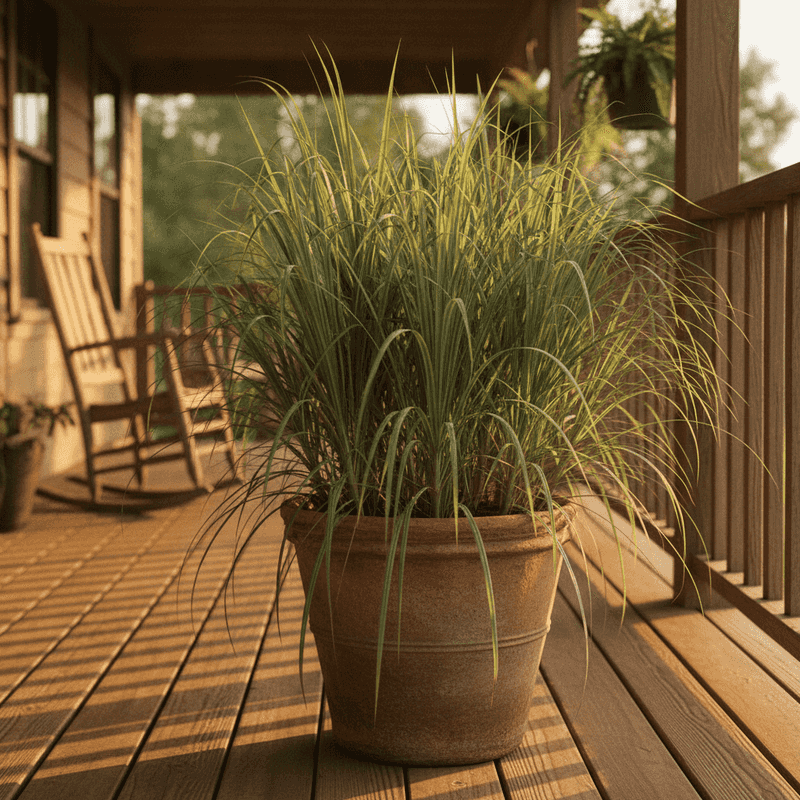
A lot of North Carolina homeowners put rosemary by the porch hoping it will keep the mosquitoes at bay.
The scent is strong, the logic feels right, and the idea of a natural fix is appealing, especially on a July evening when the bugs are relentless.
But the honest answer is that it does not work that way.
Clemson Extension’s pest-plant research review states that no studies have examined whether landscape plantings of rosemary or similar aromatic plants actually repel mosquitoes.
The fragrance that rosemary releases naturally into the open air dissipates quickly, especially when any breeze is moving across the porch.
The scent you enjoy is not concentrated enough in that moving air to do what a tested repellent does.
Some rosemary oils do show repellent activity in laboratory settings or in formulated products, but that is a different situation entirely from a living potted plant sitting a few feet away.
UC IPM’s mosquito guidance draws that distinction clearly: plant oils tested in controlled conditions do not establish that an ordinary landscape plant protects people nearby.
Do not rub crushed rosemary or homemade rosemary preparations on your skin.
Poison Control warns that essential oils can cause skin rashes, poisoning if swallowed, and serious harm when misused.
Raw plant material and concentrated oils are not the same thing, and neither is a substitute for a properly tested product.
Use a skin repellent that carries an EPA registration and follow the label directions.
The sources reviewed here also provide no reliable evidence that a porch rosemary plant reduces tick numbers or tick bites.
Do not rely on it for tick control.
For mosquitoes, CDC guidance points to the measures that actually work: scrub and empty standing-water containers at least once a week, cover any stored water, keep window and door screens intact, and use labeled control products where conditions call for them.
Rosemary is a genuinely useful porch plant, it just cannot replace any of those steps.
Can Rosemary Handle a North Carolina Winter?
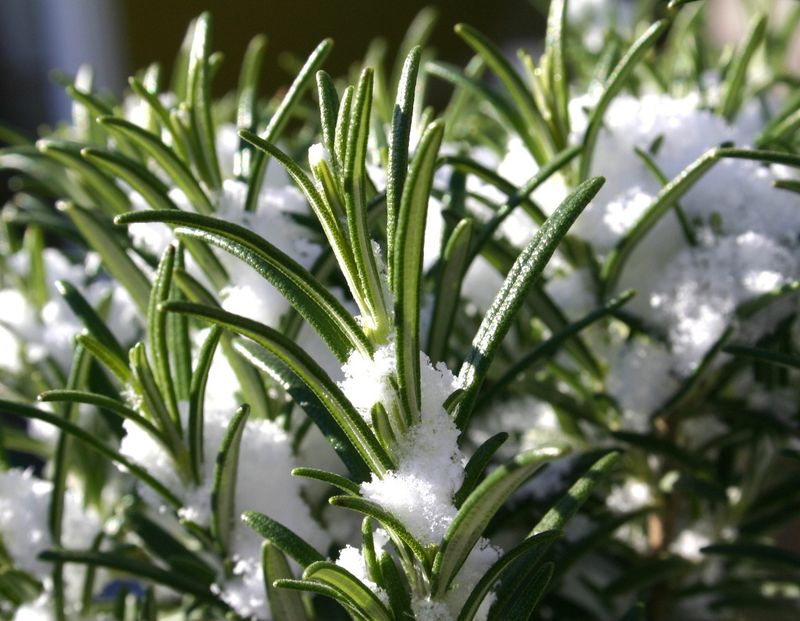
Picture a rosemary pot looking full and fragrant in October, then imagine checking on it in February after a surprise cold snap and finding the stems limp and brown.
That scenario plays out for a lot of North Carolina porch gardeners who assume the plant is tougher than it actually is in a container over winter.
Rosemary is classified as a tender perennial in North Carolina, and its cold tolerance varies significantly by region.
NC State’s herb winterizing guidance says it may need heavy mulch or indoor protection depending on conditions.
Western North Carolina’s mountain zones, which dip into USDA hardiness zones 6a and 6b, carry the most risk.
The Piedmont and Coastal Plain are milder, but even those regions see surprise cold snaps that can catch a container plant off guard.
The container itself is the real vulnerability.
When rosemary grows in the ground, surrounding soil insulates the roots and slows the freeze.
An above-ground root ball in a pot loses heat on all sides at once, which means the roots can reach damaging temperatures faster than the top growth does.
NC State’s guide to winterizing nursery plants notes that roots may die at higher temperatures than shoots, so protecting the root ball is the priority.
When temperatures are forecast to drop below 20 degrees Fahrenheit, move the container next to a sheltered wall, into a garage, or onto an enclosed porch.
That one move can make the difference between a plant that comes back in spring and one that does not.
NC State’s rosemary profile confirms this need for protection in colder conditions.
Think of the porch pot as a seasonal commitment, not a permanent fixture that takes care of itself year-round.
One Pot Helps, but Native Plants Do More

Rosemary is not from here.
NC State identifies its native range as the Mediterranean region and parts of Europe, Africa, and western Asia.
That does not make it a bad porch plant, but it does mean the flowers offer a modest contribution of nectar and pollen rather than the full ecological package that North Carolina wildlife depends on.
NC State’s wildlife landscaping guidance explains that native landscapes provide food, cover, seeds, fruits, nectar, and caterpillar host plants, which is a broader menu than one nonnative herb can supply.
A rosemary pot on the porch is a single resource, not a habitat.
The fall monarchs passing through North Carolina need milkweed, not rosemary.
The native bees that overwinter in your yard need a range of bloom times and nesting sites that one container cannot provide.
The practical move is to pair the porch rosemary with a few regionally appropriate natives somewhere in the yard.
Goldenrod, Joe Pye weed, milkweed, purple coneflower, or a native shrub suited to your specific site can do the heavier habitat work while the rosemary handles the porch-side role it does genuinely well.
NC State’s native plants handbook is a solid starting point for matching species to your corner of the state.
The porch rosemary still earns its place.
Strong fragrance when you brush past it, evergreen structure through most of the year, fresh cooking herbs within reach, and nearby pollinator activity are real, everyday benefits that improve the time you spend outside.
Mosquito control and tick management need their own proven practices, and a diverse yard needs native plants doing the deeper work.
Rosemary handles the part of the job that belongs to it, and that turns out to be enough.